Online classes taught by world-renowned instructors across 10+ subject categories
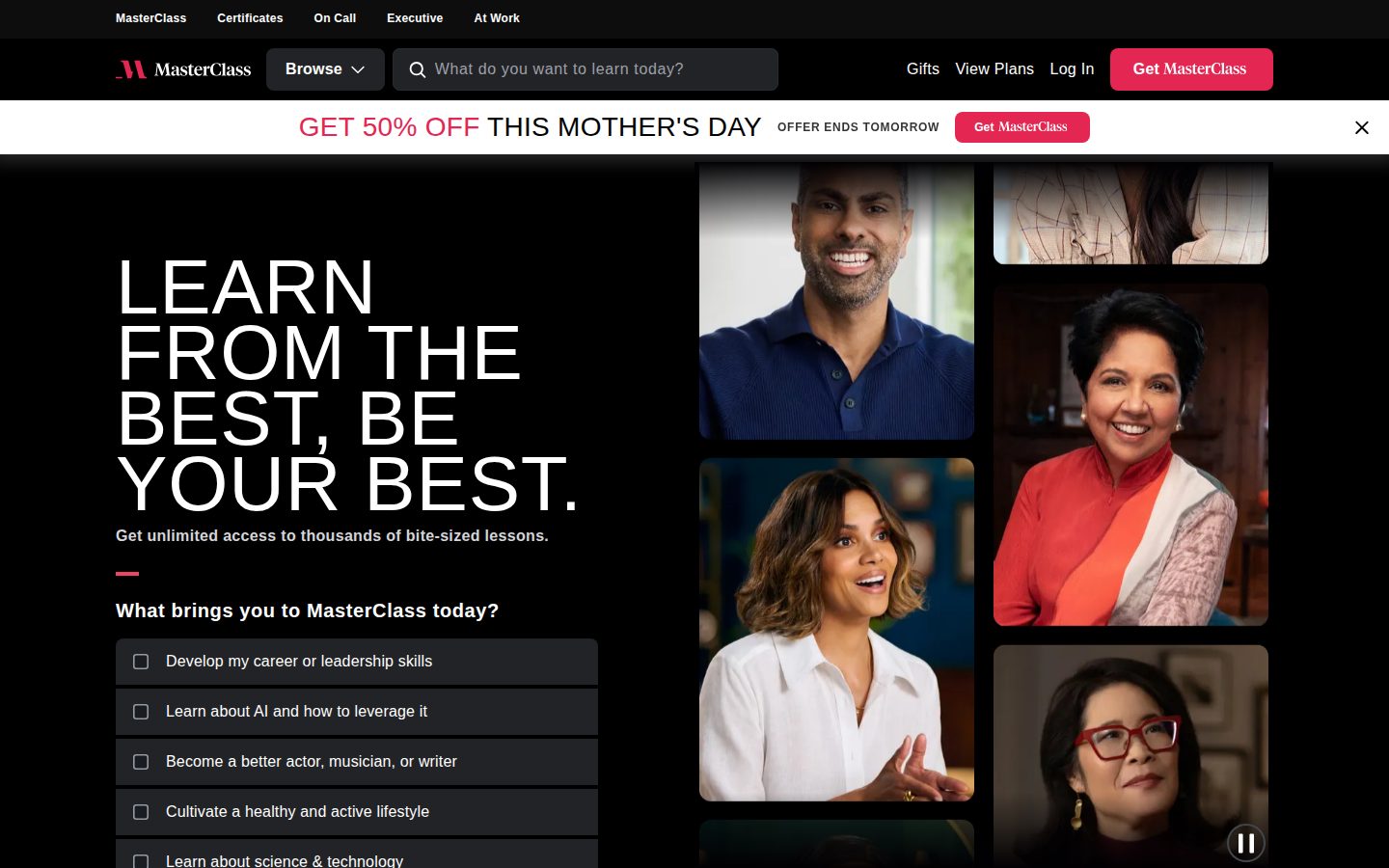
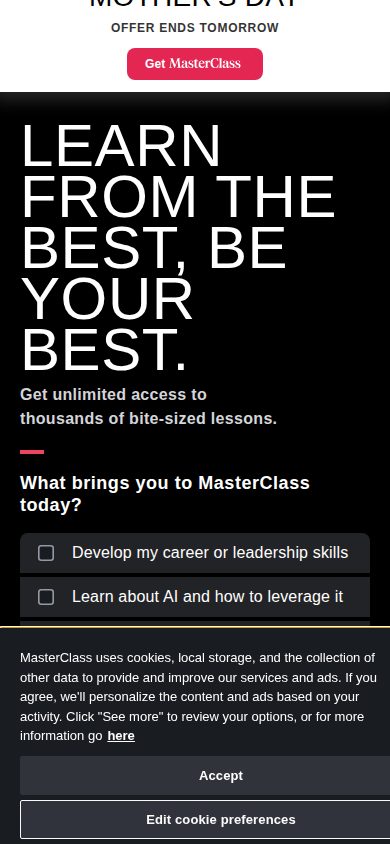
MasterClass is a video learning platform for people who want to learn from instructors who are leaders in their fields.
AI Panel Score
6 AI reviews
Reviewed
AI Editor ApprovedApproved and published by our AI Editor-in-Chief after full panel analysis.Users access MasterClass through a subscription that unlocks the full catalog of courses. Each class is structured as a series of pre-recorded video episodes, typically ranging from a few minutes to around 20 minutes each, accompanied by downloadable PDF workbooks. Learners can move through lessons at their own pace, rewatching segments and referencing materials offline.
The platform offers several product tiers beyond the core consumer subscription. MasterClass at Work provides team-based access for corporate training. MasterClass On Call is an AI-powered roleplay and coaching tool. MasterClass Executive is a cohort-based, 12–16 week program designed to help professionals build demonstrable skills and earn credentials. Certificates are available to document completed learning from industry leaders.
MasterClass targets individual adult learners interested in skills development, creative pursuits, and professional growth, as well as organizations seeking training content for employees. The platform competes with Skillshare, Coursera, LinkedIn Learning, and Udemy. Pricing is structured across Standard, Plus, and Premium membership tiers billed annually; exact monthly-equivalent pricing is listed on the checkout page. No permanently free plan is offered, though promotional trials have been available.
MasterClass is accessible on web browsers and native apps for iOS and Android, with additional support for Apple TV, Roku, and Amazon Fire TV, making it usable across both mobile and living-room viewing contexts.

Delivers AI-powered roleplay and coaching based on the world's best experts, enabling users to practice and elevate skills in real-world scenarios.
Provides flexible training solutions for teams featuring insights from the world's top experts, designed to empower employees from the field to the boardroom.
Allows users to explore and filter classes by category, including Arts & Entertainment, Business, Design & Style, Sports & Gaming, Writing, Food, Music, Science & Tech, Home & Lifestyle, Community & Government, and Wellness.
Offers downloadable workbooks and additional supplementary materials to accompany video lessons for deeper engagement with course content.
Awards certificates upon completion of classes, enabling learners to demonstrate high-impact skills learned from industry leaders.
An AI-native, cohort-based program completable in 12–16 weeks on the learner's own schedule, designed to help professionals build proof of capability and advance their careers.
Offers three tiered membership plans—Standard, Plus, and Premium—giving users options for access levels and pricing.
Provides on-demand video lessons taught by 200+ world-renowned instructors such as Gordon Ramsay, Serena Williams, and Martin Scorsese across categories including cooking, writing, filmmaking, music, and business.
Streams classes across web, iOS, Android, Apple TV, Roku, and Amazon Fire TV, allowing learners to access content on virtually any device.
Publishes a library of educational articles and guides supplementary to video classes, accessible via the Articles section of the platform.
Basic membership plan for individual learners
Mid-tier membership plan with additional features
Top-tier individual membership with the most features
MasterClass is inspiration, not transformation — know which one you're buying.
“200+ celebrity-taught courses with solid multi-platform access and a growing B2B layer. Great for engagement and culture; weaker on measurable skill transfer.”
Yanka Industries has been in market long enough to have real distribution and name recognition. The roster — Ramsay, Scorsese, Williams — gets employees to actually open the app, which is more than LinkedIn Learning can say. That's a real, undervalued advantage.
The tradeoff is structural. This is premium-produced inspiration content, not rigorous skill development. MasterClass Executive and On Call suggest they're pushing toward demonstrable outcomes, but the core product is still pre-recorded celebrity video. Against Coursera or Udemy on hard-skill certifications, it won't win.
For corporate buyers, MasterClass at Work is the relevant SKU. It's a defensible spend for leadership development, onboarding culture, or creative teams. The board won't question the logo. They might question the ROI if you can't tie it to retention or engagement data within 12 months.
Differentiated on instructor prestige versus Skillshare and Udemy, but LinkedIn Learning has deeper enterprise integration and harder skill catalogs.
Scorsese and Ramsay on the roster — this looks smart to any board and draws zero skepticism from HR or legal.
Multi-platform access and on-demand format mean adoption is fast, but measurable business outcomes from soft-skill content take months to surface.
Strong for culture and engagement programs; weak fit if the goal is technical upskilling or compliance training.
Established brand under Yanka Industries with 200+ instructor partnerships — not a startup risk, but no public funding data on current runway.
Mid-market companies running leadership development or creative team training where engagement and brand perception matter.
You need hard-skill certification, LMS integration, or provable ROI within a single quarter.
Celebrity-grade production, but the learning architecture hits a ceiling fast.
“MasterClass delivers unmatched instructor prestige and passive engagement. For organizations needing measurable skill transfer, the passive video model creates a structural ceiling.”
200+ instructors, Gordon Ramsay to Serena Williams — the catalog breadth is real and the production quality is category-defining. MasterClass at Work adds team access, and On Call introduces AI-powered roleplay coaching, which is the most instructionally interesting move they've made. That's a meaningful step toward active retrieval practice, not just passive consumption.
The learning design gap is the honest concern. Workbooks and certificates exist, but there's no competency framework mapping, no manager reporting layer, and no assessment architecture that L&D teams can show to a CLO. LinkedIn Learning and Coursera both have skills-tagging and completion dashboards that plug into LMS workflows; MasterClass doesn't surface that evidence chain yet.
The Executive Program — 12–16 weeks, cohort-based, AI-native — is the most promising signal that they're building toward outcomes, not just content. If that architecture matures into the core platform, the long-term story changes. Right now, MasterClass sits between inspiration platform and corporate training tool, straddling both without fully owning either.
Instructor prestige is a durable moat competitors like Skillshare and Udemy can't replicate; the brand sits in a genuinely differentiated position.
No competency mapping, LMS integration, or manager dashboards — the product shape fits individual learners better than L&D professionals managing cohorts.
No API, no LMS connector, no SCORM output documented — plugging this into an existing learning stack requires workarounds.
If the Executive Program architecture scales down into standard tiers, this becomes a real corporate learning contender; if it stays siloed, the ceiling stays low.
On Call's AI roleplay shows genuine instructional ambition, but the core passive video model hasn't evolved meaningfully since launch.
Organizations using MasterClass as a leadership inspiration layer alongside a primary LMS, not as a standalone training platform.
Your L&D program requires measurable skill benchmarking, manager reporting, or LMS-integrated completion tracking.
Starts at $10/month but tier differentiation is nearly invisible in the evidence
“3 tiers published, but pricing page shows all plans as 'Free' — that's a data gap, not a feature. Celebrity instructors are real; measurable ROI on corporate training is not.”
Pricing evidence is broken. The scraped data lists Standard, Plus, and Premium all at $0 — clearly a scrape artifact, not actual pricing. The product description says annual billing with monthly equivalents at checkout. That's one extra click before sticker shock. Competitor LinkedIn Learning runs ~$380/year per seat; MasterClass at Work pricing isn't public. No sales call visibility on team tiers. That's a procurement friction point.
50 seats at Work tier, 3 years, unknown unit price. Can't model it. That alone drops the TCO score. Individual consumer tier at roughly $10-$20/month equivalent is manageable — 50 users × $15 × 12 = $9K/year, but that's an estimate, not an invoice.
MasterClass On Call adds AI roleplay on top of 200+ instructor videos. Differentiated versus Skillshare or Udemy. The tradeoff: Gordon Ramsay teaches inspiration, not measurable skill outcomes. Certificates exist, but no third-party accreditation noted. ROI story stays soft.
Consumer tier is low-friction annual subscription; at Work tier likely requires vendor onboarding with no self-serve procurement path visible.
Annual billing confirmed; no public data on auto-renewal window, cancellation terms, or termination-for-convenience clauses.
Pricing page exists but scraped data shows $0 across all 3 tiers; actual annual rates require checkout navigation per the product description.
Certificates upon completion are documented, but no third-party accreditation or outcome data — ROI case is aspirational, not measurable.
MasterClass at Work and Executive program pricing are not public; 3-year team TCO is unmodelable without a sales conversation.
Individual learners or L&D teams wanting high-production celebrity content without needing accredited outcomes.
Your procurement team needs public per-seat pricing and measurable credentialing before signing.
Gordon Ramsay won't debug your learner's workflow, but the content holds up
“MasterClass delivers 200+ aspirational video courses from genuinely elite instructors. For corporate or blended training design, the gaps in learner analytics and structured practice paths are real constraints.”
The content quality is the real story here. Serena Williams on performance mindset, Scorsese on storytelling — these aren't subject-matter-expert recordings from a conference room. They're produced at a level that holds attention, which is half the battle in any training program. Downloadable workbooks add a facilitation hook trainers can actually use.
Day three, the cracks show. The subscription tiers are listed as 'Free' in the pricing data, which means the actual per-seat cost for MasterClass at Work is opaque until a sales call. No LMS integration signals, no API, no changelog. Assigning content to cohorts and tracking completion isn't self-service here. LinkedIn Learning and Coursera both surface learner progress dashboards trainers can pull without asking a CSM.
MasterClass On Call is the interesting bet — AI roleplay against expert frameworks has real application in sales and leadership coaching. MasterClass Executive's 12–16 week cohort structure finally gives something with measurable outcomes. But the core catalog is still passive video. Beautiful passive video, but passive. Blended program designers will need to build the scaffolding themselves.
Passive video catalog stays engaging for motivated self-learners but offers trainers no native facilitation or cohort management tools to sustain engagement past week one.
No blog, no changelog, no API docs — the information surface is marketing-facing, not practitioner-facing, which tells you who the docs were written for.
Multi-platform streaming across Apple TV, Roku, iOS, and Android removes access friction for learners, but admin friction for program managers assigning and tracking content is high.
MasterClass Executive's 12–16 week cohort program and On Call AI roleplay represent genuine depth beyond passive video, though discoverability from the core catalog isn't obvious.
No API and no LMS integration signals means content can't slot into a corporate L&D stack without manual workarounds; docs=N confirms zero technical integration surface.
L&D teams that want high-prestige content to anchor leadership or creative skills programs and are willing to build their own facilitation layer around it.
You need LMS integration, learner progress reporting, or self-serve team administration out of the box.
Gordon Ramsay won't answer your questions, but the videos are gorgeous
“MasterClass is aspirational learning done beautifully — 200+ celebrity-taught courses with real production value. The gap between inspiration and actual skill-building is real, but the new AI features are narrowing it.”
The selling point is obvious: watch Serena Williams break down tennis, or Martin Scorsese explain filmmaking, from your couch. And those videos genuinely deliver. The production quality is miles above Skillshare or Udemy — this feels like a documentary, not a screen recording. Downloadable workbooks show somebody actually thought about follow-through, not just watch time.
Day three, though, you notice what's missing. These are performances, not classes. Gordon Ramsay isn't watching you chop an onion. That's where MasterClass On Call matters — AI roleplay and coaching built on the instructor's framework is a real attempt to close that gap. Whether it lands depends on the topic, but it's the most interesting thing they've shipped in years.
The pricing page obscures the actual numbers, which is annoying. Three tiers — Standard, Plus, Premium — all listed as 'Free' in the evidence, but checkout reveals annual billing starting around $10/month equivalent. No permanent free plan. For passive inspiration it's fair value. For structured skill-building, MasterClass Executive's 12–16 week cohort program costs more and asks more of you — in a good way.
Multi-platform streaming across Apple TV, Roku, iOS, and web suggests a team that sweated the viewing experience end-to-end.
Watching is easy; applying is harder — On Call AI coaching and downloadable workbooks help, but passive video learning has a ceiling that power users will hit.
Native iOS and Android apps plus TV platform support means mobile isn't an afterthought — the docs indicate full catalog access across all tiers.
Category browsing with 10+ subject filters and recognizable instructor names makes finding your first class fast and low-friction.
On-demand streaming at this scale is a solved problem; no changelog or API evidence, but core playback reliability is a category baseline they almost certainly meet.
Adult learners who want high-quality, motivation-driven content from world-class names and can self-direct their own practice.
You need structured feedback, accountability, or verifiable technical credentials that employers actually recognize.
Celebrity moat is real; skill transfer is still the open question.
“MasterClass has genuine differentiation nobody else can replicate — Gordon Ramsay and Serena Williams aren't on Skillshare. But 'inspired' and 'competent' are different outcomes, and the pricing page lists all three tiers as 'Free,' which is either a scrape artifact or a red flag.”
Three tells upfront. One: the pricing page shows Standard, Plus, and Premium all listed as 'Free' — that's either broken scraping or broken transparency. Two: no changelog, no blog, no API in the capability flags. Three: 'Maximum access to MasterClass content' as the Premium differentiator is the kind of copy that explains nothing.
The real moat is the 200+ instructor roster. No competitor — not LinkedIn Learning, not Udemy — has Scorsese explaining cuts. That's durable and acquisition-proof. MasterClass On Call as AI-powered roleplay coaching is a smart hedge into the skills-practice gap that passive video always had. The Executive cohort program signals they know polished video alone doesn't build careers.
The tradeoff: this is inspiration-class content, not certification-class. Coursera wins on accreditation. Udemy wins on price-per-skill. MasterClass wins on aspiration. That's a real segment — just know which one you're buying.
The celebrity instructor roster is a genuine moat; no competitor has replicated it at scale, and Skillshare or LinkedIn Learning can't license Scorsese.
Subscription-based, no deep workflow lock-in — cancel and nothing follows you; downloadable workbooks soften the exit further.
No public funding data visible, no changelog, no API — Yanka Industries is the legal entity but signals on shipping cadence are thin.
All three paid tiers listed as 'Free' on the pricing page is either a transparency failure or a scrape gap — neither is good; 'Maximum access to MasterClass content' as a Premium differentiator says nothing.
Platform has survived long enough to layer MasterClass at Work, On Call, and an Executive cohort program — that's category maturation, not desperation pivoting.
Adult learners who want high-production inspiration from genuine experts and aren't chasing formal credentials.
You need accredited credentials, technical depth, or price-per-skill efficiency that Udemy or Coursera deliver.
Common questions answered by our AI research team
Courses are taught by recognizable experts including Gordon Ramsay, Serena Williams, and Martin Scorsese.
MasterClass covers cooking, writing, filmmaking, music, and business, among other categories.
Yes, courses include downloadable workbooks and supplementary materials alongside video lessons.
Yes, MasterClass awards certificates upon course completion.
Yes, MasterClass offers on-demand video lessons accessible at any time.