Nanonets logo

Nanonets Review

Visit

Automate document workflows with AI-powered data extraction

Nanonets is an AI document processing platform for teams that need to extract, classify, and automate data from unstructured documents.

AI Panel Score

8.0/10

6 AI reviews

Reviewed

AI Editor Approved

About Nanonets

In practice, users upload documents—PDFs, images, emails, or scans—and configure extraction fields they want to capture, such as vendor name, invoice number, or line items. Nanonets processes incoming documents automatically, pulls the specified fields, flags low-confidence extractions for human review, and can push the structured output to downstream tools via integrations or API. The human-in-the-loop review interface allows teams to correct and approve extractions before data moves forward.

The platform includes pre-built models for common document types including invoices, receipts, ID documents, and bank statements, so users can start without training from scratch. For specialized documents, users can label a sample set and fine-tune a custom model. Nanonets also offers an AP automation workflow specifically for accounts payable, covering invoice capture, two- and three-way PO matching, approval routing, and sync to accounting systems like QuickBooks, Xero, NetSuite, and SAP. Additional integrations include Zapier, Google Drive, Dropbox, and email inboxes.

Nanonets targets finance, operations, and logistics teams in mid-market and enterprise companies dealing with high document volumes. Pricing is usage-based, charged per page processed, with a free trial available. Competing products in the intelligent document processing category include Rossum, Hyperscience, AWS Textract, Google Document AI, and ABBYY FlexiCapture.

The platform is delivered as a web application with a REST API for programmatic access. Developers can integrate Nanonets directly into existing applications to submit documents and retrieve extracted data without using the visual interface. Webhooks are supported for event-driven processing pipelines.

Features

AI

  • Agentic Document Processing

    AI agents read messy document inputs, apply user-defined business rules, and complete work end-to-end inside systems of record without requiring human intervention by default.

  • Nanonets OCR-3 Extraction Model

    A proprietary document extraction model ranked #1 on the IDP Leaderboard that converts documents into structured Markdown and JSON output with high accuracy, ahead of GPT-5, Gemini, and Claude.

Analytics

  • Usage Quotas & Cost Dashboards

    Enforces per-team API budgets and rate limits with real-time cost dashboards to prevent unexpected usage overruns.

Automation

  • 3-Way Matching

    Automatically validates invoices against purchase orders and vendor records as part of the accounts payable workflow before routing for approval.

  • Approval Routing

    Routes documents and edge cases through configurable approval gates, delivering review requests to Slack, Microsoft Teams, or email for human-in-the-loop decisions.

Core

  • Agentic Data Extraction API

    A document extraction API built for LLM and agent pipelines that outputs structured Markdown and JSON with tables preserved, supporting low latency and open-source integrations with LangChain and LlamaIndex.

  • Multi-Format Document Capture

    Ingests invoices, receipts, and other documents arriving in any format from sources including email inboxes, Google Drive, Dropbox, Box, and Notion.

Integration

  • ERP Posting

    Agents post validated invoice and payment data directly into connected ERP systems such as SAP, QuickBooks, Xero, and Sage after processing.

Security

  • Audit Logs & SIEM Streaming

    Records every agent run, approval, and data access event and streams logs to a SIEM via webhook for compliance and monitoring.

  • Private Deployment Options

    Supports VPC, single-tenant cloud, or on-premises deployment with customer-managed keys (BYOK) and data residency pinned to US, EU, or APAC regions.

  • Role-Based Access Control

    Provides fine-grained permissions scoped per workspace, agent, and data source so teams only access what they need.

  • SSO & SCIM Provisioning

    Supports SAML, OIDC, and SCIM-based user provisioning integrated with Okta, Azure AD, and Google Workspace for enterprise identity management.

Preview

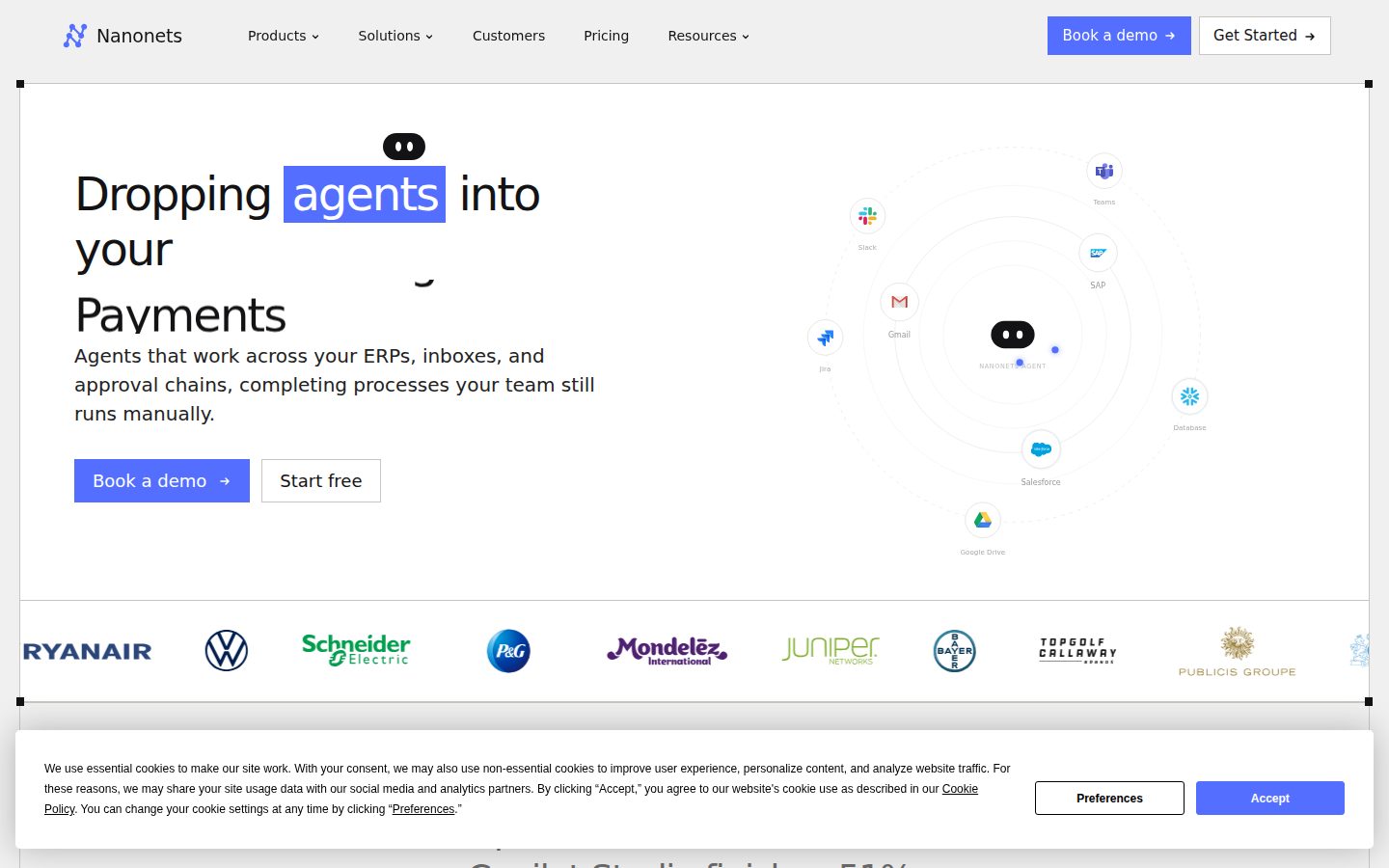
Nanonets desktop previewNanonets mobile preview

Pricing Plans

Start Free

Free

Free trial to get started with Nanonets agents and document extraction, no credit card required.

  • Nanonets Agents for business process automation
  • Agentic Data Extraction API
  • Multi-format document capture
  • Integration with ERPs, inboxes, and approval chains
Popular

Enterprise / Contact Sales

Contact sales

For large organizations running complex processes at scale with full enterprise controls and compliance requirements.

  • SSO & SCIM (SAML, OIDC, Okta, Azure AD, Google Workspace)
  • Role-based access with fine-grained permissions
  • Audit logs streamed to SIEM via webhook
  • Private deployment (VPC, single-tenant, on-prem)
  • Data residency (US, EU, APAC)
  • HIPAA BAA available, SOC 2 Type II, ISO 27001, GDPR

AI Panel Reviews

The Decision Maker

The Decision Maker

Strategic bet, vendor viability, timing, adoption approval
8.2/10

10,000 customers and a #1 IDP ranking make this an easy AP automation pilot.

Nanonets has real scale — a billion documents processed annually, 34% Fortune 500 penetration. The OCR-3 model beating GPT-5 and Gemini on extraction accuracy is the kind of claim that either holds under scrutiny or collapses fast.

The vendor viability question is the only soft spot. No public funding data, but 10,000+ customers and Fortune 500 depth suggest they're not burning cash on hope. That's enough for a pilot commitment, not a five-year lock-in. Private deployment with BYOK and SOC 2 Type II removes the usual enterprise objections before legal even asks.

The AP automation workflow is the clearest win — 3-way PO matching, approval routing to Slack or Teams, and direct ERP posting to SAP, QuickBooks, and NetSuite. That's a full loop, not a point solution. Rossum and ABBYY FlexiCapture do pieces of this; Nanonets does the whole workflow without stitching vendors together.

The tradeoff: pricing is usage-based with no published per-page rate, so cost visibility at scale requires a sales conversation. Run a 90-day pilot on a defined invoice volume before committing to enterprise terms.

Competitive Positioning8.2

OCR-3 ranked #1 on the IDP Leaderboard ahead of GPT-5 and Gemini is a defensible differentiator versus Rossum and AWS Textract.

Reputation Risk8.0

SOC 2 Type II, ISO 27001, HIPAA, and private deployment options give the board nothing to push back on.

Speed to Value8.3

Pre-built invoice and receipt models mean teams can process live documents without custom model training from day one.

Strategic Fit8.5

End-to-end AP automation with ERP posting advances ops maturity — this replaces manual process, not just a tool already in place.

Vendor Viability7.8

No public funding data, but 10,000+ customers and 34% Fortune 500 penetration signals a real business, not a seed-stage bet.

Pros

  • OCR-3 extraction model ranked #1 on IDP Leaderboard, ahead of GPT-5 and Gemini
  • Full AP loop: capture, 3-way matching, approval routing, ERP posting in one platform
  • Private deployment with BYOK and data residency for enterprise compliance requirements
  • Pre-built models for invoices, receipts, and IDs — no training required to start

Cons

  • No published per-page pricing — cost at scale requires a sales conversation
  • No public funding or runway data to anchor a long-term vendor bet
  • Web-only delivery; no native mobile for field-based document capture workflows

Right for

Mid-market or enterprise finance and ops teams processing high invoice or document volumes who need a full workflow, not just OCR.

Avoid if

You need transparent usage-based pricing before procurement will approve the pilot budget.

The Domain Strategist

The Domain Strategist

Craft and strategy in the product's domain — adapts identity per category, same lens
8.4/10

OCR-3 accuracy plus full enterprise controls makes this a serious AP automation bet.

Nanonets has moved past pure extraction into end-to-end process automation with agentic workflows, ERP posting, and enterprise security that can satisfy procurement. At 10,000+ customers including 34% of Fortune 500, this isn't a startup pitch — it's an operational platform with real deployment scale.

The compliance stack alone tells you who built this for. SOC 2 Type II, ISO 27001, HIPAA BAA, SIEM streaming via webhook, BYOK, data residency across US/EU/APAC — that's not checkbox security, that's a product that's been through enterprise procurement repeatedly. Private deployment options including on-prem mean regulated industries like healthcare and financial services can actually run this without a fight with InfoSec.

The OCR-3 model claiming the #1 IDP Leaderboard ranking ahead of GPT-5, Gemini, and Claude is a bold, specific claim — and if it holds under your document mix, extraction accuracy is the single variable that determines whether your ops team trusts the output or babysits every queue. The 3-way PO matching, approval routing via Slack and Teams, and direct ERP posting to SAP, QuickBooks, and Sage make this a closed-loop AP workflow, not just a data extraction layer.

The real operational risk is pricing opacity — usage-based per page with no published rates means CFO conversations get awkward fast at volume. Against Rossum or Hyperscience, Nanonets wins on integration breadth; where it may lose is in highly complex document schemas where specialist competitors have deeper domain models. If your document volume is predictable and your ERP is on the supported list, the fit is strong.

Category Positioning8.2

Sitting above AWS Textract and Google Document AI on workflow depth while offering more accessible deployment than ABBYY FlexiCapture puts Nanonets in strong mid-market-to-enterprise territory.

Domain Fit8.8

3-way PO matching, configurable approval routing, and direct ERP posting map exactly to how finance and operations teams actually run AP workflows.

Integration Surface8.6

SAP, QuickBooks, Xero, Sage, Salesforce, Stripe, plus LangChain and LlamaIndex for agent pipelines gives this one of the broadest connection surfaces in the category.

Long-term Implications7.8

Deep ERP integrations and custom model training create real switching costs by year two — valuable lock-in if the vendor executes, a liability if they don't.

Strategic Depth8.5

OCR-3 extraction model with a claimed #1 IDP Leaderboard ranking plus agentic end-to-end processing shows genuine R&D investment, not just feature assembly.

Pros

  • OCR-3 ranked #1 on IDP Leaderboard, a concrete accuracy benchmark against GPT-5 and Gemini
  • Full enterprise security stack: BYOK, on-prem, SIEM streaming, SCIM provisioning
  • Closed-loop AP automation with 3-way matching and direct ERP posting to SAP and NetSuite
  • 1 billion+ documents processed annually across 10,000+ customers — operational proof of scale

Cons

  • No published per-page pricing makes TCO modeling a blind spot until you're deep in vendor conversations
  • Usage-based model creates budget unpredictability during document volume spikes
  • Starting price is unknown publicly, which slows procurement cycles for mid-market buyers

Right for

Mid-market and enterprise finance or ops teams running high invoice or document volumes who need a full AP workflow, not just extraction.

Avoid if

Your document types are highly specialized and fall outside standard invoice, receipt, or ID schemas where out-of-the-box model accuracy will be lower.

The Finance Lead

The Finance Lead

Money, total cost of ownership, contracts, procurement math
7.2/10

OCR-3 ranks #1, but pricing opacity makes 3-year TCO a guess.

Nanonets processes 1B+ documents annually with a proprietary model that outperforms GPT-5 and Gemini on extraction benchmarks. No published per-page rate means you're budgeting blind until a sales call.

Usage-based pricing with no published per-page rate. That's the core procurement problem. Free trial exists, no credit card required — that part's clean. But the only real tier is Enterprise at 'contact sales.' Compare to AWS Textract at $0.0015/page (published). Nanonets forces a negotiation before you can model costs. For a team processing 500K pages/year, the delta between $0.001 and $0.003/page is $500–$1,500 annually — and you won't know which side you're on pre-contract.

The feature set is genuinely strong. OCR-3, 3-way PO matching, SCIM provisioning, private deployment with BYOK, SIEM streaming — this is enterprise-grade infrastructure. SSO isn't paywalled into a hidden add-on tier, which saves the typical $8–15/seat tax common in this category.

Tradeoff: 10,000+ customers and 34% of Fortune 500 adoption suggests real volume, but no public contract terms means auto-renewal windows and termination clauses are unknown. Procurement will push back on that. Budget 2–3 weeks for legal review on the MSA.

Billing & Procurement6.0

Usage dashboards and per-team API budgets help post-contract, but pre-contract procurement friction is high with no self-serve paid tier.

Contract Flexibility5.5

No public auto-renewal window, cancellation terms, or termination-for-convenience clause visible in the evidence.

Pricing Transparency4.5

No per-page rate published; only two tiers visible, with the operative one requiring a sales call.

ROI Clarity7.5

3-way PO matching and AP automation have measurable cycle-time and error-rate benchmarks; human-in-the-loop review adds a trackable accuracy metric.

Total Cost of Ownership6.0

SSO included (no add-on tax), but usage overages and year-3 volume costs are unmodelable without a contract.

Pros

  • OCR-3 ranked #1 on IDP Leaderboard — ahead of GPT-5 and Gemini per their benchmarks
  • SSO, SCIM, and private deployment included at enterprise tier — no hidden add-on fees
  • Usage cost dashboards with team-level API budget caps reduce invoice surprises post-contract
  • SOC 2 Type II, ISO 27001, HIPAA BAA — full compliance stack for regulated industries

Cons

  • No published per-page rate — 3-year TCO is a black box until you're in a sales cycle
  • No self-serve paid tier between free trial and enterprise contract
  • Auto-renewal and termination terms undisclosed publicly — procurement delay likely
  • Starting price listed as unknown — harder to budget against Rossum or Hyperscience without a quote

Right for

Mid-market or enterprise AP and ops teams processing high document volumes who can tolerate a sales-negotiated contract.

Avoid if

Your team needs predictable per-unit pricing before a sales call or wants a self-serve paid tier.

The Domain Practitioner

The Domain Practitioner

Daily hands-on reality in the product's domain — adapts identity per category, same lens
8.2/10

OCR-3 beats GPT-5 on benchmarks — but pricing opacity is the daily anxiety

Nanonets has real extraction muscle: OCR-3 claims the #1 IDP Leaderboard spot ahead of GPT-5 and Gemini, and the 3-way PO matching plus ERP posting covers the full AP loop. Usage-based pricing with no public per-page rate means finance teams approve a tool they can't budget without a sales call.

The approval routing to Slack and Teams is the right instinct. Knowledge workers don't want another tab — they want the exception to find them. Configurable approval gates that land in the tools already open on your screen means the human-in-the-loop review doesn't break the day. That's a real workflow win over ABBYY FlexiCapture, which routes exceptions back into its own UI.

The friction lives in pricing. Usage-based per-page with no published rate means every team using it heavily sits on cost anxiety. The usage dashboards and per-team API budgets help manage it, but a knowledge worker running month-end invoice processing at volume can't estimate exposure without a rep. That's a workflow fight that compounds.

Private deployment, BYOK, SCIM provisioning, and SOC 2 Type II are all present — that's the enterprise security checklist done. The 10,000+ customer base including 34% of Fortune 500 suggests the infrastructure holds at scale. For AP-heavy ops teams, this is genuinely feature-complete.

Day-3 Reality7.8

Pre-built invoice and receipt models reduce cold-start pain, but no-code model labeling still demands upfront document tagging effort before custom extraction stabilizes.

Documentation Practitioner-Fit7.5

Docs exist and the API supports LangChain and LlamaIndex integrations, suggesting developer-oriented writing, though depth for non-technical ops users is unconfirmed from public evidence.

Friction Surface7.2

Usage-based pricing with no public per-page rate creates recurring budget uncertainty; the cost dashboard helps but doesn't eliminate the anxiety.

Power-User Depth8.4

Agentic Data Extraction API with structured JSON and Markdown output, webhooks, SIEM streaming, and BYOK deployment give technical users a real ceiling to grow into.

Workflow Integration8.5

Approval routing to Slack, Teams, and email plus direct ERP posting to SAP, QuickBooks, and Xero means extracted data moves downstream without manual re-entry.

Pros

  • OCR-3 ranked #1 on IDP Leaderboard, ahead of GPT-5 and Gemini per their published benchmark
  • 3-way PO matching and ERP posting cover the full AP workflow end-to-end
  • Exception routing to Slack and Teams keeps review inside existing work surfaces
  • Private deployment with BYOK and data residency for teams with strict compliance requirements

Cons

  • No public per-page pricing — usage cost estimation requires a sales conversation
  • Free trial exists but no self-serve paid tier is visible; growth path unclear without enterprise commitment
  • Custom model training still requires labeling a document sample set, which is time investment upfront

Right for

Finance and operations teams running high-volume AP or document intake who need ERP sync and enterprise security without building extraction infrastructure from scratch.

Avoid if

You need transparent per-page pricing before committing budget, or your document volume is low enough that the usage-based model won't justify the sales cycle.

The Power User

The Power User

Daily human experience, onboarding, polish, learning curve, reliability
8.1/10

OCR-3 is legitimately impressive, but pricing opacity will slow you down

Nanonets is a serious document processing platform trusted by 34% of Fortune 500 companies, with enterprise security that actually competes with the big players. The no public per-page pricing is a real friction point for anyone trying to budget before a sales call.

The OCR-3 model ranking above GPT-5 and Gemini on the IDP Leaderboard isn't just marketing copy — that's a meaningful claim in a category where extraction accuracy is everything. Pre-built models for invoices, receipts, and ID documents mean you're not starting from zero. The 3-way PO matching and approval routing into Slack or Teams is the kind of workflow glue that finance teams actually need, not just a nice demo feature.

The enterprise security stack is genuinely thorough: SOC 2 Type II, ISO 27001, HIPAA, private VPC deployment, BYOK, SIEM streaming. For a mid-market AP team worried about document data leaving their perimeter, this clears the IT checklist. Rossum and ABBYY FlexiCapture compete here but rarely hit all these boxes without heavy implementation work.

The tradeoff is the pricing wall. Usage-based per-page with no published rates means you can't self-serve a budget. Web-only platform with zero mobile story is fine for a desktop workflow tool, but worth knowing going in.

Daily Polish7.5

Human-in-the-loop review interface and configurable approval gates suggest real thought about the daily correction workflow, though no changelog makes it hard to track how fast rough edges get fixed.

Learning Curve7.6

No-code model training and pre-built templates lower the floor, but agentic pipelines, SCIM provisioning, and SIEM streaming assume a technically capable admin within a few months.

Mobile Parity4.5

Web-only platform with no mentioned mobile app — approval routing to Slack or email softens the pain slightly but it's not a mobile product.

Onboarding Experience7.8

Free trial with no credit card plus pre-built models for common document types means you can process a real invoice without training anything on day one.

Reliability Feel8.2

Processing over a billion documents annually for 10,000+ customers, with low-confidence flagging and audit logs for every agent run, suggests a platform that's been stress-tested.

Pros

  • OCR-3 ranked #1 on IDP Leaderboard ahead of GPT-5 and Gemini
  • Full enterprise security stack: SOC 2 Type II, HIPAA BAA, private deployment, BYOK
  • AP automation with 3-way PO matching and ERP posting to SAP, QuickBooks, Xero
  • No-credit-card free trial with pre-built models — real day-one value

Cons

  • No public per-page pricing — budget conversations require a sales call
  • Web-only, no mobile app or mobile-optimized experience
  • Pricing page shows only free trial and 'Contact Sales' — opaque for self-serve buyers
  • Learning curve steepens fast once you move past pre-built models into custom workflows

Right for

Mid-market finance and operations teams processing high invoice or form volumes who need enterprise-grade security without a 12-month implementation.

Avoid if

You need transparent per-page pricing to self-serve a budget without talking to sales.

The Skeptic

The Skeptic

Contrarian. Watch-outs, deal-breakers, broken promises, category patterns
7.8/10

OCR-3 claims #1 on the leaderboard — that's either real or it ages poorly fast

Solid IDP platform with genuine enterprise controls, a proprietary extraction model, and AP automation depth that commodity OCR tools can't match. The 'no pricing listed' pattern is a yellow flag, and the leaderboard self-citation needs external verification.

Three tells upfront. One: 'Trusted by 10,000+ enterprises' in the meta, but no named case studies in the evidence. Two: no changelog listed — can't verify shipping cadence. Three: 'OCR-3 ranked #1 on the IDP Leaderboard' with no third-party source cited. That's the kind of claim that either holds up under scrutiny or doesn't.

What's actually here is substantial. Private deployment with BYOK, SIEM streaming, SCIM provisioning, SOC 2 Type II, ISO 27001, HIPAA BAA — that's a real enterprise stack. Three-way PO matching plus approval routing to Slack and Teams covers the AP automation use case end-to-end. Rossum and Hyperscience charge comparable enterprise rates with fewer deployment options. AWS Textract wins on raw infra but lacks the human-in-the-loop workflow layer.

Exit portability is decent — REST API with JSON/Markdown output means your data isn't locked in a proprietary schema. The tradeoff: usage-based pricing with no public per-page rate makes TCO opaque until you're deep in a contract.

Competitive Differentiation7.8

Proprietary OCR-3 model plus end-to-end AP automation in a single platform separates it from AWS Textract (raw OCR, no workflow) and Rossum (workflow, no private deployment depth).

Exit Portability7.5

REST API outputs structured JSON and Markdown; LangChain and LlamaIndex integrations mean extraction logic can be rebuilt elsewhere without full vendor lock-in.

Long-term Viability7.0

No changelog, no public funding data visible — but 10,000+ customers and Fortune 500 penetration claims, if real, suggest enough revenue base to not be a 12-month shutdown risk.

Marketing Honesty6.5

The OCR-3 #1 leaderboard claim is unverified in the evidence, and '34% of Fortune 500' with no named customers is the kind of superlative that ages poorly.

Track Record Match7.5

Matches the pattern of IDP vendors that survived — deep vertical workflow (AP automation), enterprise security stack, API-first — not the pattern of ones that didn't.

Pros

  • Enterprise security is complete: BYOK, VPC/on-prem, SIEM streaming, HIPAA BAA, SOC 2 Type II
  • AP automation covers three-way matching, approval routing, and ERP posting in one platform
  • Human-in-the-loop review for low-confidence extractions — rare in commodity OCR tools
  • API outputs clean JSON with tables preserved, suitable for agent pipelines

Cons

  • No public per-page pricing — TCO is opaque until you're in a sales conversation
  • No changelog visible, so shipping cadence can't be verified
  • Leaderboard #1 claim is self-reported with no third-party citation in the evidence

Right for

Mid-market or enterprise finance and ops teams processing high invoice or document volumes who need AP automation plus deployment flexibility.

Avoid if

You need transparent usage pricing before a sales call, or you're a small team running low document volumes where commodity OCR is good enough.

Buyer Questions

Common questions answered by our AI research team

Security

What compliance certifications does Nanonets hold?

Nanonets holds SOC 2 Type II, GDPR, ISO 27001, and HIPAA certifications. A BAA is available for enterprise plans.

Integration

Which ERP and accounting systems does Nanonets integrate with?

Nanonets integrates with SAP, QuickBooks, Xero, and Sage for ERP/accounting, plus Salesforce, HubSpot, Stripe, and Zendesk for CRM and payments.

Features

How accurate is Nanonets document extraction compared to GPT and Gemini?

Nanonets OCR-3 is ranked #1 on the IDP Leaderboard, ahead of GPT-5, Gemini, and Claude.

Setup

Can Nanonets be deployed on-premises or in a private cloud?

Yes. Nanonets supports VPC, single-tenant cloud, and on-premises deployment, with your own keys, infrastructure, and network policies.

Features

How does Nanonets handle exceptions it cannot process automatically?

Agents route uncertain or edge-case items to a human via configurable approval gates in Slack, Microsoft Teams, or email for review.

Product Information

  • Company

    Nanonets
  • Founded

    2017
  • Pricing

    Usage-based
  • Free Trial

    Available

Platforms

web

About Nanonets

Nanonets is a San Francisco-based document processing platform that uses OCR and machine learning to automate data extraction and document workflows for enterprises.

Resources

Documentation
Blog

Also in AI Document Processing