AI chatbot platform with access to multiple language models
Poe is a platform that provides access to multiple AI chatbots and language models through a single interface.
AI Panel Score
6 AI reviews
Reviewed
AI Editor ApprovedApproved and published by our AI Editor-in-Chief after full panel analysis.Poe is an AI chatbot aggregation platform developed by Quora that provides users access to multiple large language models through a single interface. The platform supports popular AI models including OpenAI's GPT-4, Anthropic's Claude, Google's PaLM, and Meta's Llama, allowing users to interact with different AI assistants without needing separate subscriptions or accounts.
The platform caters to individuals, researchers, and professionals who want to compare AI model responses, access premium AI capabilities, or experiment with different conversational AI systems. Users can create custom bots, share conversations, and switch between models to find the most suitable AI assistant for specific tasks or queries.
Poe offers both free and subscription-based access tiers. The free tier provides limited access to select models, while paid subscriptions unlock premium models, higher usage limits, and additional features. The platform distinguishes itself by offering model diversity and comparison capabilities in a user-friendly chat interface.
As AI adoption grows across industries, Poe positions itself as a centralized hub for AI interaction, competing with individual model providers and other AI aggregation services. The platform serves users who want flexibility in AI model selection without managing multiple separate AI service subscriptions.

Access audio generation AI models alongside text and visual AI tools on Poe.
Access top image generation AI models directly within the Poe platform.
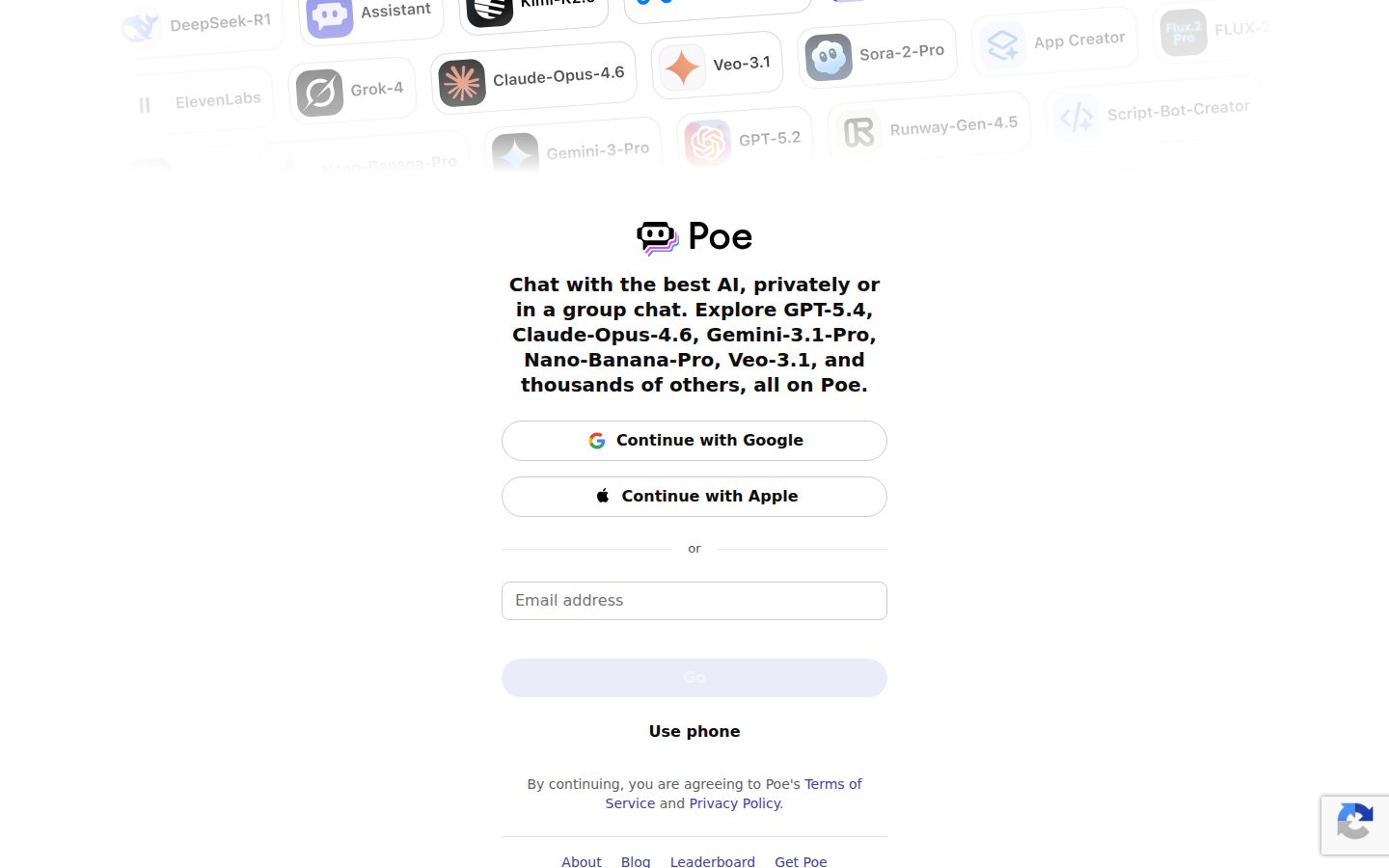
Chat with multiple AI language models including GPT-5, Claude Opus, Gemini Pro, and thousands of others from a single unified interface.
Access top video generation AI models such as Veo within the Poe platform.
Browse a leaderboard ranking AI models, helping users identify and compare top-performing options.
Engage in group chat sessions that include AI models alongside users.
Access and interact with millions of bots created by other Poe users.
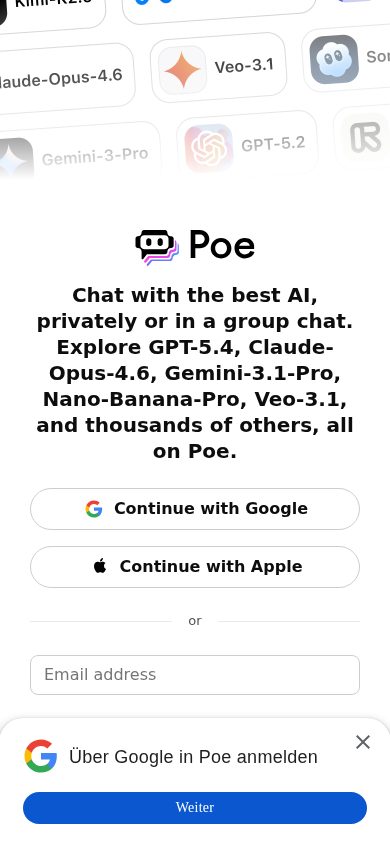
Sign in quickly using an existing Google or Apple account for seamless onboarding.
Access Poe via a dedicated mobile app available for download on mobile devices.
Chat privately with AI models in a confidential one-on-one session.
For casual users exploring AI chatbots with limited daily access to models.
Entry-level paid plan for users who want affordable access to premium models with a daily point budget.
For power users who need high-volume, multi-model AI access on a monthly basis.
Same as the monthly subscription but billed annually at $199.99/year, saving ~17%.
For power users and teams who need the highest point allowances for expensive frontier models like o1-pro, GPT-4.5, and Veo 2.
Quora marked Poe down to a $500M valuation in 2024 — interesting bet, not yet defensible long.
“Adam D'Angelo took $75 million from Andreessen Horowitz in January 2024 at a $500 million valuation, down from Quora's $1.8 billion mark in 2017. Poe's Standard tier matches ChatGPT Plus at around $20, and the new $5 Starter tier landed March 2025.”
Adam D'Angelo's been running Quora since 2009. He launched Poe in February 2023 as Quora's AI bet, then took $75 million from Andreessen Horowitz in January 2024 at a $500 million valuation. The 2017 round priced Quora at $1.8 billion — that's a real markdown.
The Model Leaderboard is the genuinely useful piece. You see GPT-5, Claude Opus, and Gemini Pro ranked head-to-head, then route work to whichever wins for the task. ChatGPT Plus locks you to one stack at $20 a month; Poe's Standard tier matches that price with optionality.
But the catch is the points economy. Standard gives you 1,000,000 points a month and image and video models burn through them fast — predictable for chat, less so for media work. The new $5 Starter tier landed March 2025, which makes pilot math easier. Try it on one team for 60 days.
Top-five generative AI property by traffic with 1M+ user-created bots, but OpenAI and Anthropic own the model relationships.
D'Angelo is a known operator and the a16z imprimatur reads safe to a board, though the valuation cut invites questions.
Free tier plus $5 Starter and Google or Apple sign-in let a team pilot in an afternoon.
Cross-model access plus the Model Leaderboard advances optionality versus a single-vendor stack like ChatGPT Plus.
Quora is cash-flow positive ex-Poe with $75M a16z runway, but the markdown from $1.8B to $500M signals real pressure.
Teams who want one bill for cross-model AI access.
Buyers who need one vendor with deep enterprise governance.
Quora's $75M a16z round in January 2024 funded an aggregator bet, not a model bet.
“Andreessen Horowitz led a $75 million round for Quora in January 2024 to scale Poe, the multi-model chat layer Adam D'Angelo shipped in February 2023. For a Head of AI Platform Strategy picking a consumer LLM substrate through 2029, the question is whether aggregation holds margin against ChatGPT and the model labs going direct.”
Andreessen Horowitz led the $75 million Quora round in January 2024, three years after Adam D'Angelo first shipped Poe in February 2023. The substrate is a points-based meter — 1,000,000 Compute Points monthly on the $19.99 Standard tier, scaling to 12,500,000 on the $249.99 Premium tier.
The architectural call is the Model Leaderboard plus User-Created Bots layered over GPT-5, Claude Opus, Gemini Pro, and Veo. Points-per-message normalizes pricing across labs the user never sees billed. That meter is the moat — and the dependency. If OpenAI or Anthropic restrict aggregator pass-through pricing, the unit economics shift overnight.
ChatGPT Plus owns the consumer brand and Perplexity owns research-grade citation. However, no first-party app gives you GPT-5 and Claude Opus side-by-side under one bill. For evaluation-heavy teams, that comparison surface is the strategic bet.
Owns the multi-model consumer lane that ChatGPT and Perplexity do not compete in directly.
Side-by-side access to GPT-5, Claude Opus, Gemini Pro, and Veo matches how evaluation teams actually work.
API access on the $19.99 Standard tier plus Google and Apple sign-in cover the common entry points.
Aggregator margin depends on lab pass-through pricing holding through 2028.
Compute Points meter and Model Leaderboard show real product depth beyond a model router.
AI platform teams who need to benchmark multiple frontier models under one bill.
Single-model power users who already pay for ChatGPT Plus or Claude Pro.
Six visible tiers from $0 to $249.99, all metered in points the user can't translate to dollars.
“Poe ships every tier publicly — no sales call between Free and $249.99/month. The catch is the unit: compute points, not messages, with per-model rates the buyer has to back-solve.”
Poe sells access to other vendors' models, not its own. That changes how the bill works. Quora launched the platform in December 2022 and added a $4.99 Starter tier in March 2025, plugging the gap between Free and the $19.99 Standard plan.
Every subscription bills in Compute Points, not messages. GPT-5, Claude Opus, and Veo each burn a different point count per query, and the docs publish per-model rates but no steady-state cost estimate. 25 users × $19.99 × 12 = $6K/year on Standard. ChatGPT Team runs $25/seat, $7.5K for the same headcount — fewer models, more predictable invoice.
The catch is mid-month exhaustion. A team leaning on video generation through Veo can drain 1M points in days, with no published overage rate beyond "upgrade your tier." Honest pricing page. Opaque consumption curve.
Credit-card SaaS at heart — no SSO, no invoicing path, no team admin tooling published.
Monthly billing, no term lock-in, cancel anytime — consumer-grade flexibility.
Six tiers from $0 to $249.99 published on one page, zero sales calls required.
Model-comparison value is real but unmetered; no admin telemetry to justify against ChatGPT Team or Claude Pro.
Compute Points meter makes steady-state cost hard to model without burning a month of usage first.
Individuals who want every frontier model under one $19.99 subscription.
Finance teams who need predictable per-seat billing for procurement.
Poe collapses six model subscriptions into one points meter, but per-message cost is opaque until you ship.
“Quora's Poe routes GPT, Claude Opus, Gemini, and Veo through one chat interface metered in compute points rather than seats — Starter runs $4.99/month for 10,000 points daily, Standard at $19.99 unlocks 1M monthly with API access bundled. The catch for builders is point opacity: a Veo generation burn-rates very differently than a Claude Haiku turn, and the price-per-call only resolves after you watch the counter.”
Switching models mid-conversation is the move Poe gets right. The dropdown sits next to the prompt, and the same thread accepts a swap from GPT to Claude Opus to Gemini without re-pasting context. For a builder evaluating which model wins a specific task, that's faster than three browser tabs against OpenAI's Playground.
The daily fight is the points meter. Starter at $4.99 gives 10,000 points per day; Standard at $19.99 lifts to 1M monthly with API access bundled. But cost-per-call isn't surfaced before you press send — a Veo generation drains points at a wildly different rate than a Claude Haiku turn. OpenRouter prints per-token pricing inline.
User-Created Bots is where Poe stops being a chat client. Wrap a system prompt, publish, take a revenue share. The 2025 Poe API exposes the same models through one endpoint. However, points-to-payout conversion reads finance-flavored, not author-flavored.
Model dropdown is fast, but the points counter trains you slowly.
API docs are functional; points-economy docs read finance-flavored.
Opaque per-call point cost is the daily nag for any serious builder.
User-Created Bots, revenue share, and the Model Leaderboard reward exploration.
Web, iOS, Android plus the 2025 Poe API fit a multi-tool prototyping loop.
Solo builders who want one bill across GPT, Claude, and Gemini for prompt prototyping.
Teams who need per-token cost transparency before each API call.
Poe sells AI access by the point, not the seat, and three months in you feel it.
“Standard at $19.99 buys 1M monthly points across Claude, GPT, Gemini and thousands of user-created bots. The friction isn't the models — it's checking your daily point balance like a 2008 phone plan.”
Poe's pricing reads like a credits ladder, not a SaaS. Free gets you 150 messages a day. Standard at $19.99 buys 1M points a month. Premium at $249.99 is 12.5M. The unit is "points," and different models burn through them at different rates.
User-Created Bots and the Model Leaderboard earn the subscription. Bots wrap a system prompt around any model on the platform; the leaderboard ranks them by usage so you see what people actually pick. Group Chat puts multiple models in one thread, which OpenRouter doesn't really do.
The catch is point fatigue. Three months in, you're checking your daily allowance like a phone plan from 2008. Mobile parity is real here — iOS and Android both work, which makes Poe a pocket model-shopping app more than a workstation tool.
Group Chat, Model Leaderboard, and Apple/Google sign-in show daily-use care across web and mobile.
Easy first hour, but learning which models cost how many points takes weeks of usage to internalize.
Dedicated iOS and Android apps offer the same model selection and chat experience as the web.
Free tier with 150 messages a day, no credit card, and instant access to Claude, GPT, Gemini in one screen.
Points system is deterministic and Quora-stable, but daily resets without rollover make heavy days feel rationed.
Curious users who want to compare AI models without juggling separate subscriptions.
Heavy daily users who hate metered usage and rate-limit math.
Quora's aggregator bet — fine for now, but the moat shrinks every time OpenAI ships a multimodal surface.
“Quora launched Poe in December 2022 and bundles GPT-5, Claude Opus, and Gemini behind one chat at $19.99/month for 1M compute points. The product is honest and the parent durable, but OpenRouter on the developer side and native frontier apps on the consumer side keep narrowing the unique surface.”
Quora launched Poe in December 2022. Adam D'Angelo runs both companies. Aggregators in this category usually die — Poe is the rare one whose parent is durable and profitable.
The product itself is honest. GPT-5, Claude Opus, Gemini Pro behind one chat. User-Created Bots with a creator payout topping out at $20 per converted subscriber. Standard tier is $19.99/month for 1M compute points. The points abstraction lets Poe re-price models without renegotiating subscriptions — clever for them, opaque for buyers.
The catch is the aggregator squeeze. OpenRouter does this cheaper for developers. ChatGPT already ships GPT, DALL-E, and voice in one app. Each time a frontier vendor adds a modality, Poe's surface narrows. Exit is clean — no lock-in, just cancel. Worth it if you compare models weekly. Otherwise native apps win.
OpenRouter undercuts on developer API access and native frontier apps keep absorbing the modalities Poe used to uniquely aggregate.
No data lock-in — cancel and use native vendor apps or OpenRouter the next day.
Durable profitable parent, shipping cadence solid, creator monetization shipped in 2024 — survives category pressure better than peers.
Landing claims match the product — multi-model access and the points system are clearly disclosed up front.
Aggregator graveyard is real, but Quora parent is durable and profitable, raising survival odds versus typical category entrants.
Buyers who compare AI models weekly across one interface.
Users who already live inside one frontier vendor's app.
Common questions answered by our AI research team
GPT-4, Claude, and other AI language models are available on Poe through a single unified chat interface.
Yes, Poe lets you compare responses across different AI models side by side in one interface.
Yes, Poe offers free access alongside premium AI capabilities.
Yes, Poe provides access to both GPT-4 and Claude in one unified chat interface.
Quora is a Mountain View-based Q&A platform and home of Poe, its AI chatbot aggregator that provides access to dozens of leading LLMs in a single interface.