Qwen logo

Qwen Review

Visit

Multilingual large language model for chat, coding, and reasoning tasks

Qwen is a large language model platform for users and developers seeking AI-assisted text generation, coding, and analysis.

AI Panel Score

7.7/10

6 AI reviews

Reviewed

AI Editor Approved

About Qwen

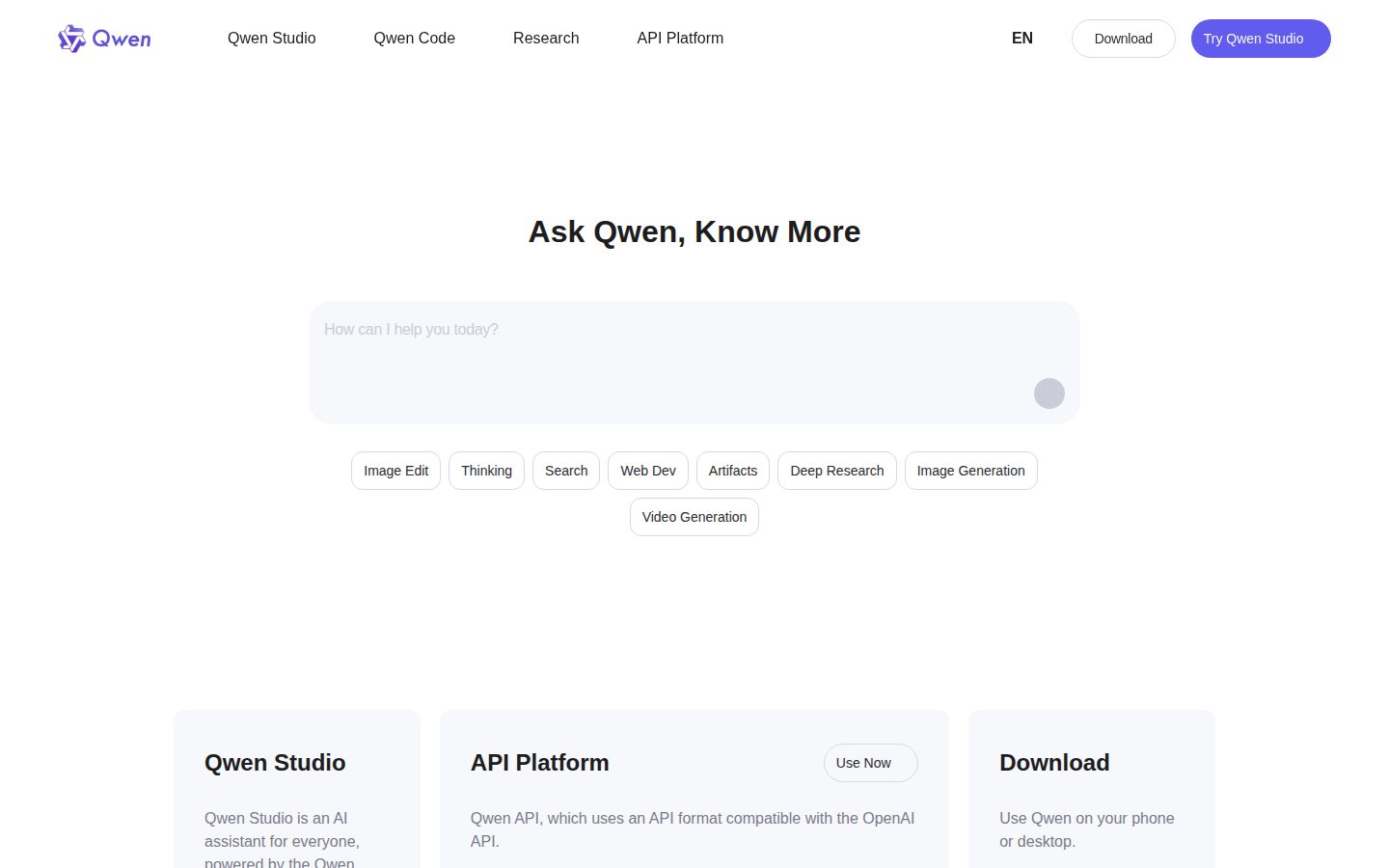
Users interact with Qwen through a browser-based chat interface at qwen.ai, where they can submit text prompts, upload documents or images, and receive generated responses. The workflow follows a standard conversational AI pattern: enter a prompt, receive a response, and continue the exchange in context. The platform also exposes model access via API for developers integrating capabilities into their own applications.

Qwen offers several model variants tuned for different use cases, including general-purpose chat, long-context document processing, coding assistance, and multimodal input handling. The multimodal models accept image inputs alongside text, enabling tasks like image description and visual question answering. Specific model versions differ in parameter count and context window length, with some variants supporting contexts of up to 128,000 tokens.

Qwen targets individual users looking for a general-purpose AI assistant as well as developers and enterprises building applications on top of foundation models. The web interface is available at no cost with usage limits, while higher-tier API access is priced on a usage-based model per token. Competitors in the same category include OpenAI's ChatGPT, Google Gemini, Anthropic's Claude, and Meta's Llama.

The underlying models are also released in open-weight versions on platforms such as Hugging Face, allowing developers to self-host or fine-tune them. API access is managed through Alibaba Cloud's model service infrastructure. Supported deployment options include cloud API, local inference via compatible runtimes, and integration into third-party tools that support OpenAI-compatible endpoints.

Features

AI

  • Dedicated Math & Code Models

    Qwen offers specialized Qwen-Math and Qwen3-Coder-Plus models designed specifically for mathematical problem-solving and autonomous code generation with advanced tool-calling and environment interaction.

  • Hybrid Thinking / Non-Thinking Mode

    Qwen3 models seamlessly switch between a deep reasoning 'thinking mode' for complex math, logic, and coding tasks and a fast 'non-thinking mode' for general-purpose chat within a single model.

  • Image Generation & Editing (Qwen-Image)

    Qwen-Image is a 20B image foundation model that generates high-quality images from text prompts and supports precise image editing, including adding, removing, or modifying text and elements in images.

  • Multimodal Input & Output (Qwen-Omni)

    Qwen-Omni accepts text, image, audio, and video as input and generates both text and speech responses, enabling real-time voice and video chat interactions.

  • Qwen Code — Terminal AI Coding Agent

    Qwen Code is a command-line AI agent optimized for Qwen3-Coder that creates execution plans, writes and runs files autonomously, and integrates with VS Code and JetBrains IDEs via extensions.

Analytics

  • Structured Data Understanding & Analytics

    Qwen understands structured data such as tables and JSON, enabling users to perform queries, extract insights, and generate new datasets from tabular inputs.

Automation

  • Agentic Tool Use with MCP Protocol

    Qwen3 supports the Model Context Protocol (MCP), enabling precise integration with external tools, APIs, and databases to build intelligent agent workflows and automate complex multi-step tasks.

Core

  • Document Processing & OCR (Qwen-OCR)

    The Qwen-OCR model extracts text from images of documents, tables, exam papers, and handwriting, recognizing multiple languages including English, French, Japanese, Korean, and German.

  • Multilingual Support (119 Languages)

    Qwen3 supports 119 languages and dialects, enabling high-quality text generation, translation, and conversation across a globally diverse user base.

Integration

  • Open API Platform (DashScope & OpenAI-Compatible)

    Alibaba Cloud Model Studio exposes Qwen models through both a native DashScope API and an OpenAI-compatible Chat Completion interface, enabling developers to build generative AI applications for writing, image generation, audio analysis, and more.

  • Web Search Integration

    Qwen Studio and the OpenAI Responses API interface include built-in web search, allowing models to retrieve live information from the internet as part of a response.

Security

  • Safety Guardrail Model (Qwen3Guard)

    Qwen3Guard is a dedicated safety model fine-tuned on Qwen3 foundations that delivers precise safety detection for both prompts and responses, with risk levels and categorized classifications for content moderation.

Preview

Qwen desktop previewQwen mobile preview

Pricing Plans

Qwen-Flash (Free Tier)

Free

Free quota for lightweight, fast model usage via API

  • 1 million free tokens (input + output each) per model
  • Free quota valid 90 days after activating Model Studio
  • Models: qwen3.5-flash, qwen-flash
  • Input from $0.05/1M tokens (paid usage)
  • Output from $0.4/1M tokens (paid usage)
  • Batch calling 50% off and Context Cache discount available

Qwen-Plus (Free Tier)

Free

Free quota for mid-tier model usage via API

  • 1 million free tokens (input + output each) per model
  • Free quota valid 90 days after activating Model Studio
  • Models: qwen3.5-plus, qwen-plus
  • Input from $0.4/1M tokens (paid, 0–256K tokens)
  • Output from $1.2/1M tokens non-thinking (paid usage)
  • Supports both thinking and non-thinking modes
Popular

Qwen-Max (Free Tier)

Free

Free quota for the most capable Qwen model via API

  • 1 million free tokens (input + output each) per model
  • Free quota valid 90 days after activating Model Studio
  • Models: qwen3-max, qwen-max
  • Input from $1.2/1M tokens (paid, 0–32K tokens)
  • Output from $6/1M tokens (paid usage)
  • Supports thinking and non-thinking modes; Batch calling 50% off

Qwen-Flash (Pay-as-you-go)

Contact sales

Pay-per-token pricing for fast, lightweight Qwen Flash models

  • qwen3.5-flash: $0.1 input / $0.4 output per 1M tokens (International)
  • qwen-flash: $0.05–$0.25 input / $0.4–$2 output per 1M tokens
  • Global region pricing from $0.022/1M input tokens
  • Batch calling 50% discount available
  • Context Cache discount available
  • No free quota in Global/Chinese Mainland/US deployment modes

Qwen-Plus (Pay-as-you-go)

Contact sales

Pay-per-token pricing for mid-tier Qwen Plus models

  • qwen3.5-plus: $0.4 input / $2.4 output per 1M tokens (International, 0–256K)
  • qwen-plus: $0.4 input / $1.2–$4 output per 1M tokens (non-thinking/thinking)
  • Global region pricing from $0.115/1M input tokens
  • Supports thinking and non-thinking modes
  • Multiple deployment regions: International, Global, US, CN, HK, EU
  • No free quota in Global/Chinese Mainland deployment modes

Qwen-Max (Pay-as-you-go)

Contact sales

Pay-per-token pricing for the most capable Qwen Max models

  • qwen3-max: $1.2–$3 input / $6–$15 output per 1M tokens (International, tiered)
  • qwen-max: $1.6 input / $6.4 output per 1M tokens (International, no tiers)
  • Global region pricing from $0.359/1M input tokens
  • Batch calling 50% discount available on select models
  • Context Cache discount available on select models
  • Available in International, Global, Chinese Mainland, HK, EU regions

AI Panel Reviews

The Decision Maker

The Decision Maker

Strategic bet, vendor viability, timing, adoption approval
7.8/10

Alibaba's LLM is genuinely capable, but the geopolitical overhang is real.

Qwen3 matches OpenAI and Claude on core benchmarks at a fraction of the cost. The Alibaba parentage creates board-level questions you'll need answers for before standardizing.

Qwen-Max tops out at $6/1M output tokens. That's cheaper than GPT-4o and Claude Sonnet. The 119-language support and hybrid thinking mode aren't gimmicks — they're real differentiation for global or technical workloads. Open-weight releases on Hugging Face mean you're not fully locked into Alibaba Cloud either.

Two things give me pause. One: Alibaba is a Beijing-listed company. Regulated industries and US federal contractors will face procurement friction, full stop. Two: the free tier expires 90 days after activating Model Studio — that's a short runway to validate before you're on the meter.

For developers building multilingual apps or cost-sensitive pipelines, this is a serious option. Qwen Code's VS Code and JetBrains integration and MCP protocol support show they're not just shipping a chat wrapper. Pilot with your API team for 60 days. Don't standardize until you've cleared data residency with legal.

Competitive Positioning7.8

At $0.05/1M input tokens on Flash, you're getting GPT-class throughput at a price point ChatGPT and Claude can't match.

Reputation Risk6.5

Alibaba parentage won't raise eyebrows at most startups, but it will in regulated sectors and enterprise procurement reviews.

Speed to Value8.5

OpenAI-compatible endpoints mean near-zero switching cost for any team already calling GPT-4 — days to integrate, not weeks.

Strategic Fit8.0

Hybrid thinking mode, Qwen Code's IDE integrations, and MCP tool-use advance AI-native development workflows, not just chat replacement.

Vendor Viability7.5

Alibaba Cloud is a multi-billion dollar operation — runway isn't the question, geopolitical durability is.

Pros

  • Qwen-Max input pricing starts at $1.20/1M tokens — significantly undercuts OpenAI and Anthropic at comparable capability tiers
  • 119-language support is best-in-class for multilingual workloads
  • Open-weight releases let you self-host or fine-tune without full cloud lock-in
  • Qwen Code with VS Code and JetBrains extensions shows real developer investment, not just an API wrapper

Cons

  • Alibaba ownership creates data residency and procurement friction in regulated industries
  • 90-day free quota expiry is short — not enough time for a real enterprise pilot
  • No public changelog or docs visibility in the scraped evidence, which makes integration diligence harder
  • Brand recognition outside Asia is thin — harder to defend to a skeptical board than OpenAI or Google

Right for

Developer teams building multilingual or cost-sensitive AI pipelines who need OpenAI-compatible endpoints fast.

Avoid if

You're in a regulated industry or federal-adjacent work where Alibaba's Beijing ties create compliance exposure.

The Domain Strategist

The Domain Strategist

Craft and strategy in the product's domain — adapts identity per category, same lens
7.8/10

Alibaba's open-weight LLM stack is a serious engineering bet with real geopolitical baggage.

Qwen3's architecture is legitimate — 119-language coverage, MCP protocol support, hybrid thinking modes, and OpenAI-compatible endpoints signal a team that's shipped real infrastructure. The constraint isn't the model quality; it's Alibaba Cloud as your runtime dependency.

The model family breadth here is striking. Dedicated Qwen-Math and Qwen3-Coder-Plus variants, a 20B image foundation model, Qwen-Omni for multimodal I/O, and a terminal coding agent with VS Code and JetBrains extensions — this isn't a wrapper, it's a platform. OpenAI-compatible Chat Completion endpoints mean migration friction from existing integrations is low, and the open-weight releases on Hugging Face give you a genuine self-host escape valve that GPT-4 and Claude can't match.

Pricing is aggressive. Qwen-Max input starts at $1.20 per million tokens versus GPT-4o's ~$5. If you're running high-volume inference, that delta compounds fast. The free tier — 1M tokens per model, 90-day window — is enough to qualify the stack before committing.

The hard tradeoff: if your compliance posture has concerns about Alibaba Cloud infrastructure, the cloud API path is blocked regardless of model quality. Open-weight self-hosting solves the data residency problem but shifts ops burden onto your team. Plan for that operational cost before the architecture review.

Category Positioning7.9

At $1.20 per million input tokens for Qwen-Max versus GPT-4o pricing, Qwen is the cost-performance bet in the frontier-model tier, with 119-language coverage that OpenAI and Anthropic don't match.

Domain Fit7.8

OpenAI-compatible endpoints and IDE extensions for VS Code and JetBrains map directly to how engineering teams actually build — no bespoke SDK lock-in required.

Integration Surface8.0

DashScope plus OpenAI-compatible Chat Completion plus MCP protocol support is a wide integration surface; any stack already wired for OpenAI can swap endpoints with minimal rework.

Long-term Implications7.0

Open-weight releases on Hugging Face mean you own your fine-tuned weights, but cloud API dependence on Alibaba Cloud creates geopolitical and compliance exposure that compounds over a 3-year horizon.

Strategic Depth8.2

Hybrid thinking/non-thinking mode in a single model, MCP protocol support, and Qwen3Guard safety layer show architectural maturity beyond most challenger LLMs.

Pros

  • OpenAI-compatible endpoints mean near-zero migration friction for existing integrations
  • Open-weight releases on Hugging Face enable self-hosting with full weight ownership
  • Qwen-Max at $1.20/1M input tokens is significantly cheaper than comparable frontier models
  • 119-language coverage is a structural differentiator for non-English-primary applications

Cons

  • Alibaba Cloud as runtime dependency creates compliance and geopolitical risk for regulated industries
  • Self-hosting open weights solves data residency but adds non-trivial infra ops burden
  • Free tier quota expires 90 days after Model Studio activation — not indefinite
  • No public changelog or docs surfaced in evidence, making dependency planning harder

Right for

Engineering teams building high-volume, multilingual AI applications who need frontier-model quality at sub-GPT-4o pricing and can accept Alibaba Cloud infrastructure or self-host open weights.

Avoid if

Your compliance posture restricts data routing through Alibaba Cloud infrastructure and your team lacks capacity to operate self-hosted inference at scale.

The Finance Lead

The Finance Lead

Money, total cost of ownership, contracts, procurement math
7.8/10

$1.2/1M input tokens at Max tier — transparent, usage-based, no seat tax.

Qwen publishes token pricing across three tiers without a sales call. Pure consumption billing keeps year-3 costs predictable if usage scales linearly.

Token pricing is public: qwen-max at $1.2–$3/1M input, $6–$15/1M output. qwen-flash at $0.022/1M input in Global region. Three tiers, all visible. Procurement won't fight this one. Free quota is 1M tokens per model, expires 90 days after activation — clock starts immediately, not on first use. Watch that window.

Year-3 math depends entirely on call volume. At 50M tokens/month on qwen-plus ($0.4 input / $1.2 output, 50/50 split), that's roughly $1,000/month — $36K over 3 years before batch discounts. Batch calling cuts 50%, so heavy-batch workloads land at $18K. Versus OpenAI GPT-4o at $2.5/$10 per 1M: Qwen-Max is materially cheaper at scale.

No contract terms are published — auto-renewal windows, termination clauses, and data residency SLAs aren't visible in public docs. Alibaba Cloud vendor onboarding adds procurement friction for Western enterprises. That's the real risk, not the sticker.

Billing & Procurement6.5

Alibaba Cloud vendor onboarding adds friction for non-Asia enterprises; payment terms and invoicing formats aren't documented publicly.

Contract Flexibility5.5

No public auto-renewal terms, termination clauses, or SLA commitments found in available evidence.

Pricing Transparency8.5

Three tiers with per-token rates fully published, including regional variants and batch discount rates, no sales call required.

ROI Clarity7.5

Token-level billing ties cost directly to output volume, making ROI measurement cleaner than seat-based alternatives like GitHub Copilot at $19/seat.

Total Cost of Ownership8.0

Usage-based token pricing plus 50% batch discount makes year-3 modeling straightforward; 90-day free quota expiry is the main gotcha.

Pros

  • Full token pricing published without a sales call
  • Batch calling 50% discount structurally lowers heavy-workload TCO
  • Free tier covers 1M tokens across Flash, Plus, and Max — real evaluation budget
  • qwen-max input at $1.2/1M undercuts GPT-4o ($2.5/1M) significantly

Cons

  • 90-day free quota expiry starts on activation, not first use — easy to waste
  • No public contract terms, auto-renewal windows, or termination clauses
  • Alibaba Cloud vendor onboarding is procurement friction for Western enterprises
  • Data residency and compliance SLAs not visible in public materials

Right for

Cost-sensitive developers or enterprises needing multilingual coverage at scale who can absorb Alibaba Cloud onboarding friction.

Avoid if

Your procurement team can't clear Alibaba Cloud as a vendor or your compliance posture requires published SLAs before signing.

The Domain Practitioner

The Domain Practitioner

Daily hands-on reality in the product's domain — adapts identity per category, same lens
7.8/10

Qwen's OpenAI-compatible API and $0.05/1M token floor make it worth wiring up

Alibaba's Qwen gives engineers a credible self-host-or-API choice with pricing that undercuts OpenAI by a wide margin. The MCP support and OpenAI-compatible endpoints mean your existing integration code largely just works.

OpenAI-compatible Chat Completion endpoint is the right call. Drop in your base URL, swap the model name, and most SDK code runs without refactoring. Qwen-Flash at $0.05/1M input tokens is aggressive — that's well below GPT-4o-mini territory. The 90-day free quota window is fine for prototyping, but don't build around it without watching the expiry.

Qwen Code ships as a terminal agent with VS Code and JetBrains extensions. CLI-first tooling tells me someone actually builds software here, not just demos. MCP protocol support for agentic tool use is the workflow feature that matters most — it's what separates a chat toy from something you can wire into a real pipeline. Hybrid thinking/non-thinking mode in a single model is genuinely useful for mixed workloads.

The DashScope API layered under the OpenAI-compatible surface is friction waiting to happen — two auth systems, regional deployment quirks, and no public changelog in the scraped evidence. Compared to Anthropic's Claude, which has clean, practitioner-written API docs, Qwen's documentation story is unclear. 119 language support is a real moat for international apps, but sovereign-cloud concerns around Alibaba infrastructure will kill deals in regulated industries.

Day-3 Reality7.5

OpenAI-compatible endpoints reduce onboarding drag, but dual API surface (DashScope plus OpenAI compat) and regional deployment modes create config complexity that surfaces fast.

Documentation Practitioner-Fit6.5

No public docs, blog, or changelog captured in evidence — category norm for serious API platforms is versioned, searchable reference docs; what's here is unclear.

Friction Surface7.0

Regional pricing tiers, 90-day free quota expiry, and no visible public changelog mean small operational surprises stack up across a working week.

Power-User Depth8.5

Dedicated Qwen-Math, Qwen3-Coder-Plus, Qwen-Omni multimodal, and Qwen3Guard safety model give power users genuine model selection depth beyond a single general-purpose endpoint.

Workflow Integration8.2

Qwen Code's VS Code and JetBrains extensions plus MCP tool-use protocol map directly onto existing engineering workflows without demanding new habits.

Pros

  • OpenAI-compatible endpoint means existing SDK integrations port with minimal refactoring
  • Qwen-Flash at $0.05/1M input tokens is among the cheapest capable model APIs available
  • MCP protocol support enables real agentic pipelines, not just single-turn completions
  • Open-weight releases on Hugging Face enable self-hosted fine-tuning when cloud latency or data residency matters

Cons

  • No public changelog or versioned API docs in evidence — debugging model behavior changes is harder than it should be
  • DashScope plus OpenAI-compatible dual API surface means two auth patterns to manage
  • Alibaba Cloud infrastructure provenance will block adoption in regulated Western enterprise contexts
  • 90-day free quota expiry is a prototyping footgun if you're not watching the clock

Right for

Engineers building multilingual or Asia-Pacific-facing applications who need cheap, OpenAI-compatible API access with self-hosting as a fallback.

Avoid if

Your deployment environment has data-residency or sovereign-cloud restrictions that rule out Alibaba Cloud infrastructure.

The Power User

The Power User

Daily human experience, onboarding, polish, learning curve, reliability
7.8/10

119 languages, ChatGPT prices, and a free tier that's actually generous

Qwen is a serious multilingual AI platform backed by Alibaba Cloud, with a feature set that punches well above its price point. The free tier is real and the model depth is surprising — but Western users will feel the edges.

The feature list here is legitimately broad. Qwen-Omni does text, image, audio, and video. There's a dedicated coding agent called Qwen Code that hooks into VS Code and JetBrains. A hybrid thinking mode that switches between deep reasoning and fast chat in the same model. 119 languages. And a free tier with 1 million tokens per model — that's not a trial, that's actual runway. Qwen-Max paid usage starts at $1.20 per million input tokens, which undercuts OpenAI's comparable tier meaningfully.

The tradeoff is the origin story. Alibaba Cloud infrastructure, DashScope API, pricing pages that fragment across International, Global, Chinese Mainland, HK, EU regions — this is a product built for a global market from a Chinese enterprise base. Western users integrating via API will feel that friction in the docs and the account setup, not in the model output.

Daily polish is the open question. No changelog visible, no blog evidence, capabilities page shows mostly N flags. The web interface at qwen.ai is live with web search and artifact support, but there's no public signal on how carefully the small moments were designed. iOS and Android apps exist, which is more than some ChatGPT alternatives manage.

Daily Polish6.5

No changelog or blog visible in evidence, and the meta description reads like a feature dump — suggests UX care is uneven across the surface area.

Learning Curve7.2

Hybrid thinking/non-thinking mode and MCP tool use are powerful but the model tier naming — Flash, Plus, Max across multiple regional pricing grids — adds unnecessary cognitive load.

Mobile Parity7.8

iOS and Android apps are listed as supported platforms, not just a mobile web wrapper — that's a real commitment most challenger LLMs skip.

Onboarding Experience7.0

Free tier requires activating Alibaba Cloud Model Studio with a 90-day quota clock, which is more friction than just opening ChatGPT or Claude.

Reliability Feel7.5

Alibaba Cloud infrastructure is enterprise-grade, and the OpenAI-compatible endpoint means failover integrations are straightforward for developers.

Pros

  • 1 million free tokens per model across Flash, Plus, and Max tiers
  • 119-language support is wider than any Western LLM competitor
  • Qwen Code terminal agent with VS Code and JetBrains integration is genuinely useful
  • Qwen-Max at $1.20/1M input tokens undercuts comparable OpenAI tiers

Cons

  • Regional pricing fragmentation across International, Global, CN, HK, EU is confusing
  • No visible changelog or documentation quality signals in scraped evidence
  • Alibaba Cloud account setup adds friction Western users won't expect from a chat tool
  • Daily polish evidence is thin — hard to know if the small moments are cared for

Right for

Developers and multilingual teams who want serious model depth at below-ChatGPT API prices.

Avoid if

You need a frictionless onboarding experience and have no tolerance for navigating Alibaba Cloud's account and regional infrastructure.

The Skeptic

The Skeptic

Contrarian. Watch-outs, deal-breakers, broken promises, category patterns
7.2/10

119 languages, Alibaba's balance sheet, one big geopolitical asterisk

Qwen is technically serious — 128K context, hybrid thinking mode, MCP tool use, open weights on Hugging Face. The flag isn't the model. It's the parent.

Three tells. One: no pricing page scraped — had to piece it together from plan data. Two: Alibaba Cloud infra means your data route goes through a Chinese-owned cloud. Three: no public SLA, no docs link confirmed live. Those aren't dealbreakers. They're eyes-open requirements.

What's real: Qwen-Max at $1.20/1M input tokens undercuts GPT-4o at list price. Open-weight releases mean if the API dies, you're not stranded — self-host via any OpenAI-compatible runtime. Qwen Code with VS Code and JetBrains integration is a named, shipped feature, not vaporware. 119 languages is a concrete moat over Claude or Gemini for non-English markets.

The tradeoff is Alibaba. Enterprise compliance teams in regulated Western sectors will block this on day one. For developers in APAC, cost-sensitive builders, or multilingual apps, this is a legitimate GPT-4 alternative at a real discount. Sovereign risk is the variable that makes this 7.2, not 8.5.

Competitive Differentiation7.5

$1.20/1M input vs GPT-4o, 119-language support, and open weights create a real gap for cost-sensitive or multilingual use cases that ChatGPT and Claude don't serve as cheaply.

Exit Portability8.5

OpenAI-compatible endpoints plus open-weight releases on Hugging Face make this one of the cleaner exits in the category — swap the base URL and self-host if needed.

Long-term Viability7.0

Alibaba's balance sheet is not the concern — geopolitical and regulatory headwinds in Western enterprise markets could constrain adoption ceiling regardless of model quality.

Marketing Honesty7.0

Tagline is grounded — 'chat, coding, reasoning' matches the feature set — but the scraped meta description piles on every capability at once, the kind of list that raises an eyebrow.

Track Record Match7.5

Alibaba has shipped iterative Qwen releases with open weights on Hugging Face — that's a real cadence, not vaporware, and matches the pattern of durable foundation model platforms.

Pros

  • Open-weight releases on Hugging Face — real exit option
  • $1.20/1M input tokens on Qwen-Max undercuts comparable Western models at list
  • 119 languages is a concrete multilingual moat
  • Hybrid thinking mode ships in the same model — no separate endpoint needed

Cons

  • Alibaba Cloud data routing is a non-starter for regulated Western enterprise
  • No public SLA or docs confirmed live from scrape
  • 90-day free quota expiry creates a forced evaluation clock
  • Sovereign risk variable makes long-term Western enterprise adoption unpredictable

Right for

Cost-sensitive developers and APAC-focused applications needing multilingual coverage at below-GPT-4o pricing.

Avoid if

Your compliance team flags Chinese-owned cloud infrastructure or you're in a regulated Western industry.

Buyer Questions

Common questions answered by our AI research team

Features

What can Qwen do beyond chat?

Qwen supports multimodal input/output via Qwen-Omni, image generation through Qwen-Image, OCR through Qwen-OCR, and a terminal coding agent called Qwen Code.

Features

How many languages does Qwen support?

Qwen supports 119 languages — significantly broader multilingual coverage than most Western LLMs.

Pricing

Is Qwen free to use?

Yes. Qwen-Flash, Qwen-Plus, and Qwen-Max all have free tiers via Alibaba Cloud's Model Studio. Pay-as-you-go pricing kicks in beyond free quotas.

Features

What is hybrid thinking mode?

Hybrid Thinking / Non-Thinking Mode lets users toggle deeper chain-of-thought reasoning for complex tasks or fast direct responses for simple queries.

Integration

Does Qwen support tool use?

Yes. Agentic Tool Use with the MCP Protocol lets Qwen call external functions and connect to custom tools, plus built-in Web Search Integration for live data.

Also in AI Agents & Assistants