Rasa logo

Rasa Review

Visit

Open-source platform for building and deploying conversational AI assistants

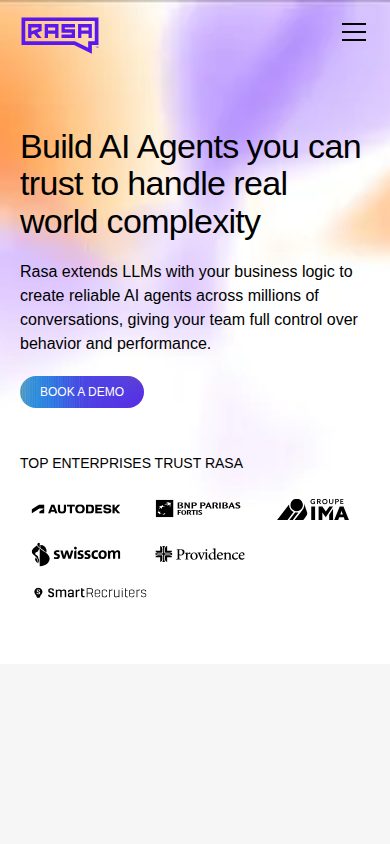
Rasa is an open-source conversational AI platform for building, deploying, and managing AI assistants with full data control.

Rasa·Founded 2016·FreemiumFree PlanFree TrialAI Agents & AssistantsAI Coding ToolsAI Customer Support

AI Panel Score

7.4/10

6 AI reviews

Reviewed

AI Editor Approved

About Rasa

In practice, users build conversational AI assistants by defining intents, dialogue flows, and business logic through Rasa's tooling, then connect those assistants to channels like Slack, WhatsApp, Microsoft Teams, or Twilio. The Rasa X interface provides a collaborative environment for managing training data, reviewing conversations, and iterating on assistant behavior without requiring deep ML expertise for every update.

Rasa's platform includes several distinct components: Rasa NLU for natural language understanding, Rasa Copilot as a real-time orchestration layer connecting business logic to LLMs, and Rasa Pro for enterprise deployments with advanced analytics and governance tooling. It integrates with LLM providers including OpenAI, Anthropic, and Hugging Face, and supports deployment on AWS, Azure, GCP, or Kubernetes. The open-source core is publicly available, with the enterprise tier adding security controls, compliance features, and deployment flexibility.

Rasa targets enterprise teams in healthcare, financial services, telecom, government, and customer support who require auditable, controllable AI assistants rather than third-party managed services. The open-source version is free; Rasa Pro is priced via direct sales contact. Competitors in the space include Dialogflow (Google), Amazon Lex, Microsoft Bot Framework, and IBM watsonx Assistant.

The platform exposes APIs and prebuilt connectors, supports on-premises or cloud deployment, and is compatible with standard DevOps infrastructure including Kubernetes. Rasa's architecture is designed to keep training data and model weights within the customer's own environment, which is a primary differentiator for regulated industries.
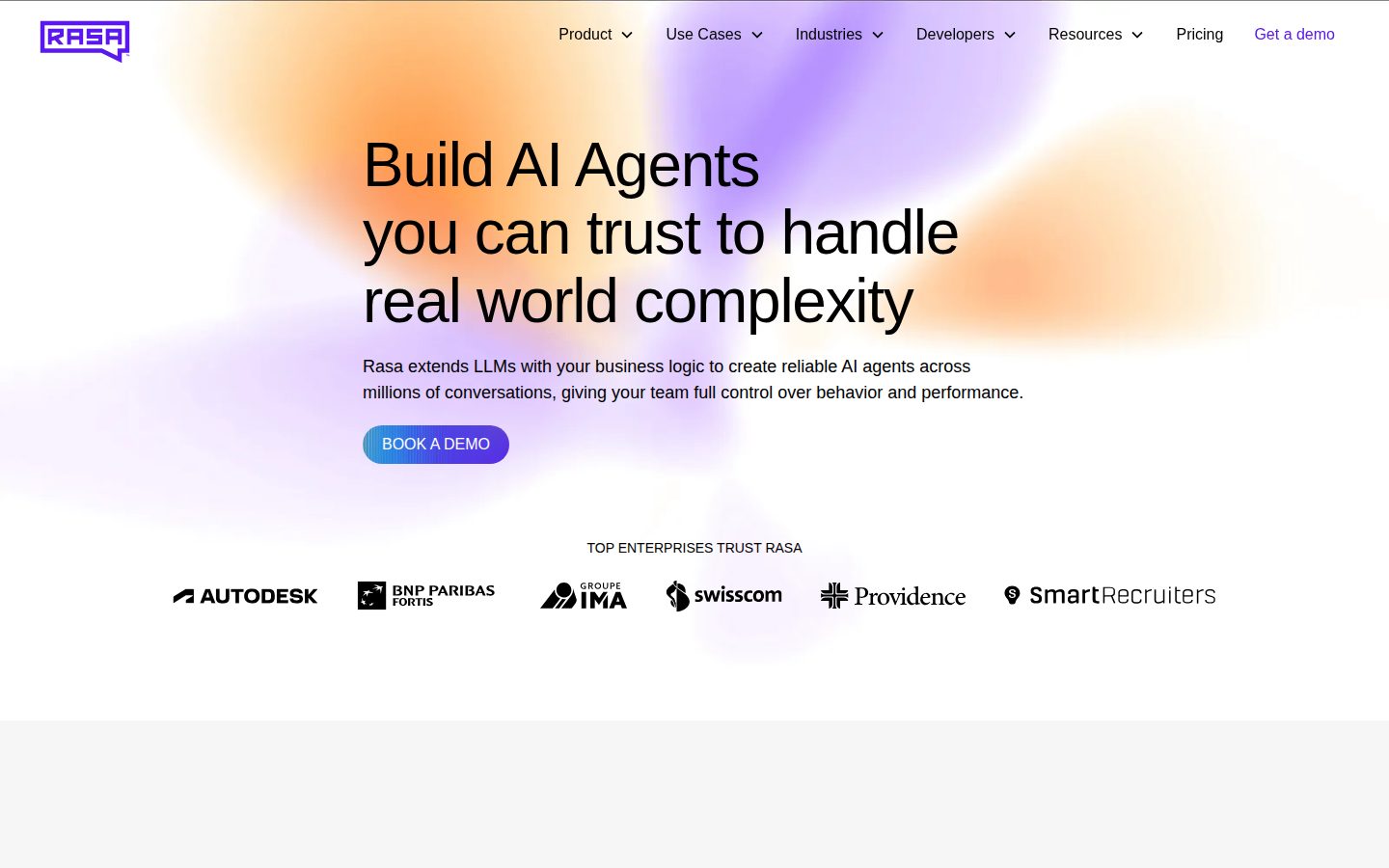
Features

AI

  • Agentic AI

    Creates agents that take initiative and adapt to complexity across conversations.

  • CALM (Conversational AI with Language Models)

    Extends the flexibility of LLMs with the reliability of deterministic logic for structured conversational flows.

  • Enterprise RAG

    Retrieves information in real time so every answer is fresh, verifiable, and aligned with trusted data sources.

  • NLU (Natural Language Understanding)

    Provides intent-based structure that can be expanded with AI flexibility as needed.

Automation

  • Orchestration

    Coordinates agents and tools to deliver the right help to users at the right moment.

Core

  • Multilingual AI

    Enables agents to adapt to language, tone, and context for global deployments.

  • Omnichannel Support

    Deploys agents across web, mobile, and messaging apps with built-in support for natural, fluid conversations.

  • Voice Gateway

    Delivers real-time voice infrastructure with built-in turn-taking, timeouts, and latency control for enterprise-grade speed.

Customization

  • Visual and Code-Based Agent Building

    Supports building, versioning, and testing agents with complete visibility through both visual and code-based development experiences.

Integration

  • Backend System Integration

    Integrates with existing enterprise systems to enable self-service features and complex logic in deployed agents.

  • MCP (Model Context Protocol)

    Gives AI agents a standard way to connect with external APIs as tools.

Security

  • On-Premises Deployment

    Allows agents to be deployed on your own infrastructure or managed by partners, giving full data control.

Preview

Rasa desktop previewRasa mobile preview

Pricing Plans

Free Developer Edition

Free

For developers and teams starting an AI assistant project with Rasa

  • Free Rasa license for local or production use
  • One bot per company
  • Up to 1000 external conversations/month or 100 internal conversations/month
  • Free community support in forum

Rasa Pro

Contact sales

Pro-code generative AI native conversational AI framework for developers to flexibly build, integrate, monitor, and deploy AI Assistants

  • CALM dialogue understanding and management
  • Enterprise search and contextual response rephraser
  • Kubernetes deployment support through Helm
  • PII data management and secrets management via Vault
  • Multi-LLM management and LLM fine-tuning recipe
  • Observability (OpenTelemetry) and multi-node concurrency (Redis)
Popular

Rasa Platform (Rasa Pro + Rasa Studio)

Contact sales

Full platform combining pro-code infrastructure and no-code UI for conversational AI teams

  • Everything in Rasa Pro
  • No-code AI assistant flow builder
  • Content and response management system
  • Role-based Access Control (RBAC) and Single-Sign-On (SSO)
  • Self-Managed or Managed Service deployment modes
  • Conversation view to analyse conversations

Enterprise

Contact sales

For enterprises looking to deploy conversational AI at scale or needing advanced support

  • Full access to Rasa Platform
  • Premium Support with 24/7/365 enhanced response times
  • Access to Customer Success Manager and Customer Success Engineer
  • Large scale deployment with pre-built enterprise security features
  • Success planning and business reviews

AI Panel Reviews

The Decision Maker

The Decision Maker

Strategic bet, vendor viability, timing, adoption approval
7.8/10

The on-prem conversational AI platform that survived the LLM disruption — by adding LLMs.

Founded 2016. Andreessen Horowitz-backed. Adobe and Deutsche Telekom in production. Rasa is the credible enterprise pick when SaaS chatbot tools fail compliance.

Founded 2016. Berlin. Andreessen Horowitz-backed since the 2020 Series B. $40M+ raised. Adobe, Lemonade, Deutsche Telekom in production deployments. Three real signals — funding, brand customers, and category persistence through the LLM shift.

Two things matter. One: Rasa is the conversational AI platform that took the regulated-enterprise pain of SaaS chatbots seriously — HIPAA, GDPR, SOC 2 Type II, on-premises deployment. Two: they didn't get killed by ChatGPT. They added LLM integration to their structured-intent framework, which is the right architectural move. Compare Dialogflow, which is structurally locked into Google Cloud.

If compliance, data sovereignty, or on-prem deployment is real, Rasa is the conversation. If it isn't, you're overbuying for Botpress or Voiceflow territory. Pilot a single regulated workflow for 60 days before standardizing.

Competitive Positioning7.5

Strongest regulated-enterprise position in the category; loses ease-of-use to Voiceflow and Botpress.

Reputation Risk7.5

Adobe and Deutsche Telekom in production gives the board a credible reference call.

Speed to Value7.0

Open-source path is fast for engineers; production-grade Rasa Pro deployment is a real engineering project.

Strategic Fit8.0

On-prem and compliance positioning fits regulated enterprises where SaaS chatbots fail at procurement.

Vendor Viability8.0

Series C, Andreessen Horowitz lead, named enterprise customers — past the early-vendor risk window.

Pros

  • Andreessen Horowitz Series C and named enterprise customers cover early-vendor risk concerns
  • On-premises deployment plus HIPAA/GDPR/SOC 2 Type II is the credible compliance story competitors lack
  • Survived the LLM disruption by adding LLM integration to structured-intent framework — strategic durability

Cons

  • Production-grade deployment is a real engineering project, not a quick SaaS configuration
  • Buyer is enterprise-only — wrong choice for SMBs that would be served by Voiceflow
  • Pricing tiers are not fully transparent past the open-source community edition

Right for

Regulated enterprises (healthcare, finance, telco) needing on-prem or HIPAA-compliant conversational AI.

Avoid if

Your team has no compliance constraint and Voiceflow or Botpress would ship faster.

The Domain Strategist

The Domain Strategist

Craft and strategy in the product's domain — adapts identity per category, same lens
8.0/10

Hybrid intent-plus-LLM architecture is the right engineering shape for regulated conversational AI.

Most chatbot frameworks bet on either intent-classification or LLM. Rasa's CALM architecture combines both — the only sustainable shape for compliance-bound conversational systems.

The architecture is the strategic call. Pure-LLM chatbots fail compliance review because hallucination is a feature, not a bug. Pure intent-classification frameworks fail user expectation because conversations are inherently fluid. Rasa's CALM (Conversational AI with Language Models) architecture combines both — structured business logic with LLM-driven understanding.

If we adopt this for regulated workflows, in 3 years our conversational layer is auditable. The structured intent layer logs every decision, which is what compliance asks for. The LLM layer handles the linguistic flexibility, which is what users ask for. Compare Dialogflow CX: structurally tied to Google Cloud, hard to argue for in EU data residency conversations.

Integration surface is YAML domain files, Python custom actions, REST channels for messaging platforms. Standard for the category. Self-hosted deployment via Docker or Kubernetes — matches enterprise IT operating models.

Category Positioning8.0

Strongest regulated-enterprise position; loses ease-of-use to Voiceflow, loses developer mindshare to LangChain.

Domain Fit8.5

Maps to how regulated enterprises actually need conversational AI — auditable, controllable, deployable on-prem.

Integration Surface7.5

YAML config plus Python actions plus REST channels — standard enterprise integration patterns covered.

Long-term Implications8.0

Hybrid shape survives both LLM advances and regulatory tightening — durable architectural bet.

Strategic Depth8.5

CALM hybrid architecture is genuine engineering depth — not a wrapper, not a pivot, a sustained ML investment.

Pros

  • CALM hybrid architecture is the right shape for compliance-bound conversational AI
  • On-premises Kubernetes deployment matches how regulated enterprises actually run infrastructure
  • Structured intent logging gives compliance teams the audit trail SaaS chatbots cannot provide

Cons

  • YAML-plus-Python configuration model is engineer-heavy — non-technical conversation designers are blocked
  • Pure-LLM competitors win on conversational fluency where compliance constraints don't apply
  • Open-source community edition lacks the production-grade tooling Pro and Enterprise add

Right for

Engineering teams building auditable, compliance-bound conversational AI on a hybrid architecture.

Avoid if

Your conversational AI does not need audit logging or compliance-grade decision traceability.

The Finance Lead

The Finance Lead

Money, total cost of ownership, contracts, procurement math
7.0/10

Open-source free. Pro and Enterprise are contact-sales — the unpredictable part.

Rasa Open Source is genuinely free. Pro and Enterprise pricing is opaque, which is the finance team's real problem.

Rasa Open Source: free, no caps. Rasa Pro and Enterprise: contact-sales, no published pricing.

Category norm for enterprise conversational AI is $50K-300K/year all-in for production deployment. Rasa Enterprise pricing assumed in that band; final number depends on traffic volume, support tier, and on-prem vs managed. Compare Dialogflow CX at roughly $0.007 per request — for a 10M-request/year workload, that's $70K. Rasa's self-hosted model means the cost shape is FTE plus license, not per-request.

The hidden cost is the deployment FTE. Open Source needs an ML engineer to build and train. Pro adds tooling but still needs the same ML engineer. Year-1 all-in for a 10-person engineering team standing up Rasa: $150-250K including license, infrastructure, and partial-FTE cost. Honest compared to alternatives once you model both lines.

Billing & Procurement6.5

Enterprise procurement involves sales conversation, technical assessment, and security review.

Contract Flexibility7.5

Open Source has no contract; Enterprise contracts assumed annual with category-typical terms.

Pricing Transparency6.0

Open Source is free; Pro and Enterprise pricing is contact-sales — finance teams cannot model without a quote.

ROI Clarity7.5

Containment-rate measurement is direct; ROI vs traditional support headcount is straightforward to model.

Total Cost of Ownership7.0

License plus FTE plus infrastructure is the real TCO — easy to underestimate the FTE line.

Pros

  • Open Source community edition is genuinely free with no usage caps for non-production use
  • Self-hosted cost shape is FTE plus license — not per-request, which is predictable at scale
  • Containment-rate ROI is directly measurable against traditional support cost baseline

Cons

  • Pro and Enterprise pricing is opaque — no public model for finance budgeting
  • FTE cost (ML engineer) is the largest TCO line and easy to miss in initial budget
  • Sales-led procurement extends time-to-deployment by weeks compared to self-serve competitors

Right for

Enterprises with existing ML engineering capability and predictable conversational AI volume.

Avoid if

Your team has no in-house ML engineering and the FTE cost is invisible to the budgeting conversation.

The Domain Practitioner

The Domain Practitioner

Daily hands-on reality in the product's domain — adapts identity per category, same lens
7.5/10

YAML for domain logic, Python for actions, CALM for the LLM layer — the engineer-shaped chatbot framework.

Day-3 reality: you're writing intents and stories in YAML, custom actions in Python, deploying via Docker. Standard ML engineering workflow.

The structure is YAML for domain definitions, Python for custom actions, training data for intents and stories. That's the shape of a real ML engineering project, not a no-code drag-and-drop builder. Compare Voiceflow: visual flow builder, accessible to non-engineers, fights you the moment you need custom logic.

Day-three reality: you spend most of your time writing training stories — the example conversation flows that teach the model. That work is genuinely useful and genuinely tedious. The hot-reload during development is fast. The Rasa CLI ships with --debug and --verbose flags that show you the model's reasoning per turn — engineer-grade observability.

Day-thirty fight is the LLM integration. CALM is newer than the structured-intent core and the documentation is thinner. You'll spend a week understanding when to defer to LLM versus when to use structured logic. Real depth — and worth it for regulated workflows where structured logic is non-negotiable.

Day-3 Reality7.5

Training-story authoring is the daily work; CLI tooling and hot-reload make iteration fast.

Documentation Practitioner-Fit7.5

Tutorials are thorough for the structured-intent path; CALM and LLM integration docs are sparser.

Friction Surface7.0

Training data authoring is tedious; LLM integration via CALM has thinner documentation than core framework.

Power-User Depth8.5

Custom actions, custom NLU pipelines, custom policies — depth scales for any production scenario.

Workflow Integration8.0

Python and YAML — every dependency is something an ML engineer already runs in their stack.

Pros

  • CLI tooling with --debug and --verbose flags exposes model reasoning at the right level for engineers
  • Hot-reload during development makes iteration on training data fast
  • Python custom actions integrate with standard ML engineering workflows without proprietary patterns

Cons

  • CALM and LLM integration documentation lags behind the structured-intent core
  • Training story authoring is tedious work that takes weeks for a production conversation tree
  • No visual flow builder means non-engineer collaborators cannot edit conversations directly

Right for

ML engineers and conversational AI specialists comfortable with YAML, Python, and engineer-grade tooling.

Avoid if

You expect a no-code visual builder and conversation design without writing training data.

The Power User

The Power User

Daily human experience, onboarding, polish, learning curve, reliability
7.0/10

Powerful and uncompromisingly engineer-shaped — not the chatbot framework for marketers.

Rasa is honest about being a developer tool. The price you pay is that nobody on the marketing team can change a single message.

You can tell who built Rasa and who it's for. Engineers, ML researchers, conversational AI specialists. That's a feature for some teams and a wall for others. The framework is deeply customizable, the CLI is real, the deployment story is enterprise-grade.

The friction is the same friction every powerful framework has. You write YAML. You write Python. You train models. You deploy via Kubernetes. None of that is bad. None of it is welcoming to anyone outside engineering.

Three months in, the trained model is yours. The data, the actions, the deployment — all portable. Compare Dialogflow: easier to start, harder to leave. Rasa's open-source core means even if the company changes direction, your work survives. $0/year on community edition; opaque pricing on Pro. Worth it for teams who need real conversational depth, not a snippet to drop in a website.

Daily Polish7.0

CLI is solid; web UI for Rasa X (the visual tool) is functional but not as polished as Voiceflow.

Learning Curve7.0

First hour is steep; month three you have a deployable model that survives team turnover.

Mobile Parity6.5

Rasa is a backend framework — mobile parity isn't a category-relevant question.

Onboarding Experience6.5

First 10 minutes are setup-heavy; non-engineers feel the wall immediately.

Reliability Feel8.0

Deployments are stable in production; Adobe and Deutsche Telekom references back this up.

Pros

  • Open-source core means your conversation work survives the vendor
  • Production stability backed by named enterprise customers (Adobe, Deutsche Telekom)
  • CLI and YAML configuration model maps cleanly to existing ML engineering workflows

Cons

  • Non-engineers cannot edit conversations directly — collaboration is engineering-bound
  • First-hour setup is steep compared to Voiceflow's drag-and-drop onboarding
  • Pro and Enterprise pricing is opaque — hard to know what tier you actually need

Right for

Engineering-led teams building production conversational AI with real customization and deployment requirements.

Avoid if

You want a marketer-friendly chatbot you can configure in an afternoon without engineering involvement.

The Skeptic

The Skeptic

Contrarian. Watch-outs, deal-breakers, broken promises, category patterns
7.0/10

Survived ChatGPT's direct hit — but the next 24 months will tell us whether the architecture lasts.

Founded 2016, Series C, named enterprise customers, on-prem story. Three green flags. The yellow flag is that the conversational AI category is in active reshaping.

Founded 2016. Andreessen Horowitz-backed. Adobe and Deutsche Telekom in production. Three green flags that put Rasa past the survival window where most conversational AI startups disappeared after the GPT-3 release.

Green flags. The shift to CALM hybrid architecture suggests a team that's adapting, not freezing. The on-prem and compliance positioning is genuine differentiation in a category where every other vendor wants to be SaaS. The open-source community gives the data a portability story competitors can't match.

Two yellow flags. The conversational AI category is in active reshaping — pure-LLM agents (LangChain, AutoGPT pattern, OpenAI Assistants API) are pulling buyers away from structured frameworks. Rasa's hybrid bet might prove correct or might prove caught between paradigms. The other yellow: Pro and Enterprise pricing opacity makes it hard to know whether the unit economics work for them at the scale the category is contracting toward.

Competitive Differentiation7.0

Strongest regulated-enterprise story; weakest position against pure-LLM agent frameworks.

Exit Portability8.0

Open-source core means models, training data, and conversation logic are fully portable.

Long-term Viability6.8

Funding is solid; category reshaping risk is real and 24 months will tell.

Marketing Honesty7.5

Compliance and on-prem positioning are direct; technical claims hold up under documentation review.

Track Record Match7.5

8 years of operation, named investors, named enterprise customers — matches survivor patterns.

Pros

  • 8 years of operation through the GPT-3 disruption is real durability evidence
  • Open-source core gives full data and model portability if the company changes direction
  • Adobe and Deutsche Telekom production references make the enterprise story credible

Cons

  • Pure-LLM agent frameworks are pulling category attention and may reshape buyer expectations
  • Pro and Enterprise pricing opacity hides whether unit economics work at category scale
  • Hybrid architecture bet is correct or wrong — no middle ground over the next 24 months

Right for

Regulated enterprises who can absorb category-volatility risk in exchange for the on-prem and compliance story.

Avoid if

You need a category-leader pick and the LLM-first competitors look more like the future shape of conversational AI.

Buyer Questions

Common questions answered by our AI research team

Pricing

What are the conversation limits on the free Developer Edition, and can it be used in production?

The free Developer Edition allows up to 1,000 external conversations per month or 100 internal conversations per month, limited to one bot per company. Yes, it can be used in production — the content explicitly states it is a 'free Rasa license that can be used locally or in production.'

Features

Does Rasa support real-time voice interactions with features like turn-taking and latency control?

Yes, Rasa supports real-time voice interactions. The Voice Gateway feature includes 'built-in turn-taking, timeouts, and latency control,' and is described as 'real-time voice infrastructure with enterprise-grade speed.'

Security

Can Rasa be deployed on-premises or in a private cloud to keep our data within our own infrastructure?

Yes, Rasa supports on-premises and private cloud deployment. The Business plan (Rasa Pro + Rasa Studio) explicitly lists deployment modes as 'Self-Managed (On–prem or Private Cloud)' and 'Managed Service.'

Setup

Is the no-code flow builder (Rasa Studio) included in the base Rasa Pro plan, or does it require an upgraded Business plan?

The no-code flow builder (Rasa Studio) is not included in the base Rasa Pro plan. It requires the upgraded Business plan, described as 'Rasa Pro + Rasa Studio,' which adds the 'no-code AI assistant flow builder' and other UI-based features on top of everything in Rasa Pro.

Integration

Does Rasa support IVR connectivity, and if so, which telephony platform does it integrate with?

Yes, Rasa supports IVR connectivity via an 'IVR Connector to AudioCodes VoiceAI Connect,' which is listed as a feature of Rasa Pro but is noted as 'available through additional purchase.'

Product Information

  • Company

    Rasa
  • Founded

    2016
  • Pricing

    Freemium
  • Free Trial

    Available
  • Free Plan

    Available

Platforms

weblinuxmacwindows

About Rasa

Create AI agents you can trust with Rasa’s powerful platform, designed to scale, customize, and support real business needs across channels.

Resources

Documentation
API
Blog
Changelog

Also in AI Agents & Assistants