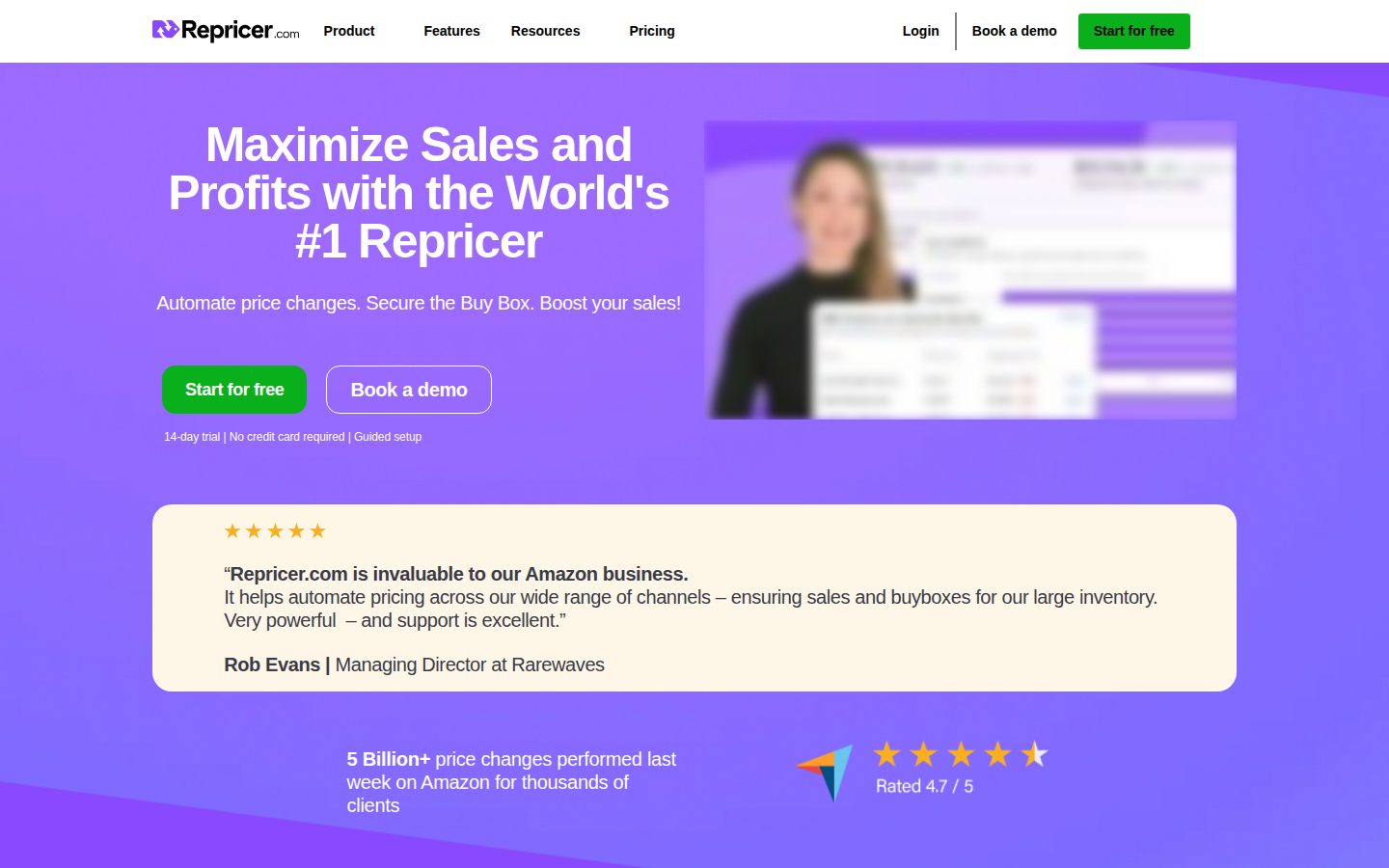
Automated repricing for Amazon and eBay sellers to win the Buy Box
Repricer AI is an automated pricing tool for eCommerce sellers on Amazon, eBay, Walmart, and Shopify.
AI Panel Score
6 AI reviews
Reviewed
Sellers connect their marketplace accounts and define pricing strategies — setting floors, ceilings, and rules based on variables such as competitor stock levels, seller ratings, and geographic location. Repricer then continuously monitors competing listings and recalculates prices automatically, uploading updates within seconds of a triggering event. A safe mode lets new users preview how prices would change before any live adjustments are published, and basic setup is described as achievable in under ten minutes.
Beyond core repricing, the platform includes an analytics layer that identifies opportunities where small strategy adjustments could increase Buy Box wins or sales volume. Sellers can target specific competitors, product subsets, or regional markets with differentiated rules. A multi-channel price replication tool synchronizes pricing across platforms including eBay, Walmart, and Shopify. The platform also sends alerts for events such as losing the Buy Box or running low on stock.
Repricer is aimed at third-party marketplace sellers ranging from small catalogues to inventories of several million SKUs. It offers a 14-day free trial with no credit card required. Direct competitors in the automated repricing category include Feedvisor, Informed.co (formerly Appeagle), and BQool. Pricing details beyond the trial period are not disclosed on the homepage.
The product runs as a web-based SaaS platform. Its repricing engine is described as hosted on Amazon infrastructure, which the company attributes to faster price-change propagation on the Amazon marketplace.

Analyzes repricing strategies and suggests where minor tweaks can deliver more sales, including targeting specific sellers, products, or jurisdictions.
Provides actionable insights into product opportunities and sends timely alerts for critical issues such as losing the Buy Box or running out of stock.
Monitors competitor price changes across a seller's entire inventory and automatically adjusts listing prices in seconds based on configurable strategies.
Uses Amazon-hosted infrastructure to perform price changes in seconds, enabling the platform to process approximately 20 billion price changes on Amazon and eBay each month.
Continuously works to maximize Buy Box exposure by recalculating and uploading new prices immediately when a competitor changes price, runs out of stock, or their ratings fall.
Simulates how prices would change under a chosen strategy without actually publishing new prices, allowing sellers to test repricing rules before going live.
Raises or lowers prices based on a range of configurable parameters including seller ratings, stock levels, and seller location.
Factors competitor seller ratings into repricing decisions, allowing sellers to increase their prices against lower-rated competition.
Maintains consistent pricing across multiple selling platforms including eBay, Walmart, Shopify, and others using a dedicated multi-channel replicator tool.
Offers a guided onboarding process that enables basic repricer configuration in under 10 minutes, with support available to help sellers maximize the platform.
Repricer.com offers a 14-day free trial with no credit card required, but no public pricing tiers or list prices are displayed on this page. Visitors are directed to start for free or book a demo for guided setup.
20 billion monthly price changes is a real moat — pricing opacity is the catch.
“Repricer.com is a mature, feature-complete repricing platform with serious infrastructure behind it. No public pricing kills the shortlist speed for mid-market buyers.”
20 billion price changes a month. 5 billion on Amazon alone in a single week. That's not a startup claim — that's a platform with real throughput. Amazon-hosted infrastructure for repricing latency isn't marketing fluff; it's a structural edge over Feedvisor and Informed.co, which don't make the same architectural claim.
The feature set covers what sellers actually need: Buy Box optimization, Safe Mode for testing strategies before going live, multi-channel replication across Walmart and Shopify, and competitor-rating-based pricing rules. Ten-minute setup with a no-credit-card trial lowers the risk to nearly zero. The tradeoff: pricing is completely opaque. No tiers, no ranges, just a demo request. That slows board approval and invites sticker shock.
Vendor viability signals are mixed — strong volume metrics, but no public funding data and no changelog visible. Pilot the 14-day trial across a defined SKU subset. Don't standardize until you see the post-trial pricing conversation.
Amazon-hosted infrastructure for repricing latency is a concrete differentiator that Informed.co and BQool don't publicly match.
Category-established player competing against Feedvisor; no red flags, but opaque pricing can look sloppy to a CFO.
Safe Mode plus sub-10-minute setup means sellers can validate strategy impact before a single live price change.
Buy Box wins directly drive Amazon revenue — this advances margin, not just operational efficiency.
20B monthly price changes suggests real scale and durability, but no public funding data or changelog makes 36-month confidence incomplete.
Amazon or multi-channel sellers running large SKU catalogs where Buy Box share directly moves revenue.
You need transparent vendor pricing before executive approval.
20 billion monthly price changes is a real number; opacity on pricing is a real problem.
“Repricer is a mature, high-throughput repricing engine built around Amazon Buy Box mechanics. The infrastructure story is credible and the feature set covers what a multi-channel catalog operation actually needs.”
The Amazon-hosted processing architecture isn't marketing fluff — it's the right infrastructure call for sub-second repricing latency on Amazon's own marketplace. Safe Mode, floor/ceiling logic, and seller-rating-weighted rules show that whoever built the strategy layer has actually worked a catalog before. At 20 billion price changes monthly, this isn't a startup experiment. That's production-grade throughput.
The multi-channel replicator covering eBay, Walmart, and Shopify matters more than it looks. Keeping margin floors consistent across channels is where mid-market sellers leak money, and a single rule layer that propagates across all four platforms saves real operational overhead. Against Feedvisor and Informed.co, Repricer's positioning is speed and simplicity; Feedvisor goes deeper on demand forecasting and algorithmic strategy, which is the ceiling Repricer doesn't yet match.
The hard gap is pricing opacity. No public tiers means every conversation starts with a sales call, which breaks the self-serve motion the 14-day no-credit-card trial is trying to build. If you're running a 500-SKU catalog, you have no idea whether this is a $200/month tool or a $2,000/month tool before you're already invested.
Strong mid-market positioning between basic repricers like BQool and enterprise platforms like Feedvisor; the 20B monthly price change volume is a credible moat claim.
Buy Box alerts, Safe Mode for rule testing, and sub-second repricing cadence map directly to how Amazon sellers actually manage competitive pricing pressure.
Native connectors for Amazon, eBay, Walmart, and Shopify cover the primary marketplace stack, but no public API documentation limits deeper integration with inventory or ERP systems.
Amazon infrastructure dependency is a feature today but creates a single-marketplace optimization bias — if your channel mix shifts toward Walmart or DTC, the core engine's advantage erodes.
Floor/ceiling logic plus seller-rating-based parameters show real repricing strategy depth, but no demand forecasting or algorithmic margin optimization like Feedvisor offers.
High-volume Amazon-first sellers with multi-channel presence who need fast, rules-based repricing without enterprise-level forecasting complexity.
Your catalog is DTC-heavy or you need repricing logic integrated directly into a custom ERP or inventory management system.
20 billion price changes monthly, zero published prices — budget blind before you commit
“Repricer AI hides all post-trial pricing behind a sales call. No public tiers means no TCO model until procurement is already invested.”
20 billion price changes per month is a real number. Amazon-hosted infrastructure for repricing latency is a defensible technical claim. Safe Mode and sub-10-minute onboarding reduce evaluation risk. The 14-day trial, no credit card required, is clean.
The pricing problem is real. No tiers, no per-SKU rates, no seat structure visible on the pricing page. Competitors Feedvisor and Informed.co have similar opacity issues, but BQool publishes tiers starting around $25/month. Without a sticker, year-3 TCO for a 50-SKU operation versus a 500K-SKU catalog is unknowable. Seat creep, SKU-tier upgrades, multi-channel add-ons — all unquantifiable until you're in a demo.
Buy Box optimization and multi-channel price replication across eBay, Walmart, and Shopify are table-stakes features delivered well here. The tradeoff: strong operational capability, zero procurement visibility. Finance teams can't model what they can't see.
Demo-gated pricing adds procurement friction; no invoice structure, payment terms, or SKU-tier logic visible without a sales call.
No published auto-renewal terms, cancellation policy, or contract length — category norm is annual contracts with 30-60 day renewal windows.
No public tiers, no list prices, no SKU-based rate card — pricing page exists but directs to a demo.
Buy Box win rate and alert-driven intervention are measurable outputs; actionable analytics layer provides a quantifiable feedback loop.
20 billion price changes and multi-channel scope suggest meaningful infrastructure cost passed to buyers, but no data to model year-3 TCO.
High-volume Amazon sellers who can negotiate pricing and absorb the demo overhead.
Your procurement process requires published pricing before a vendor conversation.
Buy Box automation that actually runs itself — pricing opacity is the daily fight
“Repricer AI handles the core repricing job well: 20 billion price changes monthly, Amazon-hosted infrastructure, sub-second updates. But no public pricing means every budget conversation starts with a demo call.”
Safe Mode is the right call for onboarding. Connect your account, set floors and ceilings, watch the simulation run before anything goes live. That's a sane first week. The guided setup claiming under 10 minutes is plausible for a small catalogue — for a multi-thousand SKU store, expect a full day configuring seller-rating rules and geographic parameters before you're comfortable going live.
Day three looks like this: Buy Box alert fires, you check the analytics layer, it suggests a strategy tweak, you adjust the rule. That loop is tight. The multi-channel replicator syncing eBay, Walmart, and Shopify in the same dashboard is genuinely useful — Feedvisor and Informed.co both require more manual channel management. No API docs listed, though, which limits any custom reporting pipeline.
The pricing opacity is a real friction point for store managers managing monthly P&L. No tiers, no per-SKU cost, no public starting number. That's a conversation you're having with sales before you can budget it.
Alert-driven workflow for Buy Box losses is solid, but no public pricing means budget justification requires a sales call every renewal cycle.
Blog present but no docs site listed — the evidence suggests marketing-written FAQs rather than operator-grade setup guides.
No changelog and no API docs create friction for stores wanting to pipe repricing data into their own dashboards or reporting tools.
Seller-rating-based pricing, geographic rules, and competitor-targeting parameters give experienced sellers real levers beyond simple floor/ceiling logic.
Multi-channel replicator covering Amazon, eBay, Walmart, and Shopify in one ruleset fits how multi-channel store managers actually operate.
Multi-channel Amazon and eBay sellers running competitive catalogues who need set-and-monitor repricing without building it themselves.
You need transparent per-SKU or tiered pricing to manage a tight margin budget before committing.
20 billion price changes a month — and setup under 10 minutes
“Repricer AI is a serious, feature-complete repricing tool for Amazon and multi-channel sellers. No public pricing is a real friction point, but the core product is genuinely well-built.”
Safe Mode is the feature that tells you someone on this team actually thought about the new-user experience. Preview before you publish, no live prices getting torched while you're still figuring out your floor and ceiling rules. That's not category standard — Informed.co doesn't lead with that. And 20 billion price changes a month processed on Amazon-hosted infrastructure isn't just marketing copy, it's the actual architecture argument for why latency is lower here.
The multi-channel replicator covering eBay, Walmart, and Shopify is legitimately useful for sellers who've grown beyond Amazon-only. Seller-rating-based pricing rules show real depth. The analytics layer that flags where small strategy tweaks could recover Buy Box wins — that's the kind of thing that compounds quietly over month three.
The thing that'll frustrate people: pricing is completely hidden. No tiers, no ballpark, nothing. For a tool that's going to live inside your margins every day, that's asking a lot of trust upfront. Web-only also means mobile is presumably read-only at best. Neither is a dealbreaker for a high-volume seller, but worth knowing.
Safe Mode and Buy Box alerts suggest real attention to daily workflow, but no changelog means it's hard to tell how often small rough edges get filed down.
Simple algorithms and Safe Mode smooth the first hour; dynamic parameters like seller-rating-based pricing and geographic rules give depth for month three.
Web-only platform with no mobile app mentioned — for a tool monitoring prices 24/7, that's a real gap on the go.
Guided setup under 10 minutes with Safe Mode preview and no credit card required for the 14-day trial is a genuinely low-friction entry.
Amazon-hosted infrastructure and 5 billion+ price changes in a single week on Amazon alone suggests the engine is production-hardened.
Third-party Amazon sellers with growing multi-channel catalogs who need Buy Box wins automated at scale.
You need transparent upfront pricing or a solid mobile experience to manage things away from your desk.
20 billion price changes monthly, but no public pricing and 'World's #1' in the H1
“Solid infrastructure story. Marketing honesty is where this starts to wobble. No pricing page, no changelog, no API docs — that's a pattern I've seen before.”
Three tells upfront. One: 'World's #1 Repricer' is the H1. Two: no public pricing — 'Contact Sales' where tiers should be. Three: no changelog visible, so I can't verify shipping cadence. Those aren't dealbreakers, but they're the same signals I flagged on tools that quietly disappeared.
The infrastructure angle is actually interesting. Amazon-hosted processing for Amazon repricing isn't a nothing claim — latency matters here, and 20 billion monthly price changes is a real number worth stress-testing. Safe Mode is genuinely smart onboarding. Named competitors Feedvisor and Informed.co are still alive, which means the category isn't a graveyard yet.
Hard tradeoff: zero API access based on what's visible. Enterprise sellers with custom stacks can't build on this. Exit portability is murky — if you've tuned 50 repricing rules inside their UI, migration is a rebuild. Category-competent, but the opacity on pricing and company provenance makes this a 'verify before committing' product.
Amazon-hosted infrastructure for repricing latency is a plausible technical moat vs. Informed.co, though it's unverifiable from public docs.
No API visible, and custom strategy rules likely live only inside their UI — migration off this platform means rebuilding pricing logic from scratch.
No changelog, no public funding data, no named team — blog exists but signals on active shipping cadence are thin.
'World's #1' headline with no public pricing and no verifiable funding or company details — the kind of superlative that ages poorly.
20 billion monthly price changes and multi-channel support match patterns of durable category players like BQool that survived the repricer consolidation wave.
Mid-size Amazon sellers who want a no-code repricing setup and don't need API access or custom integrations.
You need transparent pricing upfront or API-level control to integrate repricing into a broader seller tech stack.
Common questions answered by our AI research team
Basic setup takes less than 10 minutes. You can start with simpler algorithms within a tight price range, or use safe mode to preview how prices would change without publishing them.
Repricer supports eBay, Walmart, and Shopify in addition to Amazon, with a multi-channel replicator tool to maintain consistent pricing across all platforms.
Repricer processes approximately 20 billion price changes on Amazon and eBay every month, with over 5 billion price changes performed on Amazon alone in a single week.
Yes, Repricer offers a 14-day free trial with no credit card required and includes guided setup to help you get started.
Yes, Repricer sends timely alerts for critical issues including losing the Buy Box and running out of stock, so you can act immediately.