Conversational language practice powered by AI, no live tutor required
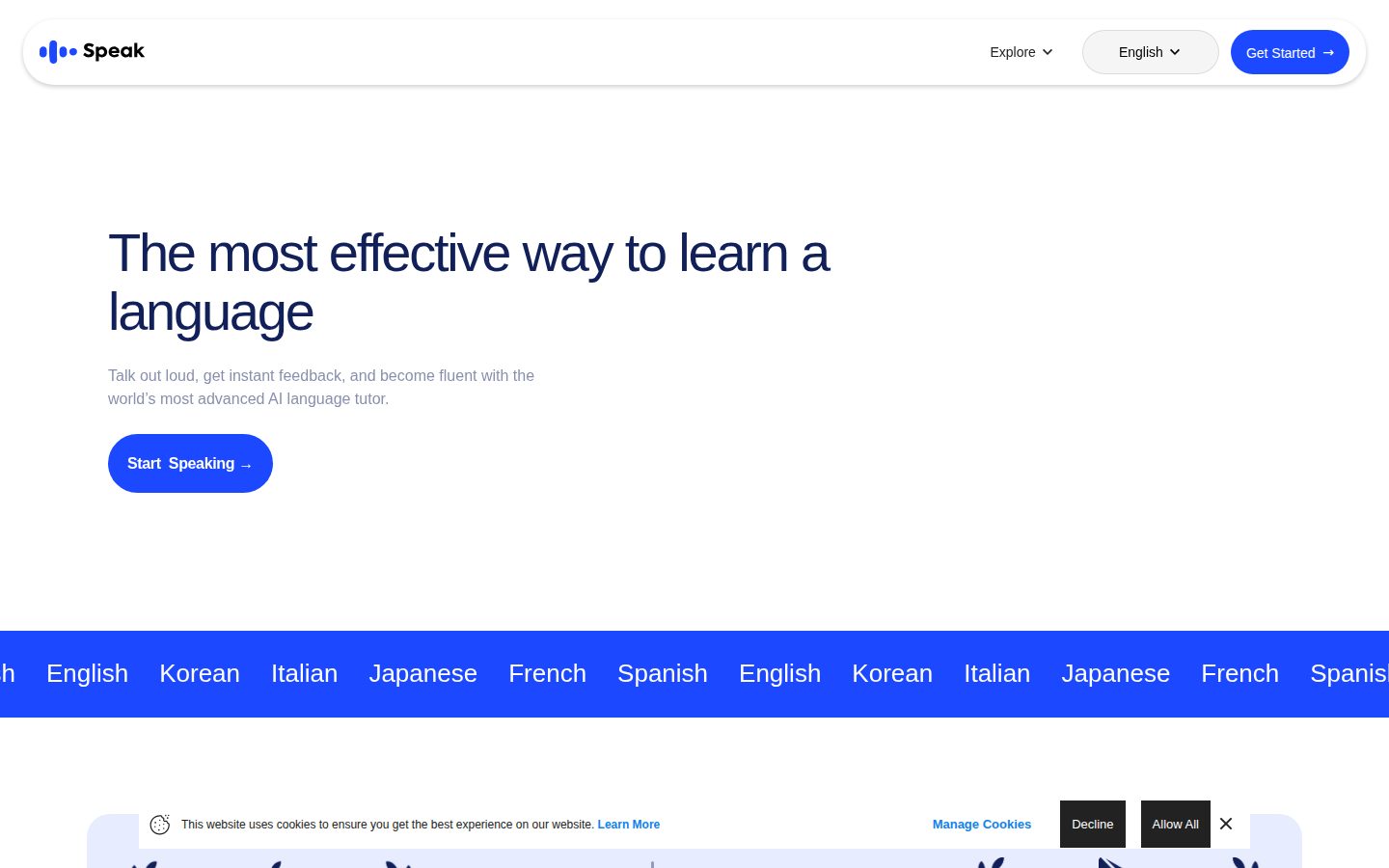
Speak is an AI-powered language learning app for people who want to practice spoken conversation without a human tutor.
AI Panel Score
6 AI reviews
Reviewed
AI Editor ApprovedApproved and published by our AI Editor-in-Chief after full panel analysis.Users open Speak and engage in spoken dialogue with an AI system that responds naturally and evaluates their speech in real time. The primary workflow involves speaking out loud, receiving immediate feedback on pronunciation and fluency, and iterating through conversation scenarios — all without scheduling a session with another person.
Speak highlights instant feedback and natural conversation as its two main technical pillars. The app is available on iOS, Android, and web, with localized versions for Korea, Japan, Spain, Latin America, Taiwan, China, Brazil, France, and Germany. It also offers a B2B product for organizations and teams seeking language training at scale across multiple regional markets.
Speak targets individual language learners who want speaking practice outside of traditional classroom or tutoring formats. A gift purchase option suggests it is also marketed to consumers buying for others. The app competes in the language learning category alongside products such as Duolingo, Babbel, and italki, though those products emphasize different modalities (gamified lessons, structured courses, or live human tutors respectively). Pricing details are not disclosed on the public website; a free trial is available via the onboarding flow.
The app is distributed through the Apple App Store and Google Play Store, with a web platform accessible at app.speak.com. A waitlist exists for languages not yet supported.
A dedicated feature (available for English learners) that provides syllable-level feedback on individual sounds, helping learners identify and correct specific phoneme errors.
Uses advanced AI (powered by OpenAI models) to analyze spoken responses in real time, assessing pronunciation, intonation, and fluency and delivering instant corrective feedback.
An AI-powered personal tutor available 24/7 that designs a personalized curriculum based on the learner's goals, motivations, and progress, and can hold open-ended conversations on any topic.
Tracks daily learning streaks and lets users set personal language goals, keeping learners motivated and accountable to maintain consistent study habits.
Open-ended, user-directed conversations where learners define the topic, setting, and roles, enabling practice on any subject at any time without a scripted structure.
Allows learners to save phrases and sentences from lessons to a personal Phrasebook for later review and study, making it easy to revisit useful vocabulary and expressions.
Scenario-based AI conversations simulating real-life situations (e.g., ordering at a café, making travel plans) where the AI assigns specific tasks for the learner to complete.
Sentence-repetition exercises where words light up on screen as the learner speaks them aloud, reinforcing speaking patterns and pronunciation through structured practice.
A language learning course organized into short thematic units across multiple lesson types, designed by language experts to build conversational fluency from beginner to advanced levels.
Matching and fill-in-the-blank games embedded within thematic units to reinforce new vocabulary acquired during lessons.
A Premium Plus feature that generates personalized lessons based on mistakes made in Free Talk sessions, allowing learners to target and drill their specific weak points.
Fully featured native apps available on both the Apple App Store and Google Play Store, enabling on-the-go language practice anywhere and anytime.
A 7-day free trial giving access to all features of the app before committing to a paid plan. No long-term commitment required.
Core subscription for language learners who want full access to Speak's curriculum and AI-powered speaking practice. Best for beginners building a structured foundation.
The advanced tier for learners who want a fully personalized, adaptive experience. Includes everything in Premium plus unlimited custom lessons and deeper personalization. Exact price not publicly listed — requires in-app upgrade or contacting Speak. Reviewers note it carries a significant price premium over the standard Premium tier.
Speak fills the gap Duolingo won't touch: actual spoken practice.
“AI-driven conversation at $20/month is a credible wedge against expensive tutors. The 7-day trial de-risks the first step.”
Duolingo gamifies reading. Babbel structures grammar. Neither makes you speak out loud to something that talks back. Speak's OpenAI-powered Real-Time Speech Analysis and syllable-level Pronunciation Coach do exactly that — and that's a real, defensible gap in the category.
Three things I'd want confirmed before scaling this to a team. One: no public pricing page, no changelog, and no API access limits visibility into their roadmap and lock-in risk. Two: Premium Plus pricing isn't disclosed publicly, which means the renewal math is a surprise. That's a governance conversation waiting to happen.
The tradeoff is this: Free Talk and Roleplay cover conversational breadth, but six supported languages on Premium means a multilingual org hits walls fast. For individual learners or a focused L&D pilot, the $20/month entry point is defensible. For enterprise rollout, the opaque Plus pricing makes budgeting harder than it needs to be.
No peer in the gamified-lesson category (Duolingo, Babbel) offers real-time spoken conversation — Speak owns that lane for now.
OpenAI-powered, multi-platform, and competing in a legitimate category — no reputational exposure here.
7-day full-access trial means a learner can validate real spoken improvement before committing a dollar.
Speak Tutor's personalized curriculum and 'Made For You' lessons advance conversational fluency in ways static e-learning tools won't.
No public funding data, but app store presence across iOS/Android/web with localized builds in 9+ markets suggests real operational scale — not a side project.
Individual learners or L&D teams running a focused pilot for one or two supported languages.
Your org needs multilingual coverage or predictable enterprise pricing before board approval.
Speak's AI conversation engine is genuinely differentiated, but enterprise L&D deployment needs more scaffolding.
“Speak solves the hardest problem in language learning — getting learners to actually speak — with always-on AI conversation and syllable-level pronunciation coaching. At $20/month for Premium, it's a credible alternative to italki for speaking practice, without the scheduling friction.”
The curriculum architecture is sound. Structured thematic units built by language experts, layered with Roleplay scenarios, Free Talk, and Speaking Drills — that's a defensible learning design stack, not just a chatbot with a paywall. The 'Made For You' personalization loop, where Free Talk mistakes generate targeted remediation lessons, is the feature that separates this from Duolingo's gamified surface-level engagement. Someone here understands spaced practice and deliberate skill acquisition.
For a B2B deployment, the gaps become visible fast. No API, no changelog, no disclosed pricing for the enterprise tier. I can't build a learning ecosystem around a tool whose integration surface is essentially zero. The Pronunciation Coach is English-only on Premium Plus, which caps utility for multilingual corporate cohorts across their 11 supported languages.
If this matures its admin layer and LMS integration story, it becomes a serious blended learning component for conversational fluency programs. Right now it's a strong learner-facing product that sits outside most L&D stacks by design.
Speak owns the AI-native conversational practice niche that Duolingo and Babbel haven't credibly entered, with 11 languages and a clear B2B motion beginning to form.
Optimized for individual learner motivation and self-direction; lacks the admin controls, cohort tracking, and reporting that corporate L&D programs require.
No API, no LMS connectors, no changelog visibility — the docs indicate near-zero integration surface for any blended learning stack.
If Speak builds its B2B layer, early adopters get a head start on conversational AI fluency programs; if it stays consumer-first, enterprise buyers will hit ceiling by year two.
Syllable-level phoneme feedback plus mistake-driven personalized lesson generation shows genuine instructional design thinking beyond category norms.
Individual learners or small teams who need high-frequency conversational speaking practice without live tutor scheduling.
Your L&D program requires LMS integration, cohort reporting, or multilingual pronunciation coaching at scale.
$20/month base, but Premium Plus pricing is invisible — budget accordingly.
“Speak's $20/month Premium tier is clear. Premium Plus price isn't published anywhere — that's the procurement problem.”
$20/month gets you Premium. 7-day free trial, no credit card friction apparent. Six languages supported at Premium. That's the easy math. Premium Plus — the tier with unlimited 'Made For You' lessons and Pronunciation Coach — carries no public price. Reviewers flag a 'significant price premium.' No invoice to sanity-check. No pricing page at all, per the evidence.
TCO scenario: solo learner, 12 months at Premium = $240/year. Year 3 at that rate = $720. If Premium Plus runs $40/month — a reasonable category guess — year 3 lands at $1,440. That's a 2x swing with zero public confirmation. B2B team pricing: entirely opaque, requires contact.
Duolingo offers a free tier and ~$84/year for Super. Speak's conversational AI depth likely justifies the gap — Roleplay and Free Talk are meaningfully richer than Duolingo's drills. But procurement teams won't book a PO against an unpublished price. Consumer buyers tolerate that. Finance teams don't.
App Store and web distribution ease consumer billing; B2B invoicing and procurement process are undocumented publicly.
No public auto-renewal terms, cancellation policy, or contract length documented in available evidence.
Premium at $20/month is visible; Premium Plus has no published price per the pricing page evidence.
Streak tracking and personalized 'Made For You' lessons provide measurable engagement signals, but language fluency ROI is inherently soft.
Premium TCO is calculable at $240/year, but Premium Plus and B2B rates are opaque, making 3-year modeling speculative.
Individual learners or small teams who can expense $20/month and aren't blocked by undisclosed Premium Plus pricing.
Your procurement process requires a published price list before issuing a PO.
Speak fills the speaking gap Duolingo never could — with real daily limits
“Speak targets the one thing Duolingo and Babbel structurally avoid: actual spoken output under pressure. The AI conversation loop is the product, not a feature bolted onto flashcards.”
The core workflow — open app, speak out loud, get syllable-level feedback, iterate — is exactly what's missing from most self-study programs. Roleplay Lessons and Free Talk together cover the two modes trainers care about: structured scenario practice and open-ended production. Real-time speech analysis powered by OpenAI models means the feedback loop is fast enough to matter. That's where most AI tutoring tools fall apart. Speak doesn't, based on the feature architecture.
Day three is where the cap shows. Premium at $20/month limits Made For You lessons to 3 per day. For a motivated learner doing an hour of daily practice, that ceiling arrives fast. Premium Plus removes the cap but hides its price entirely — no pricing page, no public number. That's a friction point trainers feel when recommending tools to learners who need budget clarity upfront.
Pronunciation Coach is English-only. For trainers working with Spanish, Japanese, or Korean cohorts, that's a meaningful gap. Still, the structured thematic curriculum plus Speak Tutor's 24/7 availability makes this a serious self-study companion, not a toy.
Free Talk and Roleplay hold up daily, but the 3 Made For You lesson cap on the $20 Premium tier creates a real ceiling for serious learners.
No changelog, no public pricing page, and no API — the docs surface reads marketing-first, not practitioner-first.
Hidden Premium Plus pricing and English-only Pronunciation Coach are weekly friction points for trainers managing multilingual learners.
Personalized Review Lessons adapting continuously to Free Talk mistakes is genuinely advanced behavior; Phrasebook Bookmarking and streak tracking round out the habit layer.
iOS, Android, and web coverage plus 24/7 AI Tutor availability means it fits micro-practice windows — commutes, lunch breaks — without scheduling friction.
Self-directed adult learners who need spoken output practice and can't or won't schedule live tutoring sessions.
Your learners need non-English pronunciation coaching or you're running an LMS-integrated corporate training program.
Finally, speaking practice that doesn't require scheduling a human
“Speak nails the one thing Duolingo won't give you: actual spoken conversation, on demand. At $20/month it's priced seriously, but it's solving a real problem seriously.”
Duolingo gamifies everything except the thing you actually need — speaking out loud to something that talks back. Speak is built around exactly that gap. Roleplay Lessons, Free Talk, real-time pronunciation feedback powered by OpenAI models. The 7-day trial gives you full access, which is the right call. No crippled preview, no bait-and-switch.
The learning curve feels gentle on day one and genuinely useful by week three. Speak Tutor builds a personalized curriculum around your goals, and the 'Made For You' lessons — capped at 3 per day on the $20 Premium tier — drill your actual mistakes back at you. That's the kind of detail that shows someone on the team has thought about what month-three looks like, not just the demo.
The tradeoff is real though: Pronunciation Coach is English-only, and Premium Plus pricing is invisible until you're already inside the app. Hidden pricing in 2024 is a friction tax. Still, as a daily speaking partner that fits in your pocket, Speak is doing something italki and Babbel simply don't.
Streak tracking, phrasebook bookmarking, and words lighting up during Speaking Drills suggest a team that's thought about the daily feel, not just the feature list.
Structured thematic curriculum plus adaptive 'Made For You' lessons means the product scales from beginner to advanced without asking you to figure out your own path.
Native iOS and Android apps with full feature access — this is clearly a mobile-first product, not a desktop tool with a shrunken app.
Full-feature 7-day trial with no long-term commitment is a confident, frictionless entry — feels like welcome, not paperwork.
OpenAI-powered real-time speech analysis is doing heavy lifting; no changelog is public, so it's hard to gauge how fast issues get addressed.
Committed language learners who want daily speaking practice and can't or won't schedule live tutoring sessions.
You need a language not yet supported, or you're only comfortable paying after seeing the full pricing upfront.
3 green flags, 2 yellow ones — Duolingo killer this isn't, but it fills a real gap
“Speak targets a genuine hole: conversational speaking practice without scheduling a human. The AI-first execution looks credible, but the hidden Premium Plus price and missing changelog are flags worth watching.”
Two tells upfront. One: 'first & only app' in the meta description — that kind of claim ages poorly fast. Two: no pricing page for Premium Plus. Reviewers note it carries a 'significant price premium.' That's a phrase that does a lot of work for something you have to discover post-download.
The differentiation is real though. Duolingo is gamified vocab drills. italki is live human tutors. Speak sits between them — AI roleplay, syllable-level Pronunciation Coach, and Free Talk for open-ended conversation. The $20/month Premium tier is disclosed. The 3 Made For You lessons per day cap is a concrete, honest limit. OpenAI-powered speech analysis is named, not vague.
Exit portability is weak. No API, no data export signals visible, no changelog. If Speak pivots or shuts down, your progress history likely stays trapped. Category graveyard includes Speeko, Speakly, and others. Speak has real geographic distribution — Korea, Japan, Brazil, Germany — which suggests actual traction. Still: no public funding data, no shipping cadence visible.
Spoken AI conversation fills a real gap between Duolingo's gamified drills and italki's live tutors; Free Talk and Roleplay Lessons are meaningfully distinct features.
No API, no visible data export, no changelog — if Speak goes away, learned progress and personalized curriculum are unrecoverable.
Geographic breadth and B2B tier suggest revenue diversity, but no public funding, no changelog, and no SLA page are missing signals for a company asking for a recurring subscription.
'First & only app' is an aggressive claim with no substantiation, and Premium Plus pricing is deliberately obscured from the public website.
Multi-region localization across 9+ markets and B2B product suggest real traction; pattern resembles early Babbel more than vaporware, but no funding data is public.
Adult self-directed learners who want spoken conversation practice and can't or won't schedule live tutors.
You need transparent upfront pricing or a recoverable data trail if you switch products in 18 months.
Common questions answered by our AI research team
Speak offers a 7-day free trial with access to all features of the app.
Speak supports French, Spanish, English, Korean, Italian, Japanese, Portuguese, Traditional Chinese, Simplified Chinese, German, and more languages on its roadmap.
Yes. Speak Tutor builds a personalized curriculum by getting to know you on a deep level, keeping you motivated and accountable toward your specific goals.
Download the app from the Google Play Store or Apple App Store, or sign up directly on the web at speak.com.
Yes. Speak's core differentiator is enabling real conversational practice without a live tutor — the AI simulates genuine exchanges and provides instant pronunciation feedback on demand.