Splunk logo

Splunk Review

Visit

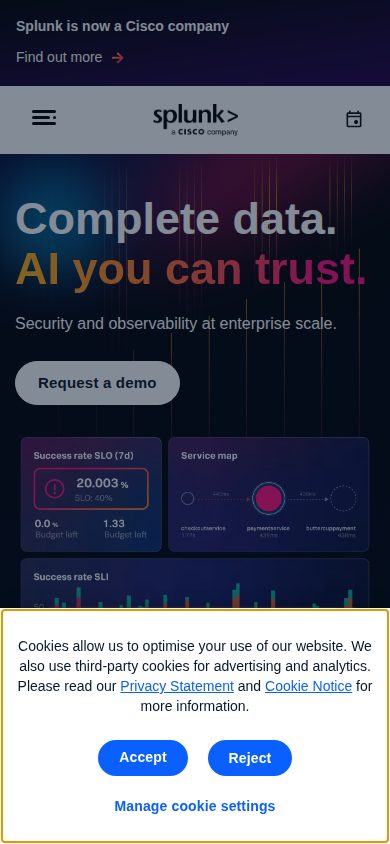
Security and observability platform for enterprise machine data at petabyte scale

Splunk is a data platform for enterprise security and IT observability that ingests and analyzes machine-generated data.

Splunk·Founded 2003·Contact for pricingFree TrialAI SecurityAI AnalyticsAI Cloud

AI Panel Score

8.0/10

6 AI reviews

Reviewed

About Splunk

In practice, users connect data sources through Splunk's 2000+ integrations — including cloud services, SaaS applications, IT infrastructure, OT, and IoT devices — and route that data into Splunk for search, alerting, and dashboarding. Security analysts use Splunk Enterprise Security to investigate threats, while IT and engineering teams use Splunk Observability Cloud to trace application performance down to the code level and across third-party APIs and networks.

Splunk highlights several specific differentiators on its platform: native OpenTelemetry support for instrumentation, Splunk IT Service Intelligence (ITSI) for AI-driven anomaly detection and alert noise reduction, and built-in Cisco Talos threat intel for an agentic SOC experience. The platform supports compliance automation for frameworks including PCI, HIPAA, and GDPR, and includes behavioral analytics with machine learning-based risk scoring for detecting insider threats, credential compromise, and lateral movement.

Splunk is aimed at enterprise security operations centers, IT operations teams, and engineering organizations at large-scale companies. Customers cited publicly include Progressive Insurance, Singapore Airlines, Carrefour, and Specsavers. Pricing is not publicly listed on the homepage and typically requires contacting sales; a free trial is available. Competitors in the SIEM space include Microsoft Sentinel, IBM QRadar, and Elastic Security; in observability, competitors include Datadog, Dynatrace, and New Relic.

Splunk is available as a cloud-hosted platform (Splunk Cloud Platform) and as a self-managed on-premises deployment (Splunk Enterprise). It supports Linux, Windows, and macOS for on-premises installation and provides a web-based interface for cloud users. The Splunkbase marketplace hosts over 2000 apps and integrations, and the platform exposes SDKs and APIs for custom development.
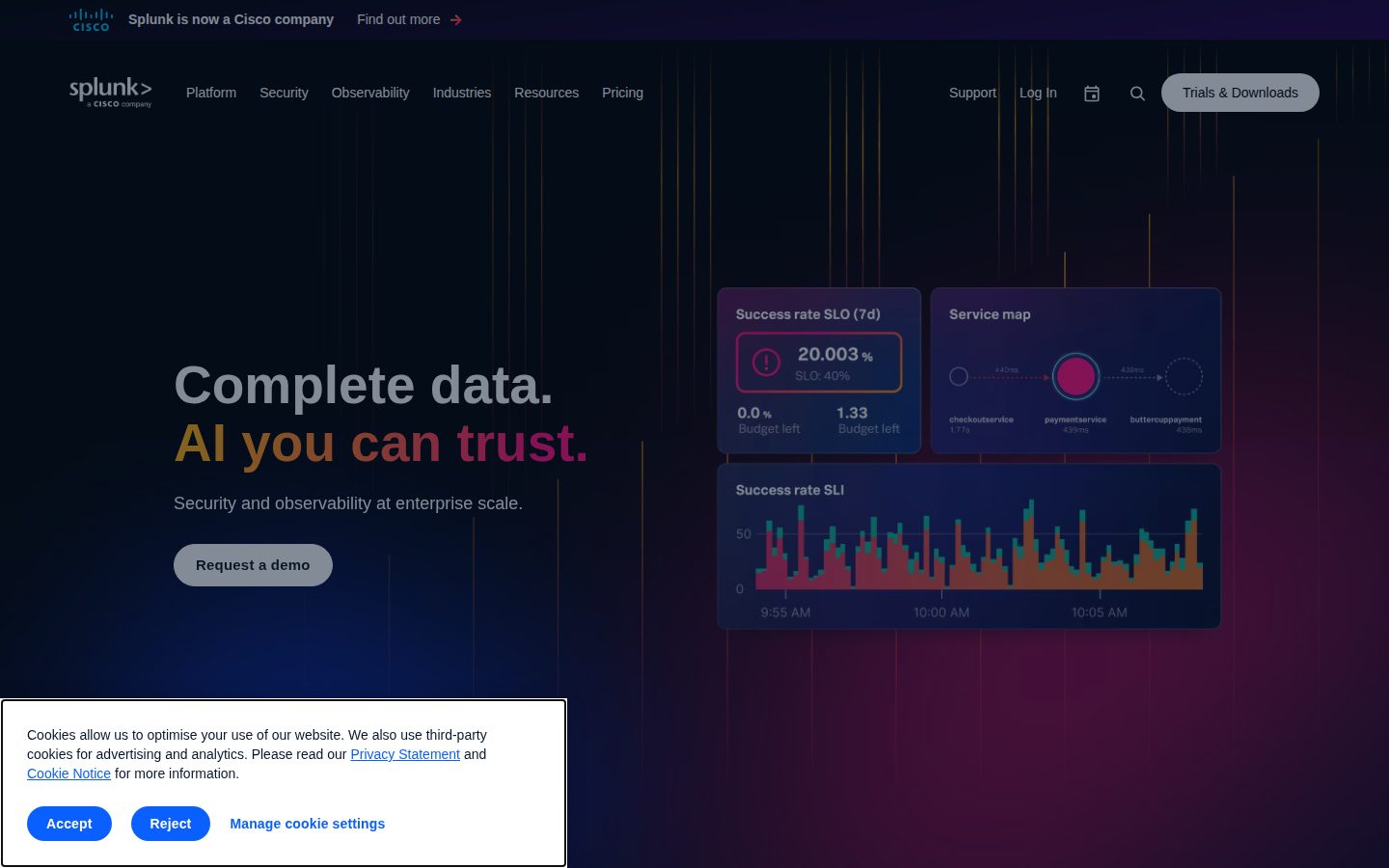
Features

AI

  • AI Capabilities for Security & Observability

    Provides cross-domain AI-driven insights and productivity tools built on Splunk's data visibility and context, designed to deliver trusted, scalable results for both security and observability use cases.

  • Splunk IT Service Intelligence (ITSI) / AIOps

    Uses AI and machine learning to identify anomalies, correlate data from multiple monitoring sources into a single live view, reduce alert noise, and proactively prevent outages.

Analytics

  • Agentic Observability

    Monitors business impact of performance problems across any stack, owned and unowned networks, and AI workloads, using AI to predict, preempt, and investigate issues.

  • Application Performance Monitoring (APM)

    Spots performance issues in real time across the full stack—from third-party APIs and the network down to the code level—and accelerates MTTR with AI assistants while showing impact on business KPIs.

Automation

  • Alert Noise Reduction

    Reduces alert noise through automated event correlation, real-time and predictive performance dashboards, and integration with IT service management tools to let teams prioritize incidents from one place.

  • Compliance Monitoring & Audit Automation

    Automates compliance monitoring, streamlines audits, and delivers real-time security visibility to help organizations prove adherence to standards such as PCI, HIPAA, and GDPR.

Core

  • Cross-Domain Machine Data Platform (Petabyte Scale)

    Unifies cross-domain machine data—logs, metrics, and traces—at petabyte scale into trusted, contextualized intelligence to give security and operations teams a complete data foundation.

Integration

  • Splunkbase Integrations (2000+)

    Connects, extends, and acts on data through 2000+ integrations and apps across cloud, SaaS, IT, OT, and IoT, with native OpenTelemetry support, SDKs, and agents.

Security

  • Agentic SOC (Threat Detection & Response)

    Unifies threat detection, investigation, and response with AI and built-in Cisco Talos threat intelligence to find and stop emerging threats at machine speed.

  • Behavioral Analytics & Advanced Threat Detection

    Uses behavioral analytics, machine learning, and risk scoring to surface anomalies and defend against insider threats, credential access and compromise, lateral movement, and living-off-the-land attacks.

  • Fraud Detection & Response

    Detects, investigates, and responds to fraud activities using specialized reporting and visualizations to analyze, measure, and manage fraud risk.

  • Real-Time Security Visibility & SIEM

    Monitors and correlates machine data across logs, metrics, and traces in real time to detect security threats and support SOC operations, as embodied in Splunk Enterprise Security.

Preview

Splunk desktop previewSplunk mobile preview

Pricing Plans

Contact Sales

Contact sales

Splunk uses a fully sales-led model with no public list prices. Pricing is custom and based on data volume, deployment type, and product suite (Platform, Security, Observability). Contact Splunk sales for a quote.

  • Splunk Platform (unified machine data at petabyte scale)
  • Splunk Security (SIEM, threat detection, Cisco Talos intel)
  • Splunk Observability Cloud (APM, AIOps, infrastructure monitoring)
  • Free trials and downloads available for evaluation
  • 2000+ integrations via Splunkbase
  • Enterprise-grade AI and agentic operations capabilities

AI Panel Reviews

The Decision Maker

The Decision Maker

Strategic bet, vendor viability, timing, adoption approval
8.5/10

The enterprise SIEM standard — powerful, opaque on price, and worth the negotiation.

Splunk is what large security teams default to for a reason: 2000+ integrations, Cisco Talos-backed threat intel, and petabyte-scale data handling. No public pricing is the one thing that slows every deal down.

Cisco acquired Splunk and the platform hasn't lost momentum. Talos threat intelligence baked into the agentic SOC capability is a real differentiator — not a marketing slide. Competitors like Microsoft Sentinel and Datadog cover pieces of this, but neither unifies SIEM, APM, and AIOps under one data layer the way Splunk does.

The tradeoff is implementation weight. This isn't a 30-day win. Behavioral analytics, ITSI anomaly detection, and compliance automation for PCI and HIPAA are genuinely powerful — but they take time to tune. Speed to value depends heavily on your team's Splunk experience going in.

No public pricing is a real friction point. The board will ask, and you won't have a number until procurement is already deep. Pilot it with a defined scope first. Don't let the sales process expand the footprint before you've proven the use case.

Competitive Positioning8.5

Microsoft Sentinel is cheaper and native for Azure shops, but Splunk's cross-environment depth and Talos intel create a real moat for complex, multi-cloud orgs.

Reputation Risk9.0

Progressive Insurance and Singapore Airlines are public customers — this is a board-defensible choice day one.

Speed to Value6.5

2000+ integrations reduce connection friction, but ITSI and behavioral analytics require meaningful tuning before they pay off.

Strategic Fit8.5

Unified SIEM plus observability advances security posture materially, not just cost savings on existing tooling.

Vendor Viability9.2

Backed by Cisco post-acquisition — this platform isn't going anywhere in the next decade.

Pros

  • Cisco Talos threat intelligence built natively into detection and response — not a third-party add-on
  • 2000+ Splunkbase integrations including OT and IoT, which most SIEM competitors don't touch
  • Compliance automation covers PCI, HIPAA, and GDPR in one platform
  • Petabyte-scale data handling with native OpenTelemetry support — infrastructure teams won't hit a ceiling

Cons

  • No public pricing means every deal starts blind — budget conversations get delayed
  • Implementation complexity is high; tuning behavioral analytics and ITSI takes months, not weeks
  • Overkill for teams without dedicated security operations capacity to run it

Right for

Large enterprises running hybrid or multi-cloud environments that need unified SIEM, APM, and compliance in one platform.

Avoid if

Your security team is under 10 people and you need something running in under 60 days.

The Domain Strategist

The Domain Strategist

Craft and strategy in the product's domain — adapts identity per category, same lens
8.5/10

Splunk is the SIEM infrastructure bet that Cisco's Talos intel just made harder to walk away from.

2000+ integrations, petabyte-scale ingestion, and now Cisco Talos threat intel baked into the detection layer — this is category-defining SOC infrastructure. The cost and operational complexity are real, but for enterprise-scale security operations, it's the default choice for good reason.

Behavioral analytics with ML-based risk scoring, native OpenTelemetry, and ITSI's alert noise reduction aren't features bolted together — they reflect a coherent threat-detection architecture. Splunk Enterprise Security handles UEBA, lateral movement detection, and credential compromise in a single data plane. That's a meaningful difference from Microsoft Sentinel, where the same coverage requires stitching in Defender and external enrichment.

The Cisco Talos integration is the three-year story. If agentic SOC workflows mature the way the market expects, having Talos feeding your detection layer directly means your ML models get first-look at threat intel your competitors are licensing secondhand. Compliance automation across PCI, HIPAA, and GDPR reduces audit overhead at the control framework level — not just reporting.

The constraint is real: opaque pricing, no public tiers, and high operational surface area mean this isn't a self-serve procurement. Teams without a dedicated Splunk admin will underutilize the platform. If you're not at enterprise scale, Elastic Security or Sentinel will close 80% of your use cases at a fraction of the total cost.

Category Positioning8.8

Clear category leader in enterprise SIEM; strong second position in observability behind Datadog, with Cisco's backing reinforcing the security moat.

Domain Fit9.0

Enterprise Security, ITSI, and fraud detection map directly to how mature SOC and IT ops teams are actually structured — not how vendors wish they were.

Integration Surface9.0

2000+ Splunkbase apps with native OpenTelemetry support covers cloud, SaaS, OT, and IoT — one of the widest integration surfaces in the SIEM category.

Long-term Implications8.5

Cisco Talos integration deepens over time, but 2000+ integrations and custom SPL queries mean migration costs compound year over year.

Strategic Depth9.2

Petabyte-scale ingestion plus behavioral ML risk scoring plus Talos-backed agentic detection is a genuinely deep security architecture, not a feature checklist.

Pros

  • Cisco Talos-backed agentic SOC is a durable threat intel moat
  • 2000+ integrations with native OpenTelemetry covers nearly any enterprise data source
  • ITSI alert noise reduction addresses real SOC analyst burnout at scale
  • Compliance automation spans PCI, HIPAA, and GDPR in a single control plane

Cons

  • No public pricing — procurement requires sales engagement, slowing POC timelines
  • High operational complexity; underutilized without dedicated Splunk-certified staff
  • Migration lock-in deepens with every custom SPL query and Splunkbase app added

Right for

Enterprise SOCs and IT ops teams running multi-cloud, hybrid, or OT environments that need unified SIEM and observability at scale.

Avoid if

Your team is under 500 users or lacks a dedicated security engineering function to manage platform complexity.

The Finance Lead

The Finance Lead

Money, total cost of ownership, contracts, procurement math
6.5/10

2000+ integrations, petabyte scale, zero public pricing — classic enterprise hostage math

Splunk is feature-complete for large SOC and observability programs. No pricing page means every deal starts with a sales call.

No published price. Not a tier, not a range, not an ingest-based estimate. The pricing page exists — the docs confirm it — but no numbers appear without a sales conversation. Category norm for enterprise SIEM, but Microsoft Sentinel publishes per-GB ingest rates. Splunk doesn't. That's a procurement problem before the contract is signed.

TCO is the real concern. Splunk licenses historically run on data ingest volume, and ingest grows. A 500-seat SOC ingesting 100GB/day today will not ingest 100GB/day in year 3. Add ITSI and Enterprise Security as likely separate SKUs, professional services for the 2000+ integration wiring, and ongoing admin headcount. Year-3 all-in routinely doubles the year-1 quote in this category.

The Cisco Talos integration and native OpenTelemetry support are genuine differentiators. Behavioral analytics with ML risk scoring is mature here, not a roadmap item. But contract flexibility is a known pain point — long terms, limited termination for convenience, and renewal windows that procurement teams miss. Eyes open.

Billing & Procurement4.0

No self-serve, no published ingest tiers, no trial-to-paid path visible — procurement friction is high by design.

Contract Flexibility4.0

No public contract terms, but enterprise SIEM category norm is multi-year lock-in with 60-90 day auto-renewal windows and no termination for convenience.

Pricing Transparency2.0

Zero published pricing; no tiers, no ingest rates, no starting numbers — requires a sales call, unlike Sentinel or Elastic.

ROI Clarity7.0

MTTR reduction via APM and alert noise reduction via ITSI are measurable outcomes; compliance automation for PCI/HIPAA/GDPR ties directly to audit cost.

Total Cost of Ownership4.5

Ingest-based licensing plus likely separate SKUs for ITSI and Enterprise Security make year-3 costs structurally unpredictable.

Pros

  • 2000+ Splunkbase integrations reduce custom integration build cost
  • Cisco Talos threat intel is a named, verifiable differentiator
  • Compliance automation covers PCI, HIPAA, GDPR — measurable audit value
  • Native OpenTelemetry support avoids proprietary instrumentation lock-in

Cons

  • No public pricing — every renewal is a negotiation
  • Ingest-based licensing means costs scale with data growth, not headcount
  • ITSI and Enterprise Security likely separate line items from base platform
  • No changelog visible — hard to track platform investment pace

Right for

Large enterprises with a dedicated procurement team, mature SOC, and petabyte-scale ingest needs.

Avoid if

Your team can't absorb opaque ingest-based pricing and multi-year contract risk.

The Domain Practitioner

The Domain Practitioner

Daily hands-on reality in the product's domain — adapts identity per category, same lens
8.2/10

Splunk's 2000+ integrations and Talos-backed detection are real. The pricing wall isn't.

Splunk Enterprise Security is the default SIEM for enterprise SOCs for a reason — petabyte-scale ingestion, behavioral analytics with ML-based risk scoring, and native OpenTelemetry support are genuinely mature capabilities. The catch: no public pricing, which means every expansion conversation runs through sales.

OpenTelemetry native support and 2000+ Splunkbase integrations tell me the platform teams aren't building walled gardens. That's the right instinct for a SOC running hybrid cloud plus OT plus IoT. Cisco Talos threat intel baked into the agentic SOC workflow — not bolted on after the fact — means detection rules have upstream context most SIEM deployments spend months hand-crafting. ITSI's alert noise reduction through automated event correlation is the feature that actually keeps analysts from burning out on alert fatigue. Day three in the query layer is where things get heavy. SPL — Splunk's search language — has a steep learning curve compared to how Elastic Security handles KQL, and there's no signal in the public evidence that onboarding ramps are self-serve friendly. Pricing opacity is the sharpest friction: no tiers, no per-GB baseline, contact-sales only. Compared to Microsoft Sentinel's consumption model or Datadog's published per-host rates, this creates budget paralysis for teams trying to model costs before a POC. Power-user depth is clearly there; discoverability for the analyst joining week two is the open question.

Day-3 Reality7.5

SPL query depth rewards power users but creates a steep on-ramp; no evidence of guided workflows for new analysts beyond the free trial.

Documentation Practitioner-Fit7.8

Docs confirmed present via evidence; Splunk's docs historically are SPL-heavy and technically dense — written for practitioners, not for onboarding.

Friction Surface7.0

Alert noise reduction via ITSI is real, but pricing opacity and SPL complexity add non-trivial weekly friction for growing teams.

Power-User Depth9.0

Behavioral analytics, ML risk scoring for lateral movement and insider threats, and petabyte-scale ingestion signal genuine enterprise depth.

Workflow Integration8.5

2000+ integrations plus native OpenTelemetry and ITSM connectors suggest it sits inside existing SOC workflows rather than demanding new ones.

Pros

  • Cisco Talos threat intel integrated into detection pipeline, not just a feed
  • Native OpenTelemetry support — no custom instrumentation shims needed
  • ITSI alert correlation reduces noise at the platform level, not just dashboard filters
  • 2000+ Splunkbase apps means most source integrations exist out of the box

Cons

  • Zero public pricing — every cost conversation requires a sales call
  • SPL learning curve is real and steeper than Elastic Security's KQL
  • No changelog found in scraped evidence — hard to track what's shipping
  • Compliance automation scope (PCI, HIPAA, GDPR) is strong but framework coverage beyond those three is unconfirmed

Right for

Enterprise SOCs running hybrid or multi-cloud environments that need unified SIEM plus observability under one query layer.

Avoid if

Your team is under 50 engineers or you need transparent per-GB pricing before committing to a POC.

The Power User

The Power User

Daily human experience, onboarding, polish, learning curve, reliability
8.2/10

Splunk is enterprise-grade muscle — if your budget can handle the workout

2,000+ integrations, Cisco Talos threat intel, petabyte-scale SIEM, and real observability depth. But zero public pricing means every conversation starts with a sales call.

Splunk is what you reach for when the stakes are genuinely high — Progressive Insurance, Singapore Airlines, these aren't teams running a 10-seat SaaS tool. The Cisco Talos-backed agentic SOC, behavioral analytics with ML risk scoring, and ITSI's alert noise reduction are all real features doing real work. That's not demo glow. That's a platform that's been stress-tested at scale.

The tradeoff is weight. No public pricing means day one starts with a sales conversation, not a trial. Datadog and Microsoft Sentinel both let you get hands dirty faster. And with a learning curve this steep, month three looks very different from week one — the platform rewards people who invest deeply, and quietly punishes teams that don't.

Mobile parity is almost certainly read-only, which for a SOC alert scenario feels like a gap. But if you're running enterprise security ops at petabyte scale, Splunk is the serious option in the room.

Daily Polish7.5

Docs are present and Splunkbase has 2000+ apps, but no changelog is publicly visible — hard to know how fast rough edges get smoothed.

Learning Curve6.0

SIEM plus observability plus AIOps under one roof is genuinely powerful but the surface area is enormous — category norm is a steep ramp that rewards investment over months.

Mobile Parity4.5

No mobile app evidence in the platform listing — for a real-time security tool, that's a meaningful gap when an alert fires at 2am.

Onboarding Experience5.5

No public pricing and contact-only sales means onboarding starts with a conversation, not a trial — the free trial exists but the path there isn't frictionless.

Reliability Feel8.8

Enterprise customers like Carrefour and Singapore Airlines at petabyte scale suggest a platform that doesn't wobble under load.

Pros

  • 2,000+ integrations across cloud, SaaS, OT, and IoT via Splunkbase
  • Cisco Talos threat intel baked into the agentic SOC experience
  • ITSI alert noise reduction actually addresses the thing that makes SOC analysts tired
  • Compliance automation across PCI, HIPAA, and GDPR built-in, not bolted on via a third party

Cons

  • Zero public pricing — every evaluation starts with a sales call
  • Learning curve is real and long; smaller teams will feel it
  • Mobile experience appears to be an afterthought based on available evidence
  • Competing against Datadog and Microsoft Sentinel, which both offer faster time-to-value

Right for

Large enterprise security and IT ops teams that need petabyte-scale SIEM plus observability in one platform and have the people to run it.

Avoid if

Your team is small, your budget needs a number before a conversation, or you need to be productive in under a week.

The Skeptic

The Skeptic

Contrarian. Watch-outs, deal-breakers, broken promises, category patterns
8.1/10

2000+ integrations, Cisco Talos under the hood — this one's actually earned its enterprise rep

Splunk is the category incumbent that keeps not dying. Cisco acquisition gives it a threat intel moat most SIEM vendors can't replicate quickly.

Three tells upfront. One: no public pricing — contact sales, always a tax on buyer time. Two: 'digital resilience' in the meta copy — the kind of phrase that means everything and nothing. Three: changelog isn't publicly visible, which makes shipping cadence hard to verify from the outside.

That said, the bones here are real. Cisco Talos integration isn't marketing gloss — it's a named, verifiable threat intel source. ITSI's alert noise reduction plus 2000+ Splunkbase integrations is a genuinely deep moat. Microsoft Sentinel and Elastic Security compete on price; Datadog and Dynatrace compete on observability UX. Splunk is one of the few playing both boards simultaneously.

The exit story is the honest concern. Heavy SPL query investment, custom dashboards, and proprietary data pipelines don't migrate clean. If Cisco shifts strategy post-acquisition, you're carrying the switching cost. Worth pricing that risk before signing.

Competitive Differentiation8.0

Cisco Talos threat intel plus unified SIEM and observability in one platform is a genuine gap vs. Microsoft Sentinel (security-only) or Datadog (observability-first).

Exit Portability4.5

SPL is proprietary, custom dashboards are non-portable, and petabyte-scale data pipelines don't lift-and-shift — lock-in is real and priced accordingly.

Long-term Viability8.2

Cisco ownership and publicly named enterprise customers across four continents suggest this isn't shutting down — the risk is strategic drift, not collapse.

Marketing Honesty6.5

'Complete data. AI you can trust.' is aspirational ceiling, not ground-floor evidence — but named customers like Singapore Airlines and Progressive Insurance ground it somewhat.

Track Record Match8.5

Splunk has survived multiple platform shifts and a major acquisition — pattern matches survivors like Datadog, not casualties like Sumo Logic's decline.

Pros

  • Cisco Talos threat intel is a named, verifiable moat — not vaporware
  • 2000+ Splunkbase integrations spans cloud, OT, and IoT edge cases competitors skip
  • Compliance automation covers PCI, HIPAA, and GDPR from a single platform
  • Native OpenTelemetry support keeps instrumentation vendor-neutral on ingest

Cons

  • No public pricing — every conversation starts with a sales call
  • SPL query language creates deep lock-in that doesn't migrate clean
  • No public changelog visible, so shipping cadence is opaque from the outside
  • Post-Cisco acquisition, long-term product direction could shift without notice

Right for

Enterprise SOC teams with petabyte-scale data needs who want SIEM and observability in one contract.

Avoid if

You're mid-market or startup-scale — the pricing model and lock-in depth will hurt proportionally more.

Buyer Questions

Common questions answered by our AI research team

Integration

How many integrations does Splunk support?

Splunk supports 2,000+ integrations and apps available on Splunkbase, spanning cloud, SaaS, IT, and machine data from OT and IoT environments.

Security

Does Splunk help with HIPAA and GDPR compliance?

Splunk automates compliance monitoring and helps organizations report and prove adherence to PCI, HIPAA, GDPR, and more through real-time security visibility and streamlined audits.

Security

What threat intelligence does Splunk's AI use?

Splunk's AI is built on Cisco Talos threat intelligence, enabling automated detection and response to emerging threats at machine speed.

Features

Can Splunk reduce alert noise automatically?

Yes. Splunk reduces alert noise through automated event correlation, real-time and predictive performance dashboards, and integration with IT service management tools — all from a single monitoring interface.

Setup

Does Splunk support OpenTelemetry instrumentation?

Yes. Splunk supports native OpenTelemetry instrumentation, along with SDKs and agents for connecting and extending data across environments.

Also in AI Security