Squirrel AI logo

Squirrel AI Review

Visit

AI adaptive learning for K-12 math education

Squirrel Ai is an AI-powered adaptive learning platform for K-12 math education.

AI Panel Score

6.1/10

6 AI reviews

Reviewed

AI Editor Approved

About Squirrel AI

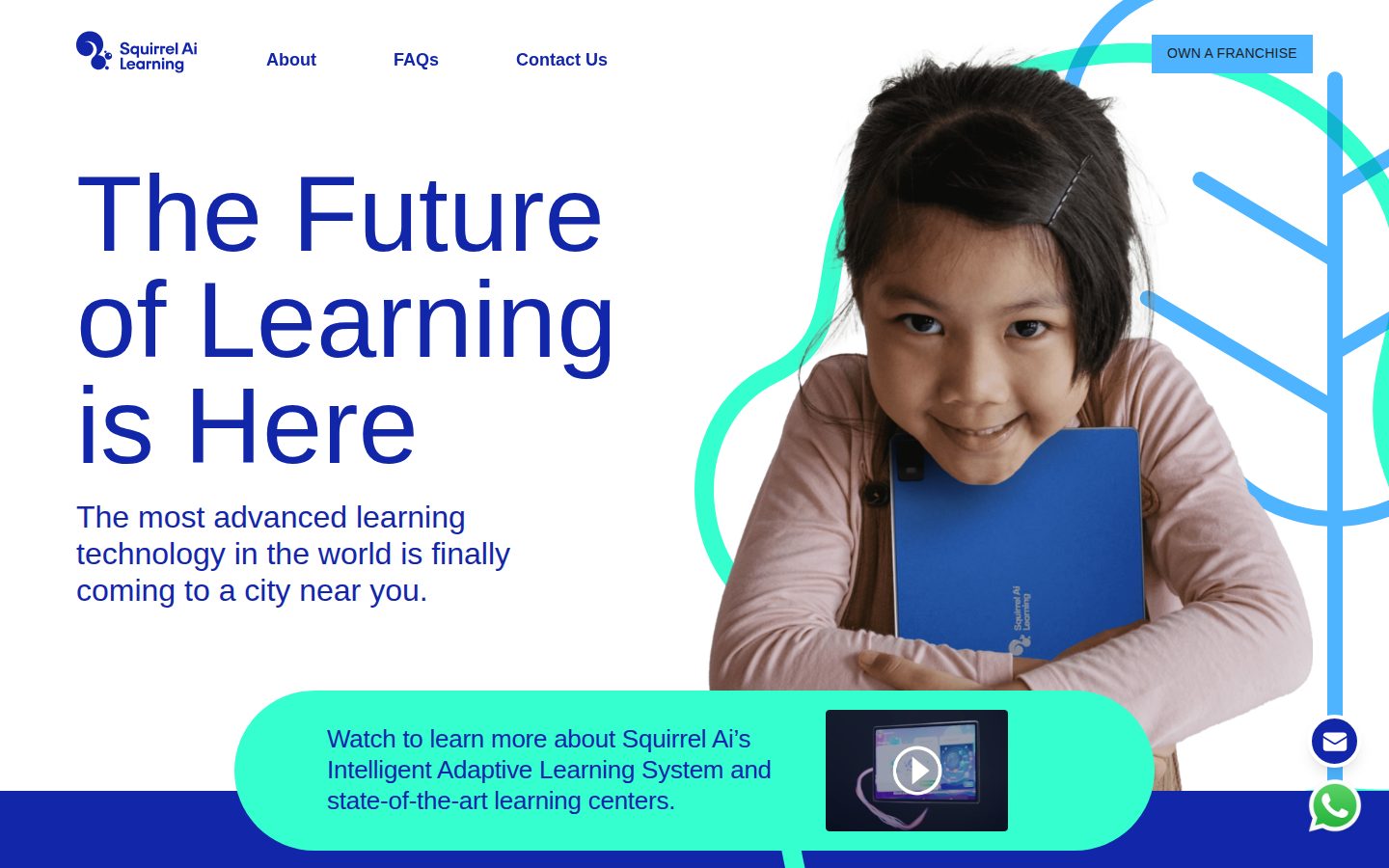
Students use the Squirrel Ai Learning Tablet to work through diagnostic assessments that identify specific gaps in their math knowledge. Based on these results, the system's adaptive algorithm builds a personalized sequence of lessons targeting the concepts each student needs to master, rather than following a fixed curriculum. This happens within physical learning centers, where staff provide in-person supervision alongside the AI-driven instruction.

The platform's core differentiator is what the company calls Level 5 adaptive learning technology, which continuously reassesses student mastery and adjusts the learning path in response. The system generates learning data and progress tracking that is shared with parents, teachers, and center staff, giving multiple stakeholders visibility into a student's advancement. The product currently covers PreK-5 math content in the U.S. market, run through a hybrid model that pairs the smart tablet with offline learning centers rather than operating purely online.

Squirrel Ai targets franchise investors, tutoring center owners, private school managers, and education entrepreneurs looking to open or operate learning centers, as well as parents seeking supplementary math instruction for their children. Franchisees get access to the proprietary technology, curriculum, training, and marketing support needed to run a center. In the AI tutoring and personalized learning category, it competes with providers such as Carnegie Learning, DreamBox Learning, and IXL, though Squirrel Ai's model is distinguished by its combination of proprietary hardware and required physical center locations rather than a purely software-based or direct-to-consumer approach.

Pricing is not published on the website and requires direct inquiry, consistent with its franchise and B2B2C sales model for center operators. The product is delivered through a dedicated hardware tablet plus supporting web-based tools for account management and progress tracking, rather than through a general-purpose app across multiple consumer platforms.

Features

AI

  • Emotion Recognition

    The model possesses sophisticated emotion recognition capabilities that detect and respond to students' emotional states during learning.

  • Large Adaptive Model (LAM)

    A proprietary all-discipline large adaptive model combining education-specific AI systems that power personalized tutoring across subjects.

  • Multimodal AI Interaction

    The enhanced Large Multimodal Model accommodates both text and voice input and manages over 100 interactive dialogue scenarios.

  • Real-Time Personalized Learning Paths

    Learning roadmaps are initially based on a diagnostic assessment and continuously adjusted in real time according to student performance.

Analytics

  • AI-Powered Fault/Draft Analysis

    Integrates intelligent capabilities for analyzing the nuances of draft papers to provide detailed assessments of student mistakes.

  • Dynamic Knowledge Graphs

    Dissects complex subjects into fine-grained knowledge points and dynamically constructs knowledge graphs to diagnose educational gaps.

  • Micro Knowledge Point Diagnosis

    Breaks subjects down into thousands of granular micro-lessons refined from core knowledge points to pinpoint precise conceptual gaps.

Automation

  • Autonomous L5 Adaptive Learning

    An L5 adaptive learning system that operates independently of human intervention, with AI managing the entire learning process and evolving autonomously.

Collaboration

  • Human Teacher Collaboration

    Combines the adaptive AI platform with experienced teachers who provide personalized instruction alongside the technology.

Core

  • Intelligent Adaptive Learning System (IALS)

    The core adaptive learning engine that tailors each student's lesson plan and testing based on individual performance.

Mobile

  • Smart Learning Tablets

    The Squirrel Ai engine works in conjunction with smart learning tablets to deliver a personalized learning experience to students.

Support

  • Physical Learning Centers

    Operates its own network of over 3,000 physical learning centers worldwide where AI personalization is paired with in-person teacher instruction.

Preview

Squirrel AI desktop previewSquirrel AI mobile preview

Pricing Plans

Contact Sales

Contact sales

Squirrel AI does not publish list pricing on its website. It sells its adaptive learning/AI tutoring platform to schools, districts, and institutional partners through a sales-led model, so pricing (e.g., per-student or per-site licensing) requires contacting the vendor directly for a quote.

  • Adaptive AI-powered learning engine
  • Personalized tutoring paths for K-12 subjects
  • Learning analytics and reporting for institutions
  • Custom deployment for schools/districts

AI Panel Reviews

The Decision Maker

The Decision Maker

Strategic bet, vendor viability, timing, adoption approval
6.4/10

3,000 learning centers and real AI, but this is a franchise bet, not a software purchase.

Squirrel AI is a hardware-plus-real-estate business wearing an AI wrapper. Impressive scale claims, zero pricing transparency, and a franchise model that isn't a fit for most buyers.

24 million students, 10 billion learning behaviors, question accuracy up to 93%. Those numbers, if real, beat most of what Carnegie Learning or DreamBox publish. That's the pitch.

But this isn't a SaaS decision. It's a franchise or center-licensing decision, with no published pricing and a proprietary tablet you're locked into. Two questions: who's actually buying, a franchisee or a school district? The site suggests both, which muddies the pitch.

No funding data, no team size, no time-in-market beyond '3,000 centers worldwide,' which cuts both ways — either they're durable or overextended. IXL and DreamBox let you pilot with a browser tab and a credit card. Squirrel AI asks you to open a physical location first.

Competitive Positioning6.8

LAM's 2024 launch and 93% accuracy claim outpace IXL and DreamBox on paper, but unproven independently.

Reputation Risk6.0

AI-tutoring is board-friendly, but 'emotion recognition' claims on K-12 kids will draw scrutiny.

Speed to Value5.0

No free trial, no published pricing, and center buildout means months before first student sees a lesson.

Strategic Fit5.5

Franchise/hardware model is a real estate and staffing commitment, not a software rollout.

Vendor Viability6.5

3,000 centers worldwide signals scale, but no public funding or team data to verify runway.

Pros

  • Deep diagnostic engine breaking math into micro knowledge points
  • Hybrid model pairs AI with human teacher oversight
  • Scale evidence: 3,000+ centers, 24M student dataset

Cons

  • No published pricing, franchise-style sales process only
  • Requires proprietary tablet and physical center, not a pure software swap
  • No funding or team transparency to judge 3-year survival

Right for

Education entrepreneurs and franchise investors ready to open a physical tutoring center.

Avoid if

You want a software-only pilot you can cancel next quarter.

The Domain Strategist

The Domain Strategist

Craft and strategy in the product's domain — adapts identity per category, same lens
6.9/10

Deep diagnostic engine, but the franchise-and-hardware model is a three-year org-design commitment, not a curriculum purchase.

Squirrel Ai's nano-level knowledge graphing is genuinely differentiated instruction design. The delivery model — proprietary tablet plus mandatory physical centers — is the real strategic question for a learning leader.

The IALS diagnostic and micro knowledge point breakdown are legitimate instructional science — 24 million students and 10 billion learning behaviors feeding the LAM, with reported question-accuracy gains from 78% to 93%, is a real data moat versus Carnegie Learning or IXL's more static content trees. That's craft depth most K-12 programs can't match internally.

But the delivery shape doesn't match how most learning leaders operate. Requiring 3,000+ physical centers and a proprietary tablet is a facilities and franchise commitment, not a software rollout — you're buying into their real estate model, not just their AI.

Over three years that's a lock-in on hardware, staffing, and location, with no published pricing to model total cost of ownership. If your org wants pure software integration into existing LMS and staffing, this isn't shaped for you; if you're building or buying a center network, the instructional engine underneath is worth the diligence call.

Category Positioning7.5

Sits apart from software-only players like DreamBox and IXL by pairing AI with in-person centers, a hybrid model competitors don't replicate.

Domain Fit6.0

Built for franchise operators and center staff, not for learning leaders trying to integrate adaptive tools into an existing school or district stack.

Integration Surface5.5

Web-based tools exist for tracking, but the core delivery requires dedicated hardware and center infrastructure rather than plugging into an LMS.

Long-term Implications6.5

Mandatory proprietary tablets and physical centers create durable facilities and staffing lock-in with no published pricing to plan against.

Strategic Depth8.0

Nano-level knowledge graphs and a LAM trained on 10 billion learning behaviors show genuine instructional-design sophistication beyond current category norm.

Pros

  • Nano-level diagnostic engine (IALS) with strong reported accuracy gains
  • Human teacher collaboration layered onto AI, not replacing it
  • 24/7 parent access to progress analytics

Cons

  • No published pricing — sales-led inquiry only, hard to model TCO
  • Requires proprietary tablet and physical center, not a pure software integration
  • PreK-5 math only in current U.S. offering, narrow scope for a K-12 mandate

Right for

Education entrepreneurs or franchise investors ready to operate physical learning centers alongside proprietary hardware.

Avoid if

Avoid if you need a software-only adaptive math tool that integrates directly into an existing school LMS and staffing model.

The Finance Lead

The Finance Lead

Money, total cost of ownership, contracts, procurement math
3.8/10

No price on the page. No trial. Hardware plus franchise fees stacked on top of tuition.

Zero published pricing. Franchise model means capex before you see a single lesson.

No pricing page. No tiers. Contact sales is the only option — for parents and franchisees alike. That's a red flag, not a category norm; competitors like IXL and DreamBox publish per-student rates.

TCO math is unknowable from public materials. Tablet hardware cost, center lease, staffing, franchise fees — none disclosed. A franchisee at 3,000 centers worldwide implies real unit economics somewhere. None surfaced here.

No free trial. No monthly option visible. This is a sales-led, likely annual-contract business wrapped around physical real estate. Auto-renewal terms unknown. Termination clauses unknown. For a parent comparing to a $20/month IXL subscription, the ask-for-a-quote model alone kills easy comparison shopping.

Billing & Procurement3.0

Sales-led inquiry only; no invoicing model or payment terms published.

Contract Flexibility3.5

Franchise and B2B2C sales model implies multi-year terms; no cancellation terms disclosed.

Pricing Transparency1.5

No published pricing anywhere; contact-sales only, per the pricing plan listed.

ROI Clarity5.0

One hard metric exists — accuracy improved 78% to 93% — but no cost-per-outcome data.

Total Cost of Ownership3.0

Proprietary tablet plus center overhead plus franchise fees, none quantified.

Pros

  • Diagnostic engine (IALS) breaks knowledge into nano-level points — real granularity
  • LAM trained on 24 million students, 10 billion learning behaviors — meaningful data scale
  • 24/7 parent progress access included

Cons

  • No pricing published anywhere, even a starting range
  • No free trial to test before committing capital
  • Requires physical center and hardware, unlike IXL or DreamBox's pure software model

Right for

Franchise investors and tutoring center operators willing to underwrite hardware and real estate costs before seeing a contract.

Avoid if

You're a parent or district that wants transparent per-student pricing without a sales call.

The Domain Practitioner

The Domain Practitioner

Daily hands-on reality in the product's domain — adapts identity per category, same lens
6.9/10

The diagnostics are genuinely sharp. Running a center on top of them is the real job.

Squirrel Ai's IALS and nano-level knowledge point diagnosis are legitimately deep tech for pinpointing gaps. But this isn't a login-and-teach product — it's a franchise operation with hardware, staffing, and a physical center attached.

As a trainer walking staff onto this platform, the diagnostic engine is the easy part to sell. Micro Knowledge Point Diagnosis and the LAM model (78% to 93% accuracy gains, per their own claim, off 24 million students) give center staff real data to work from instead of guessing where a kid is stuck. That's a strong pitch for onboarding day one.

Day three looks different. Staff aren't just reading a dashboard — they're running a hybrid model where the tablet drives the lesson and a human has to know when to step in. No public docs, no changelog, no pricing page. Training materials come through the franchise onboarding, not a public help center, so what you get depends entirely on your rep.

Compare that to IXL or DreamBox, which are software you train teachers on in an afternoon. Squirrel Ai asks you to train staff on a center operation. More powerful diagnostics, heavier onboarding lift.

Day-3 Reality6.5

Strong diagnostics but daily use depends on center staff correctly reading AI output alongside their own judgment.

Documentation Practitioner-Fit5.5

No public docs or blog; what I could find is marketing pages, not practitioner-facing materials.

Friction Surface6.5

No published pricing, docs, or self-serve trial means every operational question routes through sales contact.

Power-User Depth7.8

Nano-level knowledge graphs and LAM's 100+ dialogue scenarios show real depth for advanced diagnostic use.

Workflow Integration6.0

Requires adopting a full physical-center operating model, not integrating into an existing classroom workflow.

Pros

  • Micro Knowledge Point Diagnosis gives granular, specific gap data beyond typical adaptive placement tests
  • LAM trained on 24 million students gives it a data scale most rivals can't match
  • 24/7 parent access to analytics keeps stakeholders looped in without staff manually reporting

Cons

  • No public pricing, docs, or trial — every evaluation step requires a sales call
  • Requires operating or partnering with a physical learning center, not a pure software rollout
  • Hybrid human-plus-AI model means staff training burden is heavier than a pure SaaS competitor like IXL

Right for

Franchise investors or tutoring center owners ready to run a physical location alongside the AI system.

Avoid if

You want a straightforward software subscription a teacher can adopt without staffing a center.

The Power User

The Power User

Daily human experience, onboarding, polish, learning curve, reliability
6.2/10

Impressive AI under the hood, but you're buying a franchise, not an app.

The tech story is genuinely deep, nano-level knowledge graphs and a model trained on 24 million students. But this isn't something you sign up for and use tonight, it's a physical center you have to visit or open.

Let's separate the two products here, because Squirrel Ai is actually two things. There's the AI engine, Level 5 adaptive learning, LAM trained on 10 billion learning behaviors, pushing question accuracy from 78% to 93%. That's a real number and it's a good one. Then there's the delivery model: 3,000 physical centers, a proprietary tablet, staff supervision. No pricing on the site, no free trial, contact-sales only.

Day one for a parent means finding a center, not downloading an app. That's homework before the homework starts. Compare that to IXL or DreamBox, where you're testing math problems in your browser in five minutes. Squirrel's hybrid model might genuinely help kids who need in-person accountability, but it's friction for anyone who just wants to try it.

The tablet-at-home option is a nice release valve, and 24/7 parent analytics is a real feature. Still, this reads as B2B2C infrastructure dressed as a consumer product.

Daily Polish6.0

No pricing page, no docs, no changelog listed, suggesting the public-facing product experience isn't the focus of the org.

Learning Curve7.0

Micro Knowledge Point Diagnosis and dynamic knowledge graphs suggest the system adapts well over months, per the feature list.

Mobile Parity5.5

Delivered via a proprietary tablet rather than a standard app across platforms; home use is supported but hardware-locked.

Onboarding Experience4.5

Requires locating and enrolling at a physical center rather than a self-serve signup, a real barrier vs. IXL or DreamBox.

Reliability Feel6.5

Data scale claims (24 million students, 10 billion learning behaviors) suggest a mature backend, though unverifiable from public materials.

Pros

  • Level 5 adaptive engine with nano-level knowledge point diagnosis
  • Reported accuracy jump from 78% to 93% via the LAM model launched 2024
  • 24/7 parent analytics access
  • Human teacher oversight paired with AI, unlike pure-software competitors

Cons

  • No published pricing, no free trial, contact-sales only
  • Requires enrollment at one of 3,000 physical centers, not self-serve
  • Currently covers only PreK-5 math
  • Proprietary tablet locks you into their hardware ecosystem

Right for

Franchise investors or parents near a center who want in-person supervision paired with adaptive AI math instruction.

Avoid if

You want a purely online, try-it-tonight tool like IXL or DreamBox without hardware or center commitments.

The Skeptic

The Skeptic

Contrarian. Watch-outs, deal-breakers, broken promises, category patterns
6.2/10

3,000 centers, zero published prices, one word — franchise.

Squirrel Ai is a hardware-plus-real-estate bet dressed up as an AI product. The tech claims are big, the business model is the actual risk.

"Emotion recognition" and "Level 5 autonomous learning" — that's the kind of superlative that ages poorly once a district asks for a validation study. LAM's jump from 78% to 93% accuracy is a real number, good on them for publishing it. But it's their number, unverified, from a proprietary model nobody outside the company can audit.

The bigger tell is the business shape. This isn't software you subscribe to — it's a franchise, competing for center-owner capital as much as student outcomes. No pricing page, sales-led, "contact us." Compare that to IXL or DreamBox, both browser-based, both switchable. Squirrel Ai locks you into a tablet and a physical lease.

Exit portability is bad almost by design. If a center closes, the learning data and hardware don't travel. 3,000 centers worldwide is a real footprint — that's the strongest signal here. Whether that holds up under a Carnegie Learning-style edtech contraction is the open question.

Competitive Differentiation6.5

Hybrid hardware-plus-center model is genuinely distinct from software-only IXL and Carnegie Learning.

Exit Portability4.5

Proprietary tablet and center-based delivery make switching to IXL or DreamBox a full re-platform, not an export.

Long-term Viability6.8

24 million student dataset and January 2024 LAM launch suggest active investment, but no funding or leadership data is public.

Marketing Honesty5.5

"Emotion recognition" and "autonomous L5" claims are aspirational; the 78%→93% accuracy stat is at least specific.

Track Record Match6.0

3,000 centers is real scale, but hardware-plus-franchise edtech has a mixed history globally.

Pros

  • 3,000+ physical centers signal real operational scale
  • LAM claims a specific, sizable training dataset (24M students, 10B behaviors)
  • Home-plus-center flexibility via the tablet

Cons

  • No published pricing anywhere, franchise-style sales friction
  • Proprietary hardware locks in switching costs
  • AI claims (emotion recognition, autonomy) are unverifiable from outside

Right for

Franchise investors or tutoring center operators comfortable with a B2B2C hardware commitment.

Avoid if

You want a software-only, month-to-month tool you can drop without losing a physical lease.

Buyer Questions

Common questions answered by our AI research team

Features

How does Squirrel Ai diagnose knowledge gaps?

Squirrel Ai starts with an initial diagnostic test that feeds its Intelligent Adaptive Learning System (IALS), which breaks knowledge into nano-level points to pinpoint exactly what a student doesn't understand.

Setup

Can my child use the tablet at home?

Yes. The smart-learning tablets let students continue their personalized learning journey at home or at one of the physical learning centers, offering flexibility and consistency.

Features

What is the Large Adaptive Model (LAM)?

LAM is Squirrel Ai's flagship adaptive intelligence technology launched in January 2024, using multimodal agents and data from over 24 million students and 10 billion learning behaviors to improve question accuracy from 78% to 93% and optimize learning pathways.

Features

Can parents track progress remotely?

Yes. Parents get 24/7 access to detailed learning analytics, staying informed about their child's progress and educational journey at any time.

Setup

Do lessons happen only at physical centers?

No. While core teaching and diagnostics happen at physical learning centers with in-person supervision, students can also continue their personalized lessons at home using the smart-learning tablet.

Also in AI Education & Training