Stylitics logo

Stylitics Review

Visit

AI outfitting platform for retail merchandising at scale

Stylitics is an AI-powered visual merchandising platform for retail ecommerce teams that need automated outfit and product bundling.

AI Panel Score

7.1/10

6 AI reviews

Reviewed

AI Editor Approved

What is Stylitics?

Stylitics is an AI-powered visual merchandising platform that generates complete, shoppable outfits around any product for retail ecommerce teams. Its AI is trained on trend data, inventory rules, and brand styling logic, and merchandisers retain control to review, adjust, or override generated outfits without writing code. Styling modules deploy across product detail pages, product listing pages, email campaigns, and paid channels without requiring engineering support. Pricing is quote-based, with no free plan or trial. Key capabilities include cross-category bundling, Shop the Model experiences, one-to-one shopping personalization, visual discovery, data enrichment with automated catalog tagging, triggered email modules, hotspots, and inventory-aware styling logic that keeps recommendations aligned with stock. Built-in testing and analytics measure how outfitting experiences perform across channels. The platform fits retail merchandising teams that want automated outfitting and product bundling at scale while keeping human oversight over brand presentation.

About Stylitics

Retailers connect their product catalog to Stylitics via feed or API, after which the platform auto-generates outfits and product bundles based on brand guardrails, visual cohesion, and real-time inventory availability. Styled modules—including Shop the Look, Shop the Model, How to Style It, and campaign galleries—are published directly to product detail pages, product listing pages, homepages, triggered emails, and ad creatives. Merchandisers can preview and adjust AI-generated outfits, apply business rules, boost specific products, or exclude items through a no-code interface.

The platform includes several distinct product modules beyond basic outfit generation: Hotspots turn lifestyle photography into shoppable moments; 1:1 Shopping Personalization surfaces individual outfit suggestions based on session behavior without third-party cookies; and a Data Enrichment layer tags catalog products with AI-generated attributes such as occasion, trend cluster, and season. These enriched attributes can feed downstream channels including Google Merchant Center, retail media networks, and social commerce feeds. Inventory-aware logic prevents out-of-stock pairings and can prioritize margin movers in real time.

Stylitics targets mid-market to enterprise fashion and apparel retailers operating across multiple categories, regions, and storefronts. Named case study clients include Rhone, JD Sports, PUMA, and Suzanne's. The platform integrates with Shopify, Salesforce Commerce Cloud, and Adobe Commerce. Pricing is not publicly listed and requires direct contact; there is no publicly available free plan or trial. A named competitor in the category is FindMine, which Stylitics distinguishes itself from by offering merchandiser-editable outputs rather than a fully automated black-box model.

Stylitics is a web-based SaaS platform. Onboarding is described as requiring minimal development time, with integrations managed through standard commerce platform connectors and API or feed-based catalog sync.

Features

AI

  • 1:1 Shopping Personalization

    Serves individual shoppers personalized outfit suggestions based on behavior, session data, and preferences without relying on third-party cookies.

  • AI Outfitting

    Auto-generates complete, shoppable outfits around any product using AI trained on trend data, inventory rules, and brand styling logic for deployment on PDPs and PLPs.

  • Data Enrichment & Catalog Tagging

    Auto-tags products with AI-generated attributes such as trend, occasion, season, and style cluster to improve search, filtering, and multi-channel distribution including Google Merchant Center.

  • Inventory-Aware Styling Logic

    Automatically excludes out-of-stock products from outfit pairings and surfaces margin-priority items in real time based on live inventory data.

Analytics

  • Built-In Testing & Analytics

    Provides performance testing and analytics tools so merchandisers can monitor outfit module results and adapt styling decisions based on conversion and engagement signals.

Automation

  • Cross-Category Bundling

    Automatically recommends curated sets of complementary products across categories (e.g., top + bottom + shoes) to increase UPT and AOV without manual merchandising.

  • Triggered Email Modules

    Inserts real-time styled outfit bundles into cart abandonment, post-purchase, and new arrival email campaigns without engineering support.

Core

  • Hotspots

    Adds interactive shoppable elements directly onto lifestyle images, turning static editorial content into clickable outfit moments on PDPs or campaign pages.

  • Shop the Model

    Enables shoppers to replicate influencer or model outfits from PDPs, editorials, or social posts with a single click.

  • Visual Discovery Experiences

    Delivers interactive lookbooks, campaign carousels, hotspot-enabled lifestyle imagery, and gift guides to drive shopper inspiration and engagement.

Customization

  • Merchandiser Override & Control

    Allows merchandisers to review, adjust, boost, or exclude AI-generated outfits and apply custom business rules at any time without writing code.

Integration

  • No-Code Experience Deployment

    Publishes styling modules to PDPs, PLPs, homepages, email, and paid channels without requiring engineering support, with connectors for Shopify, Salesforce, and Adobe Commerce.

Preview

Stylitics desktop previewStylitics mobile preview

Pricing Plans

Contact Sales

Contact sales

Custom pricing based on catalog size, channels, and business goals. No public list prices are available — all plans are scoped individually.

  • Usage-based pricing that scales with catalog and activations
  • Low-lift deployment (most customers go live in under 2 weeks)
  • AI Outfitting & Bundling (Shop the Look, Styled for You, Complete the Look, Shop Similar)
  • AI Image Studio (Flat Lay to Model, Background & Scene Swaps, AI Colorway Swaps)
  • Catalog Enrichment and On-Site Search
  • Proven ROI with double-digit lifts in visibility, clicks, and conversions

AI Panel Reviews

The Decision Maker

The Decision Maker

Strategic bet, vendor viability, timing, adoption approval
7.6/10

Real client roster, real go-live speed, but pricing opacity means the board asks questions you can't answer fast.

PUMA, JD Sports, Rhone on the client list. That's not a startup guessing at product-market fit.

45 days from contract to production. Under 2 hours a month of client time for the managed imagery service. Those numbers matter more to me than the feature list, because they tell you this vendor has done this integration enough times to know its own timeline.

Two things stand out. One: merchandiser override, no-code, so this doesn't become a black box your team resents — a direct jab at FindMine's fully-automated model, and a fair one. Two: usage-based pricing that scales with catalog size means your cost grows exactly when your value does, which is defensible math for a board.

The gap is pricing transparency. No public tiers, no trial, quote-based only — fine for enterprise motion, annoying for a fast pilot decision. PUMA and JD Sports as references de-risk this considerably.

Competitive Positioning7.0

Differentiates from named competitor FindMine via editable outputs, but category adoption signal is thin beyond a handful of named logos.

Reputation Risk7.5

Adopting a platform with PUMA and JD Sports as references reads as smart, not experimental, to peer retailers.

Speed to Value8.5

45-day contract-to-production cited, with pricing page claiming under 2 weeks for most customers — fast for enterprise commerce tooling.

Strategic Fit8.0

Data Enrichment and 1:1 Personalization push beyond cost savings into new revenue mechanics, not just automating existing merchandising work.

Vendor Viability7.5

Named enterprise clients (PUMA, JD Sports, Rhone) and category-specific focus suggest real traction; no public funding data available.

Pros

  • Named enterprise clients (PUMA, JD Sports, Rhone) validate mid-market to enterprise fit
  • 45-day go-live and under-2-hour monthly maintenance lowers operational drag
  • Merchandiser override avoids the black-box trap competitors like FindMine lean into

Cons

  • No public pricing or trial makes early-stage evaluation slow
  • Usage-based pricing tied to catalog size could scale cost unpredictably
  • No funding or team-size data available to judge 3-year durability

Right for

Mid-market to enterprise apparel retailers on Shopify, Salesforce, or Adobe Commerce wanting merchandiser-controlled AI outfitting.

Avoid if

Skip if you need transparent self-serve pricing before committing sales cycles to evaluation.

The Domain Strategist

The Domain Strategist

Craft and strategy in the product's domain — adapts identity per category, same lens
7.9/10

Merchandiser-controlled outfitting that plugs into Shopify and SFCC without a dev sprint, if you can stomach quote-based pricing.

Stylitics gives merchandising teams AOV and UPT levers without engineering dependency. The tradeoff is opaque, usage-based pricing you can't benchmark before a sales call.

45 days from contract to production, under 2 weeks for most go-lives. For a merchandising org used to waiting on the dev backlog for every PDP change, that timeline is the pitch. No-code override on AI-generated outfits matters more than the AI itself here — I need to boost margin movers and kill bad pairings myself, not file a ticket.

The module breadth (Shop the Look, Hotspots, 1:1 Personalization, triggered email bundling) covers PDP through post-purchase, which is rare as a single vendor footprint. Cross-category bundling and inventory-aware logic directly hit UPT and AOV, the two levers I'm actually measured on.

Against FindMine's black-box automation, Stylitics' editable-output model is the safer three-year bet for teams with real merchandising headcount. But usage-based, catalog-scaled pricing with zero public floor makes budgeting a negotiation every renewal, not a line item.

Category Positioning7.8

Positions against FindMine with editable outputs rather than full automation, a real differentiator for enterprise apparel retailers.

Domain Fit8.3

No-code merchandiser override and business rule controls match how apparel merchandising teams actually operate day to day.

Integration Surface8.0

Native connectors for Shopify, Salesforce Commerce Cloud, and Adobe Commerce plus feed to Google Merchant Center cover the core commerce stack.

Long-term Implications7.5

Usage-based pricing scaling with catalog and activations creates renegotiation risk as catalog and channel count grow over 3 years.

Strategic Depth8.0

AI Image Studio, Data Enrichment, and inventory-aware logic go past basic outfit generation into catalog-wide merchandising intelligence.

Pros

  • Merchandiser override on every AI-generated outfit without code
  • Broad deployment surface: PDP, PLP, email, ad creative, checkout
  • 45-day implementation cited, under 2 weeks typical
  • Case studies with named apparel retailers like PUMA and JD Sports

Cons

  • No public pricing, usage-based model scales with catalog size
  • No free trial to validate outfit quality against your own catalog before committing
  • Requires clean, tagged catalog data to get value from Data Enrichment

Right for

Mid-market to enterprise apparel retailers with dedicated merchandising teams running Shopify, SFCC, or Adobe Commerce.

Avoid if

Avoid if your team needs transparent list pricing before engaging sales or lacks headcount to actively manage outfit overrides.

The Finance Lead

The Finance Lead

Money, total cost of ownership, contracts, procurement math
5.8/10

Zero public prices. Usage-based fees on top. Procurement will not enjoy this one.

No pricing page numbers, just 'contact sales.' Usage-based scaling means the invoice moves as your catalog grows, and finance can't model that in advance.

No list price. No free plan, no trial. 'Contact Sales' is the only tier shown. Usage-based, scaling with catalog size and activations — that's a variable-cost model, not a fixed one.

Year 1: implementation in 45 days, some go live under 2 weeks. Fine. Year 3 is the problem — catalog grows, activations grow, and the bill grows with them. No published overage rate, no per-SKU rate, nothing to model against. Compare to FindMine, the named competitor here — also quote-based, so this whole category hides its numbers.

Merchandiser override without code is a real cost saver — less engineering time, less training overhead. But 99.99% uptime SLA and audit logging are enterprise features usually priced at an enterprise premium. Budget owners: get the usage-based formula in writing before signing, not after month one.

Billing & Procurement5.5

45-day implementation and low-lift onboarding claims help, but quote-based billing adds sales-cycle friction.

Contract Flexibility5.0

No terms disclosed publicly; category norm is annual contracts with limited negotiation visibility.

Pricing Transparency2.5

No public tiers or list prices; everything routes through sales.

ROI Clarity6.5

Built-in testing and analytics let merchandisers track conversion lift, though 'double-digit lifts' claim is unverified marketing language.

Total Cost of Ownership4.5

Usage-based fees scaling with catalog and activations make year-3 cost unpredictable.

Pros

  • No-code merchandiser overrides reduce ongoing engineering spend
  • 45-day implementation cited, some customers live in under 2 weeks
  • Built-in analytics allow performance tracking against conversion signals

Cons

  • Zero public pricing — full sales cycle required just to see a number
  • Usage-based fees scale with catalog size, unpredictable at year 3
  • No free trial to validate ROI before committing budget

Right for

Enterprise apparel retailers with budget to negotiate custom usage-based contracts.

Avoid if

Avoid if you need a fixed, board-approvable number before finance signs off.

The Domain Practitioner

The Domain Practitioner

Daily hands-on reality in the product's domain — adapts identity per category, same lens
7.6/10

Shop the Look modules go live fast, but I'm signing a contract blind on price.

Stylitics automates outfit bundling across PDPs, PLPs, and email without needing my dev team's time. The catalog is real, the merchandiser override is real, but the quote-only pricing means I can't budget for it before a sales call.

Two weeks to launch is what I care about, not the AI trend jargon. Stylitics claims most customers go live in under 2 weeks, with full implementation at 45 days from contract. That's a Monday planning meeting, not a quarter-long IT project. No engineering ticket needed to publish Shop the Look or Complete the Look widgets — that's the daily win for my merchandising team.

The override control matters more than the AI pitch. I can boost margin movers, exclude dead stock, and adjust outfits without waiting on a dev sprint. FindMine's black-box approach doesn't give me that lever, and on the floor, that control is what keeps me from fighting the algorithm during markdown season.

The catch: no published pricing, no free trial, so I can't test-drive this against my actual catalog before committing budget. Usage-based scaling with catalog size sounds fine until renewal time hits.

Day-3 Reality7.8

No-code override lets merchandisers adjust outfits immediately without dev tickets, per the description.

Documentation Practitioner-Fit6.0

No public docs or API reference that I could find — buyer questions fill the gap instead.

Friction Surface6.8

Quote-only pricing and no trial add friction before a manager can even evaluate fit.

Power-User Depth7.5

Data Enrichment and Hotspots extend beyond basic bundling into search and retail media feeds.

Workflow Integration8.0

Connectors for Shopify, Salesforce Commerce Cloud, and Adobe Commerce fit existing storefront stacks.

Pros

  • No-code merchandiser override for boosting or excluding products
  • Fast rollout: under 2 weeks per pricing page, 45 days contract-to-production
  • Inventory-aware logic auto-excludes out-of-stock pairings

Cons

  • No published pricing or free trial to test against my catalog
  • No public docs or API reference for my dev team to vet integration depth
  • Usage-based pricing model makes budgeting uncertain at scale

Right for

Mid-market to enterprise apparel retailers on Shopify, Salesforce, or Adobe Commerce who want outfit merchandising live in weeks, not quarters.

Avoid if

Skip this if you need to see exact pricing or run a free trial before looping in finance.

The Power User

The Power User

Daily human experience, onboarding, polish, learning curve, reliability
7.2/10

Solid merchandising muscle, but I can't tell you what it costs or what it feels like on a phone.

Stylitics is clearly built for the merchandiser, not the shopper's screen size chart. Deep feature set, but a lot of the day-to-day texture is invisible from the outside.

The feature list is real, not vaporware. Shop the Look, Hotspots, inventory-aware pairings that won't stick you with a sold-out shoe next to a jacket. Merchandiser override without code is the right call — nobody wants a black box deciding what pairs with what, which is the exact line Stylitics draws against FindMine. 45 days contract-to-production, sometimes under two weeks, is a believable number for enterprise commerce tooling.

What's missing is anything about the merchandiser's actual daily desk. No mention of mobile app for the internal team, no word on what happens when the AI enrichment tags something wrong at 4pm on launch day. Analytics exist, but I don't know if they load fast or make you wait.

Quote-based pricing with no trial means you're taking a sales deck's word for the day-3 feel. That's fine for JD Sports. Rougher if you're mid-market and want to kick tires first.

Daily Polish6.8

Rich feature set (Hotspots, Shop the Model) but no evidence of the small daily UI details merchandisers would live in.

Learning Curve7.0

No-code override and business rules suggest gentle ramp-up, but no docs or API reference listed to self-serve past the basics.

Mobile Parity5.5

No mobile app or responsive merchandiser-tooling details given, despite claiming 50+ countries and 30+ languages of shopper reach.

Onboarding Experience7.5

45-day contract-to-production and under-2-week go-live claims suggest a managed, guided setup rather than a DIY scramble.

Reliability Feel7.8

99.99% uptime SLA, encryption at rest and in transit, and audit logging are concrete enterprise-grade signals.

Pros

  • No-code merchandiser overrides mean you're not waiting on engineering for every tweak
  • Inventory-aware logic stops the awkward out-of-stock pairing problem
  • Named enterprise clients like PUMA and JD Sports suggest real production use

Cons

  • No public pricing or trial, so you can't test drive before the sales call
  • No visibility into mobile experience for the merchandiser-facing tools
  • Analytics and testing tools are mentioned but not detailed

Right for

Mid-market to enterprise apparel retailers who want AI outfitting without handing full control to a black box.

Avoid if

You're a smaller retailer who needs to see pricing or try before committing to a sales conversation.

The Skeptic

The Skeptic

Contrarian. Watch-outs, deal-breakers, broken promises, category patterns
6.6/10

Named clients, 45-day rollout, zero prices. Contact sales.

Stylitics has real logos and a real integration story. It also has the pricing opacity that always makes me check the exit door first.

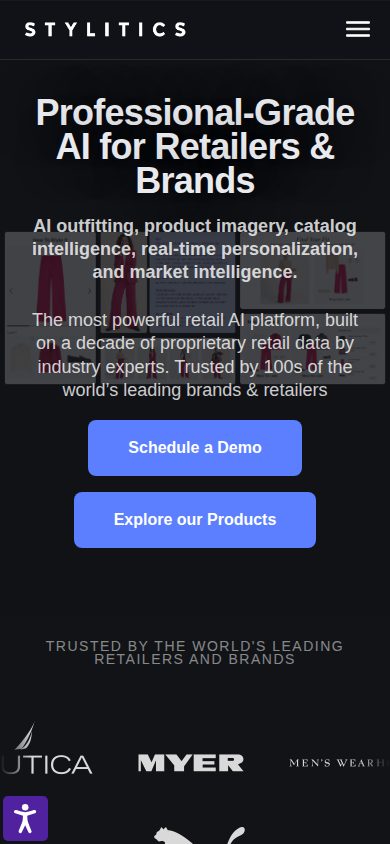
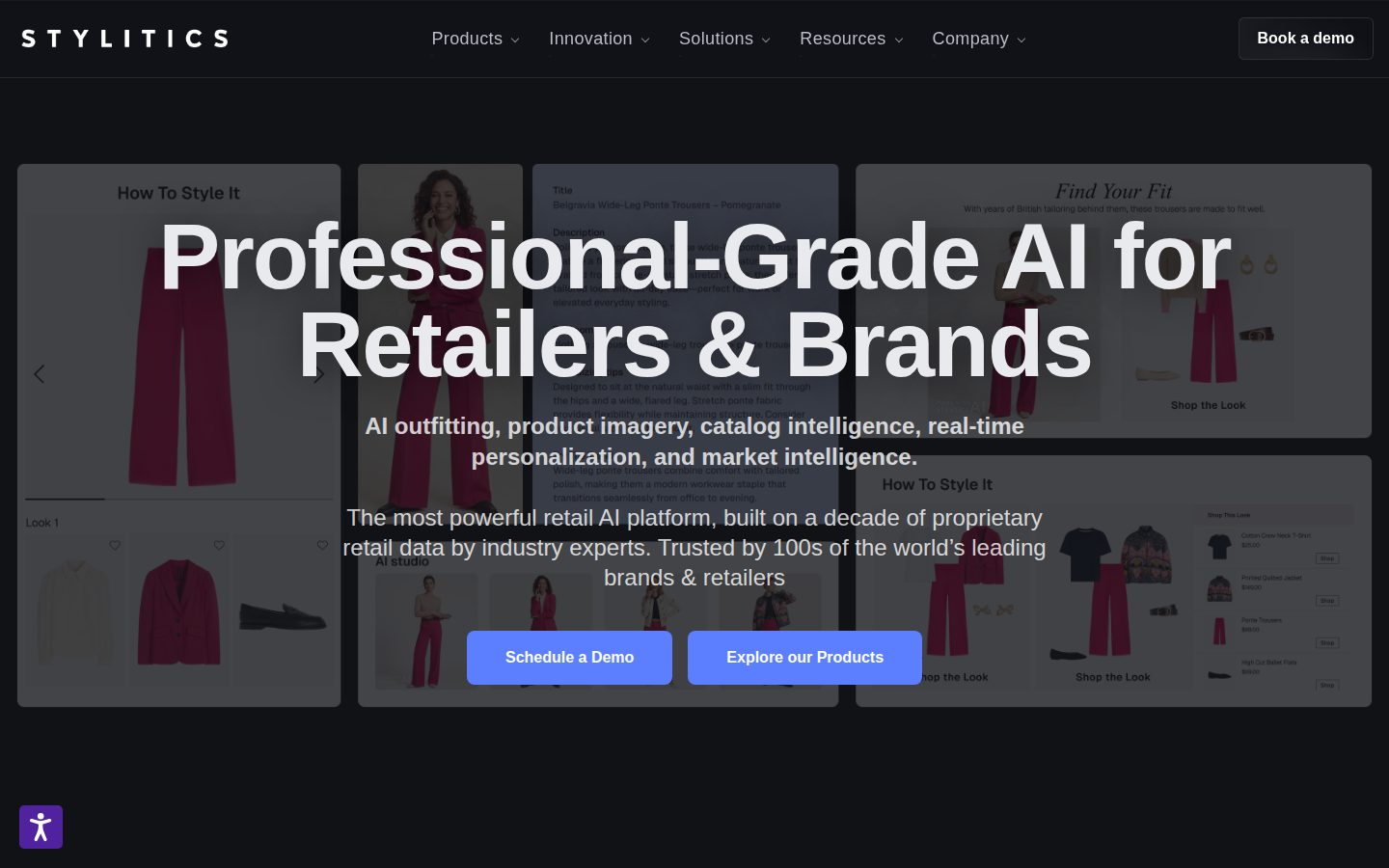
"Professional-Grade AI for Retailers & Brands" is the H1. That's the kind of superlative that ages poorly if churn ever surfaces publicly, and there's no changelog or docs page to check claims against.

What's solid: named case studies (Rhone, JD Sports, PUMA), a 45-day implementation window, 99.99% uptime SLA, connectors for Shopify, Salesforce, Adobe Commerce. That's not vaporware framing. Differentiation against FindMine is specific — merchandiser-editable outputs versus black-box automation — a real distinction, not a slogan.

But pricing is fully custom, usage-based, scaling with catalog size. No floor to compare against. If Stylitics becomes expensive at scale, you won't know until you're already enriched, tagged, and dependent on their catalog intelligence layer. Migrating that attribute data back out, or replicating Hotspots and Shop the Model elsewhere, isn't a feed-swap. It's a rebuild. Fair evidence, real customers, but the exit story is the part they don't put on the pricing page.

Competitive Differentiation7.0

Clear, specific contrast with FindMine on editable-vs-automated outputs, not just a feature-list copycat.

Exit Portability5.5

Data enrichment and tagging layer creates lock-in; no API docs published to assess extraction difficulty.

Long-term Viability6.5

SLA and enterprise security specifics are strong signals; no funding data or changelog cadence visible.

Marketing Honesty6.0

"Professional-Grade AI" and "most powerful" are aspirational; case studies and SLA specifics are grounded.

Track Record Match7.0

Named enterprise clients (PUMA, JD Sports) match successful mid-market SaaS patterns, not vaporware ones.

Pros

  • Named enterprise clients across multiple verticals
  • Specific SLA (99.99% uptime) and security controls listed
  • Clear differentiation from FindMine on merchandiser control

Cons

  • No public pricing at all, even a starting tier
  • No docs or API reference to verify integration claims
  • Catalog enrichment layer likely deepens lock-in over time

Right for

Mid-market to enterprise apparel retailers with dedicated merchandising teams and budget for custom contracts.

Avoid if

Avoid if you need transparent pricing before looping in sales or plan to switch platforms within 18 months.

Buyer Questions

Common questions answered by our AI research team

Pricing

How much does Stylitics cost for retailers?

Stylitics doesn't publish prices; pricing is quote-based via sales and customized to your catalog size, channels, and business goals. It's usage-based, scaling with your catalog and activations.

Features

What outfitting features does Stylitics offer?

Core features include Shop the Look, Styled for You, Complete the Look, and Shop Similar for out-of-stock items. Its AI Image Studio adds Flat Lay to Model conversion and AI Colorway Swaps.

Integration

Where can Stylitics widgets appear on my site?

Stylitics deploys across PDPs, category pages, galleries, checkout, email, and app. The platform operates in 50+ countries and 30+ languages, so global storefronts are supported.

Setup

How long does Stylitics implementation take?

Stylitics cites 45 days from contract to production, and its pricing page says most customers go live in under 2 weeks. Ongoing effort is light: the managed imagery service needs less than 2 hours of client time per month.

Security

Is Stylitics secure for enterprise retail data?

Stylitics provides encryption in transit and at rest, role-based access controls, and audit logging, backed by a 99.99% uptime SLA. Individual retailer and brand data is never shared across accounts.

Product Information

  • Company

    Stylitics
  • Founded

    2011
  • Pricing

    Contact for pricing

Platforms

web

About Stylitics

Stylitics is a New York-based AI platform for retailers and brands that generates outfitting recommendations, product imagery, and personalization for e-commerce sites.

Resources

Blog

Also in AI E-commerce

Stylitics Review — AI Panel Score 7.1/10 | TopReviewed.ai