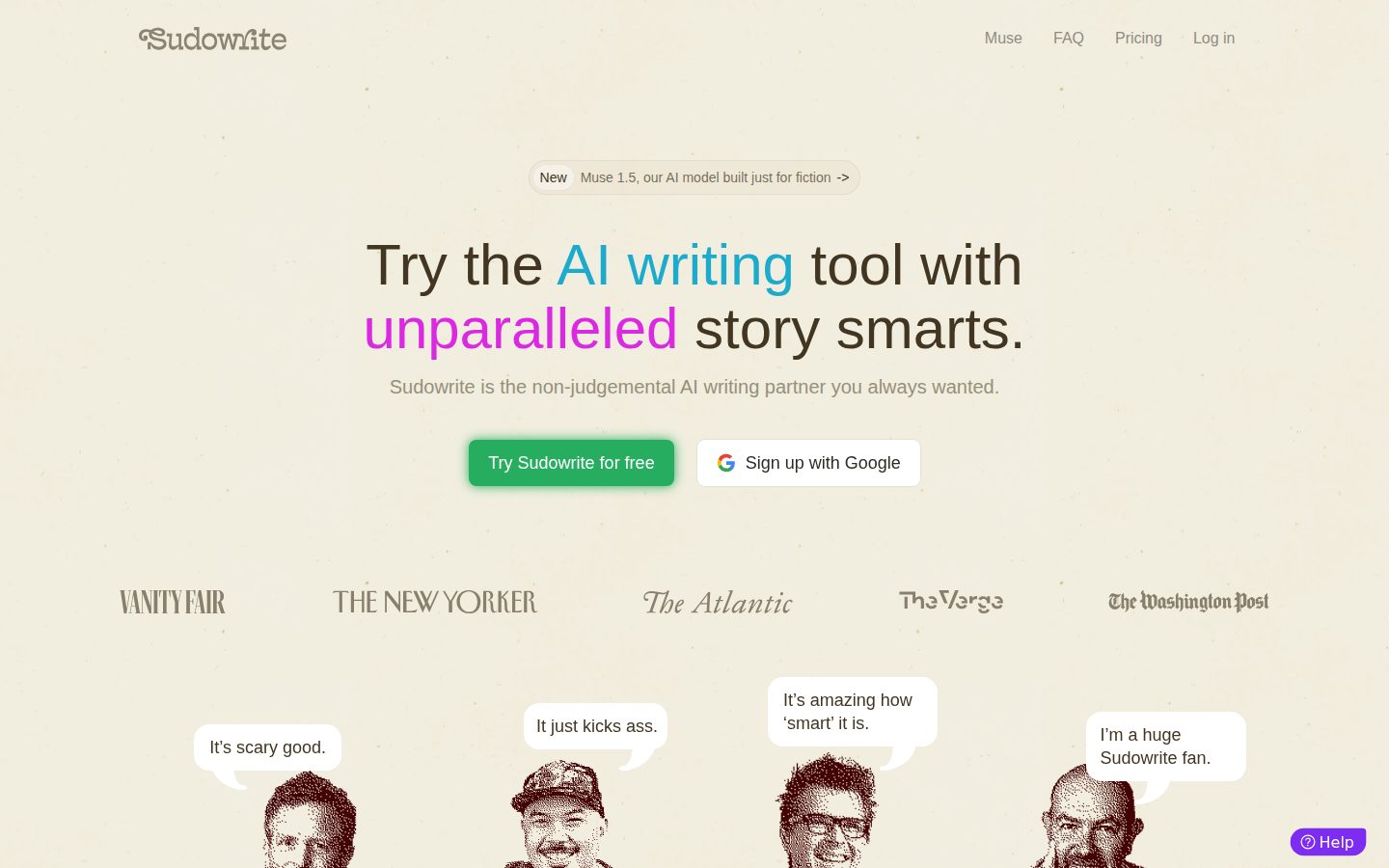
AI writing platform built specifically for fiction authors
Sudowrite is an AI-assisted writing platform for fiction authors working on novels, short stories, and serialized content.
AI Panel Score
6 AI reviews
Reviewed
AI Editor ApprovedApproved and published by our AI Editor-in-Chief after full panel analysis.Writers work inside a web-based editor where they can draft scenes chapter by chapter using the First Draft tool, continue prose with Write, revise passages with Rewrite, generate sensory detail with Describe, and expand thin scenes with Expand. A Canvas feature provides a visual whiteboard for story planning, while Braindump lets writers paste raw notes and have the AI organize them into a structured Story Bible. Chat lets authors query the AI about their own story within the document.
Sudowrite's Story Bible is its central differentiator: it stores character profiles, worldbuilding rules, plot outlines, POV settings, tense, genre, and prose style, then feeds that context to every AI generation to reduce contradictions across chapters. A Saliency Engine tracks story-critical details for consistency, and Chapter Continuity provides cross-chapter memory. The platform supports 1,000+ community-built and official plugins for genre-specific tasks, editing, and feedback, and allows users to switch between AI models including Sudowrite's own Muse, Claude Opus 4.6, GPT-5.4, and Gemini 3.1 Pro.
Sudowrite targets fiction writers of all experience levels — debut novelists through bestselling professionals — and explicitly supports genre fiction, literary fiction, fan fiction, and adult/NSFW content. The platform uses a credit-based subscription model with three paid tiers and a free trial; credits do not roll over on all plans, and additional credits can be purchased. Comparable tools include Jasper, NovelAI, and general-purpose models like ChatGPT, though those are not purpose-built for long-form fiction.
Sudowrite runs on web browsers and has iOS and Android mobile apps. It imports from Scrivener, Microsoft Word, and Google Docs and exports to multiple formats. Enterprise and team pricing is available through a separate concierge option.

Accepts raw, unstructured story ideas as input and automatically organizes them into a structured Story Bible.
Provides AI-powered brainstorming tools for generating plot ideas, character concepts, and story directions.
Generates full chapter drafts scene-by-scene from your outline, serving as Sudowrite's flagship chapter-by-chapter drafting tool.
A proprietary system that automatically tracks story-critical details across the manuscript to prevent inconsistencies.
An AI-powered story memory system that tracks characters, worldbuilding, plot continuity, style, and genre across an entire manuscript to maintain consistency.
A proprietary AI model trained specifically on fiction craft with creativity controls, voice matching, and story continuity, available exclusively in Sudowrite.
A visual story planning tool built on an infinite AI-assisted whiteboard for structuring and mapping narratives.
Generates sensory-rich descriptions for settings, characters, and objects to enhance scene-building.
Lengthens scenes, descriptions, or any passage by elaborating on the selected text with additional detail.
Revises and improves selected prose by offering alternative versions of any highlighted passage.
Continues your story with AI assistance by generating the next passage or section from your existing prose and context.
A library of 1,000+ community-built and official plugins for editing, genre-specific writing, and content feedback that writers can use or build themselves.
Best for casual writers, hobbyists, students, or anyone working on short stories and occasional creative projects. Annual billing drops the effective rate to $10/month.
Best for part-time novelists, screenwriters in production, or writers generating 200–400 words of AI-assisted output daily. Annual billing drops the effective rate to $22/month.
Best for full-time or heavy writers who need maximum output and flexibility. Includes exclusive 12-month credit rollover and a free personal setup session. Annual billing drops the effective rate to $44/month.
Enterprise plan for teams or organizations. Pricing requires contacting Sudowrite sales directly via their pricing page.
Fiction-specific AI at $19/month — NovelAI doesn't have a Story Bible like this.
“Sudowrite isn't a general writing tool wearing a fiction costume. The Story Bible plus Saliency Engine is a real architectural bet on long-form consistency that ChatGPT won't replicate.”
The New Yorker called it 'a salvation.' That's not a blurb you manufacture. At $29/month for 1,000,000 credits, the Professional tier is priced to close. The 1,000+ plugin marketplace and multi-model access — Muse, Claude, GPT — means writers aren't locked into one inference engine, which is smart hedging as the model landscape shifts.
The Story Bible is the real moat. Character continuity across a 90,000-word manuscript is where every general-purpose tool falls apart. The Saliency Engine tracking story-critical details automatically is the kind of unglamorous problem that actually matters to authors finishing novels, not just starting them.
The tradeoff: credits don't roll over on Hobby or Professional plans. A writer who takes a month off loses unused capacity. That pricing structure serves Sudowrite's revenue model, not the writer's workflow. Pilot it for 90 days on the free trial before committing to Max.
NovelAI competes but lacks the Story Bible's cross-chapter memory; ChatGPT has no Saliency Engine equivalent, making Sudowrite the purpose-built leader in long-form fiction AI.
NYT, The Verge, and The New Yorker coverage makes this an easy board conversation; no reputational exposure here.
Braindump-to-Story-Bible pipeline means a writer can go from raw notes to structured outline in a single session — payback is days, not quarters.
If your business involves fiction production — publishing, content studios, serialized platforms — the First Draft and Story Bible tools directly accelerate manuscript output, not just cut costs.
No public funding data, but active changelog, press coverage from NYT and The New Yorker, and a functioning enterprise tier suggest a real operating business — not vaporware.
Fiction publishers, writing studios, or serious novelists who need AI that holds manuscript continuity across chapters.
You need a general content engine — Jasper or ChatGPT costs less and handles non-fiction workflows better.
Sudowrite is the first AI writing platform that thinks like a story editor, not a content mill.
“Sudowrite's Story Bible and Saliency Engine solve the actual long-form fiction problem: manuscript-scale consistency. At $29/month for the Professional tier, it's priced for working writers, not enterprise budgets.”
The Story Bible is doing real editorial architecture work here — tracking POV, tense, prose style, character profiles, and worldbuilding rules, then feeding that context into every generation. That's not a feature, that's a schema. NovelAI and ChatGPT don't have anything close; they're stateless by comparison. The Braindump-to-Story-Bible pipeline suggests someone on this team has actually watched writers work from messy notes, not clean briefs.
The 1,000+ plugin library is either a strength or a signal of fragmentation — probably both. A marketplace that size means genre-specific tools exist, but it also means quality control is the writer's problem. The Muse model with voice matching is the right proprietary bet; if it compounds on fiction-specific training, that's a durable moat against general-purpose models.
Credit expiry on Hobby and Professional plans is a genuine friction point for novelists who write in bursts. A writer who drafts 40,000 words in November and nothing in December loses credits both months. Max at $59/month gets rollover — but that's where the architecture finally matches how fiction writers actually work.
Occupies fiction-specific AI writing almost alone at meaningful scale; The New Yorker and New York Times press coverage signals real practitioner adoption, not just B2B positioning.
First Draft, Expand, Rewrite, and Describe map directly to the revision and drafting stages fiction writers actually cycle through — not generic content workflows.
Scrivener, Word, and Google Docs import is solid coverage, but no API and no docs integration means it stays a standalone writing environment, not a composable one.
Story Bible creates meaningful lock-in after a full manuscript is built inside it; migrating that context to another tool won't be clean.
Story Bible plus Saliency Engine represents manuscript-level editorial architecture that no general-purpose AI tool has replicated.
Fiction writers — debut through professional — who are working on novel-length projects and need manuscript-scale consistency management.
You write short-form content, need API access, or want credits that survive your off months without paying $59/month.
$19/month entry, fiction-specific context engine, no SSO tax found.
“Three tiers, all priced publicly. Credits-don't-roll-over on two of three plans is the clause to watch.”
Hobby at $19/month, Professional at $29, Max at $59. All visible without a sales call. Annual billing cuts Max to $44 — $528/year for a solo novelist. NovelAI starts lower but lacks the Story Bible continuity engine and 1,000+ plugin library. Sudowrite wins on fiction-specific depth; NovelAI wins on price floor.
TCO scenario: 5 writers on Professional. $29 × 5 × 12 = $1,740/year. Year 3 with one upgrade to Max each: $1,800. Enterprise tier requires a sales call — no published rate, which is the only black box in an otherwise transparent structure. Additional credits purchasable; no overage rate published, which is a real budget risk on heavy-output months.
Credit expiry on Hobby and Professional is the friction point. Unused credits vanish monthly. Max gets 12-month rollover — worth the $30 delta for full-time writers. Cancellation listed as self-serve. No termination window published, but the docs indicate month-to-month flexibility on all three tiers.
Solo and SMB billing is straightforward; Enterprise requires concierge contact with zero published rate, adding procurement friction for teams.
Month-to-month cancellation listed as self-serve; no published auto-renewal window or termination-for-convenience clause found.
All three paid tiers published with credit counts, annual discounts, and feature lists — no sales call required.
ROI is writer-output dependent — measurable in words-per-session but no benchmark data published to anchor expectations.
Sticker is clean; unpublished additional-credit overage rates introduce budget uncertainty on high-volume months.
Solo novelists or small writing teams who want fiction-specific AI context at a transparent monthly rate.
Your team needs enterprise invoicing or predictable overage rates without a sales conversation.
The first AI writing tool that actually understands what a novel needs.
“Sudowrite is purpose-built for long-form fiction in ways ChatGPT and Jasper aren't even trying to be. The Story Bible system is the real differentiator — cross-chapter memory that general-purpose models fake and lose by page 40.”
The Story Bible plus Saliency Engine is the thing that makes this worth evaluating seriously. General-purpose models forget your protagonist's eye color three chapters in. Sudowrite's architecture is designed around that exact problem. Braindump accepting raw messy notes and organizing them into a structured Bible? That's someone who's actually watched writers work.
Day three looks like this: you're drafting with First Draft, toggling between Rewrite and Expand to thicken thin scenes, and leaning on Write for momentum when you stall. The credit system is where the daily friction lives — 225,000 credits at $19/month expire with no rollover. Heavy drafting sessions burn through that fast. The $59 Max tier with 12-month rollover is the honest working novelist tier, not the $29 Professional.
The 1,000+ plugin library is wild upside if you find the right ones. NovelAI has nothing comparable. The tradeoff: plugin quality is community-variable, and there's no docs API to build tighter integrations.
Story Bible and Chapter Continuity solve the real long-form problem; credit expiry on lower tiers creates recurring monthly anxiety.
Changelog exists and feature naming (Braindump, Saliency Engine) signals writers wrote the copy, not a marketing team.
Credit-based pricing with no rollover below Max ($59/month) means budget-tracking becomes a writing-session tax.
Model switching between Muse, Claude Opus 4.6, and GPT-5.4 plus 1,000+ plugins gives advanced users real surface area to optimize.
Scrivener, Word, and Google Docs import covers the actual workflows fiction writers already live in.
Genre or literary novelists who draft long-form fiction regularly and need AI that remembers the manuscript.
You write short-form content or need rollover credits without committing to the $59/month Max tier.
Finally, an AI writing tool that actually knows what a story is
“Sudowrite is purpose-built for fiction in a way ChatGPT and Jasper simply aren't. The Story Bible alone justifies the $29/month Professional tier for anyone writing a full novel.”
The feature list here reads like someone actually talked to novelists before building. Story Bible, Saliency Engine, Chapter Continuity — these aren't marketing names for generic AI features. They're solving the real problem: your AI assistant forgetting your protagonist's eye color by chapter eight. That's the gap NovelAI and general-purpose tools leave open. Sudowrite's Muse model trained specifically on fiction craft is a meaningful differentiator, not just a rebrand.
The 1,000+ plugin ecosystem is genuinely impressive for a writing tool. Simulating readers, talking to characters, converting novels to screenplays — that's a community building on top of the product, which tells you something about daily loyalty. The credit system with no rollover on Hobby and Professional plans will annoy writers who have irregular output months. That's a real friction point.
Mobile apps exist, which puts Sudowrite ahead of plenty of desktop-only competitors. But the docs don't suggest mobile parity with the web editor. For a tool used in bursts of inspiration, that matters more than it sounds.
Fiction-specific tools like Describe and Expand show someone thought hard about the actual daily writing workflow, not just generic AI text generation.
Twelve distinct named tools means real discovery depth, but the structured First Draft workflow and Braindump entry point make the first hour manageable.
iOS and Android apps exist per the listing, but the evidence doesn't indicate full feature parity with the web editor's Canvas or plugin ecosystem.
Braindump — paste raw notes, get a structured Story Bible — is an onboarding tool disguised as a feature; the free trial with no credit card lowers the barrier further.
The Saliency Engine and Chapter Continuity suggest architectural care about consistency, but no public uptime data or autosave specifics in the evidence.
Novelists and serious genre fiction writers who need AI that remembers their world across 80,000 words.
You write short-form content or just need a general writing assistant — Jasper or ChatGPT will cost less and fit better.
3 real differentiators, 1 credit trap, no API — fair bet for fiction writers
“Sudowrite isn't NovelAI with a new coat of paint. The Story Bible and Saliency Engine are category-specific bets that general tools like ChatGPT won't replicate. Credits don't roll over on the $19 and $29 tiers — that's the gotcha buried in the pricing.”
Three genuine tells this is purpose-built, not pivoted. One: the Saliency Engine tracking cross-chapter continuity is something Jasper never attempted. Two: 1,000+ plugins with character simulation and screenplay conversion signal real ecosystem depth. Three: New Yorker, NYT mentions aren't paid placements — that's earned coverage.
Two flags. Credits expire monthly at $19 and $29. Writers working in bursts get punished. No API listed in the capabilities — means no custom integrations, no workflow automation. That's a ceiling for power users.
Exit portability is actually decent. Imports from Scrivener and Word, exports to standard formats. If Sudowrite folds, manuscripts survive. What's lost is the Story Bible context — that's proprietary and doesn't travel. Viable 3-year bet for fiction-focused users. Solo or hobbyist writers should start at $19 and upgrade when they hit the credit wall.
Story Bible plus Saliency Engine plus the Muse model trained on fiction craft is a real moat vs. NovelAI and ChatGPT, neither of which offers cross-chapter memory at this specificity.
Scrivener and Word imports plus standard exports mean manuscripts are recoverable, but the Story Bible context is platform-locked with no API to extract it.
Changelog exists, pricing page is live, press coverage is recent — but no public funding data and no API signal a small team without enterprise ambitions, which could go either way.
"Unparalleled story smarts" is the kind of superlative that ages poorly, but the NYT and New Yorker citations are real, and feature descriptions match the actual toolset.
Niche-first AI tools with proprietary models and press coverage have survived; general-purpose pivots like early Jasper-for-fiction attempts didn't — Sudowrite looks more like the former.
Fiction writers — debut through professional — who need cross-chapter consistency tools that ChatGPT won't replicate.
You write in irregular bursts and won't hit 225,000 credits monthly, or you need API access for custom workflows.
Common questions answered by our AI research team
Story Bible guides you step-by-step from idea to outline to chapter beats to thousands of words in your style. It tracks characters, worldbuilding, plot continuity, style, and genre across an entire manuscript to maintain consistency.
Yes. The Write feature analyzes your characters, tone, and plot arc, then suggests the next 300 words in your voice — and offers multiple options to choose from.
Yes. Sudowrite supports 1,000+ plugins covering writing, feedback, and more. You can simulate readers, talk to your characters, convert a novel to a screenplay, or even build your own plugin.
Yes. The Visualize feature generates art from your character sheets and worldbuilding descriptions, bringing your characters and settings to life visually.
Yes. Sudowrite offers a free trial — you can sign up with Google or an email to try it for free.
Company
SudowriteFounded
2020Pricing
From $19/moFree Trial
AvailableSudowrite is a fiction-focused AI writing tool based in San Francisco that helps authors develop plots, characters, and scenes using models from Anthropic, OpenAI, and its own Muse model.