Ambient AI documentation and clinical reasoning for physicians
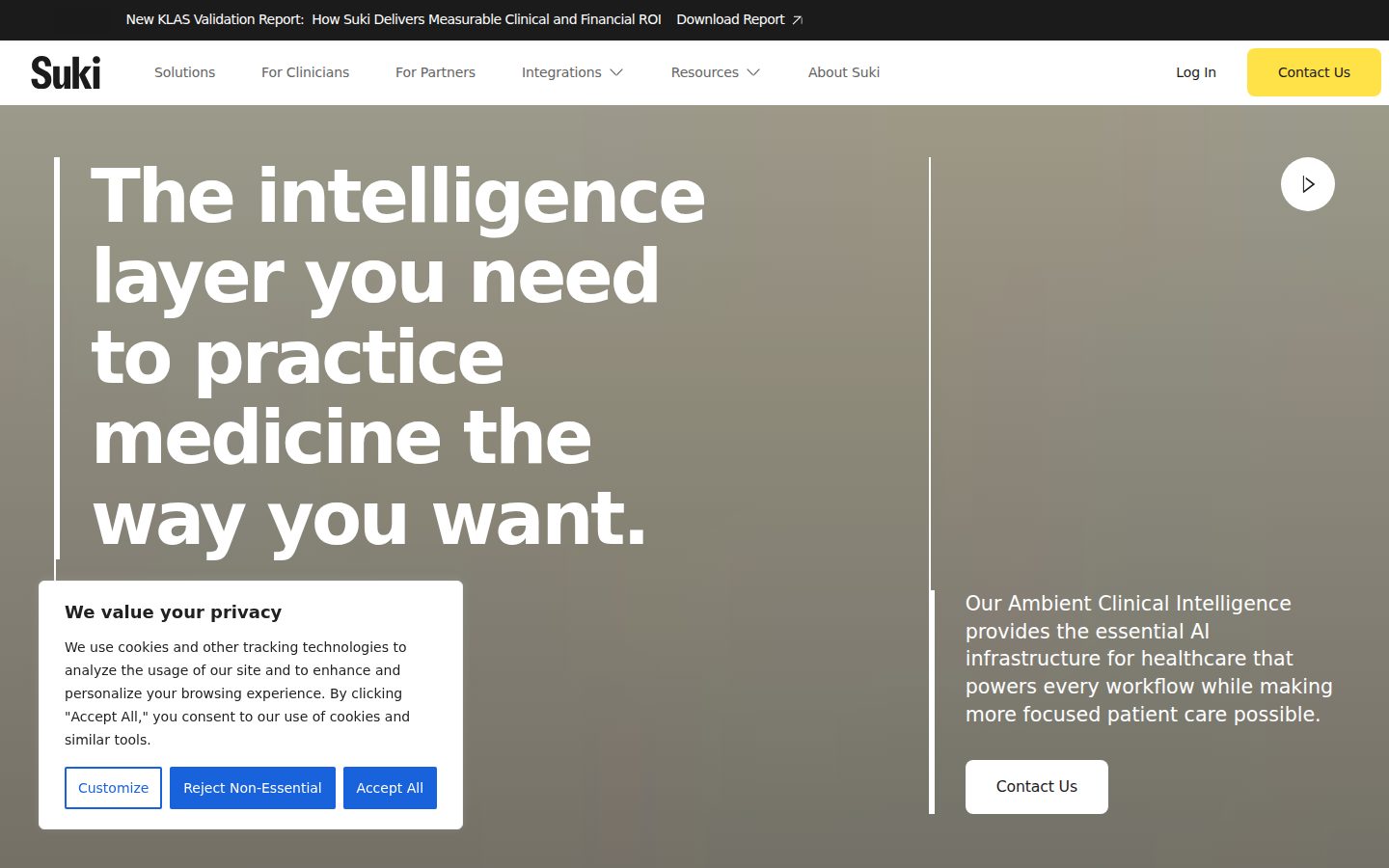
Suki AI is an ambient clinical intelligence platform for healthcare clinicians and health systems.
AI Panel Score
6 AI reviews
Reviewed
AI Editor ApprovedApproved and published by our AI Editor-in-Chief after full panel analysis.In practice, a clinician opens Suki on desktop or mobile before or during a patient encounter. The system listens to the conversation and automatically generates a structured clinical note without the clinician manually typing. From there, voice-enabled editing and problem-based charting allow further refinement, and the completed note pushes directly into the connected EHR without copy-paste or manual entry.
Beyond note generation, Suki includes assisted revenue cycle features (coding support), clinical reasoning tools, pre-charting capabilities, and a Q&A function — all accessible within a single first-party app. The platform supports over 100 medical specialties and works across various care settings including telehealth and care management environments. For health technology companies, Suki also offers a developer toolkit that allows partners to embed its AI capabilities directly into third-party applications.
Suki targets individual clinicians, medical groups, and large health systems. Pricing is not publicly listed on the website; prospective customers must contact sales. Competitors in the ambient clinical documentation space include Nuance DAX (Microsoft), Abridge, Nabla, and Freed.
The platform is available on web browsers and native iOS and Android apps. It is SOC 2 Type 2 certified and HIPAA compliant. EHR integrations with Epic, Oracle Health, athenahealth, and MEDITECH are described as deep and real-time, meaning data flows bidirectionally without manual reconciliation.

Captures the entire patient-clinician conversation in real time to generate complete clinical notes, patient instructions, and orders that sync directly into the EHR.
Provides AI-driven clinical reasoning support within the same solution as documentation, helping clinicians make informed decisions during or after patient encounters.
Offers a conversational Q&A capability within the platform so clinicians can query clinical or patient information without leaving the workflow.
Analyzes clinical encounters to provide coding assistance that can increase incremental monthly revenue per user by surfacing billable diagnoses and procedures.
Assists clinicians before the patient visit begins, spanning the workflow from pre-charting through documentation and clinical reasoning in a single app.
Organizes clinical documentation around patient problems, providing a flexible charting structure that mirrors how clinicians think and work.
Allows clinicians to edit clinical notes using voice commands, adapting to individual workflow preferences during documentation.
Provides real-time, embedded integrations with Epic, Oracle Health, athenahealth, and MEDITECH to sync notes and data directly into the EHR without manual steps.
Connects with external healthtech partners across telehealth, care management, and other care settings to support documentation in various clinical environments.
Offers a developer toolkit that enables healthtech companies to embed Suki's ambient AI capabilities directly into their own applications.
Runs on desktop and iOS and Android mobile devices across 100+ medical specialties, adapting to different care settings and use cases.
Maintains SOC 2 Type 2 certification and HIPAA compliance with a robust security posture designed to support large healthcare organizations at scale.
Entry-level plan for individual clinicians or smaller practices primarily looking to reduce documentation time. Focused on AI-driven ambient note generation and dictation.
Advanced plan for larger practices and health systems needing deep EHR integration, voice-driven commands, coding assistance, and full workflow automation beyond documentation.
Custom pricing for large hospital systems and enterprise health networks. Pricing is negotiated based on organization size, EHR integration depth, and contract terms. Requires contacting Suki sales. Multi-year agreements may lower per-user costs. Discounts available for FQHCs and community health centers.
Suki's EHR depth separates it from Nuance DAX in a crowded ambient documentation race.
“Real-time integrations with Epic, Oracle Health, athenahealth, and MEDITECH are the actual moat here. Coding assistance plus clinical reasoning in a single app is the pitch that wins health system budget conversations.”
100+ specialties, four named EHR integrations, SOC 2 Type 2. That's a serious enterprise posture, not a startup science project. The ambient documentation plus coding assistance combination is smart — it converts a cost-save story into a revenue story, which is how you survive procurement committees. No public pricing is a flag, but it's a category norm for health systems, not evasion.
The real tradeoff: no changelog, no pricing page, no API docs visible publicly. That makes vendor diligence harder than it should be. Competitors like Abridge and Freed are pushing hard on similar territory, and Nuance DAX carries Microsoft's balance sheet.
For a regional health system already on Epic or athenahealth, this is worth a serious pilot conversation. For a small practice without EHR integration needs, the value case gets thinner fast.
Deeper EHR integration than Freed or Nabla, and a broader specialty footprint than most point solutions — the gap to Nuance DAX is Microsoft's distribution, not the product.
SOC 2 Type 2, HIPAA, and named integrations with Epic make this defensible to any board or compliance team.
Ambient documentation with direct EHR sync eliminates copy-paste for clinicians immediately; coding lift shows up in the next billing cycle.
Coding assistance that surfaces billable diagnoses converts this from a documentation tool into a revenue tool — that's strategic, not just operational.
No public funding data, but four deep EHR partnerships and enterprise compliance posture suggest a company with staying power — not a seed-stage experiment.
Health systems already on Epic or athenahealth who want to cut documentation time and recover coding revenue in a single contract.
Your EHR isn't on their integration list, because the ambient documentation alone won't justify the enterprise sales cycle.
Suki's unified stack beats Nuance DAX's documentation-only play for health systems ready to commit.
“Ambient documentation plus coding assistance plus clinical reasoning in one app is the right clinical architecture. The missing public pricing creates procurement friction that slows enterprise adoption cycles.”
The 100+ specialty coverage and real-time bidirectional sync with Epic, Oracle Health, athenahealth, and MEDITECH isn't marketing language — that's a genuine integration depth that most point solutions can't match. Nuance DAX does ambient notes well, but it doesn't close the loop on revenue cycle. Suki does, and that bundled coding assistance changes the ROI conversation with CFOs and CMIOs simultaneously.
The pre-charting through post-encounter workflow architecture is clinically sound. It mirrors how physicians actually think — problem-based charting, not template-stuffing. That signals someone with real clinical workflow experience shaped the product, not just ML engineers optimizing transcription accuracy.
If we adopt this across a health system, in 3 years we're either deeply embedded in a partner that's proven durable, or we've built workflow dependency on a vendor whose pricing we never controlled from day one. No public pricing, no free trial, and no changelog visibility means we're buying on trust. That's manageable for enterprise deals but warrants hard contractual protections on pricing floors.
Suki's bundled stack positions it ahead of single-function competitors like Nuance DAX, though Abridge is closing the clinical reasoning gap.
Problem-based charting and pre-charting support reflect genuine understanding of physician cognitive workflow across 100+ specialties.
Real-time bidirectional sync with Epic, Oracle Health, athenahealth, and MEDITECH covers the dominant health system EHR landscape without manual reconciliation.

Deep EHR integration creates meaningful switching costs; no public pricing means contractual leverage shifts toward the vendor over a 3-year term.
Combining ambient documentation, clinical reasoning, and coding assistance in one platform reflects a clinical intelligence architecture, not just a transcription tool.
Health systems and large medical groups running Epic or Oracle Health who want a single vendor for documentation, coding, and clinical reasoning.
Independent practices or small groups that need transparent per-seat pricing and a trial period before committing to workflow integration.
Zero public pricing, no free trial, full enterprise sales wall — budget blind.
“Suki competes directly with Nuance DAX and Abridge, but publishes no pricing. TCO is unknowable without a sales call.”
No pricing page. No tiers. No trial. That's three procurement red flags before you've spoken to anyone. Category norm for enterprise clinical AI is $150-$300/seat/year — Suki won't confirm either direction. A 50-physician group at $200/seat × 12 months = $120K/year. Year 3, with 20% seat creep and integration fees, lands closer to $175K. Unknowable until invoice.
The feature set is legitimately broad. Ambient documentation, coding assistance, clinical reasoning, pre-charting — all in one app. Deep real-time EHR integrations with Epic, Oracle Health, athenahealth, and MEDITECH are a real differentiator. Nuance DAX has the Microsoft distribution advantage; Suki counters with multi-EHR depth. That's a real tradeoff, not a marketing claim.
No changelog, no public docs, no overage rates. Contract terms aren't disclosed. Auto-renewal windows and termination clauses require legal review before signing. Procurement teams will earn their salary here.
Full sales-gated model with no self-serve, no trial, and no invoice transparency creates high procurement friction for budget-conscious health systems.
No public contract terms, auto-renewal windows, or termination clauses disclosed — standard enterprise risk.
No published pricing, no tiers, no starting rate — contact sales only, per their pricing page absence.
Coding assistance feature claims incremental monthly revenue per user, which is a measurable output — but no benchmark numbers are published to validate the claim.
Integration fees, training, and seat creep are all unquantifiable without a vendor conversation; category benchmarks suggest $120K-$175K/year for 50 physicians over 3 years.
Large health systems with dedicated procurement teams who can negotiate enterprise contracts and absorb sales-gated buying cycles.
You need transparent pricing, self-serve evaluation, or predictable year-3 TCO before board approval.
Ambient documentation that actually lives inside Epic, not next to it.
“Suki combines ambient note capture, coding assistance, and clinical reasoning in one app with real EHR integration — not a copy-paste bridge. No public pricing is a friction point, but the workflow fit for busy clinicians is strong.”
The EHR integration story is the lead. Epic, Oracle Health, athenahealth, and MEDITECH — real-time, bidirectional, no manual reconciliation. Nuance DAX also claims deep Epic integration, but Suki's four-system coverage plus a developer toolkit for partners signals genuine infrastructure investment, not a demo-layer integration. 100+ specialty support matters too; ambient documentation that only knows primary care note structure fails the moment a hospitalist or orthopod tries it.

Day-three reality: pre-charting through note completion through coding assistance, all inside one app. That's the workflow that sticks. Voice-enabled editing and problem-based charting mirror how physicians actually think — problem-first, not template-first. The Q&A assistant is useful if it stays in the clinical workflow and doesn't require a context switch. Whether it handles complex specialty documentation without hallucinating diagnoses is the real durability question.
No public pricing and no free trial are genuine blockers for smaller practices evaluating against Freed or Nabla. Health systems can absorb a sales cycle; a three-physician cardiology group cannot. That's a real segment gap.
Pre-charting through coding assistance in a single app is the kind of end-to-end flow that survives the first week without new habits piling up.
No public docs, no changelog — the site is clearly written for buyers, not for the clinician doing daily troubleshooting.
Mobile and web parity across iOS and Android reduces device-switching friction, but no changelog visibility makes it hard to track what changed under you.
100+ specialty support and a developer toolkit suggest real depth, but discoverability of advanced features like problem-based charting isn't demonstrated publicly.
Real-time EHR sync with Epic and athenahealth eliminates the copy-paste step that kills ambient tools in practice.
Clinicians and health systems already on Epic, Oracle Health, athenahealth, or MEDITECH who want a single ambient documentation platform that doesn't require manual EHR entry.
Solo practitioners or small groups who need transparent pricing and a trial period before committing to a sales cycle.
Ambient notes that go straight into Epic — no copy-paste, no typing, no excuses
“Suki does the thing doctors hate most — the after-hours charting — and automates it into the visit itself. Deep EHR integration across Epic, Oracle Health, athenahealth, and MEDITECH is the real differentiator here.”
The feature set is genuinely complete. Ambient documentation, coding assistance, clinical reasoning, pre-charting, voice editing — all in one app, not stitched together. That coding assistance angle is smart because it doesn't just save time, it surfaces billable diagnoses that might've been missed. For a busy clinician, that's not a nice-to-have.
The EHR integration story is what separates Suki from someone like Freed, which targets solo practitioners more than health systems. Real-time bidirectional sync with Epic means the note lands where it needs to land, automatically. That's the daily friction point this whole category is fighting, and Suki seems to have actually solved it across 100-plus specialties.
No public pricing is the real frustration. No trial, no free plan, contact sales — that's fine for a health system, annoying for a medical group trying to evaluate without a sales call. The experience evidence is thin too. Strong on paper, but daily polish and onboarding are hard to assess without transparency.
Problem-based charting and voice-enabled editing suggest real workflow thinking, but no changelog or docs means it's hard to know how aggressively they're iterating on the daily feel.
100-plus specialty support and a pre-charting-through-note workflow covering the full encounter suggests strong discoverability once you're in, but the gated onboarding adds friction upfront.
Native iOS and Android apps with cross-device support across desktop and mobile suggest mobile isn't an afterthought — it's built for bedside and telehealth use, not just desktop charting.
No free trial and contact-only sales means the first experience is gated behind a demo, which slows individual clinicians trying to self-evaluate.
SOC 2 Type 2 certification and HIPAA compliance signal serious infrastructure; real-time EHR sync is the kind of feature that breaks loudly if it's unreliable, so the commitment is implied.
Health systems and medical groups already running Epic or athenahealth who want to eliminate after-hours charting at scale.
You're a solo practitioner who wants to trial something quickly without a sales conversation.
Solid ambient doc play, but no pricing and no changelog is a yellow flag
“Suki competes directly with Nuance DAX and Abridge in a category that's genuinely heating up. The EHR depth story — Epic, Oracle Health, athenahealth, MEDITECH — is the strongest thing on the page.”
Three tells upfront. One: no pricing page, contact sales only. Two: no changelog listed — I can't see shipping cadence. Three: 'most embedded ambient AI solution on the market' is the kind of superlative that ages poorly when Nuance DAX runs on Microsoft infrastructure. That said, the 100+ specialties claim and four named real-time EHR integrations are concrete and falsifiable. Not vague.
What's interesting: the coding assistance angle. Most ambient doc tools stop at note generation. Suki bundles revenue cycle support — surfacing billable diagnoses — which gives health systems a CFO-friendly ROI story. That's differentiated versus Nabla or Freed, which stay closer to pure documentation.
The exit risk is real. Notes sync into the EHR directly, which is good. But if Suki disappears, how clean is that migration? No API docs visible. No data export story publicly documented. SOC 2 Type 2 plus HIPAA compliance checks the compliance box. The viability question stays open without public funding signals.
Bundling coding assistance and clinical reasoning alongside ambient documentation in a single app is a concrete gap versus single-function competitors like Nabla or Freed.
Notes push into the EHR which helps, but no public API docs and no data export documentation means migration risk is unclear.
No changelog, no public funding data visible — hard to assess shipping cadence; SOC 2 Type 2 and enterprise EHR integrations suggest a real team, but evidence is thin.
'Most embedded ambient AI' is unsupported superlative; the EHR integration list is specific and grounded, but the headline copy is aspirational.
Ambient clinical documentation is a real and growing category — Nuance DAX survived, Freed is scaling — and Suki's multi-EHR depth matches the pattern of durable players, not the ones that closed.
Health systems already running Epic or athenahealth that want ambient documentation plus coding support in one contract.
Solo or small-practice clinicians who need transparent pricing and a proven self-serve onboarding path.
Common questions answered by our AI research team
Suki integrates with Epic, Oracle Health, athenahealth, and MEDITECH — described as deep, real-time integrations making it the most embedded ambient AI solution on the market.
Suki works seamlessly across desktop and mobile devices on both iOS and Android.
Suki is HIPAA compliant and SOC2 Type 2 certified, built to support the largest enterprise healthcare organizations.
Suki supports 100+ specialties, adapting to various care settings beyond primary care.
Yes, Suki combines ambient documentation, coding assistance, and clinical reasoning in a single solution.
Suki AI is a Redwood City-based company that provides an AI-powered voice assistant and ambient documentation platform for clinical settings, helping physicians generate notes and complete EHR tasks.