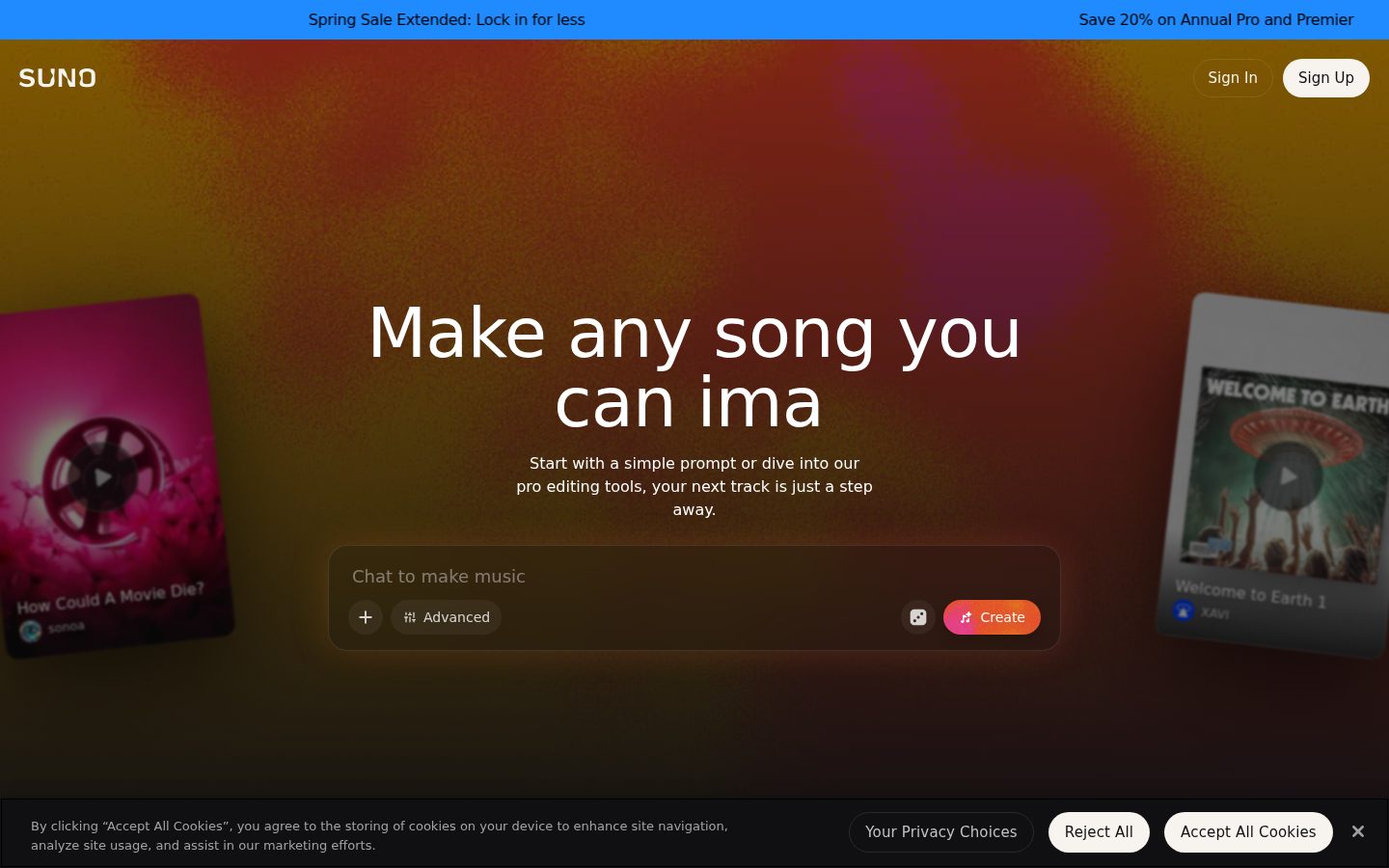
AI-powered music generation platform for creating original songs
Suno is an AI music generation platform that creates original songs from text prompts.
AI Panel Score
6 AI reviews
Reviewed
Suno is an AI-powered music generation platform that enables users to create complete original songs from simple text prompts. The platform uses advanced machine learning models to generate music that includes vocals, instrumentals, and lyrics, allowing users to specify genres, styles, moods, and themes for their compositions.
The platform is designed for musicians, content creators, hobbyists, and anyone interested in music creation without requiring traditional musical skills or expensive equipment. Users can generate songs in various genres including pop, rock, hip-hop, country, electronic, and many others by simply describing what they want in natural language.
Suno's AI can create both instrumental tracks and songs with vocals, generating original lyrics that match the specified theme or mood. The platform provides options to refine and iterate on generated content, allowing users to experiment with different variations of their musical ideas.
The service operates in the growing AI content creation market, competing with other AI music generation tools while focusing on ease of use and quality output. Suno aims to democratize music creation by making professional-sounding music generation accessible to users regardless of their musical background or technical expertise.
Generates complete songs from a simple text prompt input by the user.
Advanced editing tools available for users who want deeper control over their track creation beyond basic prompts.
Starter plan for casual creators
Best models and editing tools for serious creators
Maximum credits and every feature unlocked
Suno makes real music fast, but commercial rights and IP risk are the story.
“At $8/month, Suno's Pro plan gives 500 songs with commercial rights and stem splitting. The ceiling question isn't quality — it's legal exposure.”
Ten songs a day free. Five hundred a month at $8. That's a volume number content teams can actually use, and the v5.5 model access on Pro puts serious capability in reach without budget scrutiny. Competitors like Udio are in the same ring, but Suno's pricing page shows a cleaner tier structure.
The tradeoff is real: free plan strips commercial rights entirely, and the music copyright litigation environment for AI-generated audio isn't resolved. Your legal team will flag this. The board will ask. Have an answer before you standardize it anywhere near a product or campaign.
For content creators, social teams, or hobbyist use cases, this is a strong fit right now. For anything touching a brand, pause until the IP environment settles. Pilot it at the Pro tier, keep it out of customer-facing work for now.
Suno and Udio are the visible leaders; using it signals AI-forward, but so does every competitor — differentiation is thin at the platform level.
AI music copyright suits are active in the category; adopting for brand campaigns before legal clarity is a board conversation you don't want.
Text prompt to complete song in seconds — the docs indicate 10 songs daily on the free tier, so payback is immediate for content volume use cases.
Advances content creation velocity meaningfully, but it's an accelerant on existing workflows, not a direction-changer.
No public funding data visible in the evidence; category is hot but no confirmed runway or team size to anchor a 36-month bet.
Content teams needing high-volume background music or social audio without a production budget.
Your use case touches customer-facing brand work until the copyright environment clarifies.
Suno democratizes music creation but stops short of professional creative workflow integration.
“At $8/month for 500 songs and stem splitting, the value density is real. But the creative control architecture is built for hobbyists, not practitioners who need asset governance and brand-consistent output.”
The v5.5 model with 12-stem splitting at the Pro tier is a meaningful signal — someone understood that creators need decomposable assets, not just finished tracks. That's closer to a production tool than most AI audio competitors like Udio offer. But no API, no changelog, no documented asset management system means integrating Suno into a content production pipeline is friction from day one.
The prompt-to-song architecture is the ceiling problem. There's no voice style guide, no saved sonic brand parameters, no glossary-equivalent for musical identity. Every output starts fresh, which is fine for exploration but structurally incompatible with maintaining consistent brand audio across campaigns or content series.
If we adopt this at $24/month Premier for custom model tuning, in three years we have a library of generated assets with no metadata layer, no versioning, and commercial rights that depend on a single vendor's ongoing licensing posture — which remains legally unsettled across the AI music category.
Suno is a clear category leader in AI music generation, with v5.5 model access and commercial rights at $8/month outpacing most direct competitors on price-to-output ratio.
Built for solo creators and hobbyists — no workflow hooks for creative teams managing multi-track brand audio at scale.
Web-only, no API documented, no DAW integration — sits outside every professional creative stack rather than inside it.
No API and legally unsettled AI music licensing create genuine 3-year vendor dependency risk for any commercial production pipeline.
Stem splitting and custom model tuning show craft ambition, but no documented control over tonal consistency or sonic brand parameters limits ceiling.
Content creators and indie brands needing high-volume, low-cost background music without strict sonic brand requirements.
Your production pipeline requires DAW integration, version-controlled audio assets, or legally bulletproof commercial licensing.
$8/seat for 500 songs/month — pricing is clean, ROI math is harder
“Three visible tiers, no sales call required. ROI depends entirely on whether generated tracks replace real production spend.”
$8/month Pro, $24/month Premier. All tiers published without a sales call — rare enough to note. Free tier gives 10 songs/day on v4.5-all; Pro jumps to 500 songs/month on v5.5 with commercial rights. That version gap matters for any commercial workflow.
50-user content team on Pro: $8 × 50 × 12 = $4,800/year. Annual plan with 20% Spring Sale discount lands closer to $3,840. Year 3 without seat creep stays flat — no per-seat overage model visible. Add-on credits exist but no published overage rate, which is the one billing unknown. Compare to Udio at similar price points — Suno's stem-splitting (up to 12 stems on Pro) is a concrete differentiator.
No API docs visible in the evidence. That limits enterprise integration math. Contract terms aren't public — auto-renewal window unknown. For procurement, that's a gap worth closing before signing annual.
Credit-based model is simple; monthly or annual options visible, but no invoice/PO procurement path confirmed in evidence.
Auto-renewal terms and cancellation window aren't publicly documented, based on available evidence.
All three tiers and credit counts are publicly visible; no sales call required to see real numbers.
ROI depends on displacement of production spend — measurable only if you have a prior studio budget to benchmark against.
Flat per-seat model keeps year-3 math predictable, but unpublished add-on credit rates introduce invoice risk.
Content teams replacing stock music licensing spend with a flat, predictable monthly credit model.
Your workflow requires API integration or you need PO-based procurement with documented contract terms.
Suno generates radio-ready tracks fast, but the design workflow is a blank canvas problem
“Text-to-song generation is genuinely impressive at $8/month Pro tier. The friction shows up when you need control, not creation.”
50 daily credits on free means 10 songs — enough to feel the magic, not enough to find your sound. The Pro plan at $8/month unlocks the v5.5 model and 12-stem splitting, which is where this gets interesting for motion designers and content creators pulling audio assets for video work. That stem export is the most designer-relevant feature in the stack.
The gap is iteration control. Generating variations on a prompt is not the same as adjusting a layer. There's no equivalent to Figma's component overrides or even Audacity's envelope editor — you're re-prompting and hoping. The docs capability is listed as N across the board, which means onboarding is entirely prompt intuition. No changelog, no API. That's a walled garden.
For designers sourcing background music for client deliverables or prototypes, this genuinely competes with Epidemic Sound on speed and cost. But if you need stems organized, reproducible results, or any programmatic access to your output, the ceiling arrives fast.
Re-prompting replaces refining — the loop gets repetitive without fine-grained controls beyond the Premier tier's custom tuning.
Docs flagged as N in evidence — no changelog, no API docs, no practitioner-written guides found in public materials.
Shared creation queue on free and prompt-only iteration create compounding daily friction for anyone needing consistent output.
12-stem splitting on Pro and custom v5.5 fine-tuning on Premier ($24/month) show real depth, but discoverability relies on pricing-page reading, not in-app scaffolding.
Web-only with no API means no pipeline integration; stem splitting at Pro tier ($8/month) does fit asset-extraction workflows.
Motion designers and content creators who need royalty-free music fast and don't require reproducible, programmatic output.
You need consistent, version-controlled audio assets integrated into a production pipeline.
Type a sentence, get a song — Suno makes that feel almost normal
“Suno turns a text prompt into a full vocal track in seconds, no instrument required. At $8/month for 500 songs and commercial rights, the value math is genuinely hard to argue with.”
The free tier gives you 10 songs a day just to poke around. That's a real freebie, not a teaser. You'll know within twenty minutes whether this thing excites you or creeps you out, and that's the right way to onboard a tool this weird. The jump to Pro at $8/month unlocks the v5.5 model, stem splitting into 12 tracks, and commercial use — that's a lot of capability for the price of a sandwich.
The tradeoff is control. Udio and similar competitors let you feel more like a producer. Suno leans toward 'describe it and trust us,' which works great until you want something specific and the prompt just won't land it. Pro Editing Tools exist, but the evidence suggests they're refinements on top of the generation, not a full DAW replacement.
Web-only is the real limitation for a platform that's built around casual creativity. The 'make music anywhere' pitch rings hollow when your phone browser is your only option. Day three, that starts to matter.
The prompt-to-song flow is clearly the team's obsession, but web-only delivery and thin public changelog suggest polish is concentrated at the generation layer, not across the whole product.
First hour is genuinely easy; month three rewards users who learn to write better prompts and use stem splitting, so there's a skill ceiling worth climbing.
Web-only platform with no native app means mobile is a browser experience — for a creativity tool aimed at casual users, that's a real gap.
Ten free songs a day on the free plan means zero friction getting to the 'whoa' moment — that's onboarding done right.
Shared creation queue on the free tier and priority queue (up to 10 songs at once) on Pro suggest wait times are a real variable, which adds uncertainty to the daily experience.
Content creators and hobbyists who want professional-sounding music fast and don't need DAW-level control.
You need precise production control or a reliable mobile-first workflow.
Real product, real output quality — but the evidence gaps are loud
“Suno generates complete songs from text at $8/month Pro tier, which is genuinely accessible. What's missing from the public record worries me more than what's there.”
Three tells from the scrape. One: no blog, no changelog, no API docs visible. Two: 'stunning' and 'masterpieces' in the meta — the kind of superlative that ages poorly. Three: the free tier locks commercial use, which is the feature most casual users actually need. Not disqualifying. Just noted.
The pricing structure is honest enough. $8/month gets you v5.5 model access, 500 songs, and commercial rights. The $24 Premier tier adds stem splitting up to 12 tracks and custom model tuning — that's a real differentiation from Udio and Boomy. Category norm is that stem export is where serious creators decide to stay or leave.
Exit story is the weak link. No API visible, web-only, no export format details in evidence. If Suno pivots or prices up, your songs exist wherever they export them. Mubert and Soundraw survived by offering API access early. Suno hasn't shown that card publicly yet.
12-stem splitting and custom v5.5 model tuning at $24/month is a concrete edge over Udio and Boomy, which don't publicly offer both at that price point.
Web-only platform with no API documented and no public export format specs — migration path if Suno shuts down is unclear.
No changelog, no blog, no API, no named investors visible in scraped evidence — insufficient public signal to call this a safe 3-year bet.
'Create stunning original music' and 'masterpieces' is aspirational copy that sets expectations the product may not always meet — no hedging language visible on the pricing page.
No changelog or blog visible; no public funding signal in evidence; matches early-stage AI music tools that either raised and scaled or quietly stalled.
Content creators who need quick, royalty-clear background music at low cost and don't need programmatic access.
You need API integration or a verifiable long-term vendor with public shipping history.
Common questions answered by our AI research team
The Spring Sale offers a 20% discount on Annual Pro and Premier plans.