Synthesis logo

Synthesis Review

Visit

Personalized AI math tutor for children ages 5–11

Synthesis Tutor is an AI-powered math tutoring app for children between the ages of 5 and 11.

AI Panel Score

7.9/10

6 AI reviews

Reviewed

AI Editor Approved

About Synthesis

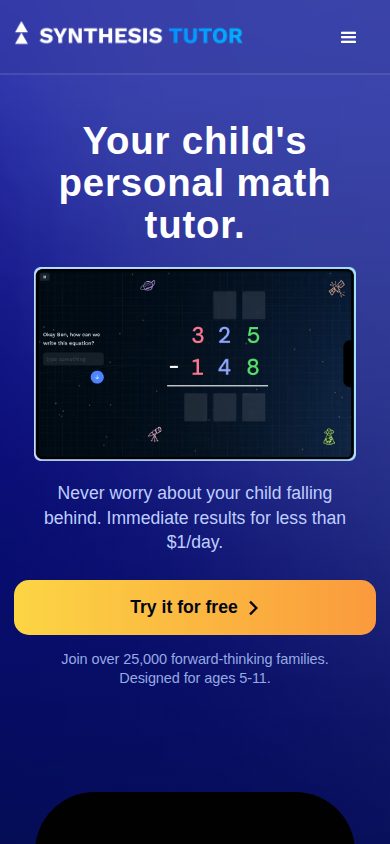
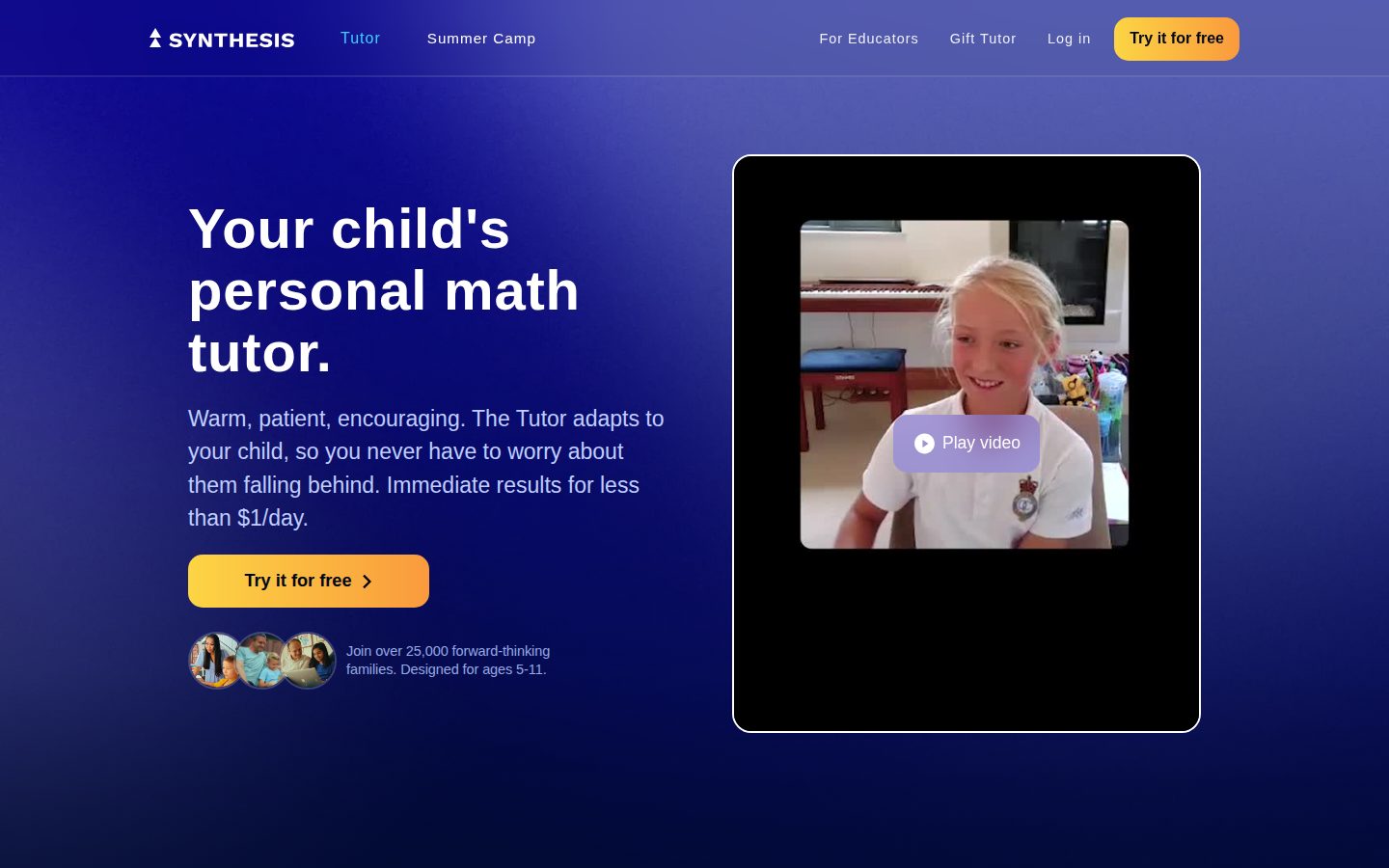
Children interact with Synthesis Tutor through a conversational AI tutor that guides them through math problems step by step. The tutor evaluates responses immediately, identifies gaps in understanding, and adjusts the difficulty and approach for each session. Lessons are designed to be completed on a tablet or desktop browser, and parents receive progress reports without needing to manage the sessions directly.

The platform emphasizes active engagement over passive learning. Specific features highlighted on the site include immediate feedback on mistakes, adaptive instruction that surfaces knowledge gaps, gamified level progression, and manipulative-style visual tools intended to make abstract concepts tangible. The experience is described as digitally native, meaning it is built around interactive software rather than digitized textbook content.

Synthesis Tutor is aimed at families with children ages 5–11, including homeschooling households and those seeking supplemental instruction. A 7-day free trial is available with no credit card required. Paid plans start at $25 per month (billed annually at $300/year) for one child, or $9.92 per month (billed annually at $400/year) for a family plan covering up to 10 students. Monthly billing is also available, as are lifetime purchase options. The product competes in the math edtech category alongside tools such as Khan Academy Kids, IXL, and Prodigy.

Synthesis Tutor runs in a web browser and is accessible on tablets and desktop computers. No app store download is listed as required. A separate free flashcard tool for times tables is available on the site without any account signup.

Features

AI

  • Adaptive AI Tutor

    The AI tutor evaluates each child's responses in real time and adjusts instruction to match their current skill level, targeting gaps in knowledge.

  • Mistake Detection and Gap Filling

    Automatically surfaces mistakes and delivers customized instruction to fill specific gaps in a child's foundational math knowledge.

Analytics

  • Progress Reports

    Generates progress reports so parents and teachers can monitor a child's advancement through math skills and concepts.

Core

  • 1-on-1 Personalized Instruction

    Provides patient, immediate, and tailored guidance for every problem in every lesson, simulating the experience of learning with a real teacher.

  • Free Adaptive Flashcards

    Offers a standalone free flashcard tool for times tables practice that requires no signup and is playable on tablet or desktop.

  • Gamified Learning Experience

    Every aspect of the product is designed to be immersive and fun, with level unlocking and engagement mechanics that make math feel like an adventure.

  • K-5 Math Curriculum Coverage

    Covers the full standard K-5 math curriculum including Counting & Cardinality, Addition, Subtraction, Multiplication, Division, Fractions, and Algebraic Thinking.

  • Multisensory Hands-On Learning

    Engages multiple senses and invites physical interaction, turning math concepts into hands-on play rather than worksheets or textbook-style exercises.

Customization

  • Family Plan for Multiple Students

    Supports subscription plans for up to 7–10 students under one family account, with monthly, annual, and lifetime payment options.

Mobile

  • Tablet and Desktop Support

    The tutor is accessible on both iPad and desktop devices, allowing children to learn across platforms.

Support

  • Hands-Off Parent and Teacher Mode

    Designed to operate independently so parents and teachers do not need to actively supervise or guide each session.

  • School and Classroom Access

    Offers a dedicated contact pathway for schools and classrooms to access Synthesis Tutor for educational institution use.

Preview

Synthesis desktop previewSynthesis mobile preview

Pricing Plans

Individual Monthly

$45/monthly

For one student, billed month-to-month

  • 1 child access
  • Personalized AI math tutor
  • Adaptive lessons for ages 5-11
  • K-5 curriculum plus advanced topics
  • Progress reports
  • 7-day free trial
Popular

Individual Annual

$29/monthly

For one student, billed annually at $348/year — most popular individual plan

  • 1 child access
  • Personalized AI math tutor
  • Adaptive lessons for ages 5-11
  • K-5 curriculum plus advanced topics
  • Progress reports
  • 7-day free trial

Individual Lifetime

$999/one-time

For one student, single one-time payment for lifetime access

  • 1 child access
  • Personalized AI math tutor
  • Adaptive lessons for ages 5-11
  • K-5 curriculum plus advanced topics
  • Progress reports
  • Lifetime access

Family Monthly

$70/monthly

For up to 10 students, billed month-to-month

  • Up to 10 students
  • Personalized AI math tutor for each child
  • Adaptive lessons for ages 5-11
  • K-5 curriculum plus advanced topics
  • Progress reports
  • 7-day free trial
Popular

Family Annual

$33/monthly

For up to 10 students, billed annually at $400/year — most popular family plan

  • Up to 10 students
  • Personalized AI math tutor for each child
  • Adaptive lessons for ages 5-11
  • K-5 curriculum plus advanced topics
  • Progress reports
  • 7-day free trial

Family Lifetime

$1,499/one-time

For up to 10 students, single one-time payment for lifetime access

  • Up to 10 students
  • Personalized AI math tutor for each child
  • Adaptive lessons for ages 5-11
  • K-5 curriculum plus advanced topics
  • Progress reports
  • Lifetime access

AI Panel Reviews

The Decision Maker

The Decision Maker

Strategic bet, vendor viability, timing, adoption approval
7.8/10

SpaceX-school pedigree, $348/year price point, and real adaptive AI make this a credible family bet.

Synthesis Tutor delivers genuine adaptive instruction for K–5 math at a price that won't require a budget meeting. The SpaceX school origin story gives it brand credibility that IXL and Prodigy simply don't have.

$29/month annually for one kid. $400/year for up to ten. That's the kind of pricing that makes the decision easy and the renewal conversation even easier. No credit card required for the 7-day trial, which removes the last objection most parents have.

The adaptive AI tutor adjusting in real time—plus read-aloud for kids under 7—signals they've thought about actual users, not just a demo. IXL covers similar curriculum but it's worksheet logic in a digital skin. Synthesis feels built for the medium. That's a real difference.

The tradeoff: no public funding data, no changelog, no API. This is a consumer product, not an enterprise platform. Vendor viability is the open question. The $999 lifetime option for one child is either confidence or a cash grab—hard to tell without runway data.

Competitive Positioning7.8

Beats IXL and Prodigy on engagement model; free times-table flashcards with no signup is a smart acquisition move competitors haven't matched.

Reputation Risk8.5

SpaceX school lineage and a no-credit-card free trial make this easy to defend to any parent community or school board.

Speed to Value8.5

No setup, hands-off parent mode, and immediate adaptive feedback mean a child can be in a productive session within minutes of signup.

Strategic Fit7.5

Strong fit for homeschool households and families with multiple kids under 11; the $400/year family plan covering up to 10 students is a real unlock.

Vendor Viability6.5

SpaceX school origin adds credibility, but no public funding data or changelog makes the 3-year survival question genuinely open.

Pros

  • $400/year covers up to 10 students — the family plan math is hard to argue with
  • Read-aloud auto-enabled for kids under 7 shows real product thinking
  • No credit card required for the 7-day trial removes friction
  • SpaceX school origin gives it a story that other edtech tools don't have

Cons

  • No public funding data — vendor viability is a genuine unknown
  • No changelog or API signals this is a closed consumer product, not a platform
  • $999 lifetime option for one child is aggressive pricing with no track record to justify it
  • Coverage tops out at K–5; families with kids over 11 will need a second tool

Right for

Families with multiple elementary-age children who want a hands-off, adaptive math tutor without managing sessions themselves.

Avoid if

You need a vetted enterprise vendor with documented funding, SLAs, or curriculum beyond fifth grade.

The Domain Strategist

The Domain Strategist

Craft and strategy in the product's domain — adapts identity per category, same lens
8.1/10

SpaceX-origin pedigree meets serious adaptive math architecture for K-5 learners.

Synthesis Tutor is a well-built adaptive math platform covering the full K-5 curriculum with real-time gap detection and genuine instructional depth. At $400/year for up to 10 students, the family plan pricing is unusually strong for what it delivers.

The adaptive instruction model here isn't cosmetic. Real-time mistake detection that adjusts difficulty and approach mid-session is closer to a genuine scaffolding architecture than IXL's drill-and-report model or Prodigy's gamification wrapper. The read-aloud feature for under-7 learners — automatic, not opt-in — signals someone on this team actually understands early literacy dependencies in math acquisition. That's a pedagogical decision, not a feature checkbox.

The curriculum spine is solid: full K-5 scope from Counting & Cardinality through Algebraic Thinking, plus the docs indicate coverage beyond standard grade-band. The multisensory, manipulative-style approach matters — abstract symbol manipulation before concrete understanding is where most edtech fails early learners. The family plan at $400/year covering 10 students is genuinely hard to compete with at this instructional quality level.

The constraint is scope. This is a math-only, ages 5-11 product. If you're building a broader learning program, Synthesis covers one subject strand, and there's no API or LMS integration surface documented. Progress reports exist, but no changelog or docs suggest deep data portability. Useful within its lane — but the lane is narrow.

Category Positioning8.3

Outperforms IXL on engagement architecture and Khan Academy Kids on instructional adaptivity; SpaceX school lineage is a credible differentiation signal.

Domain Fit8.5

Hands-off parent mode, automatic read-aloud for under-7s, and multisensory approach reflect real understanding of K-5 learning behavior.

Integration Surface6.0

No API, no documented LMS connectors, and no changelog — this sits outside most coordinated learning stacks rather than within them.

Long-term Implications7.0

Math-only coverage means you'll need parallel tools for literacy and science by year two; no LMS integration limits institutional scalability.

Strategic Depth8.2

Real-time gap detection plus manipulative-style visual tools suggests genuine instructional design investment, not digitized worksheets.

Pros

  • Adaptive gap detection adjusts approach mid-session, not just difficulty level
  • Family plan at $400/year for up to 10 students is exceptional value density
  • Automatic read-aloud for under-7 learners shows real early childhood design thinking
  • Full K-5 curriculum scope plus additional topics beyond standard grade-band

Cons

  • Math-only — no cross-subject coverage means it can't anchor a complete learning program
  • No API or LMS integration documented, limiting institutional and blended-learning use
  • Progress reports exist but no indication of data export or portfolio portability

Right for

Homeschooling families or supplemental math programs needing a credible adaptive tutor across multiple children at low per-seat cost.

Avoid if

You're building an integrated learning stack that requires LMS data flow or cross-subject coverage under one platform.

The Finance Lead

The Finance Lead

Money, total cost of ownership, contracts, procurement math
8.1/10

$348/year covers K-5 math for one child — family math at $400 total is hard to beat.

Six tiers, all prices visible without a sales call. Family Annual at $400/year for up to 10 students is the structural story here.

Pricing page shows every number. $29/month individual annual, $33.33/month family annual, $45/$70 for monthly flexibility, $999/$1,499 lifetime options. No SSO tax. No per-feature unlocks visible. Rare for edtech. IXL charges $9.95/month per child — Synthesis Family Annual at $400/year across 10 kids is $3.33/child/month. Math wins there.

Three-year TCO for a family of 3 kids: $400 × 3 = $1,200 annual, or $1,499 one-time lifetime. Lifetime breaks even at year 4. No published overage structure, no API costs, no add-on integrations visible — TCO is unusually predictable for this category. The 7-day free trial requires no credit card, which cuts procurement friction to near zero.

The tradeoff: individual plan at $348/year isn't cheap relative to Khan Academy Kids, which is free. Auto-renewal terms and cancellation window aren't published. That's the one opaque number. Otherwise, clean structure.

Billing & Procurement8.5

7-day free trial with no credit card, web-only access with no app store friction, and a direct school/classroom contact path reduce procurement overhead significantly.

Contract Flexibility7.0

Monthly billing available at $45-$70, which limits lock-in risk, but auto-renewal and cancellation window terms aren't publicly documented.

Pricing Transparency9.0

All 6 tiers — monthly, annual, lifetime — are publicly listed with exact dollar amounts, no sales call required.

ROI Clarity7.5

Progress reports and adaptive gap-filling are named features, but no published outcome data or benchmark comparisons exist to quantify learning gains.

Total Cost of Ownership8.5

Family Annual at $400/year for up to 10 students; no visible add-ons or overage rates make 3-year TCO unusually calculable.

Pros

  • Family Annual at $400/year for up to 10 students is $3.33/child/month — structurally cheap vs. per-seat competitors
  • Lifetime option at $1,499 breaks even around year 4 — real value for homeschool households planning long-term
  • All 6 pricing tiers public, no demo required
  • No credit card for 7-day trial removes procurement friction

Cons

  • Individual Annual at $348/year is hard to justify vs. Khan Academy Kids, which costs $0
  • Auto-renewal and cancellation terms not publicly documented — contract risk is unquantified
  • No API, no changelog, no integration layer — no procurement evidence beyond direct billing

Right for

Families with 2+ kids ages 5–11 who want predictable annual math tutoring costs without per-seat pricing.

Avoid if

Your household has one child and you're price-sensitive — free alternatives cover the same K-5 curriculum.

The Domain Practitioner

The Domain Practitioner

Daily hands-on reality in the product's domain — adapts identity per category, same lens
7.8/10

SpaceX-pedigreed adaptive tutor that actually replaces the worksheet stack

Synthesis Tutor delivers genuine adaptive instruction across the full K–5 curriculum, with the AI gap-detection doing real pedagogical work. The $400/year family plan covering up to 10 students is the pricing story that wins rooms.

The read-aloud-for-under-7s feature tells me someone thought about the actual learner, not just the parent buyer. Automatic audio for pre-readers, toggle for older kids, adjustable speed — that's a trainer noticing day-one onboarding friction and solving it before it becomes a dropout. The free no-signup flashcard tool for times tables is a smart trust-builder. Let families taste the product without an account wall.

The hands-off parent mode is real differentiation. IXL and Prodigy both surface reports, but neither simulates a patient 1-on-1 instructor making real-time instructional pivots. The mistake detection and gap-filling feature is the engine here — if it's executing as described, it's doing what a tutor actually does during a session, not just logging wrong answers.

The gap: no changelog, no blog, no API docs in the evidence. I can't see how curriculum updates land or whether the AI model improves over time. For a training tool, that opacity is a real concern. Progress reports exist, but depth is unknown — IXL's skill-strand breakdowns are detailed enough to drive instruction. Synthesis may not be there yet.

Day-3 Reality7.5

Gamified progression and adaptive difficulty should sustain engagement past day one, but no changelog or update cadence evidence makes long-term curriculum freshness uncertain.

Documentation Practitioner-Fit5.5

No blog, changelog, or API evidence found — what exists reads as marketing copy, not practitioner-facing guidance on how the adaptive engine actually works.

Friction Surface8.0

No app store download required, runs in browser on tablet and desktop, and the 7-day no-credit-card trial removes the typical signup-wall friction.

Power-User Depth6.5

Progress reports exist but depth is unspecified; compared to IXL's granular skill-strand data, there's no evidence Synthesis gives a trainer enough diagnostic detail to drive targeted re-teaching.

Workflow Integration8.5

Hands-off parent/teacher mode and automatic read-aloud mean it drops into a homeschool or supplemental routine without a new daily management habit.

Pros

  • $400/year family plan covers up to 10 students — IXL charges per child
  • Read-aloud auto-enabled for under-7s, toggle for older kids — real accessibility thinking
  • No-signup free flashcard tool lowers the barrier to first contact
  • Hands-off mode means it runs without trainer supervision per session

Cons

  • No changelog or blog — curriculum update cadence is invisible
  • Progress report depth unconfirmed; diagnostic granularity may not support targeted re-teaching
  • Age ceiling of 11 means families age out; no middle-school path shown
  • Documentation appears marketer-written, not practitioner-written

Right for

Homeschool families or supplemental-instruction households with multiple K–5 kids who want an always-patient adaptive tutor running without daily adult oversight.

Avoid if

You need granular skill-strand diagnostics to drive your own instruction decisions — the progress report depth isn't confirmed at IXL's level.

The Power User

The Power User

Daily human experience, onboarding, polish, learning curve, reliability
8.1/10

SpaceX school DNA, $29/month price, and a tutor that actually adapts

Synthesis Tutor is a genuinely thoughtful math app for kids 5–11 that adapts in real time instead of just drilling flashcards. The family plan at $400/year for up to 10 kids is quietly one of the best value propositions in edtech.

The SpaceX school origin story isn't just marketing — it signals a team that built this for real kids in real classrooms before packaging it for families. The adaptive AI tutor adjusting on the fly, the read-aloud for under-7s, the manipulative-style visuals instead of worksheet dumps — these feel like decisions made by people who watched children actually struggle with math. That's different from how IXL or Khan Academy Kids were built, and you can feel it in the feature list.

The family annual plan at $400/year covering up to 10 students is almost unfairly priced. Homeschool families especially should do that math immediately. The 7-day free trial with no credit card is the right call for a kids product — parents are skeptical, and removing friction there earns trust.

The real tradeoff: web-only, no native app download listed. Tablet support exists, but the category norm is App Store presence. Three months in, that might nag. And without a public changelog, it's hard to know how fast the product is improving.

Daily Polish8.2

Multisensory hands-on design and gamified level progression suggest real attention to the small moments that keep a 7-year-old engaged session after session.

Learning Curve8.4

Hands-off parent mode and adaptive difficulty mean the product scales itself — kids don't hit a ceiling and parents don't have to manage sessions manually.

Mobile Parity7.8

iPad and desktop both supported, but no App Store listing is mentioned — category norm is a native app, and that gap may matter to families who live on iOS.

Onboarding Experience8.5

No credit card for the 7-day trial, automatic read-aloud for under-7s, and a no-signup flashcard tool — the first ten minutes are designed to reduce parent anxiety, not add to it.

Reliability Feel7.5

No changelog or public status page in the evidence, which is a small flag, but browser-based delivery on both iPad and desktop suggests a stable architecture.

Pros

  • Family annual plan covers up to 10 students for $400/year — exceptional value for homeschool households
  • Read-aloud is automatic for children under 7, meaning non-readers aren't blocked
  • Adaptive tutor targets knowledge gaps in real time rather than just advancing linearly
  • 7-day free trial, no credit card required — low-friction for skeptical parents

Cons

  • No native App Store download listed — browser-based on tablet may feel less polished than competitors
  • No public changelog, so hard to gauge how actively the product is evolving
  • Individual monthly plan at $45/month feels steep compared to the annual option — easy to land on the wrong plan

Right for

Families with multiple kids ages 5–11 who want real adaptive instruction, not just glorified drill sheets.

Avoid if

You need a native iOS app experience or your child is already past the K–5 math curriculum.

The Skeptic

The Skeptic

Contrarian. Watch-outs, deal-breakers, broken promises, category patterns
7.2/10

SpaceX origin story is doing a lot of heavy lifting here

Solid adaptive math product with honest pricing and a real curriculum scope. The 'born from SpaceX school' positioning is marketing shorthand that'll age, but the underlying product signals are decent.

Three things I noticed fast. One: 'SpaceX school' in the meta description — that's a credibility loan from Elon Musk's brand. Could be real heritage, could be fading asset. Two: no changelog, no blog, no API listed. Tells me nothing about shipping cadence. Three: the 7-and-under read-aloud feature is a named, specific capability — that's the kind of detail that comes from real UX work, not vaporware.

Pricing is actually fair. $400/year for 10 kids beats IXL's per-seat model cold. The $999 lifetime option is either confidence or desperation — hard to read without funding data. Prodigy offers free tiers; Khan Academy Kids is free entirely. Synthesis charges real money and doesn't apologize for it.

Exit portability is weak. No data export mentioned, no API, web-only. If they fold, the kid's progress history likely disappears. Lifetime plan buyers should think about that.

Competitive Differentiation7.5

Family plan at $400/year for up to 10 students is a genuine price advantage over IXL's per-seat pricing, and the read-aloud-by-default for under-7s is a specific usability gap filled.

Exit Portability4.5

No data export, no API, no offline mode — if Synthesis shuts down, 18 months of a child's progress data is likely gone.

Long-term Viability6.0

No public funding data, no changelog, no blog — the operational transparency signals are thin for a product asking $999 lifetime commitments.

Marketing Honesty6.5

The SpaceX origin claim does real work on the landing page — plausible but unverifiable from public evidence, and the kind of superlative that ages poorly.

Track Record Match7.0

Adaptive K-5 math with gamification matches IXL's survival pattern more than Prodigy's freemium struggles; no changelog or funding signal to confirm execution depth.

Pros

  • $400/year family plan covering 10 students undercuts IXL meaningfully
  • Read-aloud auto-enabled for under-7s shows genuine UX consideration
  • 7-day free trial with no credit card required reduces commitment risk
  • Full K-5 curriculum scope including Algebraic Thinking is real breadth

Cons

  • No changelog or public shipping cadence — opaque on whether the product is actively improving
  • Zero exit portability — no data export or API visible from public materials
  • SpaceX brand association is a borrowed credibility story, not a product differentiator
  • Lifetime plan at $999 is a leap of faith without public funding or longevity signals

Right for

Homeschooling families with multiple kids ages 5–11 who want hands-off adaptive math and can absorb $400/year.

Avoid if

You need verifiable product longevity before committing a lifetime purchase or institutional budget.

Buyer Questions

Common questions answered by our AI research team

Pricing

How much does Synthesis Tutor cost per year?

The Individual Annual plan costs $348/year ($29/mo). The Family Annual plan costs $400/year ($33.33/mo). A 7-day free trial is available with no credit card required.

Features

Can my child use Synthesis Tutor if they can't read yet?

Yes. The Tutor reads all text and answer choices aloud. For users under 7, read-aloud is automatic; for others, it can be toggled in settings. Voice speed is also adjustable.

Pricing

How many kids can one Family plan cover?

The Family plan covers up to 7 kids on the monthly/annual tiers, and up to 10 students on the Family plan as shown in the plan header.

Setup

Does Synthesis Tutor work on tablets?

Yes, Synthesis Tutor runs on tablet and desktop. You can try it for free by entering your email to receive a link, with no signup required.

Features

What math topics does Synthesis Tutor cover?

Synthesis Tutor covers the standard K–5 math curriculum: Counting & Cardinality, Addition, Subtraction, Multiplication, Division, Fractions, and Algebraic Thinking, plus additional topics beyond that.

Also in AI Education & Training