TesterArmy logo

TesterArmy Review

Visit

AI agents that test your web and mobile app like a human

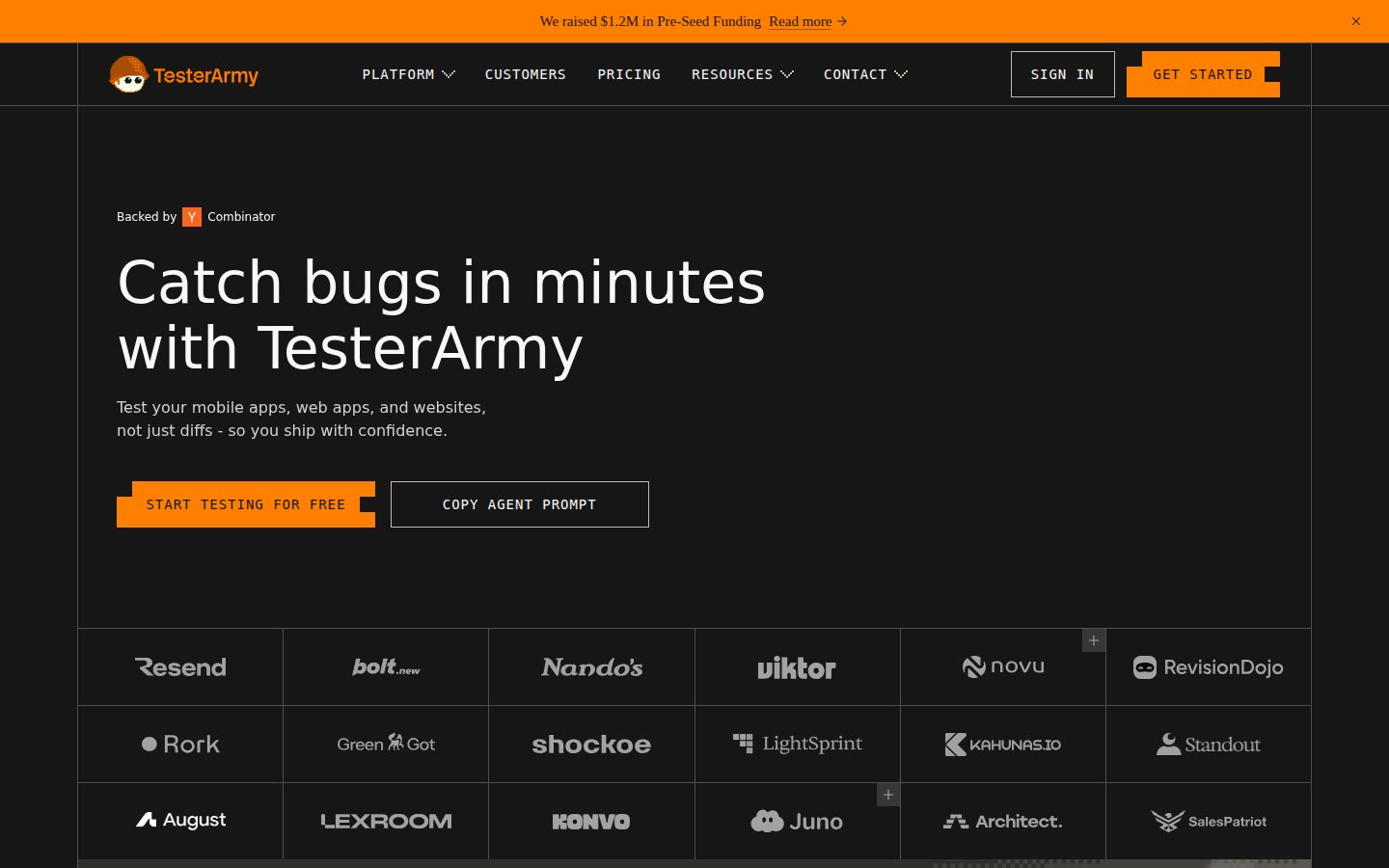
TesterArmy is an automated QA testing platform for web and mobile applications.

TesterArmy·From $99/moFree PlanAI DevOpsAI Coding Tools

AI Panel Score

7.5/10

6 AI reviews

Reviewed

Facts checked against tester.army

AI Editor Approved

About TesterArmy

With TesterArmy, a user writes a test as a plain-English description of what to check rather than a code script. The AI agent then launches a real browser (for web apps) or a cloud iOS simulator / Android emulator (for mobile apps) and carries out the steps like a human would: navigating between screens, filling in forms, tapping buttons, and validating outcomes. Each run generates screenshots and recordings as visual evidence alongside a pass/fail result, and tests can also be triggered from a CLI or run through the web dashboard.

The platform supports native, React Native, Expo, and Flutter mobile apps, with a first-party Expo EAS integration that automatically syncs and tests new EAS builds. It can run as a PR check, automatically testing GitHub deployments or builds before merge, and connects to CI/CD systems including GitHub Actions, Bitrise, GitLab CI, and generic CI webhooks (Jenkins, Buildkite, CircleCI). Authentication flows such as login, OAuth, and OTP verification are handled directly by the agents. Results can be routed to Slack or Discord, and issues found during testing can be created as tickets in Linear or Jira. TesterArmy also exposes a hosted MCP server and integrations with Claude Code, Codex, and Cursor, letting AI coding agents create, run, and read tests from within their own sessions.

TesterArmy is aimed at teams building web and mobile applications who want testing without writing and maintaining test scripts, including teams currently using tools like Playwright, Cypress, Selenium, Puppeteer, Appium, Maestro, or Mabl, for which the website provides migration playbooks. Pricing and plan details are published on a dedicated pricing page.

Features

AI

  • AI Testing Agents

    Deploys AI agents that operate a real browser or cloud mobile simulator/emulator, navigating screens, clicking, typing, and validating like a human tester.

Analytics

  • Screenshots & Recordings

    Produces visual evidence including screenshots and recordings for every test run, along with a pass/fail verdict.

Automation

  • PR Checks

    Automatically tests every GitHub deployment or build before it is merged.

Core

  • Authentication Support

    Handles login flows, OAuth, and OTP verification during automated test runs.

  • CLI & Dashboard

    Allows tests to be run and managed either from a terminal CLI or a web dashboard interface.

  • Plain English Tests

    Lets users describe tests in natural language instead of writing test code.

Integration

  • Bitrise Integration

    Bitrise builds the app, hands it to TesterArmy, and gates the pipeline on test results.

  • Coolify Integration

    Uses a Coolify deployment webhook to send every preview deployment to the agents for testing.

  • Expo EAS Integration

    First-party integration where EAS builds sync in automatically and get tested.

  • GitHub Actions Integration

    Uploads an iOS Simulator or Android build and runs a mobile test group via GitHub Actions.

  • GitHub Integration

    A GitHub App posts checks and comments on every pull request preview.

  • GitLab CI Integration

    Runs a test group via a signed group webhook after GitLab CI deploys.

  • Netlify Integration

    Sends each Netlify Deploy Preview to the testing agents upon a Deploy succeeded notification.

  • Vercel Integration

    Tests preview deployments from a selected Vercel project on every pull request.

Mobile

  • Mobile App Testing

    Tests iOS and Android builds on cloud simulators, supporting native, React Native, Expo, and Flutter apps.

Preview

TesterArmy desktop previewTesterArmy mobile preview

Pricing Plans

Free

Free

For trying it out

  • 5 free test runs
  • 1 concurrent test run
  • 2 projects, unlimited members
  • Web & Mobile support
  • No credit card required

Hobby

$99/monthly

For solo builders

  • Up to 250 test runs included
  • 3 concurrent test runs
  • 2 projects, unlimited members
  • Web & Mobile support
  • GitHub, Slack, Webhook integrations
Popular

Startup

$299/monthly

For small teams

  • Everything in the Hobby plan
  • Up to 1,000 test runs included
  • 10 concurrent test runs
  • Unlimited members and 5 projects
  • Powered by the best frontier models

Enterprise

Contact sales

For organizations; custom pricing available by booking a call

  • Everything in the Startup plan
  • SLA support via Slack Connect
  • White-glove onboarding
  • Strategic feature partnership
  • SSO / SAML, Custom integrations

AI Panel Reviews

The Decision Maker

The Decision Maker

Strategic bet, vendor viability, timing, adoption approval
7.9/10

Plain-English QA agents that test real builds on PRs, priced by run volume not seats.

“TesterArmy replaces scripted test suites with agents that click through your app like a person. The pricing and integration depth suggest a team actually shipping, not a wrapper.”

$99 a month gets you 250 test runs and 3 concurrent runs. That's the Hobby tier, and it's a real number, not a 'contact us.' The Startup tier at $299 adds 1,000 runs and unlimited members, which tells me this is priced for teams, not solo tinkerers pretending otherwise.

What's genuinely different: agents drive a real browser or cloud simulator, handle OAuth and OTP, and gate PRs on GitHub, GitLab CI, Bitrise, Vercel, Netlify, and Coolify. Playwright and Appium don't write themselves in plain English, and don't hand you screenshots and pass/fail verdicts on merge. That's a real edge over hand-rolled scripts.

Tradeoff: natural-language tests are less precise than code when a flow gets weird, and I couldn't find how flaky-test handling works. Enterprise pricing is a call, not a number. Still, free tier plus a stated trial period makes this cheap to prove out fast.

Competitive Positioning8.1

Migration playbooks from Playwright, Cypress, Selenium, Appium and Mabl show a specific, evidenced wedge against scripted test tools.

Reputation Risk6.8

SSO/SAML is Enterprise-only and I couldn't find data retention or compliance detail for the lower tiers.

Speed to Value8.2

Free plan with 5 runs and a stated trial period means a team can validate against a real PR within days.

Strategic Fit8.0

Replacing maintained Playwright/Appium scripts with plain-English agents changes how QA gets written, not just who pays for it.

Vendor Viability7.8

Docs, API reference, blog and a fully priced tier structure all point to active build-out, not a landing page.

Pros

  • PR checks gate merges automatically across GitHub, GitLab CI, and Bitrise
  • Plain-English test authoring with screenshots, recordings, and pass/fail per run
  • MCP integration lets Claude Code, Codex, and Cursor create and read tests directly
  • Free tier and Hobby tier at $99/month give a low-cost way to test fit

Cons

  • Enterprise pricing and SSO/SAML are gated behind a sales call
  • No visible detail on how the agents handle flaky or ambiguous test steps
  • Run-based pricing (250 runs at $99) could get expensive fast for high-frequency CI usage

Right for

Teams running frequent PR-based mobile or web deploys who want testing without maintaining scripts.

Avoid if

Skip it if your org needs SSO and compliance guarantees without a sales conversation.

The Domain Strategist

The Domain Strategist

Craft and strategy in the product's domain — adapts identity per category, same lens
7.6/10

Solid PR-gating QA layer, but the three-year question is who owns the flaky tests when the agent is wrong.

“TesterArmy slots into the CI/CD graph cleanly — GitHub, GitLab CI, Bitrise, Netlify, Vercel, Coolify — with an MCP endpoint that lets Claude Code or Cursor drive tests directly. The architecture bet is sound; the ownership model for test maintenance is the part I'd push on in a build review.”

The integration surface is the strongest part of this. Native hooks into Netlify Deploy Preview, Vercel PR builds, Coolify webhooks, and Expo EAS syncing means it's not a bolted-together CI plugin — someone architected this as a deployment-graph citizen, not a standalone dashboard you have to remember to check. That's the right shape for how release engineering actually works in 2026.

My concern is what plain-English test authoring does to test ownership over a 3-year horizon. Code-based suites (Playwright, Appium) live in version control with the diff history that makes 'who broke this and why' answerable. Natural-language specs sitting in a vendor's Results table are a different kind of institutional knowledge — durable only as long as the platform is.

The MCP hookup into Claude Code and Codex is the forward-looking bet worth taking seriously; it's a plausible shape for how agentic coding workflows test themselves going forward. At $299/month for 1,000 runs on the Startup tier, and Enterprise SSO/SAML gated behind a sales call, this is priced for teams still deciding how central it becomes — not yet for teams betting the whole QA org on it.

Category Positioning7.6

Positioned against Playwright/Appium/Maestro migration paths per its own playbooks, staking a claim as the no-code layer above traditional test frameworks.

Domain Fit7.8

PR-check gating and CLI plus dashboard access matches how engineering teams actually ship, not just how QA teams test.

Integration Surface8.4

Native Netlify, Vercel, Coolify, Expo EAS, Bitrise, and GitLab CI hooks plus an MCP server for Claude Code/Cursor is a genuinely wide dock.

Long-term Implications7.0

Natural-language test specs trade version-controlled maintainability for speed, a real constraint if the org later needs test-suite portability.

Strategic Depth7.5

Real browser/simulator automation with auth-flow handling (OAuth, OTP) goes past simple scripted checks, but craft ceiling versus deep flaky-test handling is unproven from what's public.

Pros

  • Deep CI/CD surface: Netlify, Vercel, Coolify, Bitrise, GitLab CI, GitHub Actions all wired natively
  • MCP server lets Claude Code, Codex, and Cursor create and read tests inline
  • Handles OAuth/OTP auth flows directly rather than requiring custom scripting around them
  • Free tier (5 runs, 2 projects) is a real zero-cost architecture spike, not a locked demo

Cons

  • Natural-language test specs sit outside version control, a different institutional-knowledge risk than code-based suites
  • Enterprise tier's SSO/SAML and custom integrations require a sales call rather than a visible price point

Right for

Engineering orgs already running preview-deploy pipelines (Vercel, Netlify, Coolify) who want a QA gate without owning a Playwright suite.

Avoid if

Avoid if your team needs test logic to live in the same repo and diff history as your application code.

The Finance Lead

The Finance Lead

Money, total cost of ownership, contracts, procurement math
7.4/10

$99 for 250 runs. $299 for 1,000. The math scales linearly, your CI usage won't.

“Four tiers, three with visible numbers. The run-based meter is the whole story here.”

Free tier: 5 runs, 2 projects, no card. Hobby: $99/month, 250 runs, 3 concurrent. Startup: $299/month, 1,000 runs, 10 concurrent. That's $2.5-3M ARR math for TesterArmy at scale, and clean unit economics for a buyer to model. Compare Hobby to Startup: 4x runs for 3x price. Volume discount, mild.

Year 3 at team of 50, active CI: PR checks on every merge burn runs fast. A team merging 20x/day blows past 1,000 monthly runs before mid-month. Overage pricing isn't listed anywhere I could find, and that's the real cost risk, not the sticker.

Enterprise sits behind a call, standard for SSO/SAML tiers. No term length or auto-renewal language visible on the public plans, which procurement will want clarified before signing anything past month-to-month. Monthly billing on Hobby and Startup at least means no annual lock-in trap.

Billing & Procurement7.2

No-card free tier and self-serve monthly plans mean low procurement friction until Enterprise triggers a sales cycle.

Contract Flexibility6.0

Monthly billing avoids annual lock-in, but no visible term length or cancellation terms on the plan pages.

Pricing Transparency7.8

Three tiers show real numbers; only Enterprise requires a call, which is category norm for SSO/SAML.

ROI Clarity7.0

Pass/fail verdicts and PR-check gating give a countable output, though no benchmark backs the 'frontier models' claim on Startup.

Total Cost of Ownership6.3

Run-based pricing at $99-299/month is clean until overage costs, which aren't published anywhere I found.

Pros

  • Free tier requires no card: 5 runs, 2 projects to test fit
  • Monthly billing on paid tiers avoids annual contract lock-in
  • Run counts and concurrency limits are stated numbers, not vague claims

Cons

  • Overage cost beyond included run counts isn't published anywhere I could find
  • No visible term length or auto-renewal language on Hobby or Startup
  • Run-based model makes cost hard to forecast for high-merge-frequency teams

Right for

Teams that can estimate monthly run volume and stay comfortably under 1,000 runs.

Avoid if

Skip if your CI triggers hundreds of PR checks daily without a clear overage price to budget against.

The Domain Practitioner

The Domain Practitioner

Daily hands-on reality in the product's domain — adapts identity per category, same lens
7.4/10

PR checks gate merges, but the on-call question is what happens when the agent flakes at 3am

“TesterArmy wires deep into CI/CD and reports pass/fail with visual evidence, which is the right shape for a gating check. What I can't assess from the outside is retry behavior and alerting semantics when an agent run itself fails, not the app under test.”

PR checks across GitHub, GitLab CI, and Bitrise, plus results routed to Slack or Discord and tickets filed to Linear or Jira — that's a reasonable incident-response chain, assuming the routing carries enough context to triage without opening the dashboard. What I couldn't find is anything on retry policy or timeout behavior when the agent itself stalls navigating a screen. In synthetic monitoring, agent-side failure needs to be distinguishable from app-side failure, or your on-call rotation starts treating every red check as a coin flip.

The Coolify and Netlify preview-deploy hooks are the kind of plumbing an SRE actually wants: test the artifact that's about to ship, not a stale staging environment. Runs land in one Results table across CI, schedule, and manual triggers, which helps for postmortems.

Run-based tiers (250 runs at $99/month, 1,000 at $299) mean cost scales with test frequency, not headcount — plan your gating strategy accordingly, since indiscriminate PR-triggered runs on a busy repo burn through quota fast.

Day-3 Reality7.2

Screenshots and recordings per run give real forensic value, but agent-failure vs app-failure distinction isn't visible from the outside.

Documentation Practitioner-Fit7.0

Docs and an API reference exist per the site, but I couldn't confirm depth on failure-mode handling, which is what an SRE reads docs for first.

Friction Surface6.8

Run-based pricing (250 runs on the $99 Hobby tier) means noisy or over-triggered PR checks become a budget problem, not just a queue problem.

Power-User Depth7.3

MCP endpoint for Claude Code, Codex, and Cursor plus CLI access suggests a real path from dashboard clicking to scripted, agent-driven test creation.

Workflow Integration7.8

Native hooks for Vercel, Netlify, Coolify, and GitHub Actions mean it slots into existing deploy pipelines rather than requiring a new one.

Pros

  • Deploy-preview hooks (Netlify, Vercel, Coolify) test the actual artifact about to ship
  • Unified Results table across CI, schedule, and manual triggers aids postmortem review
  • Concurrent-run limits scale by tier (1 to 10), giving some throughput planning signal

Cons

  • No visible detail on retry or timeout behavior when the agent, not the app, fails mid-run
  • Run-based cost model punishes high-frequency or noisy PR-triggered testing

Right for

Teams who want deploy-preview testing wired directly into GitHub, GitLab, or Bitrise without maintaining a script suite.

Avoid if

Avoid if your team triggers PR checks on every commit across many repos and needs predictable per-run cost.

The Power User

The Power User

Daily human experience, onboarding, polish, learning curve, reliability
7.6/10

Writes tests in plain English, but you still live with what the agent decides that means

“TesterArmy swaps test code for plain-English steps and runs them on a real browser or cloud simulator, screenshots and all. It's genuinely fast to start, but day-to-day trust depends on things I can't check from the outside.”

Ten minutes in, this feels good: describe a login flow in plain English, the agent drives a real browser or an Expo/iOS/Android build, and you get a screenshot reel plus pass/fail. No YAML, no locators to babysit. The free tier gives you 5 runs and 2 projects with no card, so you can actually poke at it before deciding anything.

Where it gets interesting is week three, not day one. A demo run looks clean because the flow is simple and the app hasn't changed shape yet. What I can't tell from outside is how the agent behaves when a button moves, a modal appears late, or a form field renamed itself — does it retry, guess, or just fail loud? That's the difference between a tool that saves your afternoon and one that quietly trains you to distrust its verdicts.

Mobile support is real, not bolted on as an afterthought — native, React Native, Expo, and Flutter all get cloud simulator runs, with Expo EAS builds syncing automatically. The $99/month Hobby tier and $299 Startup tier both cap concurrency (3 and 10 runs respectively), which shapes how fast your CI pipeline can actually move once you're past the free tier.

Daily Polish7.6

Screenshots, recordings, and a unified pass/fail verdict per run suggest someone thought about what a tester actually looks at after a run fails.

Learning Curve7.3

Plain-English test writing lowers the entry bar fast, but migrating a team's existing Playwright or Cypress suite over is its own project, per the migration playbooks on the site.

Mobile Parity8.0

Native, React Native, Expo, and Flutter apps all run on cloud iOS/Android simulators with a first-party Expo EAS sync, not a stripped-down side feature.

Onboarding Experience8.0

No-card free tier with 5 runs and 2 projects means you're testing a real project in the first session, not clicking through a sandbox.

Reliability Feel6.8

Pass/fail plus visual evidence builds confidence, but I found nothing describing how the agent handles a flow that half-works or times out mid-step.

Pros

  • Plain-English test authoring gets you a running test against a real browser or simulator fast
  • Expo EAS, GitHub, GitLab CI, Bitrise, Netlify, Vercel, and Coolify integrations all wired natively
  • Free tier (5 runs, 2 projects, no card) is enough to actually validate fit before paying
  • MCP endpoint lets Claude Code, Codex, and Cursor create and read tests without leaving the session

Cons

  • No visible detail anywhere on how the agent behaves when a step is ambiguous or the UI shifts mid-test
  • Concurrency caps (3 runs on Hobby, 10 on Startup) mean your pipeline speed is gated by which tier you're on
  • Enterprise SLA, SSO, and white-glove onboarding require a sales call with no visible price anchor

Right for

Teams shipping frequent web or mobile builds who want test coverage without maintaining a Playwright or Appium suite by hand.

Avoid if

Skip it if your team needs to audit exactly why a test passed or failed at the code level rather than trusting an agent's judgment call.

The Skeptic

The Skeptic

Contrarian. Watch-outs, deal-breakers, broken promises, category patterns
6.8/10

Plain-English tests are also plain-English liabilities when the agent misreads them.

“TesterArmy's CI reach is real and well-documented. Whether the natural-language layer holds up under scale is the part nobody's shown me yet.”

$99 gets you 250 runs a month on Hobby. $299 gets you 1,000 on Startup, plus a line about being 'powered by the best frontier models' — the kind of superlative that means nothing without a benchmark attached. Doesn't disqualify it. Just means I'd want to see it hold up before I trust it on a real suite.

The Coolify and Netlify webhook integrations are specific enough to be credible — that's not marketing copy, that's someone who built the plumbing. Auth handling for OAuth and OTP is named directly, not vague.

The migration playbooks for Playwright, Cypress, Selenium, Appium, Maestro, and Mabl tell me they know their real competition. Good sign. But those tools are code — yours to keep. Plain-English specs living only in TesterArmy's dashboard is a different kind of lock-in, and I couldn't find anything on exporting them out.

Competitive Differentiation7.5

Migration playbooks against Playwright, Cypress, Selenium, Appium, Maestro, and Mabl show a clear-eyed view of the field it's entering.

Exit Portability6.0

Plain-English tests replace version-controlled scripts with a proprietary format I couldn't find an export path for.

Long-term Viability6.5

Docs and an API reference are visible; I couldn't confirm a changelog, so update cadence is unclear.

Marketing Honesty6.5

Concrete integrations back most claims, but 'best frontier models' on the Startup tier is unverifiable filler.

Track Record Match6.5

Named auth flows and PR-check behavior are specific; I couldn't find failure-mode detail to confirm the human-tester claim under stress.

Pros

  • Free tier with 5 runs and 2 projects needs no card to start
  • Coolify, Netlify, Vercel, Bitrise, GitLab CI hooks show real integration depth
  • Named auth handling for OAuth and OTP, not left vague
  • Migration playbooks name the actual tools it's competing against

Cons

  • Plain-English test specs may be harder to audit or export than code-based suites
  • 'Best frontier models' claim on Startup tier has no benchmark behind it
  • Enterprise SSO/SAML pricing sits behind a sales call with no visible number
  • Couldn't confirm a changelog to gauge release cadence

Right for

Teams already using GitHub, Vercel, or Netlify previews who want a pass/fail gate without maintaining Playwright scripts.

Avoid if

You need your test suite to live in version control and survive a vendor exit cleanly.

Buyer Questions

Common questions answered by our AI research team

Features

How does TesterArmy write and run tests?

Tests are described in plain English rather than code. AI testing agents then operate a real browser or a cloud iOS simulator/Android emulator, navigating screens, filling forms, and tapping buttons like a human tester, producing screenshots, recordings, and a pass/fail verdict for each run.

Features

Does TesterArmy test iOS and Android apps?

Yes. TesterArmy runs iOS and Android builds uploaded from your pipeline, executing the same plain-language flow step by step on each platform, and it also supports React Native and Expo apps.

Integration

Can TesterArmy run tests on every pull request?

Yes. A check appears on the pull request and reports the result before anyone merges, and the same tests can also run from CI, on a schedule against Production, or manually, with every run landing in one Results table.

Integration

Does TesterArmy work with Claude Code or Cursor?

Yes. Claude Code, Codex, and Cursor connect over one MCP endpoint, letting the coding agent create a test, run it, and read the report without leaving the session.

Pricing

Is there a free trial for TesterArmy?

Yes, every account starts with a free trial so you can evaluate TesterArmy on real projects before upgrading.

Product Information

  • Company

    TesterArmy
  • Pricing

    From $99/mo
  • Free Plan

    Available

About TesterArmy

TesterArmy builds AI QA agents that test web applications automatically, running checks on pull requests and browser flows with screenshots and issue context.

Resources

Documentation
API
Blog

Also in AI DevOps