Self-service analytics powered by AI search and automated insights
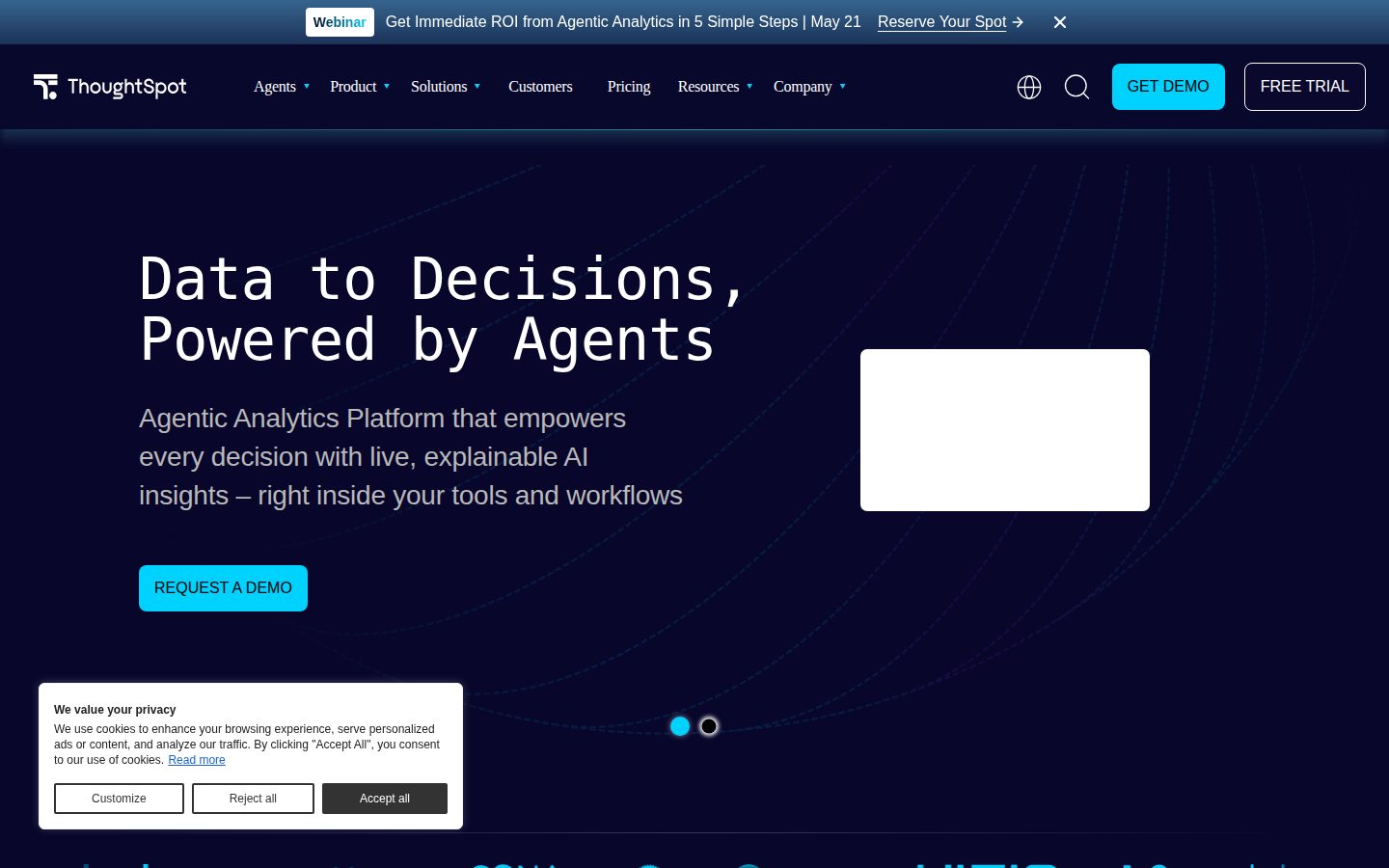
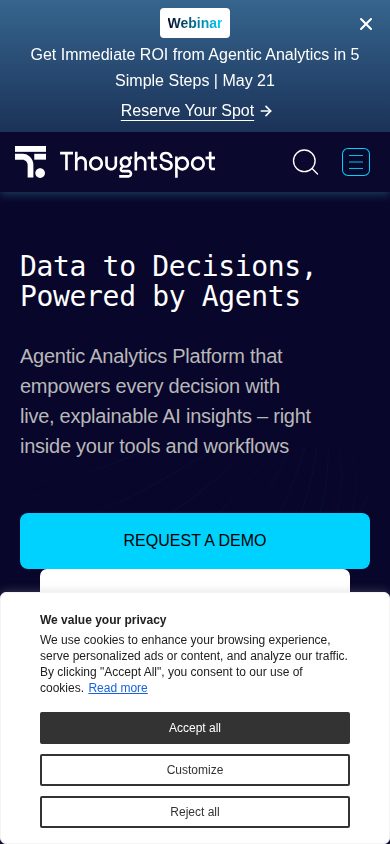
ThoughtSpot is a cloud analytics and business intelligence platform for enterprise teams seeking self-service data access.
AI Panel Score
6 AI reviews
Reviewed
AI Editor ApprovedApproved and published by our AI Editor-in-Chief after full panel analysis.In practice, users interact with ThoughtSpot by typing questions in plain language or using guided search against connected data sources. The platform returns visualizations, drill-down dashboards, and AI-generated summaries in real time. Analysts can go deeper using Analyst Studio, which supports SQL, R, and Python for more complex work, while business users stay in the search-and-click interface without needing to involve data engineering.
Several capabilities set ThoughtSpot apart from conventional BI tools. AI Agents operate autonomously to surface answers and flag trends without manual prompting. Smart Apps allow teams to embed analytics directly into external-facing products or internal workflows via APIs. The platform supports both real-time and cached data, and includes data preparation tools for joining and modeling data before analysis. Automated Insights proactively identify patterns in the data and present them to users without requiring a specific query.
ThoughtSpot targets mid-to-large enterprises with established data teams and a need to scale analytics access across business users — common deployments appear in retail, logistics, and technology sectors. Pricing is not publicly listed and typically requires contact with sales, placing it in the enterprise-contract tier. Competitors in this category include Tableau, Power BI, Looker, and Qlik.
ThoughtSpot is delivered as a cloud-based web application and also offers an Embedded Analytics SDK for integrating analytics into third-party products. It connects to major cloud data platforms including Snowflake, Google BigQuery, Amazon Redshift, and Databricks, and supports REST APIs for custom integrations.
Autonomous AI agents that deliver self-service data exploration backed by enterprise-grade trust, without requiring manual analyst intervention.
Interactive, endlessly-drillable visualizations that bring data insights to life with AI augmentation.
A dedicated environment that enables analysts to work with SQL, R, and Python to accelerate the path from raw data to insights.
Self-service business intelligence capabilities designed to drive business outcomes in an AI-first era.
AI-driven capability that automatically surfaces enterprise-grade insights, moving beyond manual analysis to deliver measurable ROI.
Enables users to prep, join, model, and shape data in real-time or cached form to make it ready for analysis.
Allows users to query data using natural language search so non-technical users can ask and answer data questions without writing code.
Embeds AI-powered insights directly into the applications and workflows where teams and customers already operate.
Connects ThoughtSpot insights into any data ecosystem and workflow, regardless of the underlying data stack.
Flexible APIs that allow AI-powered analytics and insights to be embedded into external products and customer-facing applications.
For small teams to find and share insights with AI analytics
For growing businesses looking for agentic AI analytics to drive decisions and growth
For large enterprises to transform BI with enterprise-grade agentic AI analytics
Free for 1 year for individuals and small developer teams to embed AI and analytics into apps
Flexible pricing for large-scale embedded agentic AI analytics applications
ThoughtSpot's agentic search beats Tableau for non-technical users who hate waiting on analysts.
“ThoughtSpot has been in market long enough to prove durability, and the Spotter AI Agent plus Natural Language Search solves a real bottleneck. The tradeoff: enterprise contract pricing means you won't know your real number until you've spent two months in procurement.”
ThoughtSpot isn't a startup bet. It's a named competitor to Tableau, Power BI, and Looker with cloud connections to Snowflake, BigQuery, Redshift, and Databricks already baked in. SpotterModel turning raw data into governed semantic models in minutes is the kind of feature that cuts a data team's backlog — that's real leverage.
The $25/month Essentials tier gets you natural language search up to 25M rows. Honest entry point. But most enterprise deployments will hit the Pro or Enterprise tier fast, and Enterprise is custom pricing behind a sales call. Budget for that cycle.
Two things to weigh. One: AI Agents operating autonomously sound great until governance teams ask who's responsible for the answer. Two: if your org isn't on a major cloud warehouse yet, this stack won't help you.
Embedded Analytics SDK and Smart Apps let you push insights into customer-facing products, which Power BI won't do cleanly at scale.
Named alongside Tableau and Looker in enterprise RFPs — adopting it won't raise board eyebrows.
Natural language search onboards business users fast, but the enterprise contract cycle will delay your start date by a quarter.
Automated Insights and Spotter AI Agent directly reduce analyst bottlenecks — that's advancing capability, not just cutting cost.
Long enough in market to survive multiple BI cycles, with Snowflake and Databricks integrations suggesting serious partnership depth.
Mid-to-large enterprises on a cloud data warehouse that need to scale self-service analytics without growing the analyst headcount.
Your data stack isn't cloud-native yet, or your procurement cycle can't absorb an enterprise contract negotiation.
ThoughtSpot's agentic layer is real infrastructure, not a chatbot wrapper on a legacy BI stack.
“SpotterModel doing semantic modeling in minutes with human-in-the-loop validation is the kind of governed self-service architecture that data teams have been trying to build manually for a decade. The embedded analytics play via SDK plus the Snowflake/BigQuery/Databricks connector surface means this sits natively in modern cloud data stacks.”
Natural Language Search plus Spotter AI Agent isn't just a UX feature — it's a governance bet. If your semantic layer is clean, business users get real answers. If it isn't, they get confidently wrong ones. SpotterModel addresses exactly that gap by generating governed semantic models with business-logic validation, which is the right architectural sequencing. The 250M row cap on the Pro tier at $50/month is generous for mid-market but will force enterprise contract conversations faster than buyers expect.
Analyst Studio supporting SQL, R, and Python keeps the ceiling high enough for serious analytical work without forcing analysts into a locked-down interface. That dual-mode design — search for business users, code environment for analysts — is architecturally sound and mirrors how mature data teams actually stratify work. Looker's LookML approach requires more engineering lift to achieve similar governance; ThoughtSpot's path is faster to deploy.
The embedded analytics SDK is a genuine differentiator if your roadmap includes customer-facing data products. SpotterViz automating Liveboard layout and story structure is a workflow accelerator, not a gimmick. The tradeoff: no changelog is publicly visible, which makes assessing release velocity and stability harder during vendor evaluation.
Agentic analytics with autonomous insight surfacing positions ThoughtSpot ahead of Looker and Power BI, which remain dashboard-first with AI layered on top.
Analyst Studio with SQL/R/Python plus a separate business-user search interface maps accurately to how enterprise data teams actually stratify analytical work.
Native connectors to Snowflake, BigQuery, Redshift, and Databricks plus REST APIs and an embedded SDK cover the modern cloud data stack almost completely.
Semantic layer investment compounds positively over time, but the 250M row Pro tier ceiling and opaque enterprise pricing create procurement risk at scale.
SpotterModel's governed semantic modeling with human-in-the-loop validation shows architectural maturity beyond basic NLP query tools.
Enterprise data teams that need to scale self-service analytics to non-technical business users without sacrificing semantic governance.
Your organization lacks a clean, modeled data layer in a cloud warehouse — ThoughtSpot's AI accuracy depends on what it's querying.
Essentials at $25/month looks cheap; Enterprise pricing is a black box.
“ThoughtSpot publishes partial pricing — Essentials at $25/month, Pro at $50/month — but Enterprise is contact-only with no floor disclosed. Three-year TCO for a 50-user enterprise deployment is genuinely unpredictable.”
Essentials: $25/month, 5–50 users, 25M row cap. Pro: $50/month, up to 1,000 users, 250M rows, Spotter AI Agent capped at 25 queries/month per user. That query cap is a real constraint — a team of 50 burning through 25 queries each hits 1,250 queries/month, then what? No published overage rate. That's the invoice risk, not the sticker.
Year-3 math on Pro for 50 users: $50 × 50 × 12 = $30K/year base. Add Analyst Studio as a paid add-on, standard 30% seat creep, and AI query overages — realistic all-in lands $45K–$55K annually. Compare to Power BI at $10/seat or Tableau Creator at $75/seat with known costs. ThoughtSpot's mid-tier math is competitive; the enterprise tier is opaque.
Contract terms aren't published. No auto-renewal window, no termination clause visible. Developer Embedded tier is free for one year — clean trial, but year-2 pricing is unspecified. Procurement teams will need a sales cycle before any number is real.
SMB tiers are self-serve; enterprise requires a full sales cycle, and the Developer Embedded free tier expires at 12 months with no stated successor price.
No auto-renewal window, cancellation terms, or term length visible on the pricing page — standard enterprise black box.
Essentials and Pro are published ($25/$50/month), but Enterprise and both Embedded tiers show 'free' as a placeholder with no actual price disclosed.
Automated Insights and Natural Language Search have measurable use cases — reduced analyst queue load — but no published benchmark data to anchor an ROI model.
Analyst Studio is an add-on on Pro, Spotter AI Agent has a 25-query/month/user cap with no published overage rate — year-3 TCO can't be modeled without a sales call.
Mid-market teams of 25–200 users on Pro tier who can tolerate a query cap and want AI-driven self-service without building a BI team.
You need predictable enterprise pricing before a sales cycle — the numbers aren't there without a negotiation.
ThoughtSpot's search-first model finally closes the gap between data teams and business users
“Natural language search plus autonomous Spotter AI agents give analysts real leverage to democratize data access at enterprise scale. The 250M row cap on Pro and opaque enterprise pricing are the daily negotiating realities.”
Analyst Studio supporting SQL, R, and Python in the same platform where a CFO types plain-English questions — that's genuinely rare. Most BI tools force a choice: power-user depth OR self-service simplicity. ThoughtSpot's architecture attempts both simultaneously. SpotterModel building governed semantic models from raw data with human-in-the-loop validation is the kind of data governance feature that saves analysts hours of back-channel Slack threads correcting rogue metric definitions.
The $50/month Pro tier caps at 250M rows and 25 Spotter AI queries per user monthly. For active analytics environments that's a ceiling that shows up fast. Tableau and Power BI don't meter AI queries per seat. That query cap is a daily friction point worth pricing carefully before committing.
Embedded Analytics SDK plus Slack integration means insights can surface where decisions actually get made, not just in a dashboard portal nobody bookmarks. The changelog is absent from public-facing docs — for an analyst tracking platform evolution quarter over quarter, that's a gap. SpotterViz automating full Liveboard layout and story structure is the kind of workflow accelerant that earns adoption past day three.
Natural language search reduces ticket volume to data teams, but the 25 Spotter AI query/month/user limit on Pro creates rationing friction in high-frequency analytics environments.
Docs confirmed present with API coverage, but absence of a public changelog suggests documentation skews toward new-user orientation over practitioner depth.
No public changelog makes it harder to track what changed between releases, and Pro's 250M row cap means data volume conversations happen at renewal, not onboarding.
Analyst Studio with SQL, R, and Python alongside SpotterModel for semantic layer governance gives technical users a real environment, not just a pretty front-end.
Slack integration and Salesforce embedded analytics put insights inside existing workflows rather than demanding a context switch to a separate BI portal.
Mid-to-large enterprises with established Snowflake or Databricks stacks that need to scale analytics access to non-technical business users without expanding the data team headcount.
Your team runs high-frequency ad hoc querying at scale and won't tolerate per-user AI query metering on a monthly cap.
Natural language BI that actually works for non-analysts, at an enterprise price
“ThoughtSpot's search-driven interface and AI agents give business users real data independence without routing everything through a data team. The pricing floor starts at $25/month but enterprise reality means a sales call.”
The Natural Language Search feature is the core pitch and it's a genuinely different approach from Tableau or Power BI — you type a question, you get a chart, no one has to file a ticket. Spotter AI Agent sits on top of that, working autonomously to surface answers without a prompt. SpotterViz building a full Liveboard automatically is the kind of thing that saves a real hour of dashboard wrangling. That's not demo magic, that's daily time back.
The Essentials tier at $25/month handles up to 25M rows, which is a reasonable starting point. But Analyst Studio — where SQL, R, and Python live — is an add-on on the Pro tier. That's a friction point if your analysts want depth and business users want ease in the same account.
Web-only with no mobile parity is the quiet limitation nobody mentions in the pitch. For a tool that's supposed to get data to anyone, anywhere, read-only mobile or nothing is a shrug. Day three you won't miss it. Month three, someone on your team will.
AI-augmented dashboards and SpotterViz automating layout and styling suggest real attention to the daily workflow, not just feature checklists.
Natural language search flattens the floor for new users, and Analyst Studio with SQL/R/Python handles the ceiling, but discovering where one ends and the other begins takes time.
Web-only platform with no listed mobile app — for a self-service analytics tool targeting business users everywhere, that's a real gap.
Free trial exists and natural language search is a low-barrier entry point, but Analyst Studio as an add-on creates a two-speed onboarding depending on your role.
Real-time and cached data support plus enterprise-grade trust framing in AI Agents docs suggests the team has thought about consistency, though no changelog is public to verify.
Mid-to-large enterprises that want to hand data access to business users without scaling up the analyst headcount.
You need mobile analytics access or want transparent enterprise pricing without a sales process.
Real product, real moat — but the pricing page tells two stories
“ThoughtSpot has genuinely differentiated search-driven analytics and an embedded SDK that Tableau can't easily match. The gap between $25/month Essentials and 'call us for Enterprise' is wider than it looks.”
Three tells upfront. One: 'Agentic Analytics Platform' is exactly the kind of label that'll need explaining in two years. Two: no changelog visible — I can't verify shipping cadence from public evidence. Three: the $25 Essentials tier caps at 25M rows; the Pro tier at 250M. That's actually honest scoping, not typical enterprise bait-and-switch.
The differentiated pieces are real. Natural Language Search plus Spotter AI Agent isn't just Tableau with a chatbot layered on. SpotterModel handling semantic layer generation is a genuine workflow unlock for data teams drowning in dbt maintenance. Analyst Studio adding SQL, R, and Python keeps this from being a toy. The embedded SDK has a free developer tier for 12 months — that's a serious distribution play competitors like Qlik haven't matched cleanly.
The exit story worries me more than the product. Data models built inside ThoughtSpot's semantic layer don't port cleanly to Looker or Power BI. If they pivot pricing or get acquired — they've had acquisition rumors before — you're re-modeling. That's the real tradeoff here.
Natural language search plus embedded analytics SDK plus AI agent layer is a genuine combination — Tableau and Power BI don't offer the same out-of-product distribution story at this maturity level.
Semantic models built in ThoughtSpot's proprietary layer won't migrate cleanly; the embedded SDK dependency makes switching even harder for teams that've built customer-facing products on it.
No public changelog, no listed funding round in the evidence, but named integrations with Snowflake, BigQuery, Redshift, and Databricks suggest infrastructure-level partnerships that reduce single-point-of-failure risk.
'Agentic Analytics Platform' is aspirational labeling; the actual features like Spotter AI Agent and SpotterViz are concrete, but the homepage H1 leads with 'Spotter for Industries' which tells me almost nothing.
ThoughtSpot has survived where Domo stalled and MicroStrategy aged poorly — the search-first model has proven stickier than expected, and enterprise deployments in retail and logistics suggest real production use.
Mid-to-large enterprises that want to hand data exploration to non-technical business users without rebuilding their data stack.
You're a small team that might outgrow the Pro tier's 25-query AI cap or need clean exit options in 18 months.
Common questions answered by our AI research team
Yes, ThoughtSpot integrates with Salesforce, delivering insights directly inside Salesforce as part of its embedded analytics capabilities.
SpotterViz is a dashboarding agent that turns data into a complete Liveboard automatically—planning the story, generating answers, and handling structure, layout, and styling in minutes.
Yes, non-technical users can query data using natural language search and receive AI-generated answers, charts, and dashboards without writing any code.
Yes, ThoughtSpot works inside Slack as a listed integration, delivering insights where users work.
SpotterModel turns raw data into governed semantic models in minutes, mapping relationships, dimensions, and measures guided by business logic, with human-in-the-loop validation to keep definitions consistent.
Company
ThoughtSpot, Inc.Founded
2012Pricing
From $25/moFree Trial
Available


ThoughtSpot is a Sunnyvale-based analytics platform that enables business users to query data using natural language search and AI-generated insights.