Qdrant logo

Qdrant Review

Visit

Open-source vector database for AI applications and semantic search

Qdrant is a vector database designed for storing and searching high-dimensional vectors used in AI and machine learning applications.

Qdrant·Founded 2021·From $25/moFree PlanFree TrialLLM PlatformsAI APIsAI AnalyticsAI CloudAI Data ToolsAI DevOps

AI Panel Score

8.0/10

6 AI reviews

Reviewed

AI Editor Approved

About Qdrant

Qdrant is an open-source vector database built specifically for handling high-dimensional vector data used in modern AI and machine learning applications. It provides efficient storage, indexing, and similarity search capabilities for vector embeddings generated by neural networks, making it suitable for applications like semantic search, recommendation engines, and retrieval-augmented generation (RAG) systems.

The database offers both exact and approximate nearest neighbor search algorithms, with support for filtering and payload-based queries. Qdrant can handle various distance metrics including cosine similarity, dot product, and Euclidean distance. It features horizontal scaling capabilities, real-time indexing, and ACID compliance for production workloads.

Qdrant targets developers, data scientists, and organizations building AI-powered applications that require fast vector similarity search. It competes with other vector databases like Pinecone, Weaviate, and Milvus in the growing vector database market. The platform offers both self-hosted open-source deployment options and managed cloud services.

Key technical features include support for multiple vector types, payload filtering, distributed deployment, and integration with popular machine learning frameworks. Qdrant provides REST and gRPC APIs, along with client libraries for Python, Rust, Go, and other programming languages, making it accessible to developers across different technology stacks.

Features

Analytics

  • Cluster Monitoring

    Provides metrics, logs, and alerts for Qdrant Cloud clusters to enable performance monitoring and observability.

Automation

  • Managed Cloud Service

    Offers a hosted managed cloud deployment so users can run Qdrant without managing their own infrastructure.

Core

  • Advanced Filtering

    Provides filtering capabilities that can be applied during vector searches to enable precise retrieval of matching results.

  • GPU Support

    Supports running Qdrant with GPU acceleration to enhance indexing and search performance.

  • Hybrid Search

    Combines dense and sparse vector support to enable hybrid search capabilities through the Query API for enhanced retrieval quality.

  • Multivector Representations

    Allows use of multiple vector representations per document to improve document retrieval precision and quality.

  • Snapshots

    Supports creation and restoration of collection snapshots for data protection and backup management.

  • Sparse Vector Support

    Supports sparse vectors alongside dense vectors to enable efficient vector-based hybrid search.

  • Vector Similarity Search

    Stores, indexes, and retrieves high-dimensional vectors to perform fast and scalable vector similarity search operations.

Customization

  • Hybrid Cloud Deployment

    Supports hybrid cloud cluster creation and operator configuration for deploying Qdrant across mixed infrastructure environments.

Integration

  • Platform & Framework Integrations

    Offers integrations with popular platforms and frameworks to enable seamless embedding of Qdrant into existing AI and data pipelines.

Security

  • Role-Based Access Control (RBAC)

    Provides cloud RBAC with a permission reference system for managing access control and securing cloud resources.

Preview

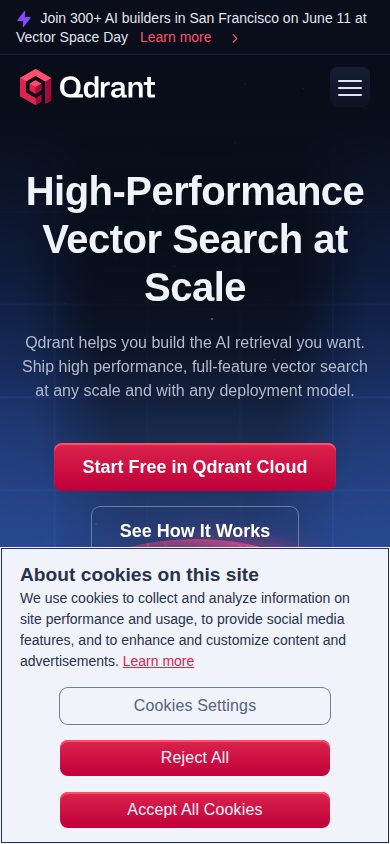
Qdrant mobile preview

Pricing Plans

Free Tier

Free

For testing and prototypes

  • Single Node Cluster
  • 0.5 vCPU / 1GB RAM / 4GB Disk
  • Free Cloud Inference With Selected Models
  • Community Support
Popular

Standard Tier

Contact sales

For production workloads and scaling applications

  • Dedicated Resources
  • Flexible Vertical and Horizontal Scaling
  • Highly Available Setups
  • Backup & Disaster Recovery
  • Free Tokens for Paid Inference Models
  • 99.5% Uptime SLA

Premium Tier

Contact sales

For enterprises with additional security and compliance needs

  • SSO
  • Private VPC Links
  • 99.9% Uptime SLA
  • Extra Support (24/7)
  • Premium Support Response Times

Hybrid Cloud

Contact sales

Run managed Qdrant clusters on your own infrastructure using your compute, network and storage

  • Local Data Residency
  • Data Stays in Your Network
  • Fully Managed Through Qdrant Cloud
  • Production-Grade Uptime
  • Supports Regulated Workloads

Private Cloud

Contact sales

Dedicated, isolated deployment for strict security or compliance needs

  • Custom SLAs
  • Full Isolation
  • Air-Gapped Setups Support
  • Best for Large Enterprises and Sensitive Workloads

AI Panel Reviews

The Decision Maker

The Decision Maker

Strategic bet, vendor viability, timing, adoption approval
8.2/10

Qdrant doubled its raise on Bosch and HubSpot running in production — the open-source bet has a moat.

AVP led a $50M Series B in March 2026, bringing Qdrant to $87.8M total raised. The harder question is whether to standardize before Pinecone's managed convenience locks the org in elsewhere.

Canva, HubSpot, Bosch, Tripadvisor, and OpenTable run Qdrant in production. That's the logo wall a CIO can defend without a memo. Spark Capital and Bosch Ventures both wrote checks in the March 2026 round — that tells you what the strategic buyers think.

The substance is the Rust core and Hybrid Cloud. Andrey Vasnetsov built the engine in Rust from scratch — that's a performance moat Pinecone can't copy without a rewrite. Hybrid Cloud keeps vectors on your own infrastructure under Qdrant's managed plane, which is the regulated-workload play your CISO will actually approve.

The catch is the pricing surface. Standard and Premium tiers ship without published prices — you're in sales-led quotes once you outgrow the free 1GB cluster. Pilot on the free tier for 60 days. Get Standard quoted in writing before you commit.

Competitive Positioning8.0

Pinecone still owns the managed-only buyer, but Qdrant's open-source plus Hybrid Cloud is the stronger board story.

Reputation Risk8.3

Canva, HubSpot, Bosch, Tripadvisor, and OpenTable in production make this an easy slide for any board.

Speed to Value8.0

Free 1GB cluster plus REST, gRPC, and Python and JavaScript clients lets engineers prototype before procurement.

Strategic Fit8.2

RAG and semantic search are direction-of-travel, and Hybrid Cloud is the right shape for regulated AI workloads.

Vendor Viability8.5

$87.8M raised across two rounds with Spark Capital, AVP, and Bosch Ventures — vendor existence is settled.

Pros

  • Open-source Rust core means the performance work transfers to self-hosted, with no vendor lock-in on the engine itself.
  • Hybrid Cloud is the right answer for regulated workloads — your data stays in your VPC, Qdrant manages the plane.
  • Canva, HubSpot, Bosch, and Tripadvisor in production validates the scale story without a Gartner quote.
  • Free tier gives you a real 1GB cluster to prototype before any procurement conversation.

Cons

  • Standard and Premium pricing is sales-led — no public number until you talk to someone.
  • Pinecone still owns the managed-only buyer who doesn't want to think about deployment.
  • Standard tier ships without automated shard rebalancing — that's a Premium-only operation.

Right for

Engineering teams who run RAG and semantic search in regulated environments.

Avoid if

Solo developers who just need a local prototype with sqlite-vss.

The Domain Strategist

The Domain Strategist

Craft and strategy in the product's domain — adapts identity per category, same lens
8.3/10

Rust substrate plus a self-hostable cloud is the architectural bet most AI platform teams should defend.

Qdrant runs the same engine in OSS, Managed, Hybrid, and Private Cloud — that optionality is the architectural hedge against Pinecone-style lock-in. The Rust core gives you 30-40ms p99 latency at 100M vectors and a Query API that fuses dense, sparse, and multivector retrieval in one call.

Berlin-based, founded 2021, Rust core. That stack choice isn't decorative — it's why Qdrant lands p99 in the 30-40ms band on 100M-vector workloads where Weaviate's JVM tax shows. Andrey Vasnetsov and Andre Zayarni built the engine before they built the cloud.

The Query API fuses dense, sparse, and multivector retrieval in one request — the shape RAG actually wants. Pinecone gives you a polished managed surface and no exit ramp. Qdrant's Hybrid Cloud tier keeps the data plane on your VPC while the control plane stays managed — the right answer for regulated AI workloads.

The catch is the Standard Tier line that reads 'no automated shard rebalancing.' That's the operational tax below the Premium SKU, and it bites whenever you reshape collections at scale. Spark Capital led a $28M Series A in January 2024, but the open-core model means strategic features land in the cloud first.

Category Positioning8.3

Sits at the top of the vector DB pack against Pinecone, Weaviate, and Milvus per public benchmarks.

Domain Fit8.4

Hybrid Cloud and Private Cloud match how regulated AI platform teams actually need to deploy.

Integration Surface8.2

REST and gRPC plus Python, JavaScript, Rust, and Go clients cover the realistic stack surface.

Long-term Implications8.0

Open-core means strategic features land in cloud first, but OSS exit ramp keeps optionality intact.

Strategic Depth8.5

Rust core, HNSW, multivector, and the Query API show engine-first craft above category norm.

Pros

  • Rust core delivers p99 latency in the 30-40ms band on 100M-vector workloads — performance ceiling above Weaviate.
  • Query API fuses dense, sparse, and multivector retrieval in a single request — the architectural shape modern RAG needs.
  • Hybrid Cloud and Private Cloud tiers keep data on your VPC while Qdrant runs the control plane — clean answer for regulated workloads.
  • Spark Capital led a $28M Series A in January 2024, plus a real OSS community gives the project durable runway.

Cons

  • Standard Tier explicitly excludes automated shard rebalancing — collection reshaping at scale is hands-on until Premium.
  • Strategic security features like SSO and Private VPC Links land in the cloud SKUs first, not the OSS build.
  • Smaller mind share than Pinecone among teams that just want the easiest hosted endpoint.

Right for

AI platform teams who need a vector substrate they can self-host today and lift to managed cloud later.

Avoid if

Solo developers who just want a hosted endpoint and zero ops surface.

The Finance Lead

The Finance Lead

Money, total cost of ownership, contracts, procurement math
7.9/10

Qdrant Cloud bills hourly on vCPU and RAM — open-source escape hatch keeps the lock-in math honest.

Managed Cloud starts at $25/month with usage-based hourly billing across vCPU, RAM, storage, and backups. The catch is SSO and Private VPC sit behind Premium, with no published rate.

Qdrant Cloud bills by the hour. vCPU, RAM, storage, backup volume — line items, not seats. No per-query charge, no per-vector tax. Compare to Pinecone's pod-hour shape: different floor, same procurement question.

Free tier runs 0.5 vCPU and 1GB RAM — useful for prototypes, not load. Standard starts at $25/month per cluster with a 99.5% SLA. Premium goes to 99.9% and bundles SSO and Private VPC Links. A 50-engineer team across three Standard clusters at $200 each lands near $7,200/year.

The catch is Premium pricing isn't published. Hybrid Cloud and Private Cloud sit behind sales. Standard also omits automated shard rebalancing per the docs. However, the Apache 2.0 self-host path is the real negotiation lever, and Spark Capital's $28M Series A in January 2024 makes the OSS commitment look durable.

Billing & Procurement7.5

Hourly invoicing line-items compute, memory, and storage; inference tokens billed separately for paid models.

Contract Flexibility8.5

Apache 2.0 self-host option keeps every renewal honest and the OSS migration tool is documented.

Pricing Transparency7.0

Standard usage-based and Free tier are public; Premium, Hybrid, and Private Cloud are sales-gated.

ROI Clarity7.5

Cluster-level metrics, logs, and alerts in the dashboard make per-workload cost attribution measurable.

Total Cost of Ownership8.0

Hourly resource billing avoids per-vector or per-query overage surprises common with Pinecone.

Pros

  • Free tier and Standard tier prices are visible without a sales call.
  • Hourly resource-based billing scales with actual cluster load — no per-query surprises.
  • Apache 2.0 self-host path provides a credible exit lever for renewal negotiation.
  • Hybrid Cloud option lets data stay in your own VPC for regulated workloads.

Cons

  • Premium, Hybrid Cloud, and Private Cloud tiers have no published pricing.
  • SSO and Private VPC Links are gated behind Premium — common SSO-tax pattern.
  • Standard tier excludes automated shard rebalancing per the documentation.

Right for

Engineering teams who want usage-based vector search billing without seat math.

Avoid if

Procurement teams who need every tier published before signing.

The Domain Practitioner

The Domain Practitioner

Daily hands-on reality in the product's domain — adapts identity per category, same lens
8.1/10

Qdrant's Query API folds dense, sparse, and ColBERT reranking into one round trip — RAG plumbing stops sprawling.

Built on Rust with HNSW under the hood, Qdrant ships hybrid retrieval and RRF fusion in a single Query API call. The Standard cluster floor at $25/month and Spark Capital's $28M Series A make it a defensible bet for a RAG backend.

The retrieval layer is where every RAG project bleeds time. Qdrant's Query API collapses dense + sparse + RRF fusion + ColBERT reranking into one round trip — no orchestration code stitched across BM25 and a vector store. Compare Pinecone where reranking still means a second client call.

Multivector support handles ColBERT-style late interaction without forcing you to flatten 32 token vectors into one. Payload filters apply pre-search, not post — the docs are explicit about indexed payload fields and the gRPC schema matches the REST schema field-for-field. Rust under the hood means the Free tier's 1GB RAM goes further than Python-stack rivals.

The catch is the Standard tier billing model — compute, RAM, storage, and inference tokens metered hourly from $25/month, but no automated shard rebalancing, so horizontal scale-out still means manual operator work. Backed by Spark Capital's $28M Series A from January 2024.

Day-3 Reality8.0

Query API collapses hybrid retrieval into one call, removing a real daily friction in RAG plumbing.

Documentation Practitioner-Fit8.0

Docs explicitly cover indexed payload fields, schema parity, and OSS-to-Cloud migration tooling.

Friction Surface7.5

No automated shard rebalancing on Standard tier and hourly metered billing add cognitive overhead.

Power-User Depth8.3

Multivector, ColBERT reranking, sparse vectors, GPU acceleration, and Hybrid Cloud span beginner to advanced.

Workflow Integration8.2

REST plus gRPC with Python, JS, Rust, and Go clients fit existing stacks without retooling.

Pros

  • Universal Query API merges dense, sparse, and ColBERT reranking in one round trip.
  • Rust core delivers strong RAM efficiency on the 1GB Free tier cluster.
  • Schema parity between REST and gRPC clients keeps polyglot stacks honest.
  • Hybrid Cloud option keeps data residency in your VPC while Qdrant operates the control plane.

Cons

  • Standard tier explicitly excludes automated shard rebalancing.
  • Hourly metered billing on compute, RAM, storage, and inference tokens makes monthly forecasting harder than flat pricing.
  • SSO and Private VPC Links require Premium tier and a sales conversation.

Right for

ML engineers who build RAG pipelines on managed infrastructure.

Avoid if

Teams who need automated shard rebalancing on the Standard tier.

The Power User

The Power User

Daily human experience, onboarding, polish, learning curve, reliability
7.9/10

Qdrant's free tier runs forever on 1GB, and that small choice tells you who they built it for.

The free 1GB cluster fits roughly 250,000 vectors and never expires, which is rare in this category. The catch is the Standard tier scales horizontally but skips automated shard rebalancing, so growth still wants planning.

The free tier tells you a lot. Most vector databases throttle you into a paid plan inside two weeks — Pinecone's starter is generous but pushes you toward pods fast. Qdrant's free 1GB cluster sits there indefinitely, fits about 250,000 vectors at 768 dimensions, and asks for no credit card.

Day thirty is when you find the Query API. Hybrid Search through one endpoint — dense and sparse vectors fused at the database, not stitched in your app code. Multivector Representations show up in the same call. Weaviate covers similar ground but the docs make you work harder.

The catch is the rough edges around scale. Standard tier scales horizontally but the pricing page admits there's no automated shard rebalancing — your team plans the resharding. Premium adds SSO and Private VPC Links with a 99.9% SLA, but pricing is on request.

Daily Polish8.0

Pricing page lists every tier on one screen and the Rust core shows in response feel.

Learning Curve7.7

REST, gRPC, Python and JavaScript clients are easy day one, but advanced Hybrid Search needs reading.

Mobile Parity7.5

Backend vector database — mobile is not the use case, scored neutral per category norm.

Onboarding Experience8.2

Free 1GB cluster with no credit card and a published quick-start lowers the cost of trying.

Reliability Feel7.8

Snapshots and ACID compliance ship, but Standard tier explicitly lacks automated shard rebalancing.

Pros

  • Free 1GB cluster runs indefinitely with no credit card, fitting roughly 250,000 vectors at 768 dimensions.
  • Query API fuses dense and sparse vectors at the database with Hybrid Search and Multivector Representations.
  • Open-source Rust codebase paired with REST and gRPC plus official Python and JavaScript clients.
  • Hybrid Cloud lets regulated teams keep data in their own network while Qdrant manages the cluster.

Cons

  • Standard tier scales horizontally but does not include automated shard rebalancing, so resharding is manual.
  • Premium tier pricing for SSO and Private VPC Links is on request rather than published.
  • Documentation for advanced multivector and hybrid setups assumes more vector-search fluency than newcomers may have.

Right for

Developers who want a self-hostable vector store with a generous free tier.

Avoid if

Teams who need automated shard rebalancing without manual planning.

The Skeptic

The Skeptic

Contrarian. Watch-outs, deal-breakers, broken promises, category patterns
7.4/10

Qdrant closed $50M Series B in March 2026 while Pinecone was reportedly weighing a sale.

Andrey Vasnetsov and Andre Zayarni built Qdrant in Rust from Berlin in 2021; the cadence and the $87.8M raise hold up. The yellow flag isn't Qdrant — it's the category consolidating into Postgres extensions before vector DB winners are crowned.

Berlin, 2021. Andrey Vasnetsov and Andre Zayarni built this in Rust. Series B closed at $50M in March 2026, led by AVP — total raise sits at $87.8M. The team is real and the cadence held.

The product evidence is real. Hybrid Cloud lets you run managed Qdrant on your own VPC — that's the exit hatch most vector DBs don't ship. Multivector Representations and Query API hybrid fusion are concrete, not category words. Free tier starts at $0, managed cloud from $25/month.

But the category itself is the worry. Vector DBs are consolidating into Postgres extensions like pgvector and into OLTP stores. Pinecone was reportedly weighing a sale by August 2025. Milvus is open-source too. Qdrant's moat is Rust performance and that Hybrid Cloud option. Worth a 12-month bet, not a five-year one.

Competitive Differentiation6.8

Hybrid Cloud and Rust perf are real, but Pinecone, Weaviate, Milvus, and pgvector make this a crowded space.

Exit Portability8.2

Apache 2.0 self-hosted option, REST and gRPC APIs, plus Hybrid Cloud means migration off is clean if direction shifts.

Long-term Viability7.0

$50M Series B in March 2026 led by AVP is fresh runway, but category consolidation into Postgres extensions is the real watch.

Marketing Honesty8.0

Landing page leads with "vector search engine in Rust" — grounded, not aspirational, and the docs back it up.

Track Record Match7.0

Rust plus open-source plus steady changelog matches surviving infrastructure patterns, but the vector DB cohort itself is shaky.

Pros

  • Open-source under Apache 2.0 with managed cloud option — clean exit hatch if direction shifts.
  • Series B closed at $50M in March 2026 led by AVP — fresh runway with Bosch Ventures and Spark Capital backing.
  • Rust implementation delivers real performance advantage that Python-stack competitors struggle to match.
  • Hybrid Cloud lets regulated workloads stay in-network while remaining fully managed through Qdrant Cloud.

Cons

  • Vector DB category is consolidating into pgvector and OLTP stores — cohort risk is concrete, not theoretical.
  • Pricing page hides Standard and Premium tier dollar amounts behind sales conversations.
  • No automated shard rebalancing on Standard Tier despite the horizontal-scaling claim on the pricing page.

Right for

Engineering teams who run RAG and similarity search at production scale.

Avoid if

Solo developers who already use pgvector for small workloads.

Buyer Questions

Common questions answered by our AI research team

Features

Does Qdrant's Standard Tier support horizontal scaling with automated shard rebalancing?

The Standard Tier supports horizontal up and downscaling, but the pricing page notes there is "no automated shard rebalancing" for this tier. So while horizontal scaling is available, automated shard rebalancing is not included.

Pricing

How is Qdrant Cloud billing calculated — is it per query, per vector stored, or based on compute and memory resources?

Qdrant Cloud billing is based on actual resource usage — specifically compute (vCPU), memory (GB), storage (GB) consumed by clusters, storage (GB) consumed by backups, and inference tokens used for paid models. Usage is billed hourly and can be monitored through the Qdrant Cloud dashboard. It is not per query or per vector stored.

Security

Does the Premium Tier include Private VPC Links and SSO (SAML/OIDC) support for enterprise security requirements?

Yes, the Premium Tier includes both Private VPC Links and Enterprise SSO Authentication. The homepage also lists SSO (SAML/OIDC) as part of the enterprise-ready tooling, confirming support for those protocols.

Setup

Can I migrate my existing self-hosted Qdrant OSS deployment to Qdrant Cloud, and is there a migration tool available?

Yes, you can migrate from an existing Qdrant OSS deployment to Qdrant Cloud. Qdrant provides a migration tool and documentation to help with the transition, as stated in the FAQ section.

Integration

Does Qdrant integrate with Python and JavaScript clients, and does it support REST and gRPC APIs out of the box?

Yes, Qdrant supports official clients for Python and JavaScript, and provides both REST and gRPC APIs. The homepage states developers can "start with a single API call — scale to advanced control over HNSW, hybrid fusion, reranking, and multi-vector retrieval, all via REST, gRPC, or official clients (Python, JavaScript, etc.)."

Product Information

  • Company

    Qdrant
  • Founded

    2021
  • Pricing

    From $25/mo
  • Free Trial

    Available
  • Free Plan

    Available

Platforms

weblinuxmacwindows

About Qdrant

Qdrant is an open-source vector database and similarity search engine written in Rust, headquartered in Berlin. It provides a service for storing, searching, and managing high-dimensional vectors with a REST and gRPC API.

Resources

Documentation
API
Blog
Changelog

Also in LLM Platforms