Tsenta logo

Tsenta Review

Visit

An agent that finds, tailors, and submits your job applications

Tsenta is an AI job application agent for job seekers applying across many companies at once.

AI Panel Score

6.9/10

6 AI reviews

Reviewed

Facts checked against tsenta.com

AI Editor Approved

About Tsenta

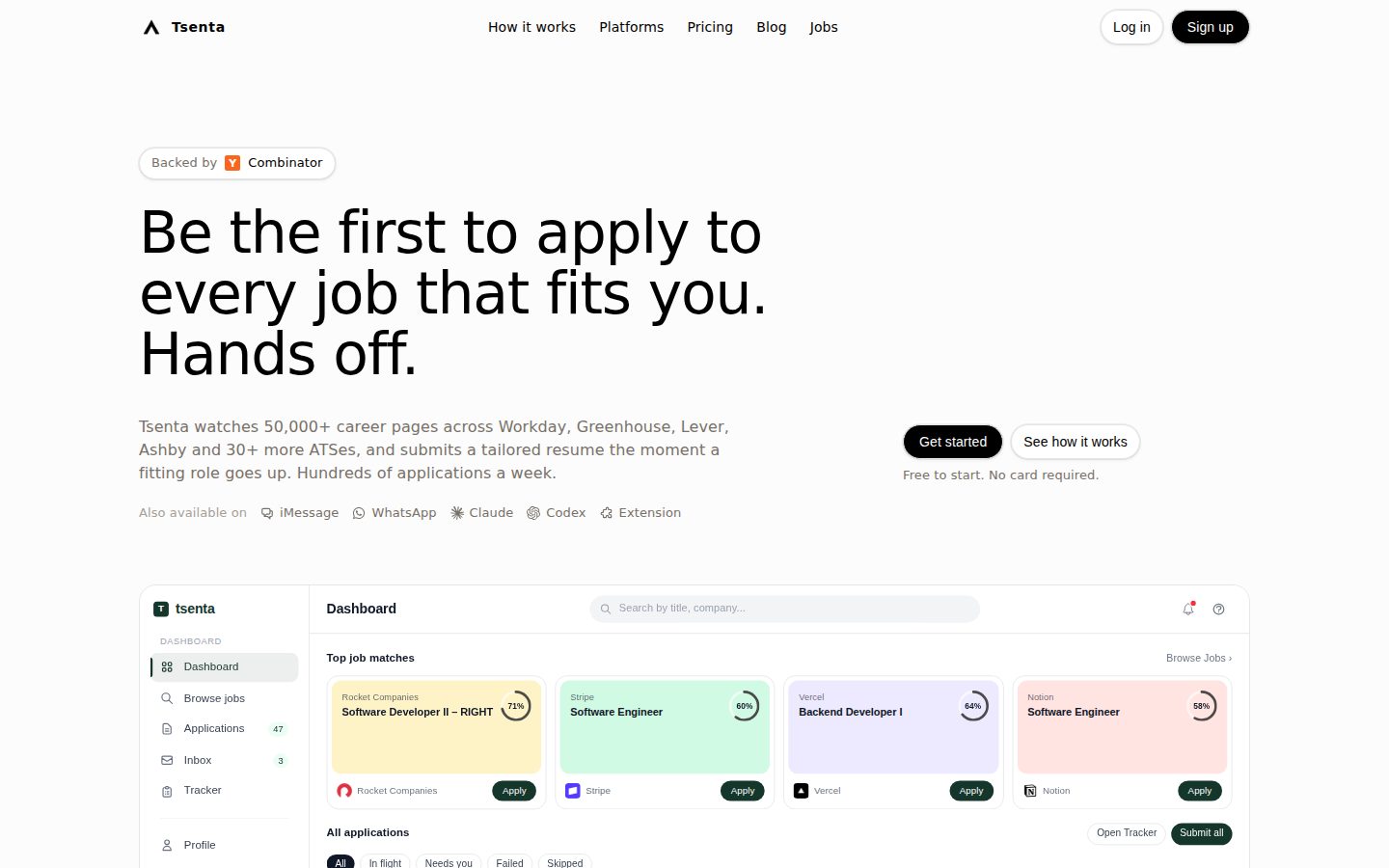
Tsenta works in four stages: find, prep, apply, and track. It monitors career pages for new postings that match a user's resume and surfaces them, according to the site, hours before they appear on LinkedIn or Indeed. For each match, it generates a per-role resume and cover letter with keyword alignment and ATS-safe formatting, then opens the application form and submits it, handling login steps, standard fields, open-ended screening questions in the user's voice, and document uploads. Recruiter email replies are then matched back to the corresponding application to keep status updated.

The product publishes individual integration pages for each ATS it supports, covering platforms such as Workday, Greenhouse, Lever, Ashby, iCIMS, SAP SuccessFactors, SmartRecruiters, Workable, BambooHR, JazzHR, Rippling, ADP, Oracle Cloud, Paylocity, UKG (UltiPro), Dayforce, BrassRing, Jobvite, Recruitee, Teamtailor, BreezyHR, Zoho Recruit, Gem, Dover, Pinpoint, Phenom, Polymer, Join, and Hireology — each page describes the specific steps that ATS requires (account creation, verification codes, multi-page forms, custom screening questions) and how Tsenta automates them. Every application can be watched live or reviewed later via a recording, which the site frames as a transparency feature distinguishing it from tools that submit applications silently.

Tsenta is built for active job seekers applying at high volume across multiple companies, including software engineers, product managers, and designers, particularly those targeting employers on complex ATSes like Workday where the site says manual form-filling can take 20-45 minutes per application. The product offers 25 free applications to start, with further pricing details, per-application cost, and what counts as an application described on its pricing page.

Tsenta is available on the web, as native iOS and Android apps, via iMessage and WhatsApp (where a match triggers a text and a reply of "apply" submits it), as a Chrome extension for applying from any job page, and as an MCP server and CLI for use with agents like Claude Code and OpenClaw.

Features

AI

  • Per-Role Resume and Cover Letter Tailoring

    Generates a tailored resume and cover letter for each role based on the actual job description, with keyword alignment and ATS-safe formatting.

Analytics

  • Application Tracking Pipeline

    Matches incoming recruiter emails to the right application and updates status automatically, turning the inbox into a tracked pipeline.

Automation

  • Auto-Apply Across ATSes

    Submits applications directly on 30+ applicant tracking systems including Workday, Greenhouse, Lever, Ashby, iCIMS, and others, handling login, form fields, screening questions, and document uploads.

  • Career Page Monitoring

    Watches over 50,000 company career pages and alerts users the moment a matching role is posted, often before it appears on LinkedIn or Indeed.

  • Watch or Headless Application Mode

    Lets users watch each application happen in real time or run the process headlessly and review a recording afterward.

Core

  • Change Preview Before Submission

    Shows every change made to a resume or application before it is sent, so users can review edits prior to submission.

  • Job Board

    Provides a browsable board of curated job openings sourced from supported ATSes.

  • Web Dashboard

    Combines a discovery feed, application queue, and recruiter inbox into a single web-based interface.

Integration

  • Chrome Extension

    Allows users to trigger an application directly from any job posting page on the web.

  • MCP Server / CLI

    Exposes an MCP server and command-line interface so tools like Claude Code or other AI agents can invoke Tsenta's application capabilities.

Mobile

  • Messaging-Based Applications

    Surfaces job matches via iMessage or WhatsApp and lets users reply to trigger an application to be submitted in the background.

  • Native Mobile Apps

    Offers native iOS and Android apps for discovering matches and managing applications on the go.

Preview

Tsenta desktop previewTsenta mobile preview

Pricing Plans

Free

Free

First 25 applications free, no credit card required — try the full agent before paying.

  • 25 total applications, no credit card required
  • Full Find, Prep, Apply, Track agent included
  • Résumé and cover letter tailored per role
  • All 30+ supported employer systems including Workday
  • Available on web, iOS, Android, Chrome, iMessage, WhatsApp, MCP
  • Nothing to cancel

Starter

$19/monthly

Enough for a focused, real job search against a short list of target companies.

  • 600 applications per 30-day cycle
  • Full four-stage agent included (Find, Prep, Apply, Track)
  • Résumé and cover letter tailored per role
  • All 30+ supported employer systems including Workday
  • Receipt for every application
  • Cancel any time, one click
Popular

Pro

$39/monthly

For the desperate, the laid-off, and OPT-clocked candidates running against a deadline; usual fit for new grad or OPT searches.

  • 1,500 applications per 30-day cycle
  • Full four-stage agent included (Find, Prep, Apply, Track)
  • Résumé and cover letter tailored per role
  • All 30+ supported employer systems including Workday
  • Receipt for every application
  • Cancel any time, one click

Power

$99/monthly

For hitting every single match the moment it appears, ideal for broad functions or multi-city searches.

  • 4,500 applications per 30-day cycle
  • Full four-stage agent included (Find, Prep, Apply, Track)
  • Résumé and cover letter tailored per role
  • All 30+ supported employer systems including Workday
  • Receipt for every application
  • Cancel any time, one click

AI Panel Reviews

The Decision Maker

The Decision Maker

Strategic bet, vendor viability, timing, adoption approval
6.8/10

An auto-apply agent for a game the board should ask us why we're playing.

“Tsenta submits real applications across 30+ ATSes at volume, with receipts and previews. The question is whether volume-applying is a capability we want our name near.”

600 applications a month for $19. That's the Starter tier. Pro at $39 gives you 1,500, pitched at "the desperate, the laid-off, and OPT-clocked candidates." That copy alone tells you the buyer profile and the risk profile in one sentence.

The mechanics are real: per-role resume tailoring, change preview before submission, recruiter-email matching back to applications, MCP/CLI access for Claude Code. Failed or skipped applications get refunded against the quota, which is a fair mechanic. Coverage across Workday, Greenhouse, Lever, Ashby and two dozen more ATSes is the actual product.

Here's my concern: mass-submitting tailored applications at 4,500-a-month scale (the Power tier) is the kind of behavior that gets candidates flagged, not hired, and gets employers writing angry blog posts about bot floods. This isn't a vendor-viability problem. It's a "does this actually help the humans involved" problem.

Competitive Positioning7.2

The live-watch-or-recorded-review transparency feature and 30+ ATS depth is a differentiated angle versus silent auto-apply tools, though none is named.

Reputation Risk5.8

High-volume auto-submission across employer systems risks candidate flagging and ATS pushback that the pricing page doesn't address.

Speed to Value8.0

25 free applications with no card required, plus a workflow that replaces the 20-45 minute manual Workday form per the site's own framing.

Strategic Fit6.0

Useful for a job seeker's own search, but it's a consumer tool with no obvious extension into an HR or talent-acquisition roadmap.

Vendor Viability7.5

Individual integration pages per ATS and a four-stage pipeline (find, prep, apply, track) suggest active, specific build-out, not a thin wrapper.

Pros

  • 25 free applications with no credit card, full four-stage agent included
  • Receipts and refunds for failed or skipped applications keep the quota honest
  • MCP server and CLI let other agents like Claude Code trigger applications directly

Cons

  • Power tier's 4,500 applications/month invites the exact spray-and-pray behavior employers screen against
  • Per-application unit economics and what counts as 'an application' need more clarity than the pricing page gives
  • No pricing tier addresses what happens if an ATS changes its form flow mid-cycle

Right for

A laid-off or OPT-deadline candidate running a high-volume search against Workday-heavy employers.

Avoid if

Skip it if you're targeting a short list of employers where a hand-written application matters more than speed.

The Domain Strategist

The Domain Strategist

Craft and strategy in the product's domain — adapts identity per category, same lens
6.4/10

Built to flood requisitions on the candidate's behalf, which is a problem I now have to screen for on the employer side.

“Tsenta is a volume weapon for job seekers, and my ATS pipelines are the target range. As Head of People, I have to score it on what it does to my funnel, not just on what it does for the applicant.”

As a buyer of candidate experience, not of this tool, my read is adversarial by design. Tsenta watches over 50,000 career pages and submits into Workday, Greenhouse, Lever, and Ashby within our own ATS, using per-role tailored resumes built to beat the keyword matching we rely on to triage volume. The Pro tier's positioning line, aimed at 'the desperate, the laid-off, and OPT-clocked candidates,' tells me exactly which applicant segment will adopt this fastest and hit our reqs hardest.

The MCP server and CLI extend this further: any agent that speaks tools can now call an application into our system programmatically. Over three years, if tools like this scale, our screening stack has to evolve from keyword-matching to detecting agent-submitted applications entirely, which is a real architecture shift on our side.

I can't fault the craft. Change-preview before submission and per-application receipts are thoughtful design. But thoughtful design aimed at gaming my pipeline is still a pipeline problem I now own.

Category Positioning6.5

Sits opposite the recruiting-ops tools I'd buy for my own team, positioned as the candidate-side counterweight to employer ATS gatekeeping.

Domain Fit4.5

It matches how job seekers now operate at volume, but it actively works against how recruiting teams need signal, not noise, from applicants.

Integration Surface7.0

MCP server and CLI integration with Claude Code and OpenClaw means this plugs into an applicant's agent stack cleanly, which is exactly my concern.

Long-term Implications4.0

If agent-submitted applications become normal at 4,500/month on the Power tier, our screening and ATS-tuning work has to be rebuilt around detecting them.

Strategic Depth7.5

Four-stage find/prep/apply/track architecture with per-ATS integration pages shows real engineering depth, even if aimed at my side of the desk.

Pros

  • Per-ATS integration pages show genuine engineering investment across Workday, iCIMS, SAP SuccessFactors and two dozen more systems
  • Change-preview and receipts suggest the vendor cares about auditability, which is rare in this corner of the market
  • MCP/CLI access signals where agent-to-agent application flow is heading, useful for me to understand even as I defend against it

Cons

  • Built explicitly to outpace employer screening, which puts my team's ATS tuning in a permanent arms race
  • Messaging like 'for the desperate, the laid-off, and OPT-clocked' openly targets high-volume, low-fit application behavior
  • No visible acknowledgment on the product side of the downstream burden this creates for recruiting teams

Right for

Job seekers running a high-volume search who want tailored applications submitted fast across many ATSes.

Avoid if

You're evaluating this from the employer side and need a reason to trust inbound application volume as signal.

The Finance Lead

The Finance Lead

Money, total cost of ownership, contracts, procurement math
7.6/10

$19 to $99 a month, no seats, no sales call. Math you can do yourself.

“Three tiers, all priced, all monthly, all cancel-anytime by the site's own claim. The unit that actually matters — cost per submitted application — needs a closer look.”

$19, $39, $99. Monthly. No seat math, no quote-gated tier. Rare in any AI category, rarer in recruiting tools aimed at individuals.

Do the per-application math. Starter: $19 for 600 apps = 3.2 cents each. Pro: $39 for 1,500 = 2.6 cents. Power: $99 for 4,500 = 2.2 cents. Scale discount is real, if you use the volume. Skipped and failed applications get refunded against quota, per the pricing page — that changes the effective cost per submitted application, not just the sticker.

Three-year TCO for a job seeker is a few months of Pro, not a multi-year contract. That's the category: usage bursts, not annual terms. One-click cancellation claimed, no stated notice window, no auto-renewal trap visible on the page. The free tier's 25 applications, no card, is the real trial — 25 applications run through actual Workday and Greenhouse flows tells you more than a sales demo would.

Billing & Procurement7.8

Consumer-style monthly card billing with no credit card needed for the free tier keeps friction near zero; no invoicing or team procurement path is visible.

Contract Flexibility8.0

Monthly billing, stated one-click cancellation, no long-term term length visible — low lock-in by design.

Pricing Transparency8.7

All four tiers, including the popular one, show a number and an application cap on the pricing page — no quote-gated step.

ROI Clarity7.0

Receipts per application give an audit trail, but the value metric is applications submitted, not interviews or offers, so ROI is directional, not proven.

Total Cost of Ownership7.4

Cost scales cleanly with usage ($19-$99/month) but 'what counts as an application' isn't fully defined, so real monthly spend is estimatable, not exact.

Pros

  • Four priced tiers from $19 to $99/month, all visible without a sales call
  • Cost per application drops from 3.2 cents to 2.2 cents as you move up tiers
  • Cancel-anytime billing claimed, no visible multi-year term

Cons

  • Per-application unit definition is thin enough to make exact monthly cost hard to pin down in advance
  • No team or recruiter-seat pricing path for anyone buying this beyond individual use

Right for

A solo job seeker who wants predictable monthly cost and no contract to escape from.

Avoid if

You need a team invoice or multi-seat procurement path rather than a personal credit card charge.

The Domain Practitioner

The Domain Practitioner

Daily hands-on reality in the product's domain — adapts identity per category, same lens
6.8/10

Built for the applicant, and every requisition I post just became a target.

“Tsenta automates the exact form-filling grind candidates hate, across 30+ ATSes I personally screen against every week. From my side of the desk, that's a volume problem I now have to design around.”

I don't run this tool, I receive its output. When a candidate's résumé and cover letter get regenerated per posting with keyword alignment and 'ATS-safe formatting,' what lands in my Workday requisition queue looks tailored but isn't a decision. It's a template with the nouns swapped. On day three of a req being open, I can't tell the difference between a candidate who read my job description and one whose agent parsed it in nine seconds. That's the actual friction, and it's mine, not the candidate's.

The screening-question handling worries me more than the resume tailoring. Open-ended prompts answered 'in the user's voice' by an agent means my qualifying questions stop qualifying anything.

Career page monitoring that surfaces roles before LinkedIn or Indeed just means my inbox fills faster, with less signal per application. Nothing here helps me sort it. That's not this product's job, but it's the gap it leaves behind for mine.

Day-3 Reality6.5

After the novelty fades I'm still the one triaging a heavier, less differentiated applicant pool per requisition.

Documentation Practitioner-Fit7.5

The per-ATS integration pages describing Workday and iCIMS form flows in detail read like they were written by someone who actually mapped those systems.

Friction Surface6.0

Screening questions answered by an agent 'in the user's voice' create low-grade signal decay I now have to filter for on every submission.

Power-User Depth7.0

The MCP server and CLI for agents like Claude Code show real depth for power users, though that depth compounds the exact volume problem recruiters absorb.

Workflow Integration6.0

It integrates cleanly into the candidate's workflow across web, iMessage, and Chrome, but has no touchpoint acknowledging the recruiter's ATS on the receiving end.

Pros

  • Per-ATS integration documentation is detailed enough to show real engineering work behind Workday and iCIMS support
  • Change-preview before submission at least keeps a human in the loop on the candidate side

Cons

  • Open-ended screening questions answered by an agent erode the one signal recruiters use to differentiate genuine interest
  • Faster alerts than LinkedIn or Indeed mean higher volume into my pipeline with no added signal to sort it

Right for

Job seekers running a high-volume search who want tailored applications submitted fast across many ATSes.

Avoid if

Skip it if you're a recruiter hoping it will somehow ease, rather than increase, the flood of applications you screen.

The Power User

The Power User

Daily human experience, onboarding, polish, learning curve, reliability
7.2/10

Applies to jobs while you sleep, but the WhatsApp trick is the real tell here.

“Tsenta turns job hunting into a texting habit — reply 'apply' and it's done. The parts that matter three months in, like what happens when an ATS glitches mid-submission, are less clear than the pitch.”

The four-surface spread is the interesting part to me, not the AI. Web, iOS, Android, Chrome extension, iMessage, WhatsApp, plus an MCP server for Claude Code. That's not one product, that's six front doors into the same pipe, and getting a text that says 'reply apply to submit' is the kind of low-friction moment that either becomes a daily habit or gets muted in a week once the novelty wears off.

Watching an application happen live versus reviewing a recording later is a nice touch for trust, but I'd want to know what the headless recording actually shows when a Workday form times out mid-fill. Nothing in the pricing tiers ($19 Starter, $39 Pro, $99 Power) mentions what happens then, and that's the exact moment a tool either recovers gracefully or leaves you wondering if 400 of your 600 monthly applications got mangled.

Mobile isn't an afterthought here, it's arguably the main event given the messaging integrations. That's rare in this category and worth crediting even before you weigh the rest.

Daily Polish7.5

Change-preview and per-role tailoring show real attention, though I couldn't find detail on how errors surface mid-application.

Learning Curve7.0

Four-stage structure (find, prep, apply, track) is simple to grasp in an hour but ATS-specific quirks likely take longer to trust.

Mobile Parity8.5

Native iOS and Android apps plus iMessage and WhatsApp triggers make mobile a genuine primary surface, not a stripped-down copy.

Onboarding Experience8.0

25 free applications with no credit card and instant Workday-level access is about as low-homework as onboarding gets.

Reliability Feel6.5

Refunded quota for failed applications is reassuring, but there's no visible detail on how form breakage mid-cycle is handled.

Pros

  • Six ways in: web, iOS, Android, Chrome, iMessage, WhatsApp, plus MCP/CLI for agent workflows
  • Watch-live or review-recording option gives a real choice in how hands-on you want to be
  • 25 free applications with no card needed lowers the try-it bar to almost nothing

Cons

  • No visible detail on how mid-submission failures on a given ATS actually get resolved for the user
  • Job Board feature feels like an afterthought bolted next to the core apply-agent flow
  • Tier pricing jumps from $19 to $99 with no clear guidance on which volume actually fits a typical search

Right for

Someone comfortable getting a text message and replying 'apply' as part of their daily job search routine.

Avoid if

You want full manual control over every word going out under your name before it's too late to unsend.

The Skeptic

The Skeptic

Contrarian. Watch-outs, deal-breakers, broken promises, category patterns
6.4/10

An agent that submits your application in your voice. What's left of your voice after that?

“Tsenta's ATS coverage is real and specific. The parts that worry me are the parts no pricing tier or FAQ addresses directly.”

Thirty-plus ATS integrations, named ones like Workday and iCIMS, with per-platform docs on login flows and screening questions. That's concrete. Harder to verify: the claim that matches surface hours before LinkedIn or Indeed. No mechanism given for how that timing edge holds up once a career page changes its feed structure.

The four-stage pitch (find, prep, apply, track) is clean marketing, and mostly it matches the feature list. But 'ATS-safe formatting' is the kind of line every resume tool says. I'd want to see what happens when Workday changes a multi-page form mid-cycle, not just that refunds exist for failed submissions.

Exit portability is fine in theory. Your resume and cover letter templates are yours. Your application history and the recruiter-email matching, though, live in Tsenta's tracking layer. Walk away and you're rebuilding a pipeline view from scratch. Cancel-anytime billing doesn't offset that.

Competitive Differentiation6.5

MCP server and CLI access for agents like Claude Code is a real point of difference from a simple browser-extension auto-filler.

Exit Portability5.8

Tailored documents likely export fine; the tracked pipeline and recruiter-email matching don't have a stated export path.

Long-term Viability6.8

I found docs, a blog, and a changelog page, plus named integrations for two dozen systems, which suggests active maintenance.

Marketing Honesty6.5

The four-stage framing matches the feature set, but 'before LinkedIn or Indeed' is an unverifiable superlative sitting next to solid ATS documentation.

Track Record Match6.0

Per-ATS integration pages back the core claim, but I couldn't find detail on failure recovery mid-submission on a platform like Workday.

Pros

  • Named, documented support for 30+ ATSes including Workday, Greenhouse, and iCIMS
  • Refund-on-failure policy keeps the monthly quota from punishing broken submissions
  • MCP/CLI access lets other agents trigger applications directly

Cons

  • No clear answer on what happens when an ATS changes its form flow mid-cycle
  • Tracked application history and recruiter-email matching have no stated export path
  • 'Before LinkedIn or Indeed' timing claim has no mechanism behind it that I could find

Right for

A high-volume job seeker targeting complex ATS employers who wants receipts on every application sent.

Avoid if

Skip it if you need your application history portable outside Tsenta's own tracking layer.

Buyer Questions

Common questions answered by our AI research team

Pricing

What's included in the Starter plan?

Starter costs $19/month for 600 applications per 30-day cycle. It includes the full four-stage agent (Find, Prep, Apply, Track), tailored résumés and cover letters, all 30+ supported employer systems including Workday, every surface (web, iOS, Android, Chrome, iMessage, WhatsApp, MCP), and a receipt for every application.

Integration

Which applicant tracking systems does Tsenta support?

Tsenta covers 30+ applicant tracking systems, including Workday, Greenhouse, Lever, and Ashby, with support spanning over 50,000 company career pages it monitors for new roles.

Features

Can I review applications before they're submitted?

Yes. Tsenta shows every change to your résumé and cover letter before anything is sent, and you can approve, edit, or watch the application happen live, or run it headless and review a recording afterward.

Pricing

What happens to failed or skipped applications?

Matches you skip, drafts you never approved, and applications that fail on the employer's side never count against your monthly application allowance and are refunded automatically.

Integration

Can I use Tsenta from an AI coding agent?

Yes. Tsenta offers an MCP server and CLI for Claude Code, OpenClaw, and any agent that speaks tools, letting your own AI assistant call tsenta.apply() and submit applications on your behalf.

Product Information

  • Company

    Tsenta
  • Pricing

    From $19/mo
  • Free Plan

    Available

Platforms

webiosandroid

About Tsenta

Tsenta provides an AI agent that monitors career pages and submits job applications across applicant tracking systems on behalf of users.

Resources

Documentation
Blog
Changelog

Also in AI HR & Recruiting