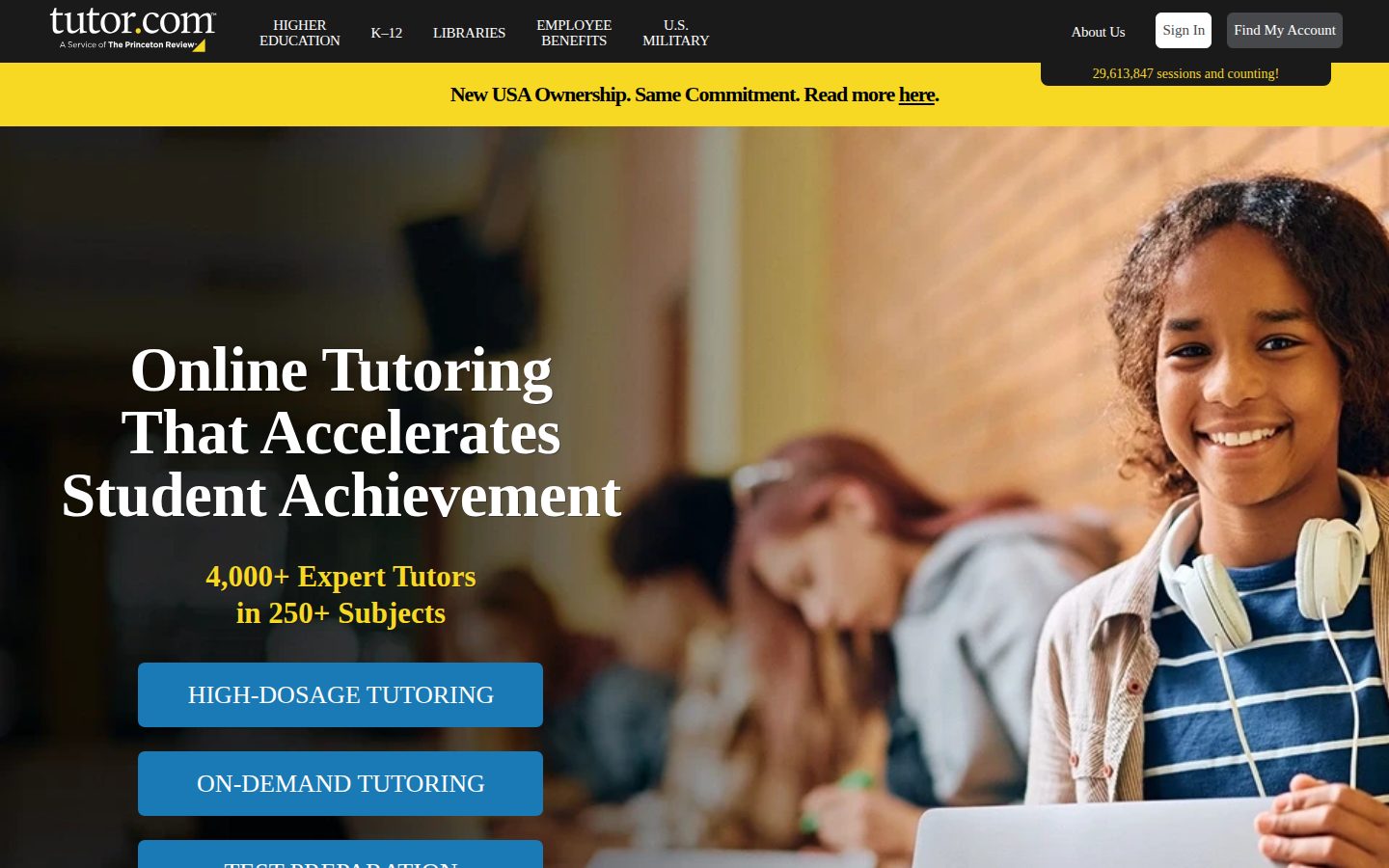
On-demand online tutoring across 250+ subjects for students K–12 through college
Tutor.com is an online tutoring platform for K–12 schools, higher education institutions, libraries, and military families.
AI Panel Score
6 AI reviews
Reviewed
Tutor.com is an online tutoring platform connecting students with a network of more than 4,000 vetted tutors across 250-plus subjects, serving K-12 schools, higher education institutions, libraries, and military families. Sessions run on demand around the clock or through scheduled programs, including high-dosage small-group tutoring in math and English language arts for grades 3 through high school. Test preparation is delivered through a partnership with The Princeton Review. Institutional pricing is quote-based, while consumer plans start at $39.99 per month for one hour of tutoring, with three- and five-hour monthly packages at $114.99 and $179.99 and six-month bundles of 10 to 50 hours priced from $349.99 to $1,449.99. Additional capabilities include real-time data and analytics, post-session learner surveys, a multimodal learning methodology, and dedicated customer success management. The platform fits schools, libraries, and families wanting vetted, on-demand academic support across many subjects.
Students access Tutor.com through their institution—school, library, employer, or military benefit program—and can connect with a tutor at any time without scheduling in advance. Sessions are delivered online using a multimodal, research-based methodology that the platform describes as adapting to individual learner needs. Post-session survey data cited on the site (from 2025) indicates 94% of users report grade improvement and 95% would recommend the service to a peer.
Tutor.com offers three distinct service tiers beyond standard on-demand tutoring: High-Dosage Tutoring, which provides small-group, high-frequency sessions for K–12 students in math and ELA; On-Demand Tutoring, covering 250+ subjects available around the clock for higher education, K–12, library, employee benefits, and U.S. military audiences; and Test Preparation delivered in partnership with The Princeton Review. Institutional partners receive dedicated Customer Success Managers and access to real-time analytics dashboards to track student outcomes and usage patterns.
Tutor.com is sold exclusively through institutional partnerships rather than directly to individual students or parents. Target customers include K–12 school districts, colleges and universities, public libraries, corporations offering employee benefits, and U.S. military programs. Pricing is not published publicly and requires contacting the sales team. Competitors in the online tutoring space include Chegg Tutors, Wyzant, Khan Academy (free), and Varsity Tutors.
The service is delivered entirely through a web browser, making it accessible on any internet-connected device without requiring a dedicated app installation. Students seeking access must do so through an institution that has an existing Tutor.com partnership.
Collects student satisfaction and outcome data through post-session surveys to track metrics such as grade improvement and homework completion rates.
Delivers real-time data and actionable analytics dashboards to measure tutoring impact and continuously improve student outcomes.
Delivers small-group, high-frequency tutoring programs for students in grades 3 through high school, focused on Math and ELA.
Offers tailored tutoring programs for distinct user groups including K–12 schools, higher education institutions, libraries, employee benefits programs, and U.S. military families.
Applies a research-based, multimodal instructional approach that adapts to each individual learner to deliver personalized and engaging support.
Connects students with expert tutors 24/7 for individualized tutoring sessions across 250+ subjects, available anytime and anywhere.
Provides test prep offerings through a partnership with The Princeton Review, available to K–12 institutions.
Provides access to a network of 4,000+ rigorously vetted and trained expert tutors to ensure consistent, high-quality academic support.
Integrates The Princeton Review's test preparation offerings as a co-branded capability available to K–12 institutional partners.
Assigns dedicated Customer Success Managers to institutional partners to support their goals and drive long-term student success.
Best for students who need occasional tutoring each month
Best for students who need regular tutoring every month
Best for students with frequent tutoring needs and test prep
One-time purchase for students who prefer flexibility over a 6-month period
One-time purchase for students needing substantial tutoring over 6 months
Best value one-time purchase for students with high tutoring needs over 6 months
Founded in 1998, still standing, still boring in the best way for a board memo.
“Tutor.com is the safe, institutional pick in a crowded tutoring market. Nothing flashy, but it's been shipping since before most competitors existed.”
27 years in market. That's not a startup pitch, that's an operating history. When a vendor survives Chegg's rise, Khan Academy going free, and Varsity Tutors eating the direct-to-consumer lane, you're not betting on their existence — you're betting on their relevance.
Two things stand out: the institutional-only sales model, and the $29-$39/hour pricing spread depending on volume. Selling exclusively through schools, libraries, and the military means slower deals but stickier ones. That 94% grade-improvement number is self-reported via post-session survey, so treat it as marketing, not proof.
No API, no docs, no public pricing page — this is a relationship sale, not a product-led one. Fine for a district superintendent. Less fine if you're trying to move fast.
Coexists with Khan Academy (free) and Varsity Tutors by owning the institutional-only lane rather than competing head-on.
Long tenure and Princeton Review partnership make this a low-risk, boring-but-safe board decision.
24/7 on-demand access means fast first session, but real outcome data relies on self-reported surveys, not third-party validation.
Solid for institutions needing tutoring infrastructure, but it's a cost-and-access play, not a differentiator.
Founded 1998, still operating with 4,000+ tutors and institutional contracts across military, library, and school segments.
School districts, libraries, or the military needing a proven, institution-grade tutoring vendor with a long track record.
Skip it if you want transparent pricing or a product-led evaluation before talking to sales.
A dependable high-dosage and on-demand backbone, but analytics depth won't satisfy a real learning-outcomes program.
“Tutor.com is the safe institutional pick for breadth and 24/7 access, not the pick for districts building rigorous, data-driven intervention models. It's proven infrastructure, not instructional innovation.”
4,000+ tutors, 250+ subjects, founded 1998 — this is infrastructure depth, not pedagogy depth. High-Dosage Tutoring in math and ELA for grades 3-12 aligns with what the research literature actually supports, which tells me someone on their instructional design team reads the evidence base. But 'multimodal, research-based methodology' is marketing language until I see a rubric, and the 94% grade-improvement stat comes from a post-session survey, not a controlled outcome study.
For a Head of Learning managing multiple vendor relationships, the real question is whether this integrates into an evidence framework or just generates activity logs. Real-time dashboards and a dedicated Customer Success Manager help with adoption reporting to a superintendent, but that's usage tracking, not learning-science measurement.
Against Varsity Tutors and Khan Academy, Tutor.com wins on institutional plumbing and vetting scale, not on curriculum sophistication. Three years in, you own a reliable access layer — not a differentiated instructional strategy.
27-year incumbent with 4,000+ tutors sits ahead of Chegg Tutors and Wyzant on institutional trust, behind Varsity Tutors on brand momentum.
On-demand plus scheduled high-dosage models match how districts actually structure intervention time.
Real-time analytics dashboards and district/library sign-in flows are built for institutional procurement, not standalone use.
Institutional-only sales and CSM support build durable dependency, but no published outcome studies beyond self-reported surveys.
High-Dosage Tutoring in math/ELA reflects research-aligned design, but 'multimodal methodology' lacks published pedagogy detail.
Districts, libraries, or military programs needing a proven, scaled access layer for tutoring without building their own vendor network.
You need independently validated learning outcomes data or granular pedagogical transparency before committing budget.
$29-$39/hour, two pricing worlds — consumer sticker shock, institutional black box.
“Consumer plans are transparent but pricey per hour. Institutional deals — where most volume lives — require a sales call.”
Two pricing tracks here. Consumer: $39.99 for 1 hour/month, down to $29/hour at the 50-hour/6-month tier. That's $1,449.99 upfront — no monthly smoothing. Institutional pricing: not published. Contact sales.
3-year TCO for a family running 5 hours/month: $179.99 × 36 = $6,480. Add nothing — no SSO tax, no per-subject upcharge. But compare Varsity Tutors or Wyzant, both similarly opaque on bulk rates, and Khan Academy at $0. Free beats $29/hour on paper; it doesn't beat a live tutor.
Contract terms are clean for consumers: no long-term lock-in, cancel anytime, downgrades next cycle. Institutional contracts — where districts and libraries sit — aren't disclosed here. Dedicated Customer Success Managers and analytics dashboards suggest real invoicing complexity behind that curtain. ROI claim: 94% report grade improvement, self-reported via post-session survey. Take that number with normal skepticism.
Consumer billing is simple card-based; institutional procurement path (districts, libraries) has zero published detail.
No long-term contract for consumers, cancel anytime, upgrades immediate — institutional terms undisclosed.
Consumer tiers are fully published with per-hour math; institutional pricing requires a sales call.
94% grade-improvement stat is self-reported via post-session survey, not independently verified.
50 hours/6 months at $1,449.99 works out to $29/hour — no add-on fees disclosed, but no bulk institutional benchmark either.
Institutions or families who value 24/7 access and don't mind calling sales for bulk rates.
You need hard numbers for a board presentation before you'll pick up the phone.
24/7 access solves the real problem — matching a specific tutor to a specific gap — less so.
“On-demand model is built for the homework-at-9pm crisis, not for sustained skill-building with one instructor. Institutional buyers get dashboards; individual learners get session-to-session roulette.”
Sessions run 20-25 minutes on average. That's fine for a stuck-on-one-problem moment, not enough time to diagnose why a kid keeps missing the same fraction concept across three weeks. No persistent tutor relationship on the on-demand tier means every session starts from zero context — the tutor doesn't know what was covered Tuesday.
High-Dosage Tutoring fixes this for K-12 math/ELA with small-group, high-frequency sessions, which is the right instinct — consistency beats novelty for skill retention. But that's a separate product line from the flagship 24/7 offering, and pricing for it isn't public.
The vetting claim (4,000+ tutors) is asserted, not demonstrated — no tutor bios, ratings, or rematch mechanism that I could find. Compare to Varsity Tutors, where you can request the same tutor repeatedly. Real-time analytics dashboards are the one genuinely practitioner-useful feature here, if you're the Customer Success Manager, not the student.
Short average session length (20-25 min) suits quick fixes, not sustained tutoring relationships.
No docs, API, or changelog that I could find — site reads as marketing copy, not a practitioner resource.
Browser-based access with no app install is low-friction, but institutional gatekeeping (login via school/library) adds a step individuals can't bypass.
Tiered model (on-demand, High-Dosage, Princeton Review test prep) scales by need, though features aren't discoverable outside institutional sales conversations.
No tutor continuity on the on-demand tier means re-explaining context every session.
School districts and libraries wanting a 24/7 safety-net tutoring benefit with usage analytics.
You want a single dedicated tutor building a relationship with your student over months.
Solid tutor pool, but the buying experience feels stuck in 2010
“Been around since 1998 and it shows, in good and bad ways. The tutoring itself sounds fine, but getting in the door is either free through your library or a confusing pricing maze.”
Here's the weird split with Tutor.com: if you're getting it free through school, library, or the military, this is probably a great deal — 4,000+ tutors, 250+ subjects, on-demand 24/7, no app to install. That's real value and it explains why they've lasted since 1998.
But if you're a parent paying out of pocket, the pricing page is rough. $39.99 for one hour a month. $1,449.99 for 50 hours over six months. Sessions run 20-25 minutes on average, so do that math before you commit. Compare that to Khan Academy sitting there free, or Varsity Tutors and Wyzant with more transparent per-session rates, and Tutor.com's institutional-first model starts to feel like it wasn't built with the direct-pay customer in mind.
No API, no blog, no changelog listed — this isn't a product iterating in public. It's infrastructure. Reliable, unglamorous, occasionally annoying to shop for.
No public pricing page and no visible product changelog suggest a service, not a polished self-serve app.
On-demand, no scheduling required, keeps first-hour friction low; 250+ subjects give long-term room to keep using it.
Browser-based access on mobile, tablet, or desktop with no app required, per the pricing FAQ.
Institutional access via school login or library card is frictionless; direct consumer signup means picking from six confusing hour-based tiers first.
27 years in business and a 4,000+ vetted tutor network signal operational maturity even without visible uptime data.
Students accessing Tutor.com free through a school, library card, or military benefit.
You're a parent comparing hourly costs against free alternatives like Khan Academy.
Founded 1998, still selling by the hour. That's either stability or stagnation.
“A 27-year-old business with no API, no docs, no changelog — which is either a sign it doesn't need to move fast, or a sign nobody's watching. The math on the per-hour pricing rewards commitment you can't easily test first.”
No free trial. $39.99 for one hour a month, dropping to $29/hr only if you commit to 50 hours over six months. That's a real cost curve to evaluate before you've tried a single session.
'94% report grade improvement' — self-reported, post-session survey, 2025. That's the kind of stat that sounds ironclad until you ask who didn't fill out the survey. Category norm is to cite these anyway; Varsity Tutors and Chegg Tutors do the same dance.
Exit story: fine, actually. Web-only, no lock-in tech, institutional contracts renew or don't. Differentiation is thinner — 250+ subjects and a Princeton Review partnership is solid but not unique against Wyzant or Khan Academy's free tier. Viability looks steady rather than exciting: old company, no funding news, no visible shipping cadence. That's not a red flag. It's just not a growth story.
250+ subjects and Princeton Review tie-in are solid but overlap heavily with Varsity Tutors and Wyzant.
Browser-only, no proprietary app or lock-in tooling; institutional contracts end cleanly.
No public funding, docs, or changelog signals — longevity implied by age, not by visible momentum.
94% and 95% stats are self-reported post-session surveys, not independently verified outcomes.
Founded 1998, institutional model (schools, libraries, military) matches durable B2B2C patterns, not hype-cycle startups.
Institutions or parents who want an established, low-drama vendor and don't need cutting-edge features.
You want to test quality with a free trial before committing money.
Common questions answered by our AI research team
Monthly plans start at $39.99 for 1 Hour/Month, with 3 Hours/Month at $114.99 and 5 Hours/Month at $179.99. One-time packs run from 10 Hours/6 Months at $349.99 to 50 Hours/6 Months at $1,449.99. You can change or cancel anytime.
Consumer plans include expert help in 80+ subjects, while institutional programs cover 250+ subjects. Sessions are on demand, 24/7, on mobile, tablet, or desktop, and average about 20-25 minutes each.
Yes — it is available free of charge through thousands of participating schools, local public libraries, and employers. Schools provide usernames and passwords, and library cardholders sign in through their library's website using their card number.
No long-term contracts are required; plans bill monthly to a Visa, MasterCard, or American Express card with a U.S. or Canadian billing address. You can upgrade, downgrade, or cancel anytime — upgrades apply immediately, downgrades on the next billing cycle.
Tutor.com describes its 4,000+ expert tutors as rigorously vetted and trained experts, providing consistent, high-quality support. This vetting underpins programs it runs for K-12 schools, higher education, libraries, employers, and U.S. military families.


Tutor.com is an online tutoring platform based in New York that connects students with tutors for live, on-demand help in over 250 subjects.