Enterprise automation platform connecting apps, data, and business processes
Workato is an enterprise integration and automation platform for connecting applications and automating workflows.
AI Panel Score
6 AI reviews
Reviewed
Workato is an enterprise integration platform as a service (iPaaS) that enables organizations to connect applications, automate business processes, and manage APIs through a visual, low-code interface. The platform combines integration, automation, and API management capabilities in a single solution.
The platform serves enterprise customers across various industries who need to integrate cloud and on-premises applications, automate repetitive business processes, and manage data flows between systems. Workato's visual recipe builder allows both technical and non-technical users to create integrations and automations without extensive programming knowledge.
Key capabilities include pre-built connectors for popular business applications like Salesforce, ServiceNow, and Slack, real-time data synchronization, workflow automation, API lifecycle management, and enterprise-grade security features. The platform also offers AI-powered automation suggestions and natural language processing capabilities for building recipes.
Workato competes in the enterprise integration and automation market alongside platforms like MuleSoft, Zapier, and Microsoft Power Automate. The platform differentiates itself by focusing on enterprise-scale deployments with robust governance, security, and scalability features while maintaining ease of use for citizen integrators.
Low-code studio for designing, testing, and deploying enterprise-grade AI agents, where users define agent job descriptions, connect to knowledge bases, set triggers, and embed agents into business processes.
Domain-specific pre-built AI agents for Sales, IT, Support, Customer Experience, HR, and Marketing that automate role-specific workflows across relevant enterprise systems like Salesforce, ServiceNow, and Workday.
Visual control plane for coordinating agents with people, systems, and each other to complete multi-step workflows and govern agents from any source under shared policy.
End-user interface for the agentic enterprise that lets employees search systems, get AI assistance, and take real action via Slack, Microsoft Teams, or the Workato GO app.
Securely exposes and manages APIs with built-in gateway, federation, and portal capabilities designed for both internal teams and external partners.
Unifies enterprise data without unnecessary copying by supporting real-time access, master data consistency, and federated views across data warehouses, lakes, databases, and operational systems.
Enterprise iPaaS platform that orchestrates processes, apps, data, and APIs across the enterprise, including integration, automation, API management, B2B/EDI, data orchestration, and AI-powered operational intelligence.
Ruby-based SDK for building, testing, and publishing custom connectors to the Workato platform, including support for authentication patterns, triggers, and action design.
Enables SaaS companies to offer white-labeled, fully governed integration and automation capabilities natively within their own product without building or maintaining the infrastructure in-house.
Pre-built connectors for Salesforce, Workday, ServiceNow, SAP, NetSuite, Slack, Zendesk, and 1,200+ other apps enabling real-time event-driven workflows across SaaS and on-prem systems.
Connects any MCP-compatible AI agent (Claude, ChatGPT, Cursor, and more) to 1,200+ enterprise systems with governance, security, and auditability built in, structured across Context, Trust, and Action pillars.
Provides BYOK with hourly key rotation, container isolation, end-to-end encryption, full audit trails, and certifications including SOC 2 Type II, ISO 27001, GDPR, HIPAA, and PCI DSS.
Sales-led usage-based pricing. Standard edition starts ~$10K/year; mid-market $25-50K/year; enterprise $75-150K/year. Tiers: Standard, Enterprise, Workato One.
A well-funded iPaaS that turned its install base into a credible agentic-AI control plane.
“Workato raised a $200M Series E at a $5.7 billion valuation and posted 35% ARR growth in FY26. The catch is contact-only pricing that a board cannot model before sales engages.”
Workato raised a $200M Series E in 2021 at a $5.7 billion valuation, led by Battery Ventures, and has built enterprise integration software since 2013. The vendor-survival question is not the worry here.
The real call is whether this advances your stack or just relabels middleware you already run. Enterprise MCP connects AI agents like Claude to 1,200+ systems under audit and policy, and Agent Studio lets non-engineers ship governed agents. MuleSoft still owns the Salesforce-heavy accounts, but Workato pairs that integration depth with an agentic layer most iPaaS rivals are still assembling.
The catch is pricing. Everything runs through Contact Sales with no public rate, and premium SAP and Oracle connectors cost extra, so spend climbs in ways a board cannot model upfront. Speed to value is real once recipes ship. Pilot it with one process owner for 90 days, confirm the usage math, then commit.
Workato leads citizen-integrator iPaaS while MuleSoft holds Salesforce-anchored accounts on heavier tooling.
A repeat Deloitte Fast 500 honoree with SOC 2, ISO 27001, and HIPAA certifications defends cleanly to a board.
The visual recipe builder and 1,200+ connectors shorten time-to-first-integration, though enterprise rollout still takes quarters.
Enterprise MCP and Agent Studio extend existing integration spend into governed agentic AI rather than duplicating it.
Founded 2013, $421M+ raised, $200M Series E at a $5.7B valuation, and 35% ARR growth in FY26.
Enterprises who need governed integration plus an agentic-AI layer in one platform.
Small teams who want published, predictable per-seat pricing.
Workato is repositioning from iPaaS to agentic control plane, and that pivot is the real three-year bet.
“Workato is a category-leading enterprise iPaaS with genuine governance depth. The integration craft is best-in-class, but the roadmap now leans hard on an agentic thesis still proving itself.”
A CTO scoping an integration layer through 2029 should weigh Workato's positioning shift before any connector count. Founded in 2013, it raised a $200M Series E in 2021 led by Battery Ventures at a roughly $5.7B valuation, and is now rebuilding the platform around agent orchestration rather than plain iPaaS.
The craft ceiling is real. The visual recipe builder plus 1,200+ connectors to Salesforce, SAP and Workday gives citizen integrators real reach, and Enterprise MCP structured across Context, Trust and Action is a serious governance substrate for AI agents. The Ruby-based Custom Connector SDK means edge systems are not dead ends. Against MuleSoft it carries far less integration ceremony; against Zapier the governance depth is a different category.
The catch is the SKU map. Usage-based pricing has no public tiers and agentic capability is gated to Workato One, so the strategic bet is how fast the agent layer matures.
A funded, durable iPaaS leader repositioning ahead of the agentic shift rather than reacting to it.
Visual low-code plus a Ruby Custom Connector SDK serves both citizen integrators and platform engineers.
Pre-built connectors to Salesforce, SAP, Workday and ServiceNow plus API management fit cleanly into an enterprise stack.
Adopting it now means betting on an agentic roadmap gated behind the Workato One SKU.
The recipe builder, 1,200+ connectors, and Enterprise MCP show best-in-class iPaaS engineering.
CTOs who need governed enterprise integration across many SaaS and on-prem systems.
Small teams who want flat, transparent pricing on simple workflow automation.
No public price anywhere — every Workato quote runs through sales on annual task-pool billing.
“Pricing is fully sales-gated, so procurement starts blind. The real budget risk is overage repricing your task pools mid-term.”
No price survives the website. Every quote sits behind a sales call, so procurement starts blind. Workato sells a platform edition fee plus a usage fee, billed on annual task pools with overage when consumption runs over. Standard editions open near $10K per year. Enterprise lands at $84K to $180K.
Model the meter, not the page. Workato One adds Agent Orchestration, and premium connectors for SAP and Oracle bill separately. A mid-market rollout clears $25K to $80K annually. The catch is overage: task pools reprice mid-term once recipes scale, so the renewal invoice rarely matches the signature. MuleSoft is also quote-only and costs more.
ROI is partly legible. The 1,200-plus Connectors and full audit trails make integration spend auditable. However, a $5.7B valuation from the 2021 Series E means renewal pricing carries growth-funding expectations you negotiate against.
Usage-based platform-plus-meter billing is standard for iPaaS but needs negotiation.
Annual task pools with overage charges leave little month-to-month room.
No tier or rate is published; every number requires a sales call.
1,200-plus Connectors and full audit trails make integration spend auditable.
Standard near $10K but enterprise reaches $84K-$180K plus premium connector fees.
Enterprises who need governed integration across many SaaS and on-prem systems.
Small teams who need a published flat price before committing budget.
Workato gives integration developers a testable connector SDK, but every pricing tier hides behind contact-sales.
“The Custom Connector SDK ships a CLI with RSpec and VCR support, so you test connectors locally. But pricing is entirely contact-sales, so scoping a pilot needs a quote first.”
An integration developer judges an iPaaS by the Wednesday a connector breaks in production, not the connector count on the marketing page. Workato's recipe builder is genuinely usable — drop a trigger, chain actions, the data tree shows what each step returns. The 1,200+ pre-built connectors mean wiring Salesforce or NetSuite is config, not a custom pipeline.
The practitioner win is the Custom Connector SDK. It's Ruby, ships a CLI, and works with RSpec and VCR, so you write unit tests and replay HTTP fixtures locally instead of clicking through the UI to verify a fix. That's a tool built by people who actually debug connectors.
The catch is pricing opacity. Every tier is contact-sales with no public per-recipe number, so scoping a pilot needs a quote first. Zapier publishes its plans to the dollar. And premium connectors like SAP and Oracle cost extra on top.
The recipe builder data tree and 1,200+ connectors keep routine integration work as config, not custom code.
SDK docs cover RSpec, VCR fixtures, and CLI workflows, showing they are written for people who debug connectors.
Premium connectors for SAP and Oracle cost extra, and contact-sales pricing slows any quick pilot.
Custom Connector SDK, API management, and Embedded iPaaS give advanced builders real depth beyond the visual layer.
The Ruby SDK ships a CLI that fits a normal git-and-test development loop rather than demanding UI clicks.
Integration developers who maintain connectors across enterprise SaaS systems.
Small teams who need transparent published pricing before committing.
Workato is a serious automation engine that hides behind a sales call
“Workato connects 1,200+ enterprise apps with a visual recipe builder that non-engineers can actually drive. The catch is there is no free plan, so day one is a quote, not a workspace.”
A regular person can build a recipe in Workato without writing code, and that matters. Drag a Salesforce trigger, drop a Slack action, the flow takes shape on screen. Zapier feels lighter for a solo task, but it taps out at scale. Workato is built for the messy enterprise where SAP, Workday, and ServiceNow all need to talk.
The newer work leans into AI. Agent Studio lets you describe an agent's job in plain language and wire it into real systems, and Workato GO puts that help inside Teams or Slack where people already live. That is the right instinct. Help should come to you, not the other way around.
Now the honest part. There is no public pricing and no free plan, so you cannot judge the daily feel before procurement gets involved. For a company valued at $5.7 billion in 2021, a real trial would not hurt.
The visual recipe builder and 1,200+ connectors show real care for everyday integration work.
Low-code recipes welcome non-engineers, though enterprise governance depth takes months to master.
Workato GO ships a mobile app and Slack/Teams access, fine for an enterprise integration tool.
No free plan or public pricing means the first ten minutes is a sales form, not a workspace.
Enterprise iPaaS with SOC 2 Type II, BYOK, and real-time sync signals a solid, dependable platform.
Enterprises who need many apps connected under one governed roof
Solo users or small teams who want to try before talking to sales
A funded iPaaS survivor that ships fast, but the agentic rebrand is moving faster than I trust.
“Workato has shipped since 2013 and raised over $420M, with a $200M Series E at a $5.7B valuation. The catch is a homepage now built entirely around agents and a contact-only price.”
The homepage leads with Enterprise MCP and the agentic enterprise. A year ago this was an iPaaS pitch. The product underneath is still that — Workato Orchestrate, 1,200+ connectors, the Ruby-based Custom Connector SDK. The AI layer is the part moving fast.
The survival question is mostly answered. Founded 2013, over $420M raised, a $200M Series E at a $5.7B valuation in 2021. That buys runway. But "the #1 iPaaS" is the kind of superlative that ages poorly, and the agentic story leans on MCP, a protocol barely a year old.
Pricing is the yellow flag. Contact-only, with Standard reportedly near $10K/year and premium SAP and Oracle connectors billed extra. Zapier publishes its tiers; Workato makes you call. Exit portability is thin too — recipes do not port to MuleSoft.
Combining iPaaS, API management, and Enterprise MCP in one platform is a real gap versus Zapier or MuleSoft alone.
Recipes, the Ruby SDK, and 1,200+ proprietary connectors do not port cleanly to MuleSoft or Power Automate.
Over $420M raised, named investors, and a steady changelog signal a credible three-year bet.
Capabilities are real, but "the #1 iPaaS" and an all-agentic homepage outrun what the core product is.
Twelve-plus years shipping and a $5.7B-valuation Series E match a durable iPaaS pattern, not a failed one.
Enterprises who need governed integration across many SaaS and on-prem systems.
Small teams who want published pricing and a quick self-serve start.
Common questions answered by our AI research team
Yes, Workato supports AI agent building. The platform enables building KPI-driven agents that are fully autonomous using Enterprise MCP.
Enterprise MCP is Workato's enterprise-grade Model Context Protocol that provides the context, trust, and accuracy needed to make AI work, built on the #1 iPaaS.
Workato integrates with Claude, OpenAI, and Microsoft Copilot.
Workato uses a customer-first pricing model optimized for predictability and maximum value, but specific tier or usage details are not disclosed publicly.
Workato serves every department on one platform.
Company
WorkatoFounded
2013Pricing
Contact for pricingFree Trial
Available


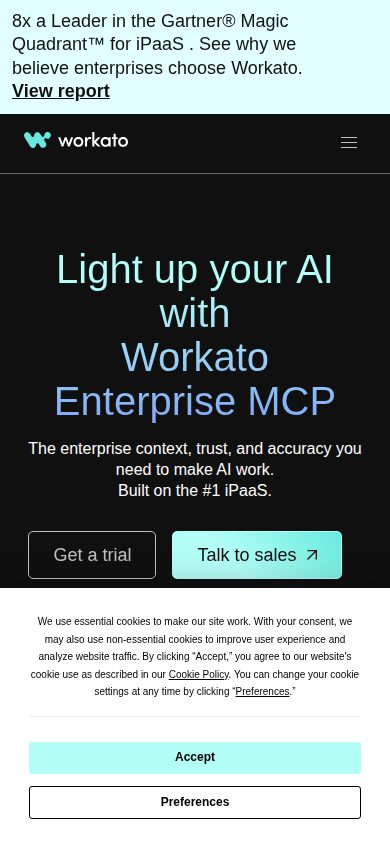
Workato is a Mountain View-based enterprise iPaaS offering AI agents and automation that connect 1,400+ business apps for sales, finance, and IT teams.