AdAnt AI logo

AdAnt AI Review

Visit

Chat-driven AI video ad generator for short-form UGC-style ads

AdAnt is a web-based AI creative agent for generating short-form video ads for TikTok, Instagram Reels, and YouTube Shorts.

AI Panel Score

7.1/10

6 AI reviews

Reviewed

AI Editor Approved

About AdAnt AI

The core workflow starts with a product URL or an inspiration/competitor video. Users discuss creative direction with AdAnt's ad-creative agent in a chat workspace, and the agent analyzes the reference ad's format, breaking it into scenes, hooks, pacing, and captions. AdAnt then maps that structure onto the user's own brand and generates batches of editable 9:16 short-form video ad variations for TikTok, Instagram Reels, and YouTube Shorts.

The workspace manages products, AI avatars, voices, and a curated library of proven video-ad templates that the agent draws on when reconstructing an ad format. Beyond the web app, AdAnt exposes its media-generation tools through a remote MCP server for clients like Claude and Cursor, a ChatGPT plugin/connector for its social-ad research, and an `adant-cli` npm package for scripting against a user's own AdAnt account.

AdAnt is aimed at e-commerce and DTC marketing teams, performance marketers, and agencies producing UGC-style social video ads at scale. It is offered on a subscription basis with a free trial and generation credits included per plan. Published tiers are Pro at $39/month (or $32.50/month billed yearly, $390/year), Max at $99/month (or $82.50/month billed yearly, $990/year), a quote-based Custom tier, and Studio — a done-for-you production service billed at $100–$200 per finished video with a $5,000/month minimum.

Features

AI

  • AI Avatar Video Rendering

    Renders editable 9:16 video ad variants using AI avatars for UGC-style delivery.

  • Ad Breakdown Analysis

    AdAnt analyzes a proven short-form ad and breaks it down into scenes, hooks, pacing, and captions.

  • Chat-Driven Creative Agent

    Users discuss creative direction in a chat interface with an AI agent that plans the ad's structure before generation.

Automation

  • Batch Variant Generation

    Produces batches of short-form video ad variations for creative testing.

  • adant-cli Automation Tool

    A user-scoped npm command-line tool for automating AdAnt account actions.

Core

  • Product URL / Reference Video Ingestion

    Users paste a product URL or a reference/competitor video as the starting point for generating a new ad.

  • Template Library

    Provides a curated library of proven video-ad templates within the workspace.

  • Workspace Management

    Manages products, AI avatars, voices, and templates in a single workspace.

Customization

  • Brand Mapping

    Maps the analyzed ad structure onto the user's own brand and product to create a tailored variant.

Integration

  • ChatGPT Plugin / Connector

    Allows users to access AdAnt's social-ad research directly from ChatGPT.

  • Remote MCP Server

    Connects Claude, Cursor, and other MCP clients to AdAnt's media-generation tools.

Preview

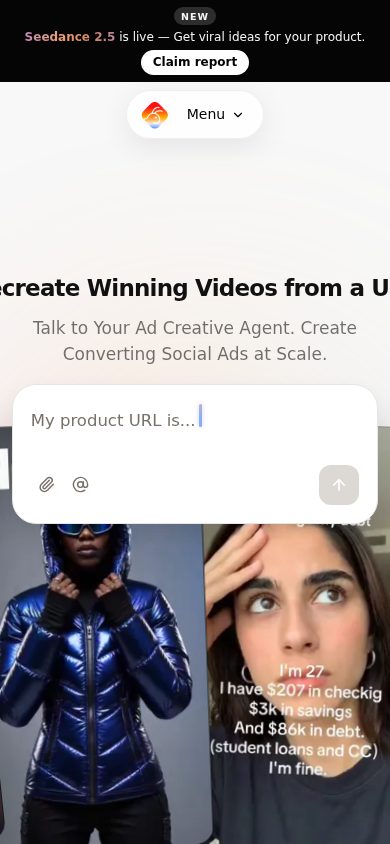
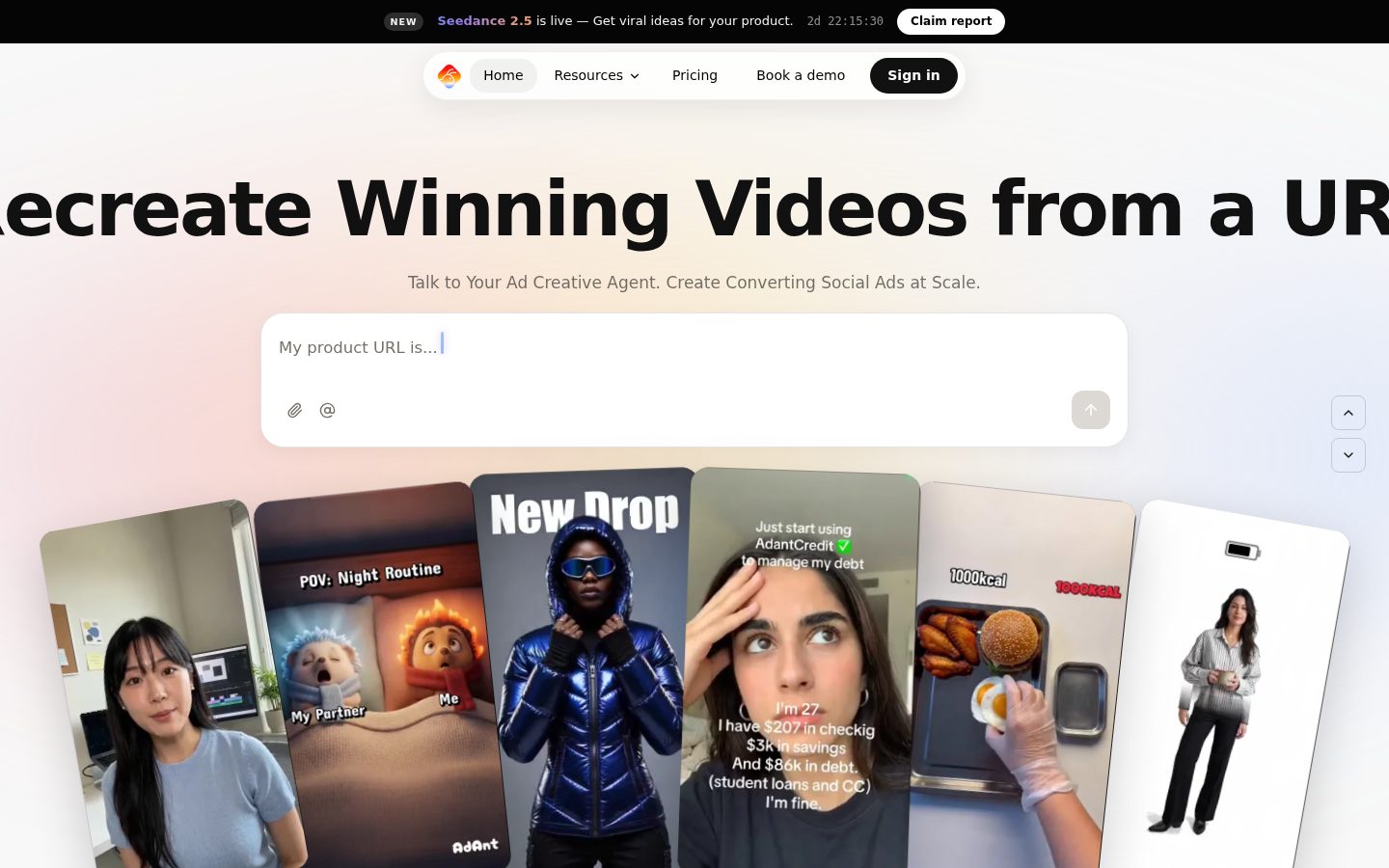
AdAnt AI desktop previewAdAnt AI mobile preview

Pricing Plans

Popular

Pro

$33/monthly

Marked "Recommended" — $32.50/mo billed yearly ($390/year, 2 months free) or $39/mo month-to-month, with 150 generation credits a month.

  • 150 credits per month
  • Up to 300 seconds of video (or ~2,000 images)
  • Agentic video creation included
  • 100+ AI avatars
  • No watermarks

Max

$83/monthly

High-volume tier — $82.50/mo billed yearly ($990/year) or $99/mo month-to-month, with 400 generation credits a month.

  • 400 credits per month
  • Up to 800 seconds of video (or ~5,333 images)
  • Everything in Pro
  • 100+ AI avatars
  • No watermarks

Custom

Contact sales

Sales-led tier for larger teams ("Let’s talk") — volume credits and custom agent workflows priced by contacting AdAnt.

  • Custom credit packages for larger teams
  • MCP support for internal tools and data
  • Claude and Codex plugin workflows
  • Advanced avatar, template and brand workflows
  • Dedicated onboarding and support

Studio

$100/usage

Done-for-you creative service billed per finished video at $100-$200, with a $5,000/month minimum — not a self-serve subscription tier.

  • Ads engineered for organic reach and paid performance
  • Hooks, scripts and formats based on viral social ads
  • Built to lower CAC when winners become paid ads
  • Batch production with creative testing and iteration
  • UGC, TVC and animation formats for TikTok, Reels and Shorts

AI Panel Reviews

The Decision Maker

The Decision Maker

Strategic bet, vendor viability, timing, adoption approval
7.2/10

Clever workflow, published prices, and almost nothing else to check before a pilot.

AdAnt turns a competitor's ad into a template and reskins it for your brand with AI avatars. Good idea, priced in public, but there's still no changelog or docs to check before a pilot.

Paste a URL or a rival's ad, chat with an agent, get batches of 9:16 UGC-style variants. That's a real workflow, and the ad-breakdown-into-scenes-and-hooks approach is a smarter starting point than a blank prompt box.

The pricing page does the work now. Pro at $39 a month or $390 a year, Max at $99 or $990, and a Studio service tier at $100–$200 per video with a $5,000 monthly floor. That's enough to size a pilot without a call — but the large-team number is still "Let's talk."

The MCP server and adant-cli are a nice signal someone's building for power users, not just marketers clicking buttons. But no docs, no changelog, no company name that I could find. I can't tell if this is three people or thirty.

Competitive Positioning6.8

Reverse-engineering a reference ad's structure via chat is a distinct approach versus generic template-fill tools, per the feature list.

Reputation Risk6.5

Month-to-month billing on both self-serve tiers lowers lock-in, but no cancellation or data-handling terms are published.

Speed to Value7.2

URL-to-batch-variant workflow with editable output should compress creative iteration time if it performs as described.

Strategic Fit7.0

Advances creative testing speed for DTC/agency teams rather than just cutting cost on existing video production.

Vendor Viability6.8

A complete four-tier pricing page is a shipping signal, though there's still no docs or changelog to gauge cadence.

Pros

  • Chat-driven agent breaks reference ads into scenes, hooks, and pacing before generating
  • Batch variant output built specifically for creative testing
  • MCP server and CLI extend it into developer/agency workflows
  • Pro and Max are priced in public at $390 and $990 a year

Cons

  • No published seat structure, so team-size cost is still an open question
  • No docs or changelog to gauge shipping cadence
  • Company identity and scale entirely absent from evidence

Right for

DTC and agency teams who want to systematize UGC-style ad testing.

Avoid if

Skip if you need contract clarity or compliance detail before piloting a new vendor.

The Domain Strategist

The Domain Strategist

Craft and strategy in the product's domain — adapts identity per category, same lens
6.9/10

Reverse-engineers winning ad structure well, but the template library is the whole creative ceiling.

AdAnt is built for volume-testing UGC ads, not for building a brand's visual language. It's a performance-marketing tool wearing a creative-direction interface.

The chat-driven breakdown into scenes, hooks, pacing, and captions is a genuinely smart mechanic — it's teaching the agent to reverse-engineer what already converts, then remap it. That's a real creative operation, not just a render pipeline. But the ceiling is set by whoever curated the template library: you're only as good as the 'proven ad formats' AdAnt was trained to recognize.

This is shaped exactly like how performance-marketing teams actually work — batch, test, iterate, kill losers fast. 9:16 output, AI avatars, editable variants, all correctly scoped to the job. It is not shaped for anyone building a distinctive brand voice across a campaign arc.

Three years in, this locks you into a testing workflow, not a visual identity. The MCP server and adant-cli are smart integration bets for automation-heavy teams, but I'd worry about creative sameness once every DTC brand is remapping the same proven formats.

Category Positioning7.0

Sits squarely in short-form UGC ad generation for TikTok, Reels, and Shorts, not the broader brand-video space.

Domain Fit7.5

Matches how performance marketers actually test UGC ads: batch variants, kill losers, iterate fast.

Integration Surface7.5

MCP server, ChatGPT plugin, and adant-cli npm package show real investment in fitting into an existing automation stack.

Long-term Implications6.0

Locks teams into a testing-and-remapping workflow that risks converging every brand toward the same 'proven' formats.

Strategic Depth6.5

Scene/hook/pacing breakdown is a real craft mechanic, but ceiling is capped by the curated template library, not open creative range.

Pros

  • Chat-based creative breakdown into scenes, hooks, pacing, and captions is a differentiated mechanic
  • MCP server, ChatGPT connector, and CLI give it real automation-stack integration
  • Batch variant generation matches how performance teams actually test creative

Cons

  • Creative ceiling depends entirely on the curated template library, not open direction
  • Studio's $5,000 monthly minimum sits far above the $990-a-year Max plan, leaving a gap for scaling teams
  • Built for volume testing, not for building a distinctive brand visual language

Right for

Performance marketers and DTC teams who need to batch-test UGC-style ad variants fast.

Avoid if

Avoid if your priority is building a distinctive, non-templated brand visual identity.

The Finance Lead

The Finance Lead

Money, total cost of ownership, contracts, procurement math
7.6/10

Pro at $390 a year, Studio at $5,000 a month — same page, different businesses.

AdAnt publishes four tiers, and the two self-serve ones cost $390 and $990 a year on annual billing. What it doesn't publish is a seat definition or an overage rate.

Two businesses share one pricing page. Pro and Max are self-serve software. Studio is a done-for-you retainer at $100–$200 per finished video with a $5,000 monthly floor. Pick the wrong one and you're off by more than 100x.

Annual billing is the whole play on the software side. Pro is $39 month-to-month, $32.50 billed yearly — $390 a year, two months free. Max is $99 monthly, $82.50 yearly, $990 a year. Three years on Max annual: $2,970. That's under one month of Studio.

Batch Variant Generation is what consumes the credits, and that's where the page goes quiet. No seat definition. No overage rate. Custom is still "Let's talk." But the first two tiers are priced in public, a free trial comes before the card, and procurement can model this without booking a call.

Billing & Procurement7.5

Pro and Max can be bought without a sales call; only the Custom tier is quote-gated.

Contract Flexibility7.5

Both self-serve tiers offer month-to-month at $39 and $99, so the annual commitment is optional.

Pricing Transparency8.5

Four tiers published with monthly and annual prices, a recommended plan marked, and Studio's per-video rate stated.

ROI Clarity7.0

Published per-plan cost makes cost-per-variant computable, but no conversion or performance benchmark is offered.

Total Cost of Ownership7.5

Pro at $390/year and Max at $990/year make multi-year cost modelable, though no overage rate is published.

Pros

  • Free trial lowers initial risk
  • adant-cli and MCP server support scripted, repeatable workflows
  • Editable 9:16 outputs reduce post-generation rework
  • Annual billing on Pro saves $78 a year against the $39 month-to-month rate

Cons

  • No published overage rate once a plan's credits run out
  • No seat definition on any tier, so per-head cost is unmodelable
  • Custom tier stays quote-gated, so large-team pricing is unpublished

Right for

Finance teams who need published software prices before approving a creative-tooling trial.

Avoid if

Buyers who need a published per-seat rate before committing budget.

The Domain Practitioner

The Domain Practitioner

Daily hands-on reality in the product's domain — adapts identity per category, same lens
7.2/10

Reverse-engineers winning ads into batches fast, but the edit suite is where it'll get tested

AdAnt's chat-driven breakdown of a reference ad into scenes, hooks and pacing is a genuinely useful shortcut for UGC-style batch testing. The real question for a producer is what happens after render, when 'editable' variants meet an actual revision pass.

Paste a product URL or a competitor ad, chat through creative direction, get batches of 9:16 variants with AI avatars mapped to your brand. That front half of the workflow is the pitch, and it's a real time-save versus briefing a human editor from scratch on hook structure and pacing breakdown.

Day three is where I want to know more. The site says variants are 'editable' post-generation, but nothing describes the actual timeline/edit interface — no mention of caption styling controls or avatar voice-swap granularity. Batch generation for testing is the stated use case, and at $390 a year on Pro the budget is easy to sign off; what's harder is planning weekly creative refreshes when no rerender cost is published.

The MCP server, ChatGPT connector, and adant-cli npm package are unusual depth for this category — that's power-user runway most avatar-ad tools skip. Practitioner-facing documentation is still thin though.

Day-3 Reality6.5

Ad breakdown-to-batch workflow is strong, but post-render editing depth isn't described anywhere I could find.

Documentation Practitioner-Fit5.5

There's a blog, but no docs site or release notes I could find — little practitioner-facing documentation to evaluate.

Friction Surface7.2

Plan prices are published for both self-serve tiers, so budgeting doesn't require a sales call, though rerender cost isn't stated.

Power-User Depth7.8

Remote MCP server for Claude/Cursor and an adant-cli npm package go well beyond the typical avatar-ad tool's scripting surface.

Workflow Integration7.5

Starting from a product URL or reference video mirrors how performance marketers already brief creative, which lowers the adoption bar.

Pros

  • Chat-driven agent breaks a reference ad into scenes, hooks, pacing and captions automatically
  • Batch variant generation built specifically for creative testing workflows
  • adant-cli and MCP server support give technical teams real automation hooks
  • Plan cost is published, so budgeting a weekly refresh cadence needs no sales call

Cons

  • No published cost for re-rendering a variant after edits
  • Post-generation editing capabilities aren't described in available evidence
  • No changelog or release notes to show which editing controls shipped recently

Right for

DTC and agency teams who need fast batches of UGC-style avatar ads for paid social testing.

Avoid if

Avoid if you need a documented editing interface before committing a production workflow.

The Power User

The Power User

Daily human experience, onboarding, polish, learning curve, reliability
7.1/10

Paste a URL, chat about it, get UGC ads — and the price is right there.

AdAnt turns a product link or competitor video into batches of 9:16 avatar ads through a chat workflow. Interesting idea, and the pricing is plain enough, but there's no mobile story to speak of.

The pitch is clean: paste a product URL or a reference video, chat with the agent about direction, and it breaks the reference into scenes, hooks, pacing, captions, then rebuilds it with your brand and an AI avatar. Batch generation for testing is the right instinct — nobody runs one ad variant anymore.

I went looking for what this costs and found it — $39 a month for Pro, $32.50 if you pay yearly, $99 for Max. But there's no free plan, just a trial. The MCP server and adant-cli for Claude and Cursor are a nice touch for people who script things.

Web-only, per the platforms listed, so there's no mobile parity question to even ask — it just isn't there. Editable 9:16 output and a template library suggest real category thinking. Whether the chat agent feels fast or like typing into a void three months in, I can't tell from the outside.

Daily Polish6.0

Feature list is solid but no visible empty-state, loading, or micro-copy detail from the outside.

Learning Curve7.0

Chat-driven direction plus a template library and MCP/CLI options give room to grow from casual to scripted use.

Mobile Parity3.5

Platforms listed as web only — no mobile app or responsive workflow mentioned.

Onboarding Experience7.0

Published self-serve prices and a free trial mean you can start without a demo call, though the first-run experience isn't documented.

Reliability Feel6.0

Editable outputs and batch generation suggest structure, but no error-state or uptime evidence given.

Pros

  • Chat-driven ad breakdown into scenes, hooks, pacing, and captions is a genuinely useful structure
  • Batch variant generation supports real creative testing workflows
  • MCP server and adant-cli extend the tool into Claude, Cursor, and scripted automation
  • Prices are on the page — $39 a month for Pro, $32.50 billed yearly

Cons

  • Nothing published about onboarding, empty states, or what the first session actually looks like
  • Web-only, so no mobile workflow for a format built entirely around phone-native platforms
  • No free plan, only a trial, for a category where testing volume matters

Right for

DTC and agency teams who want to reverse-engineer competitor ad formats into their own branded batches.

Avoid if

Avoid if you expect to work from a phone.

The Skeptic

The Skeptic

Contrarian. Watch-outs, deal-breakers, broken promises, category patterns
6.8/10

"ChatGPT for viral, converting social videos" is a big claim from a site with no changelog.

Feature list reads well — reference-video ingestion, brand mapping, batch testing. The pricing is published and specific, but nothing on the site shows the product is still being worked on.

'ChatGPT for viral, converting social videos' is the kind of superlative that ages poorly if the avatars look like every other UGC-avatar tool. A blog, but no docs or API reference I could find, no changelog. Not disqualifying for a small team. But no evidence of active maintenance beyond the feature list.

The MCP server and adant-cli are genuinely interesting — scripting your own account is real portability, better than most closed video generators. But the core render pipeline (AI avatars, 9:16 output) is table stakes now, not differentiation. Every competitor in this space claims 'proven ad breakdown.'

Pricing is the part that holds up. $39 a month for Pro, $99 for Max, $390 and $990 if you commit to a year — published, no call required. Still no free plan, just a trial. And the $5,000-a-month Studio floor tells you where the revenue actually comes from.

Competitive Differentiation5.0

AI-avatar UGC ad generation is a crowded lane; nothing I could find names a gap versus the obvious alternative.

Exit Portability6.5

adant-cli and MCP server suggest scriptable access to your own account, better exit story than a closed web app.

Long-term Viability5.5

A blog is the one maintenance signal I found — I couldn't spot a changelog, docs or a public API reference.

Marketing Honesty7.0

Tagline is a superlative, but the pricing page backs the self-serve framing with published monthly and annual rates.

Track Record Match6.0

Named features (ad breakdown, brand mapping) are specific, but no docs or changelog to verify they work as described.

Pros

  • Reference-video-to-ad workflow with scene/hook/pacing breakdown is a concrete feature, not vague AI talk
  • MCP server and CLI give technical buyers a real automation path
  • Batch variant generation fits actual ad-testing workflows
  • Month-to-month option at $39 means no annual lock-in just to try it

Cons

  • "Let's talk" Custom tier means the real large-team number is still unpublished
  • A blog exists, but no docs or changelog I could find to confirm active development
  • AI avatar UGC ads are now a commodity category, not a differentiator on their own

Right for

Agencies and DTC teams already sold on AI-avatar UGC ads who want scripting access via CLI or MCP.

Avoid if

You want a documented changelog before trusting a vendor with a creative pipeline.

Buyer Questions

Common questions answered by our AI research team

Features

What video format do the generated ads use?

AdAnt renders ad variants in 9:16 vertical video format, suited for short-form platforms like TikTok, Reels, and Shorts.

Features

Can I start from a reference video instead of a URL?

Yes, you can paste either a product URL or a reference video to start the creative direction chat with the AI agent.

Features

Does AdAnt use AI avatars in the ads?

Yes, AdAnt renders the video ad variants using AI avatars mapped to your brand's structure.

Features

Can I edit the ad variants after they're generated?

Yes, the rendered 9:16 video ad variants are editable after generation.

Features

Does AdAnt generate multiple ad variants for testing?

Yes, AdAnt produces batches of ad variants specifically for testing.

Product Information

  • Company

    AdAnt
  • Pricing

    From $33/mo
  • Free Trial

    Available

Platforms

web

About AdAnt

AdAnt is a software company that generates short-form video ad variants from product URLs or reference videos for social media advertising.

Resources

Blog

Also in AI Video Generation