Higgsfield logo

Higgsfield Review

Visit

AI-native creative suite for video, image, and voice generation with 30+ models

Higgsfield is an AI video and image generation platform for creators and marketing teams.

AI Panel Score

8.1/10

6 AI reviews

Reviewed

AI Editor Approved

What is Higgsfield?

Higgsfield is an AI-native creative suite for generating video, images, and voice content from text prompts or reference media. It serves content creators, marketing teams, and agencies producing short-form video, product ads, and cinematic clips without traditional production. Pricing is freemium: a free tier includes 10 daily credits, and paid plans start at $15 per month for Starter with 200 credits, with Plus at $39 and Ultra at $99 on annual billing, plus team and enterprise options. The platform aggregates 30+ generation models, including Sora 2, Kling 3.0, Veo 3.1, and Seedance 2.0, and layers on Cinema Studio camera controls, Soul ID character consistency, face swap, lipsync, and one-click viral presets. An MCP server and CLI let Claude and other agents drive generation programmatically. It fits creators who want many models under one subscription; alternatives include Runway, Pika, Luma Dream Machine, and Krea.

About Higgsfield

Higgsfield works as a single workspace where you pick a generation model or a one-click app, feed it a text prompt or reference image, and spend credits from your plan to render the result. Generated media can then be edited with inpainting, upscaled to 4K, or passed into follow-on tools like lipsync and scene composition, and the whole flow runs on the web app or the iOS and Android apps.

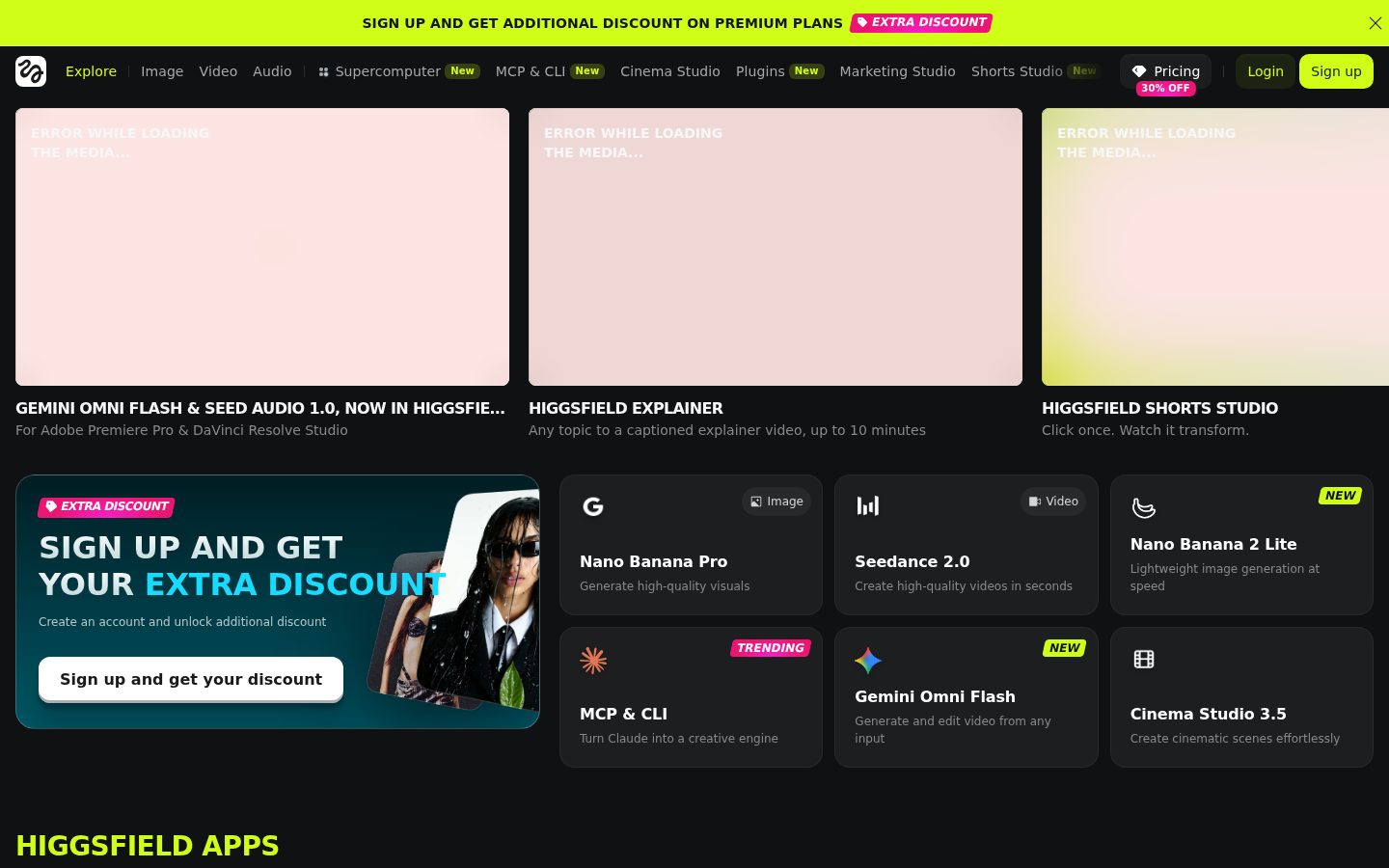
Its distinctive tools are named studios: Cinema Studio 3.5 adds camera and lens controls for cinematic shots, Higgsfield Explainer turns any topic into a captioned explainer video up to 10 minutes, Shorts Studio produces short-form video in one click, and Soul ID keeps a trained character consistent across generations. A library of 30+ Viral Presets (Baseball Game, Drift Racing, Storm Giant) applies trending camera and VFX effects, and face swap, virtual try-on, and a storyboard generator round out the editing stack.

The suite targets content creators, marketing teams, and agencies. It is freemium: a free tier grants 10 daily credits, Starter costs $15 per month with 200 credits, Plus $39 with 1,000 credits, and Ultra $99 with 3,000 credits on annual billing, with Team and Enterprise plans adding shared workspaces and SOC 2-aligned controls. It competes with Runway, Pika, Luma Dream Machine, Krea, and Freepik in the multi-model AI video and image space.

For developers and agents, Higgsfield exposes an MCP server at mcp.higgsfield.ai that works with Claude and any MCP-compatible client without API keys, plus a CLI and agent skills. The Supercomputer layer adds agents, automation, and skills on top of the generation models, and plugins bring Higgsfield output into Adobe Premiere Pro and DaVinci Resolve.

Features

Audio

  • Lipsync Studio

    Syncs generated voice audio to on-screen characters for talking-head and dialogue videos.

Automation

  • Supercomputer

    Agent layer with agents, automation, and skills that chains generation, editing, and publishing steps into workflows.

Collaboration

  • Team Workspaces

    Shared folders, credits, and an admin dashboard for users, roles, and permissions, with SOC 2-aligned and GDPR-compliant controls.

Editing

  • Face Swap & Virtual Try-On

    Swaps faces and places outfits or products on subjects across generated images and video.

Integration

  • MCP Server & CLI

    Connects Claude and any MCP-compatible agent to Higgsfield's generation tools at mcp.higgsfield.ai, with a companion CLI for scripted use.

Personalization

  • Soul ID Characters

    Trains a consistent character identity so the same face and persona persist across image and video generations.

Platform

  • Multi-Model Generation

    Runs 30+ image and video models, including Sora 2, Kling 3.0, Veo 3.1, Seedance 2.0, FLUX, and Nano Banana Pro, from one credit-based workspace.

Templates

  • Viral Presets

    Library of 30+ one-click camera and VFX effects such as Baseball Game, Drift Racing, and Storm Giant for trend-ready clips.

Video Generation

  • Cinema Studio 3.5

    Generates cinematic scenes with camera and lens controls for shot-level direction of AI video.

Workflow

  • Higgsfield Explainer

    Turns any topic into a captioned explainer video up to 10 minutes long from a single prompt.

  • Shorts Studio

    One-click studio that transforms source material into short-form vertical videos for social feeds.

  • Storyboard Generator

    Builds multi-scene storyboards with character consistency before rendering full videos.

Preview

Higgsfield desktop previewHiggsfield mobile preview

Pricing Plans

Free

Free

Entry tier for trying the platform with watermarked output.

  • 10 credits per day
  • Watermarked generations
  • Limited model access

Starter

$15/yearly

Light tier for casual creators on selected models.

  • 200 credits per month
  • Selected models only
  • Roughly 100 Nano Banana Pro images per month
  • No Veo 3 access

Plus

$39/yearly

Mid tier for regular creators who need every model.

  • 1,000 credits per month
  • All models unlocked
  • $49 if billed month-to-month
  • About 167 Kling 3.0 generations per month
Popular

Ultra

$99/yearly

Heavy-usage tier for professionals and high-volume output.

  • 3,000 credits per month, scalable to 9,000
  • All models unlocked
  • One 365-day unlimited video model (e.g. Nano Banana 2, Wan 2.6, Seedance 1.5 Pro, or Kling 2.6)
  • $129 if billed month-to-month

Team

$62/yearly

Per-seat plan for teams of 2-15 with shared resources.

  • 1,500 credits per seat per month
  • Shared credit pool and workspaces
  • Admin dashboard for users, roles, and permissions
  • SOC 2-aligned, GDPR compliant

Enterprise

Contact sales

Custom contract for large organizations; pricing requires contacting the vendor.

  • Dedicated generation capacity
  • Volume discounts
  • SOC 2 security controls
  • Admin and access management

AI Panel Reviews

The Decision Maker

The Decision Maker

Strategic bet, vendor viability, timing, adoption approval
8.4/10

Higgsfield pairs a proven founder with breakneck growth, though it rents the models it resells.

Higgsfield aggregates 30-plus generation models behind one subscription and grew to a reported $500 million annualized revenue within 15 months. The founder's track record and Team-plan controls make it a defensible pilot for marketing orgs.

Alex Mashrabov sold his last company to Snap for $166 million, ran Snap's generative AI group, then built this. Higgsfield went from a March 2025 launch to a reported $500 million in annualized revenue. Vendors with that trajectory rarely vanish mid-contract.

The product is an aggregator — Sora 2, Kling 3.0, and Veo 3.1 behind one credit pool, plus in-house tools like Cinema Studio 3.5. Runway asks you to bet on its models; Higgsfield lets you bet on the category. For a marketing org, that's the safer wager.

The catch: they don't own most of what they resell, so access and margins sit in OpenAI's and Google's hands. Team runs $62 a seat with SOC 2-aligned controls, so procurement won't stall. Pilot it with the social team for a quarter, then decide at renewal.

Competitive Positioning8.4

Aggregating Sora 2 and Veo 3.1 outflanks single-model rivals like Runway on breadth.

Reputation Risk7.8

Face swap and viral-format tooling carries brand-safety exposure the Team plan controls only partly offset.

Speed to Value8.7

One-click studios and a free tier mean the pilot produces usable clips in week one.

Strategic Fit8.3

Multi-model access advances a content org rather than just trimming cost on existing output.

Vendor Viability8.5

A $1.3 billion January 2026 valuation and reported $500 million annualized revenue buy real runway.

Pros

  • Founder previously sold AI Factory to Snap for $166 million and ran Snap's generative AI group.
  • Reported $500 million annualized revenue within 15 months of launch.
  • One subscription covers Sora 2, Kling 3.0, Veo 3.1, and 30-plus models.
  • Team plan adds SOC 2-aligned controls and an admin dashboard at $62 a seat.

Cons

  • Core generation models are rented from OpenAI, Google, and others, not owned.
  • Company is young, founded in 2023 with the platform live only since March 2025.

Right for

Marketing teams who need many video models under one vendor contract.

Avoid if

Buyers who require vendors that own their core models outright.

The Domain Strategist

The Domain Strategist

Craft and strategy in the product's domain — adapts identity per category, same lens
8.3/10

For a social-first brand, Higgsfield turns model choice into a per-brief decision, not a procurement one.

Higgsfield gives a creative team 30-plus video and image models plus consistency tools like Soul ID under one credit pool. That fits social-first volume production better than single-model suites.

A social calendar shipping thirty clips a week can't marry one model's aesthetic. Higgsfield's design concedes that up front: 30-plus models under a single credit pool, so the team picks Kling 3.0 for motion or Veo 3.1 for realism per brief, not per subscription.

Soul ID is the piece with strategic weight. A trained character that survives across image and video is how a brand mascot scales to daily volume without drift, and Viral Presets map straight onto trend formats the calendar already chases. Freepik runs the same aggregation play; the studio layer here is deeper.

The long-term risk is the wrapper itself, however: if model vendors court brands directly, the middle layer thins. The Premiere Pro and DaVinci Resolve plugins protect us either way, since finishing stays in our stack. At $39 a month for Plus, testing the bet costs almost nothing.

Category Positioning8.3

It out-breadths Runway and out-tools fellow aggregators like Freepik and Krea.

Domain Fit8.7

Shorts Studio, Viral Presets, and Soul ID map directly onto a social calendar's daily needs.

Integration Surface8.5

Premiere Pro and DaVinci Resolve plugins plus an MCP server slot into existing pipelines.

Long-term Implications7.7

Dependence on rented models means roadmap and pricing shift with upstream vendors.

Strategic Depth8.0

Aggregation plus in-house studios is a coherent thesis, though the moat lives in tooling, not models.

Pros

  • One credit pool spans Sora 2, Kling 3.0, Veo 3.1, and 30-plus other models.
  • Soul ID keeps a brand character consistent across campaigns.
  • Native plugins for Premiere Pro and DaVinci Resolve keep finishing in pro editors.
  • Viral Presets match the trend formats social calendars actually run.

Cons

  • The craft ceiling on any single model trails what its native platform offers.
  • Upstream model vendors could change access terms under the aggregator.
  • Starter tier locks out Veo 3, limiting low-cost experimentation.

Right for

Creative teams who produce high-volume social video across shifting trend formats.

Avoid if

Brand teams who want deep control over a single signature model.

The Finance Lead

The Finance Lead

Money, total cost of ownership, contracts, procurement math
7.9/10

Transparent tiers from $15 to $99, but the credit burn rate is the number to model.

Higgsfield prices five visible tiers from free to $99 monthly plus custom Enterprise, all self-serve. Credit burn per model is the cost variable the pricing page doesn't fully expose.

The annual-versus-monthly spread is where Higgsfield shows its hand: Plus is $39 billed yearly but $49 month-to-month. Ultra repeats it: $99 annual, $129 monthly. That 20-25% premium funds the commitment they want.

Team math: $62 × 5 seats × 12 = $3,720 a year, with 1,500 credits per seat monthly. Plus's 1,000 credits buy about 167 Kling 3.0 generations, and re-rolls burn the same pool. Runway's Max plan is $76 for 9,500 credits on one vendor's models; Higgsfield's $99 Ultra covers 30-plus.

The catch is burn-rate opacity: per-model credit costs vary and no overage terms are published. Team Workspaces bundle admin controls and SOC 2 alignment at $62 without an enterprise upcharge. Enterprise itself needs a sales call; every other tier is self-serve. Commit annually or the premium stings.

Billing & Procurement7.6

Self-serve checkout and a SOC 2-aligned Team plan help, but overage and rollover terms aren't published.

Contract Flexibility7.5

Monthly escape hatches exist but cost 20-25% more than annual commitments.

Pricing Transparency8.2

Four self-serve tiers with visible prices; only Enterprise hides behind a sales call.

ROI Clarity8.0

Replacing per-model subscriptions with one $39-99 monthly bill makes the consolidation math easy.

Total Cost of Ownership7.7

Credit burn varies by model, so heavy re-rolling makes year-one spend hard to forecast.

Pros

  • Every non-enterprise tier has a visible price and self-serve checkout.
  • Consolidates multiple model subscriptions into one $39-99 monthly bill.
  • Team plan includes admin controls and SOC 2 alignment at $62 a seat.

Cons

  • Per-model credit burn rates make spend forecasting imprecise.
  • No published overage or rollover terms.
  • Month-to-month billing carries a 20-25% premium over annual.

Right for

Teams who can commit to annual billing for predictable creative-tool spend.

Avoid if

Finance teams who need audited per-unit costs before signing.

The Domain Practitioner

The Domain Practitioner

Daily hands-on reality in the product's domain — adapts identity per category, same lens
8.2/10

One-click Shorts Studio earns its keep, but the credit meter taxes every re-roll.

For daily campaign clips, Shorts Studio and Viral Presets compress a brief into a post in one sitting. The credit pool punishes heavy iteration, which is where short-form work actually lives.

Shorts Studio is the button that matters when a brief lands at 9am and the clip posts by noon — source material in, vertical cut out, one click. Stack a Viral Preset like Drift Racing on top and the camera work is already done.

The credit meter is the catch. Plus's 1,000 credits buy roughly 167 Kling 3.0 generations a month, and every re-roll of a bad take drains the same pool — in CapCut, iterating on a cut costs nothing. Soul ID is the real reshoot-saver: one trained character stays consistent across a whole campaign week.

Starter friction is real: $15 gets selected models only and no Veo 3, so the cheap tier can't chase whatever look the brief demands. The Premiere Pro and DaVinci Resolve plugins mean finishing never leaves the editor. Mobile apps on both stores cover the shoot-from-the-couch fix.

Day-3 Reality8.4

One-click studios and 30-plus presets produce postable clips before any learning curve bites.

Documentation Practitioner-Fit7.8

Named studios and presets are self-explanatory, though per-model credit costs take digging.

Friction Surface7.6

Metered re-rolls and Starter's model lockouts are the daily annoyances.

Power-User Depth8.4

Cinema Studio 3.5 camera controls, Soul ID training, and an MCP server reward going deep.

Workflow Integration8.3

Premiere Pro and DaVinci Resolve plugins plus mobile apps fit an existing edit pipeline.

Pros

  • Shorts Studio turns source material into vertical clips in one click.
  • Soul ID keeps one character consistent across a week of campaign clips.
  • Viral Presets apply trend-ready camera and VFX moves instantly.
  • Plugins for Premiere Pro and DaVinci Resolve keep finishing in the editor.

Cons

  • Every re-roll burns credits, taxing the iteration short-form work needs.
  • Starter tier excludes Veo 3 and limits model choice.
  • Per-model credit costs are hard to see before generating.

Right for

Short-form creators who ship multiple campaign clips every day.

Avoid if

Editors who iterate dozens of takes before picking one.

The Power User

The Power User

Daily human experience, onboarding, polish, learning curve, reliability
8.2/10

Generous free credits and real mobile apps make this one of the friendlier AI video tools.

Higgsfield hands you 10 credits daily for free and ships genuine iOS and Android apps. The polish is real; the credit meter is the thing you'll negotiate with.

Ten free credits a day, every day. Not a 7-day trial that expires while you're busy — an actual standing allowance, watermarked but real. That's a company confident you'll come back.

The one-click layer is where the care shows. Viral Presets like Storm Giant do the camera moves for you, Higgsfield Explainer turns a topic into a captioned ten-minute video, and the iOS and Android apps are real apps, not a wrapped website. Midjourney made the world wait years for a proper interface; this shipped mobile early.

The catch is the credit anxiety. When every generation costs something and a model's burn rate isn't obvious, you hesitate before hitting generate — and hesitation is the opposite of play. $15 Starter softens that, though its model list is trimmed. Three months in, you'll either budget credits calmly or resent the meter.

Daily Polish8.2

Named one-click studios and preset effects show sweat on the everyday paths.

Learning Curve8.0

Presets carry beginners while Cinema Studio 3.5 gives experts somewhere to grow.

Mobile Parity8.5

Full apps on both stores generate images and video, not just view them.

Onboarding Experience8.4

A standing 10-credit daily allowance beats expiring trials for actually learning the tool.

Reliability Feel7.7

Its site claims 4.5 million generations a day, but queue behavior under load isn't documented.

Pros

  • Free tier renews 10 credits daily instead of expiring.
  • Real iOS and Android apps, not a mobile webview.
  • One-click presets make first outputs postable, not embarrassing.
  • Explainer builds a captioned ten-minute video from a single prompt.

Cons

  • Credit anxiety makes experimentation feel expensive.
  • Free outputs carry watermarks.
  • Per-model burn rates take trial and error to learn.

Right for

Casual creators who want to make real clips from day one.

Avoid if

People who freeze up when every click has a visible cost.

The Skeptic

The Skeptic

Contrarian. Watch-outs, deal-breakers, broken promises, category patterns
7.3/10

The revenue is real, but most of the models belong to someone else.

Higgsfield's growth numbers check out against independent reporting, which is rarer than it should be. Its dependence on rented frontier models is the risk the marketing doesn't dwell on.

"4.5 million video generations per day," their site says. Maybe. What's independently reported: launch in March 2025, roughly $500 million annualized revenue by mid-2026, a $1.3 billion valuation in January. Growth that fast is either a rocket or a sugar rush.

Strip the resold models — Sora 2, Veo 3.1, Kling — and what's left is the in-house layer: Soul ID, Cinema Studio 3.5, the preset library. That's the actual moat, and it's thinner than the model list makes it look. Krea and Freepik run the same aggregator playbook.

Exit story is decent: your MP4s leave with you, and prompts port anywhere. A trained Soul ID character doesn't. The yellow flag is upstream dependency — if OpenAI reprices Sora access, Higgsfield's $15-99 tiers absorb it or pass it on. Watch the renewal terms, not the demo reel.

Competitive Differentiation7.1

Krea and Freepik sell the same aggregation; the studios layer is the only distinct asset.

Exit Portability7.2

Rendered media exports freely; trained Soul ID characters and workflows stay behind.

Long-term Viability7.4

Heavy revenue and fresh funding help, but margins depend on upstream model vendors' pricing.

Marketing Honesty7.0

The 4.5M-generations claim is unverifiable, but pricing and tier limits are stated plainly.

Track Record Match7.4

Reported $500M annualized revenue and a $1.3B valuation back the growth story so far.

Pros

  • Growth claims are corroborated by independent reporting, not just vendor copy.
  • Pricing and tier restrictions are published, including what Starter doesn't get.
  • Media exports leave cleanly, keeping switching costs low.

Cons

  • Core models are rented, so upstream repricing lands on subscribers.
  • Trained Soul ID characters don't port to other platforms.
  • Aggregator differentiation is fragile as Krea and Freepik converge on the same play.

Right for

Buyers who want model variety without betting on one lab.

Avoid if

Teams who need multi-year price stability from their creative stack.

Buyer Questions

Common questions answered by our AI research team

Pricing

How much does Higgsfield AI cost per month?

Starter is $15 per month with 200 credits, Plus is $39 with 1,000 credits, and Ultra is $99 with 3,000 credits on annual billing; month-to-month rates run higher. A free tier adds 10 credits daily, and Team and Enterprise plans cover organizations.

Features

What AI video models does Higgsfield support?

Higgsfield runs 30+ models in one workspace, including Sora 2, Kling 3.0, Veo 3.1, and Seedance 2.0 for video, plus FLUX, Nano Banana Pro, GPT Image 2, and Seedream 4.5 for images. Credits are shared across all of them under one subscription.

Integration

Does Higgsfield integrate with Claude via MCP?

Yes. The MCP server at mcp.higgsfield.ai works with Claude on web, Cowork, and Claude Code, plus any MCP-compatible agent. No API keys are needed since you authenticate with your Higgsfield account, and a CLI covers scripted workflows.

Setup

Is Higgsfield available on iPhone and Android?

Yes. Higgsfield ships mobile apps on both the Apple App Store and Google Play (Higgsfield AI Photo & Video), alongside the full web app, so you can generate images and videos from prompts on desktop or phone.

Security

Is Higgsfield secure enough for team use?

The Team plan is SOC 2-aligned and GDPR compliant, with a central admin dashboard for managing users, roles, and access permissions, plus shared workspaces and folders for organizing team projects.

Also in AI Video Generation