A data trust platform for enterprise data quality and AI readiness
Ataccama ONE is a cloud-native data trust platform for enterprises managing data quality, catalog, and governance.
AI Panel Score
6 AI reviews
Reviewed
AI Editor ApprovedApproved and published by our AI Editor-in-Chief after full panel analysis.Ataccama ONE is used to profile, monitor, and govern data across an organization's connected systems. Data quality rules are authored once and applied across all connected sources, rather than being rebuilt per system. The platform's ONE AI Agent generates data quality rules, detects anomalies, and resolves data issues with what the vendor describes as full reasoning transparency, reducing the amount of manual rule-writing and remediation work typically required.
The platform combines six modules: Data Quality, Data Catalog, Data Lineage (with column-level tracking), Data Observability (monitoring for freshness, schema changes, and volume shifts), Master Data Management (multidomain, with AI-powered entity matching), and Reference Data Management (for governing shared codes, lists, and hierarchies). It includes pre-built connectors to systems such as Snowflake, Databricks, BigQuery, Azure, AWS, Salesforce, and SAP, and can be deployed as fully managed SaaS (Ataccama Cloud) or in a hybrid mode where raw data is processed locally in the customer's environment while the platform itself runs in the cloud. According to Ataccama's documentation, generative AI features send only metadata to language models, not raw data values.
Ataccama ONE is aimed at large enterprises with complex, multi-source data environments, including regulated industries like banking and insurance. It is used by 450+ enterprises according to the vendor, with named customers including T-Mobile, Fifth Third Bank, Prudential, Allianz, and HP. Pricing is not publicly listed and is handled through direct contact with sales. Competing products in the data quality and governance category include Informatica, Collibra, and Talend.
Technically, Ataccama ONE offers a REST API and a GraphQL/REST core platform API, along with a desktop client (ONE Desktop) for rule authoring and local data processing. The platform also exposes a Model Context Protocol (MCP) server intended to connect Ataccama ONE into broader multi-agent AI ecosystems.

Autonomously generates data quality rules, detects anomalies, and resolves data issues end-to-end with full reasoning transparency.
Tracks column-level lineage from source to consumption across all connected systems.
Continuously monitors data pipelines for anomalies, freshness issues, schema changes, and volume shifts.
Offers a fully managed SaaS deployment option requiring no infrastructure management.
Automates data discovery, maintains a business glossary, and manages metadata and a data marketplace.
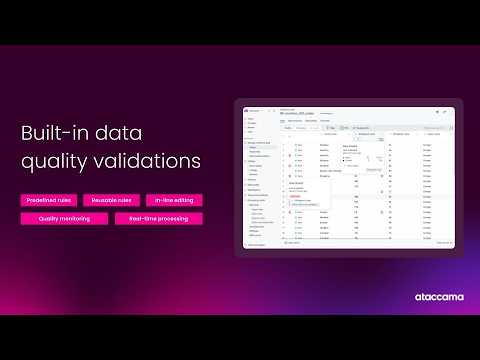
Provides automated profiling, DQ rule authoring, monitoring, anomaly detection, and remediation across connected data sources.
Provides multidomain MDM with AI-powered entity matching and flexible data provisioning for core entities like customers and products.
Governs and distributes controlled vocabularies, codes, and hierarchies such as regions, categories, and statuses.
Provides a desktop client for authoring rules and processing data locally.
Exposes a Model Context Protocol server that connects Ataccama ONE to multi-agent AI systems.
Connects to Snowflake, Databricks, BigQuery, Azure, AWS, Salesforce, SAP, and other systems out of the box.
Processes data locally while running the platform in the cloud, so no raw data leaves the customer's environment.
Ataccama ONE does not publish fixed list pricing; the platform is sold via a sales-led, quote-based model for organizations of all sizes (enterprise data quality, governance, and MDM teams). Pricing requires contacting Ataccama directly for a custom quote.
Real enterprise platform, real customers, but you'll negotiate blind on price.
“450+ enterprise customers and named logos like T-Mobile and Prudential say this isn't vaporware. No public pricing means every deal starts from a weaker position than it should.”
Six modules, one platform: data quality, catalog, lineage, observability, MDM, reference data. That consolidation story is the pitch against Informatica and Collibra, and named customers like Fifth Third Bank and Allianz suggest it lands in regulated industries.
The ONE AI Agent and MCP server are the forward bet. Hooking into LangChain, CrewAI, AutoGen means Ataccama wants to be the trust layer under your agents, not just a governance tool. Metadata-only to LLMs is a smart, specific safeguard worth checking in due diligence.
No pricing page, no free trial, sales-contact only. That's normal for this category but it slows your evaluation and hides total cost until you're deep in a POC. Fine for a bank with a real data governance mandate. Overkill if you just need clean tables in Snowflake.
Sits directly against Informatica and Collibra with a broader six-module bundle and newer agentic angle.
Customers like T-Mobile, Prudential, and HP make this a safe, board-defensible name to cite.
No free trial and sales-only pricing means a long procurement cycle before any payback starts.
MCP server and Data Trust Index push this beyond cost-saving into AI-readiness infrastructure.
450+ enterprise customers and named Fortune-scale clients signal staying power, though no public funding data is provided.
Large regulated enterprises consolidating data quality, catalog, and MDM under one governance mandate.
Skip if you need transparent self-serve pricing or a lightweight tool for a single data problem.
A real six-module data trust platform, but you're buying a governance commitment, not a tool.
“Ataccama ONE consolidates DQ, catalog, lineage, observability, MDM, and RDM under one rule set authored once and applied everywhere. The MCP server and Data Trust Index show real thinking about agentic AI, but pricing opacity and 450+ enterprise customer base signal this is a multi-year platform bet, not a quick pilot.”
Six modules under one rule authoring layer is the actual pitch here, and it's the right architecture. Write DQ rules once, apply across Snowflake, Databricks, BigQuery, SAP — that's how mature data orgs actually want to work, versus rebuilding logic per source system like Informatica shops often end up doing.
The Data Trust Index and MCP server are the interesting bets. Scoring datasets as validated/certified before an autonomous agent acts on them is exactly the control plane multi-agent systems need, and metadata-only LLM exposure is the right call for regulated shops like the named banking and insurance customers.
No public pricing, no free trial, sales-contact-only — a 3-year commitment you can't cheaply reverse. If the vendor lock-in on MDM and RDM data models is deep, migrating off in year three is a real project, not a config change. Fine tradeoff for enterprise scale, brutal for anyone wanting to test drive first.
Sits alongside Informatica and Collibra but leads with agentic AI framing via the Data Trust Index and ONE AI Agent.
Author-once rule model and hybrid deployment (raw data stays local) matches how regulated enterprise data teams actually operate.
Pre-built connectors to Snowflake, Databricks, BigQuery, SAP, Salesforce plus an MCP server for LangChain/CrewAI/AutoGen is a wide, forward-looking surface.
No public pricing or trial means a multi-year sales cycle and switching cost that's hard to unwind once MDM/RDM data models are entrenched.
Six integrated modules plus column-level lineage and AI-powered entity matching is genuine platform depth, not a point solution.
Large regulated enterprises with multi-source data estates who need one governance layer feeding both BI and AI agents.
Avoid if you need to pilot cheaply or want transparent pricing before engaging sales.
No pricing page, no free trial, 450+ customers. Budget by RFP, not by math.
“Zero published pricing. Six modules bundled, but you can't model year-1 cost without a sales call, let alone year 3.”
No pricing plans found. No free trial. Contact sales — that's the whole pricing page. Compare Collibra and Informatica, same category, same opacity problem. Enterprise data governance rarely publishes rate cards.
Six modules bundled: Data Quality, Catalog, Lineage, Observability, MDM, Reference Data. That's consolidation value, if you'd otherwise buy separately. But bundled pricing means bundled lock-in — hard to drop MDM if only Data Quality delivers ROI.
450+ enterprise customers, named accounts like T-Mobile and Prudential. Real deployment scale, not vaporware. But regulated-industry buyers mean long procurement cycles and custom contracts by default. No auto-renewal terms disclosed. No termination language published. Assume standard multi-year enterprise terms until legal sees the MSA. Budget a 6-month sales cycle before you see a number.
No self-serve onboarding; 450+ enterprise logos imply established but sales-led procurement process.
No published renewal or cancellation terms; category norm is multi-year enterprise contracts.
No pricing page, no tiers listed, sales-contact only.
Data Trust Index gives a measurable data-quality score, but no benchmark numbers or case-study ROI figures provided.
Six-module bundle plus connectors to Snowflake, SAP, Salesforce suggests significant implementation cost, unquantifiable from public evidence.
Large regulated enterprises already running Snowflake or SAP that need unified governance across multiple data domains.
Avoid if you need transparent, self-serve pricing to model costs before a sales call.
Six modules, one metadata model, and an MCP server that actually points at LangChain and CrewAI.
“Ataccama ONE consolidates DQ, catalog, lineage, observability, MDM, and RDM under one rule-authoring layer instead of six disconnected tools. The AI Agent and Data Trust Index are the real differentiators, but pipeline-level docs and pricing transparency are missing from the public evidence.”
Rule-once-apply-everywhere is the pitch that matters here. Most shops I've worked in rebuild DQ rules per Snowflake schema or per Salesforce object; if Ataccama's cross-source rule authoring holds up past the sales deck, that's real time back. The MCP server connecting to LangChain, CrewAI, AutoGen is the interesting bet — governed data as a tool call in an agent chain, not a dashboard.
Day-3 concerns: no public pricing tier, no free trial, so you're evaluating this through a sales cycle, not a sandbox. ONE Desktop for local rule authoring plus hybrid deployment (raw data stays local) matters for banking/insurance compliance, but it means two surfaces to learn — desktop client and cloud platform.
Docs capability shows blog and docs but no changelog, no public API reference visible. Compared to Informatica or Collibra, connector breadth (Snowflake, Databricks, BigQuery, SAP) looks competitive, but power-user depth is unverifiable without hands-on access.
Cross-source rule reuse is a real daily win if it works as described, but no trial means you can't verify before contract.
Docs and blog exist per scraped capabilities, but no changelog and no visible public API reference for the REST/GraphQL core.
Two authoring surfaces (ONE Desktop plus cloud platform) and a sales-only pricing gate add friction before day one even starts.
Multidomain MDM with AI entity matching and MCP server integration into LangChain/CrewAI suggest real depth beyond basic profiling.
Pre-built connectors to Snowflake, Databricks, BigQuery, SAP, Salesforce fit existing stacks without custom pipeline work.
Enterprise data teams in regulated industries like banking or insurance juggling multiple source systems and needing one rule layer instead of six.
Avoid if you need to validate the AI Agent's remediation claims hands-on before signing, since there's no free trial or sandbox.
Six modules, one desktop client, zero pricing page — enterprise data tools doing enterprise data tool things.
“Ataccama ONE bundles data quality, catalog, lineage, observability, MDM and RDM into one platform with an AI agent layered on top. Feels built for the data team's boss, not the person clicking through it daily.”
No pricing page, no free trial, sales-only contact. That's not unusual for enterprise data governance — Collibra and Informatica play the same game — but it means you're three sales calls deep before you ever see the product move. That's homework, not a welcome mat.
The feature list is genuinely deep. Column-level lineage, an MCP server hooking into LangChain and CrewAI, hybrid deployment that keeps raw data local while the platform runs in the cloud — that last one matters if you're in banking or insurance, which is clearly who they're courting (T-Mobile, Prudential, Allianz, HP are named customers, 450+ enterprises total). The ONE Desktop client for rule authoring tells me this still leans on a specialist doing configuration work, not a drag-and-drop afternoon.
Mobile isn't mentioned anywhere, which for a governance tool your data stewards live in daily is a real gap, not a shrug. This is a tool you commit to for a year, not one you poke at for a weekend.
Deep module set (DQ, catalog, lineage, observability, MDM, RDM) but ONE Desktop client suggests configuration-heavy daily use, not lightweight polish.
AI Agent automates rule generation and remediation, but six integrated modules plus a desktop client imply real ramp time before month three fluency.
Platforms listed are web and Windows only — no mobile presence mentioned anywhere in the evidence.
No free trial, no public pricing, sales-gated access — first ten minutes is a sales call, not a product tour.
450+ enterprise customers including regulated banks and insurers (Fifth Third, Allianz) suggests production-grade stability, though no uptime data is public.
Large regulated enterprises like banks or insurers juggling Snowflake, SAP, and Salesforce data who need governed AI pipelines.
You want to try before you buy or need a mobile-friendly tool for a small team.
Old-school MDM vendor now speaks fluent agentic AI. Verify before believing.
“Ataccama's been around long enough to have Informatica and Collibra as its real competitors, not startups. But the AI Agent and 'Data Trust Index' language is doing a lot of aspirational lifting with no pricing page to ground it.”
450+ enterprise customers, T-Mobile and Prudential named. That's not a story you fake easily. Data quality, catalog, lineage, MDM, RDM — six modules, one platform, which is either real consolidation or six acquisitions wearing a trenchcoat. No way to tell from here.
Two flags. One: no pricing page, no free trial — 'contact sales' is category norm for enterprise data tools, but it also means every buyer negotiates blind. Two: 'Data Trust Index' scoring datasets for autonomous AI action is the kind of concept that sounds great in a slide and untestable in a demo.
Exit portability is the real question. MDM systems are notoriously sticky — once master records and rules live in Ataccama, unwinding to Informatica or Talend is a multi-quarter migration, not a weekend export. Hybrid deployment (raw data stays local) is a genuinely good trust signal though, and the connector list — Snowflake, Databricks, SAP — is credible, not vaporware.
MCP server and multi-agent framework support (LangChain, CrewAI) is a real differentiator vs. Informatica and Collibra.
MDM and rule-authoring lock-in is a known category trap; no public API pricing or export tooling detailed.
450+ customers and six integrated modules suggest scale, but no funding or changelog data is visible to confirm shipping cadence.
Tagline 'AI built on quality data' is grounded by real modules, but 'Data Trust Index' reads more aspirational than proven.
Named customers like Fifth Third Bank and Allianz match the pattern of a durable enterprise MDM vendor, not a hype startup.
Large regulated enterprises already juggling Snowflake, SAP, and Salesforce who need one governance layer.
You're a mid-market team wanting transparent pricing or a fast trial before committing.
Common questions answered by our AI research team
The ONE AI Agent autonomously monitors, profiles, and remediates data quality issues across connected sources, acting as a digital data steward that extends data teams without adding headcount.
Yes. Ataccama integrates with cloud lakehouse platforms including Snowflake, Databricks, Amazon Redshift, and Google BigQuery, helping maximize those investments while bringing trusted, clean data along.
The Data Trust Index is a real-time, machine-readable signal that scores data and tells AI agents whether a dataset is validated, certified, and cleared for autonomous action before execution.
Yes. Ataccama exposes an MCP server that connects agent frameworks like LangChain, CrewAI, AutoGen, and LlamaIndex to governed data sources and tools as part of the agent orchestration layer.
Yes. Ataccama's data sources layer covers unstructured sources including Slack, Gmail, SharePoint, Notion, and Google Drive, alongside structured systems like SAP, Workday, and Salesforce.


Ataccama develops a data management platform covering data quality, governance, and master data management for enterprises, headquartered in Toronto, Canada.