Unified governance for enterprise data and AI
Collibra is a data and AI governance platform for large enterprises.
AI Panel Score
6 AI reviews
Reviewed
AI Editor ApprovedApproved and published by our AI Editor-in-Chief after full panel analysis.Collibra is a data and AI governance platform that helps large enterprises catalog, trace, and control their data and AI systems from a single environment. It is built for regulated organizations in finance, healthcare, and the public sector where data stewards, analysts, and compliance teams need trusted, well-documented assets. Pricing is quote-based and sold through enterprise contracts, with no public self-service tiers, so buyers contact sales for a custom quote. Core capabilities include a governed data catalog and marketplace, column-level data lineage, data quality and observability monitoring, automated policy enforcement, and an AI Command Center that registers models and agents, assigns an AI Trust Score, and maps assessments to the EU AI Act and NIST AI RMF. It fits enterprises standardizing governance across Databricks, Snowflake, and cloud platforms. Alternatives worth comparing include Alation, Atlan, Informatica, data.world, and Microsoft Purview for data catalog and governance needs.
Collibra centralizes an organization's data and AI assets in a governed catalog where technical and business users search for trusted data, view its lineage, and request access under enforced policy. Data stewards define a shared business glossary, assign ownership, and automate classification so definitions and controls stay consistent across teams.
The platform pairs data governance with data quality and observability, which monitors pipelines and surfaces issues for self-service remediation, and column-level lineage that traces data flow across systems. Its AI Command Center registers every AI use case, model, and agent in a unified registry, calculates an AI Trust Score, and runs assessment templates mapped to the EU AI Act and NIST AI RMF. Embedded collaboration pushes governance workflows into Slack and Microsoft Teams.
Collibra targets large, regulated enterprises in finance, healthcare, and the public sector, and is sold through enterprise contracts with quote-based pricing rather than public tiers. It competes with Alation, Atlan, Informatica, data.world, and Microsoft Purview in the data catalog and governance market.
It integrates with Databricks, Snowflake, Google Cloud, AWS, SAP, Azure AI Foundry, and MLflow, and offers a developer portal, REST APIs, and a CLI for code-first AI registration. The platform runs in the cloud and is also available through the AWS Marketplace.
Aggregate documentation, data integrity, lifecycle status, and regulatory signals into a single AI readiness metric.
Visualize column-level data flow and transformations from source through consumption systems.
Monitor pipelines with AI-driven rules that surface and prioritize data quality issues for self-service remediation.
Capture AI use cases from code via a CLI that generates structured manifests and syncs metadata automatically.
Discover personal data and automate privacy compliance with regulatory risk assessment.
Search and discover governed data assets with business context across the entire organization.
Publish and shop for curated, trusted data products through a governed internal marketplace.
Register and govern every AI use case, model, and agent across the full AI lifecycle.
Track AI systems with connections to their data, policies, and dependencies from one system of record.
Run governance workflows directly inside Slack and Microsoft Teams.
Define access policies once and enforce them automatically across connected data sources.
Create a shared language of terms and metrics with federated definitions across teams.
Pricing requires contacting the vendor.
Collibra is the safe governance bet for regulated enterprises now facing AI audit pressure.
“A 2008-founded category leader with a $5.25 billion valuation and blue-chip regulated customers, Collibra is a low-risk board defense. The catch is a quote-based contract and a rollout measured in months, not days.”
Public-company auditors have started asking where the AI model inventory lives, and Collibra sells a credible answer. Its AI Command Center registers every model and agent, then maps lineage back to source data for the EU AI Act.
Vendor risk is low here. Founded in 2008, funded past $546 million, and valued at $5.25 billion in its 2021 Sequoia-led round — this company will be around to renew the contract. That matters more than any single feature when you're defending the choice in 18 months.
The honest caveat: pricing is quote-only and deployment runs weeks to months, so speed-to-value trails lighter rivals like Microsoft Purview. But for a bank or hospital that needs audit-ready governance, that's the price of the moat. Run a scoped pilot on one regulated domain before you standardize.
The AI Command Center extends governance to models and agents ahead of most catalog rivals.
Established brand with blue-chip regulated customers lowers the reputational downside of the choice.
Quote-based sales and a weeks-to-months rollout mean no fast win.
Purpose-built for finance, healthcare, and public-sector firms with hard compliance mandates.
Founded 2008, over $546 million raised, and a $5.25 billion 2021 valuation make survival a non-issue.
Regulated enterprises who need audit-ready AI governance.
Small teams who want catalog value in days.
One metadata graph for catalog, lineage, quality, and AI governance is the strategic draw.
“For a Head of Data, Collibra's pull is consolidation: one governed metadata layer where the business glossary, column-level lineage, and the AI registry share definitions. The tradeoff is a heavier operating model that needs dedicated stewards to pay off.”
Collibra runs 12 governance modules on one metadata graph — catalog, lineage, quality, privacy, and now a Unified AI Registry that inherits the same glossary. That shared-definition design is the real strategic asset. It means an AI model's data provenance and a business term's owner resolve against one system of record, not three.
Domain fit for a regulated data org is strong. Assessment templates mapped to the EU AI Act and NIST AI RMF mean the governance program and the compliance program stop being separate spreadsheets. Alation covers the catalog well, but its AI-governance story is thinner today.
The long-term implication is lock-in at the stewardship layer, not the database. If your glossary, workflows, and ownership model all live in Collibra, that's years of encoded process to unwind. However, open REST APIs and column-level lineage exports soften the exit more than most enterprise suites.
The Unified AI Registry pushes it ahead of catalog-only rivals in the governance category.
EU AI Act and NIST AI RMF assessment templates match a regulated data org's mandate.
Connects to Databricks, Snowflake, SAP, MLflow, and Azure AI Foundry across the estate.
Deep stewardship lock-in makes an eventual migration a multi-year unwind.
Twelve modules on one metadata graph deliver catalog, lineage, quality, and AI governance together.
Data leaders who consolidate governance onto one platform.
Small analytics teams who need a lightweight catalog.
No public price, six-figure contracts, and a module bill that grows with every domain.
“Collibra is quote-only, with analyst data putting typical contracts in the low-to-mid six figures per year. The modular structure is the real cost risk: catalog is one line, quality, privacy, and the AI Command Center are more.”
There's no sticker here. Collibra sells through custom enterprise contracts, so the model starts with a sales call. Analyst data points to low-to-mid six figures annually, scaling with modules and users.
The bill is modular. Catalog, Data Lineage, Data Quality & Observability, and the AI Command Center price separately. Buy three, and year-two renewal is where seat and connector creep — often 20% or more — shows up. Atlan competes on faster time-to-value at a lower entry point.
Procurement gets one break: Collibra is on the AWS Marketplace, so a committed spend can absorb it. But contract terms aren't public, and multi-year enterprise deals rarely include termination for convenience. ROI is real for regulated buyers who'd otherwise staff a compliance team; thinner for everyone else.
AWS Marketplace availability lets buyers draw down committed cloud spend.
Multi-year enterprise deals rarely include termination for convenience.
Fully quote-based with no public price list forces a sales call to budget.
Clear payback for regulated buyers replacing manual compliance labor.
Modular pricing across catalog, quality, and AI modules makes year-two costs creep.
Regulated enterprises who can absorb six-figure governance contracts.
Budget-conscious teams who need transparent per-seat pricing.
A CLI that turns pipeline code into governed AI manifests signals real engineering intent.
“Collibra's Code-First AI Registration CLI and column-level lineage are built for engineers who live in pipelines, not just governance dashboards. The friction is deployment scale: connector coverage and metadata scans across a large estate take weeks, not an afternoon.”
The Code-First AI Registration CLI generates structured manifests from pipeline code and syncs metadata automatically. That's a tell — someone who ships data pipelines designed it, not a governance PM. It slots AI registration into the same repo workflow as everything else you version.
Column-level lineage traces flow across Snowflake, Databricks, and MLflow without hand-drawn diagrams. Three days in, that's the feature you actually lean on when a downstream table breaks. Governance workflows also route into Slack and Microsoft Teams, so approvals don't strand in a separate console.
The catch is scale. Standing up connectors and scanning metadata across a big estate runs weeks to months, often with one of 300+ service partners. data.world leans harder into a knowledge-graph query model, which some engineers prefer for exploration. But for lineage depth and AI coverage, Collibra's surface is wider.
Column-level lineage is the feature engineers lean on when a downstream table breaks.
A developer portal, REST APIs, and CLI give engineers code-first entry points.
Connector setup and metadata scans across a large estate take weeks to months.
Twelve modules plus code-first AI registration give deep room to grow into.
CLI-driven registration and Slack/Teams approvals fit existing repo and chat workflows.
Data engineers who register AI models from code.
Small teams who need a catalog running this week.
Heavy enterprise governance that tries, in a few spots, to feel almost human.
“This isn't a tool you pick up in ten minutes; it's a platform you get trained on over weeks. But the Data Marketplace and the Slack and Teams integration are the parts that keep it from feeling like pure paperwork.”
Most governance tools feel like paperwork with a login. Collibra's Data Marketplace at least tries to feel like shopping — you browse curated, trusted data products instead of filing a ticket and waiting. That's a small thing that adds up when you need data on a Tuesday.
The Business Glossary and Embedded Collaboration in Slack and Microsoft Teams mean governance meets you where you already work. That's the polish that matters day to day. Reliability-wise, this is a mature 2008-era platform running in the cloud, so it isn't going to surprise you.
The learning curve is the honest downside. Rollout runs weeks to months, and you'll need a steward to hold your hand early. Mobile is basically not the point here — it's a web platform for desk work, and that's fine. Atlan feels lighter on day one, but Collibra goes deeper once you're in.
Data Marketplace and Business Glossary add human touches most governance tools skip.
Deep enough that early users need steward support to get productive.
A web platform for desk work where mobile isn't the intended use case.
A weeks-to-months rollout that needs a steward is a slow start.
A mature 2008-era cloud platform feels stable and predictable.
Enterprise users who want governance inside their chat tools.
People who expect to be productive on day one.
A real survivor whose single AI Trust Score is the number I'd probe hardest.
“Eighteen years in, $546 million raised, and a $5.25 billion valuation — this isn't a startup that vanishes next year. But a single AI Trust Score that rolls up documentation, data, and compliance into one number is the kind of metric that flatters more than it reveals.”
Data catalogs have a habit of turning into expensive shelfware. Collibra mostly earns its way out of that graveyard. Founded 2008, past $546 million raised, $5.25 billion valuation in the 2021 Sequoia round — the track record matches the pitch.
Where I'd push: the AI Trust Score. Aggregating documentation, data integrity, lifecycle, and regulatory signals into one metric is convenient for a slide, easy to game in practice. Yellow flag, not a red one — the underlying registry and lineage are real.
Exit story is decent. REST APIs, a CLI, and column-level lineage mean your metadata isn't fully hostage. Informatica and Alation have both survived this category, so Collibra isn't uniquely durable — but it isn't the one I'd bet against either. No public pricing is the only thing that reads like they're hiding a number.
The AI Command Center leads, but Alation and Informatica keep the category crowded.
REST APIs, a CLI, and lineage exports keep metadata from being fully hostage.
A $5.25 billion valuation and mature funding make a near-term exit unlikely.
Claims are mostly substantiated, though the AI Trust Score and hidden pricing invite scrutiny.
An 18-year history and real regulated customers back up the enterprise pitch.
Enterprises who need a proven governance vendor.
Buyers who need public pricing upfront.
Common questions answered by our AI research team
Collibra uses quote-based pricing sold through enterprise contracts, so there is no public price list and buyers contact sales for a custom quote. Analyst data puts typical annual contracts in the low-to-mid six figures depending on modules and users.
Yes. The AI Command Center registers every AI use case, model, and agent in a Unified AI Registry, assigns an AI Trust Score, and traces lineage from source data through deployment. It ships assessment templates aligned to the EU AI Act and NIST AI RMF.
Collibra connects to Databricks, Snowflake, Google Cloud, AWS, Azure, SAP, and MLflow, plus Azure AI Foundry for automated AI lineage. Governance workflows also embed into Slack and Microsoft Teams, and it offers REST APIs and a CLI.
Data Access lets you define access policies once and enforce them automatically across connected sources, while Data Privacy discovers personal data and runs regulatory risk assessments. Role-based accountability assigns owners and stewards to protect sensitive assets.
Collibra is an enterprise deployment that typically rolls out over weeks to months, often with help from its professional services team or one of 300+ service partners. It runs in the cloud and is also available through the AWS Marketplace.
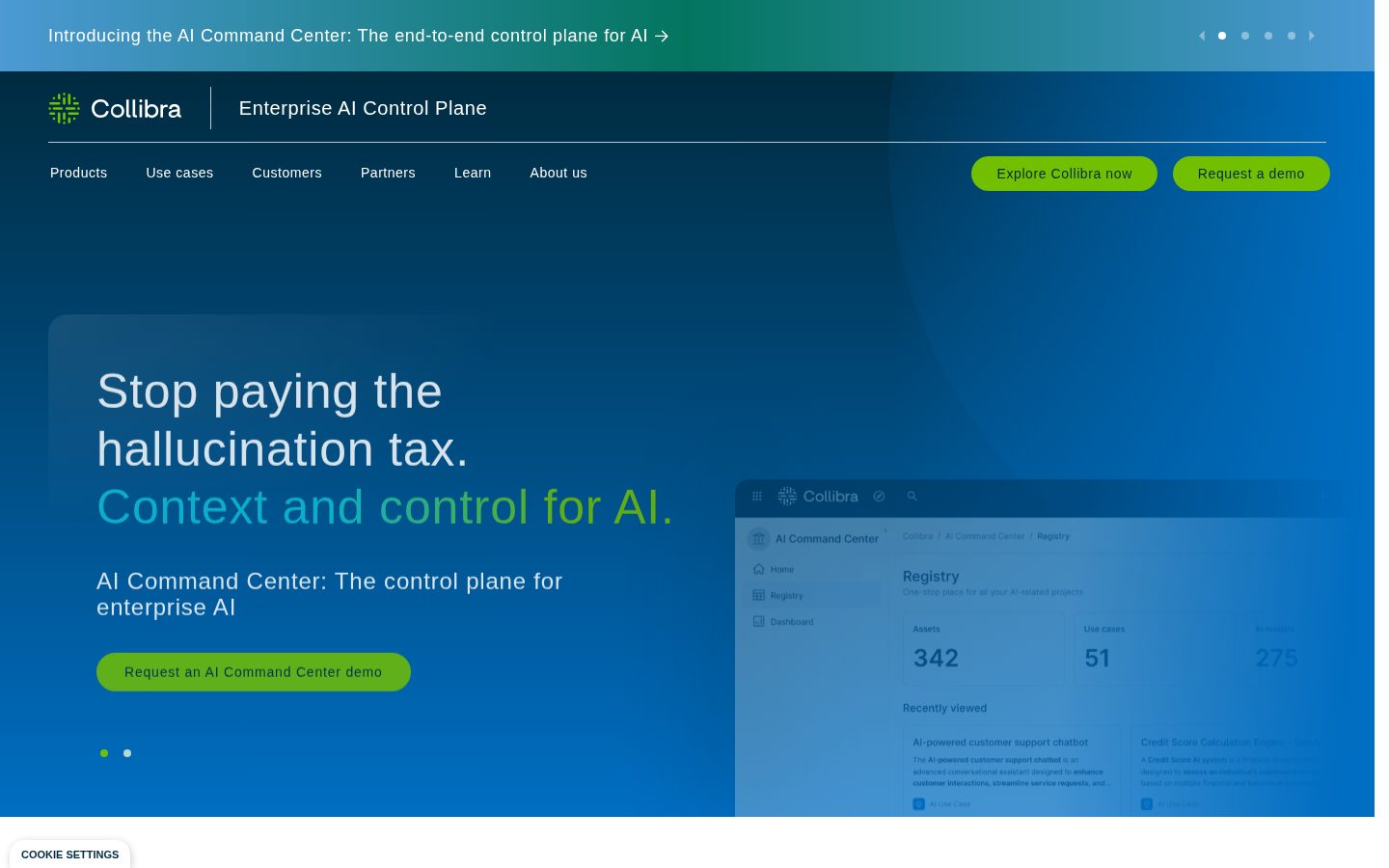
Collibra builds enterprise data and AI governance software that helps organizations catalog, manage, and trust their data. Based in New York and Brussels.