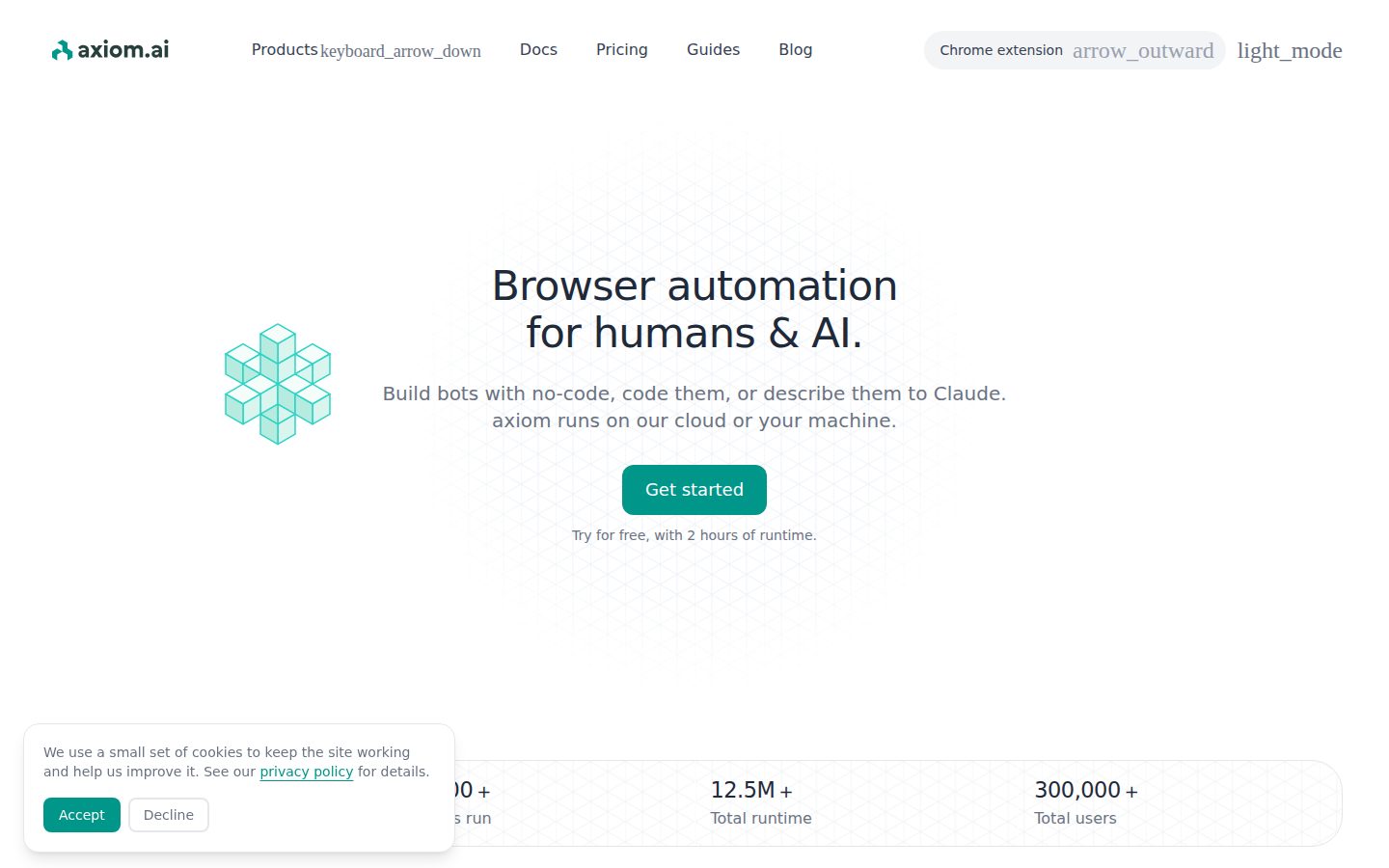
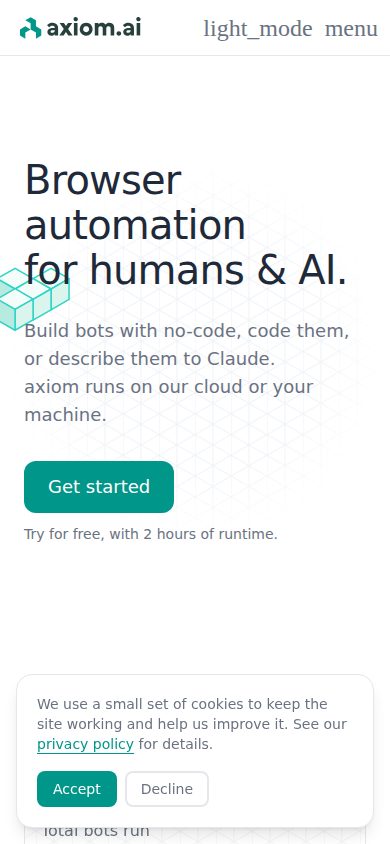
Browser automation for humans and AI
Axiom is a browser automation and web scraping tool for building bots without code, in code, or via natural language.
AI Panel Score
6 AI reviews
Reviewed
AI Editor ApprovedApproved and published by our AI Editor-in-Chief after full panel analysis.Axiom is built around a visual Builder that runs as a Chrome extension: users point and click on elements of a webpage to define steps like navigating, scraping, entering text, clicking, uploading or downloading files, and looping through data from a spreadsheet or CSV. Bots built this way can be scheduled to run unattended, either in Axiom's cloud or on a local machine via a desktop runner, and can be triggered manually, on a timer, or through webhooks and tools like Zapier or Make.
Beyond the no-code Builder, Axiom exposes three developer-facing layers. The Chrome API is a Chrome DevTools Protocol WebSocket endpoint that can be driven with Puppeteer or Playwright for full programmatic control of a cloud browser. The Step API is a Node.js library (`@axiom_ai/api`) offering higher-level functions such as `goto`, `click`, `enterText`, and `scrape`. The Orchestrate API is a REST interface for triggering and managing runs of any saved automation, whether it was built with no-code or code. Axiom also provides an MCP server and a Claude skill, letting users describe an automation in plain English and have Claude assemble the corresponding no-code or code bot. Other documented capabilities include login handling (saved credentials, 2FA, session sharing, password manager integrations including 1Password), captcha solving via a 2Captcha integration, custom JavaScript steps, and AI integration for passing scraped data to models like Claude or ChatGPT within a run.

Passes scraped or form data to Claude, ChatGPT, or another LLM within an automation to extract structured fields or generate new content.
Users describe an automation in plain English and the axiom.ai Claude skill assembles a no-code or code bot to perform it.
Solves reCAPTCHA and similar challenges via a 2Captcha integration, manual interaction, or anti-bot blocking settings.
A Node library (@axiom_ai/api) of high-level browser actions like goto, click, enterText, and scrape for scripting automations from a user's own stack.
Reads rows from a spreadsheet or CSV and loops through them to fill and submit a web form for each entry.
Uses If, Try/Catch, and jump steps to branch automations based on data conditions, loop until a condition is met, or stop a run early.
A visual Chrome extension Builder where users add, duplicate, move, and configure steps to construct browser automations by pointing and clicking.
Runs automations manually, on a schedule, or triggered via webhook/Zapier/Make, and can distribute runs across multiple computers or the cloud.
Downloads and uploads files to and from Google Drive or a local computer as part of an automation run, including looped file transfers.
Extracts lists or tables of data from web pages, including a smart-scrape function with optional pagination support.
A Chrome DevTools Protocol WebSocket endpoint that lets developers drive a cloud browser with Puppeteer or Playwright for full programmatic control.
Connects axiom.ai to any MCP client, such as Claude Code or Claude Desktop, so automations can be triggered from those tools.
A REST API for triggering saved automations and managing their runs, working for both no-code and code-built bots.
Handles sign-in across sites via saved credentials, shared browser sessions/cookies, 2FA, password managers, or a Google Sheet of logins, without storing passwords directly in the automation.
For individuals getting started with browser automation who want to try building bots with no commitment.
For individuals or small teams who need regular scheduled automation and integrations.
For growing teams with more demanding automation needs requiring parallel runs.
For enterprises or larger teams with extensive, high-volume automation requirements.
For organizations whose needs exceed the Ultimate tier; requires contacting Axiom directly for a tailored plan.
Solid RPA tool since 2019, but the Claude skill is the only thing making it feel new.
“Axiom does no-code, code, and now natural-language browser automation with real depth. The pricing math punishes anyone who scales past a hobby use case.”
Six years in market, three ways to build a bot, and a Chrome DevTools API for developers who want full control. That's a real product, not a demo.
Two things worth flagging. One: the runtime caps are stingy — Pro at $50/month gives you 30 hours and a 2-hour single-run limit, which is thin for anything production-grade. Two: this competes with UiPath, Zapier, and Make, none of whom struggle for credibility with a board.
The Claude skill and MCP server are the actual differentiator — describe a bot in English, get a working automation. That's ahead of most RPA tools I've seen. But the core scraping and form-filling has been commodity since 2019. Pilot it for a scraping-heavy team of five, don't roadmap around it yet.
Chrome API and MCP server put it ahead of legacy RPA tools like UiPath for developer flexibility, but Zapier owns broader mindshare.
Browser automation and scraping carry mild scrutiny risk but are mainstream category, not fringe.
No-code Builder plus templates means a working bot in days, not a quarter-long implementation.
Mostly automates tasks you already do manually; the Claude-skill layer is the only genuinely new capability.
Six years in market since 2019 with a live product, but no public funding data or team size disclosed.
Small teams needing scraping or form automation who'll actually use the Claude-skill workflow.
Skip if you need high-volume concurrent cloud runs without paying up to the $250 Ultimate tier.
Solid ops tool for scoped scraping and form work, but runtime metering will surface as a headcount-planning problem.
“Axiom covers the no-code-to-code spectrum well and prices sanely at the entry tiers. The runtime-hour model means growth in automation volume shows up as a recurring line-item negotiation, not a fixed cost.”
Operationally, Axiom is buildable across three skill levels — Builder, Step API, plain-English via Claude skill — which matters when the person maintaining a bot isn't the person who built it. That's real continuity insurance versus tools like UiPath that assume a dedicated RPA team.
The constraint I flag for planning: pricing is metered in monthly runtime hours (30 hrs at $50, 100 at $150, 250 at $250) with cloud single-run caps up to 12 hours. That's fine at pilot scale. At real production volume across multiple departments, hours become a procurement conversation every quarter, not a settled budget line.
Desktop runs are unmetered and unlimited concurrency, which is a smart release valve for privacy-sensitive or high-frequency jobs. But that pushes reliability onto whichever employee's machine is running the bot — a single point of failure I'd want solved before scaling past pilot teams. 2Captcha and Zapier/Make integrations extend reach without new engineering.
Sits below UiPath's dedicated-RPA-team assumption — sane entry pricing for department-level automation.
Built for scoped scraping and form work where the maintainer often isn't the builder — real continuity insurance.
2Captcha and Zapier/Make integrations extend reach without new engineering.
Runtime-hour metering means automation growth becomes a quarterly procurement conversation, not a settled budget line.
Three build surfaces — no-code Builder, Step API, plain-English via Claude — cover the full skill spectrum most rivals split across products.
Ops teams scaling browser automation across mixed skill levels without a dedicated RPA function.
Avoid if you need fixed automation costs at production volume or can't accept desktop-machine reliability risk.
Runtime hours, not seats, drive the invoice. Watch the Pro-to-Pro-Max jump.
“Five tiers, all published, no sales call needed. But the real cost driver is monthly runtime hours, and that scales fast for a team.”
$15/month Starter, 5 hours runtime. Pro at $50 gets 30 hours, Zapier, webhooks. Pro Max at $150 triples to 100 hours but only doubles concurrency to 2 bots. That's the tier to watch — teams outgrow 30 hours quickly once scheduling goes daily.
Year 1 for a small team: $50 × 12 = $600. Add overage risk once runtime caps hit — no published per-hour overage rate, so a busy month forces an upgrade, not a bill. Year 3 at Pro Max: $150 × 36 = $5,400, likely more once concurrency needs grow.
Desktop runs are unlimited concurrency, no time cap — real cost lever if cloud hours get expensive. Compare to Zapier's task-based pricing: different unit, similar trap. No stated contract term or auto-renewal language that I could find — month-to-month looks likely, but confirm before signing.
Free plan and 2-hour trial with no credit card lowers onboarding friction significantly.
No stated term length or renewal clause that I could find; monthly billing implied but not confirmed.
Five tiers with hours, concurrency, and limits all listed publicly, no gated pricing page.
Hours saved on scraping and form-filling are measurable, but no benchmark data or case studies provided.
Runtime-hour model means costs scale with usage, not seats — hard to project without a usage baseline.
Small teams with predictable, moderate-volume scraping or form automation needs.
You need enterprise concurrency without calling sales for custom terms.
Solid bot builder for spreadsheet-driven tasks, but runtime caps will bite mid-month
“Axiom covers the real ops workflow: point-and-click Builder, scheduled runs, CSV loops, login/2FA handling. The runtime-hour pricing model means you're watching a meter the way you'd watch API credits, which changes how you plan recurring jobs.”
Day-to-day, the Chrome extension Builder plus scheduling covers 80% of what an ops person actually automates: form fills, scraping into a Google Sheet, looping a CSV of vendor logins. Login/session handling with 2FA and 1Password support means fewer 2am re-auth failures, which is where most no-code scrapers quietly break.
The friction shows up in the pricing math, not the UI. Pro at $50/month buys 30 hours of runtime with a 2-hour single-run cap and daily-only cloud scheduling — if you're running hourly jobs across multiple sites, you're either upgrading to Pro Max ($150, 100 hours, 2 concurrent) or pushing work to the desktop runner, which is unlimited but ties up a machine. That's a real tradeoff versus something like UiPath's attended/unattended split, where concurrency isn't gated by a monthly hour meter.
Power-user path is genuinely there: Chrome DevTools Protocol access for Puppeteer/Playwright, a Step API, Orchestrate API, and now a Claude skill for describing bots in English. Docs cover all three layers, which suggests engineers wrote them, not just marketing.
Builder and scheduling handle routine scraping/form-fill fine, but runtime hour caps become a live concern by week two of daily jobs.
Separate docs for Chrome API, Step API, and Orchestrate API suggest documentation written by people who actually ship code against them.
2-hour single-run limit on Pro and daily-only cloud scheduling force workarounds for anything time-sensitive or long-running.
Scales from no-code Builder to Puppeteer/Playwright CDP access and a Claude skill for natural-language bot assembly.
Zapier, Make, webhooks, Google Sheets/Drive integrations slot into existing ops stacks without much retooling.
Ops teams running scheduled, spreadsheet-driven web tasks who can live within metered monthly runtime hours.
Avoid if you need high-concurrency, long-duration cloud automations without watching an hour meter.
A real point-and-click scraper with a coding backdoor, if you can survive the runtime clock.
“Axiom lets you build bots by clicking, coding, or just talking to Claude. The three-way approach is genuinely useful, but the hour-based pricing will nag at you every month.”
Point-and-click bot builders are usually toys once you leave the demo. Axiom's Chrome extension Builder looks like the usual suspects, but then it also gives you a Step API, a raw Chrome DevTools/Puppeteer endpoint, and a Claude skill that writes the bot from a plain-English description. That's three doors into the same house, which is rare — most tools like this (think Zapier, but for the browser) pick one lane and stay there.
The catch shows up in the pricing page. Free gets you 2 hours total, one-time, no renewal. Pro is $50/month for 30 hours with a 2-hour single-run cap. If your scrape runs long, you're watching a clock, not a spinner — that's a different kind of anxiety than most SaaS dashboards give you.
Desktop runs are unlimited time and concurrency, which is the smart escape hatch. Three months in, you'll live on desktop and treat cloud hours like a rationed resource. Login handling with 1Password and 2FA support is a nice daily-use touch most competitors skip.
Login handling with 1Password and 2FA support is a daily-use touch most competitors skip.
Click, code, or talk to Claude — three ramps into the same house means you grow into it instead of out of it.
It's a Chrome-extension and desktop tool — mobile isn't the point, and there's no story for it.
The Chrome extension Builder gets you a working bot fast; the free tier's 2-hour one-time cap is the catch.
Cloud runs against a 2-hour single-run cap mean you're watching a clock, not a spinner.
Hands-on tinkerers who'll live on unlimited desktop runs and treat cloud hours as a rationed resource.
Your scrapes run long in the cloud — the runtime clock will nag you every month.
2019 vintage, still Chrome-extension shaped. That's not automatically bad.
“Axiom's been around since 2019, which in browser automation is a decent track record. But the pricing runtime model and Chrome-extension core raise the usual portability questions.”
Three layers of API, a Claude skill, an MCP server. That's more surface area than UI-Vision or most no-code scrapers had five years ago. Founded 2019 — old enough to have survived a category that's eaten plenty of scrapers whole.
The pricing is metered runtime, not seats. Free tier is 2 hours, one-time, doesn't renew. Pro is $50/month for 30 hours. That's a usage-based model, same playbook as Browse.ai and Octoparse, and it can get expensive fast if a bot runs long — note the 2-hour single-run cap on Pro.
Exit portability is fine on paper: Step API is just a Node package, Chrome API is standard CDP, so Puppeteer/Playwright scripts aren't fully locked in. No-code Builder flows are the real lock-in — those don't export anywhere. Competing against Zapier and Make for orchestration, but scraping-first positioning is the actual differentiator.
Three build modes (no-code, code, Claude-described) vs. Zapier/Make's orchestration-only approach, though scraping-focused tools are crowded.
Step API and CDP access reduce lock-in, but the no-code Builder's visual flows don't export.
No public funding data visible, but five-tier pricing and MCP integration suggest active shipping, not maintenance mode.
Tagline 'for humans and AI' is delivered on — Claude skill and MCP server are real, documented features.
2019 founding plus tiered pricing plans match durable no-code automation patterns, not a pump-and-dump launch.
Small teams needing scheduled scraping or form-fill bots without hiring a developer.
You need heavy concurrent cloud runs on a tight budget, since concurrency only unlocks at $150/month and up.
Common questions answered by our AI research team
The Starter plan costs $15/month with 5 hrs monthly runtime, unlimited desktop concurrency, 1 bot in the cloud with a 1-hour single-run limit, no-code and code dashboard access, and email and community support.
Yes. Axiom runs on Axiom's cloud infrastructure or on your own desktop via a desktop app, running automations in complete privacy with unlimited concurrency and no time limit on desktop runs.
Yes. Axiom integrates with Zapier and Make (available starting on the Pro plan and above), along with Google Sheets, Excel, Google Drive, 2Captcha, ChatGPT, and other LLMs.
Yes. Axiom lets you build automations by describing them in plain English, which are assembled into bots by a Claude skill using the Claude Code agent with deep integrations across all products.
Yes. All new accounts get 2 free hours of runtime to try before subscribing, with no credit card required.
Company
Axiom AI LimitedFounded
2019Pricing
From $50/moFree Trial
AvailableFree Plan
Available


Axiom.ai is a browser automation tool based in Vancouver, Canada that lets users build bots without code to automate repetitive web tasks like data scraping and form filling.