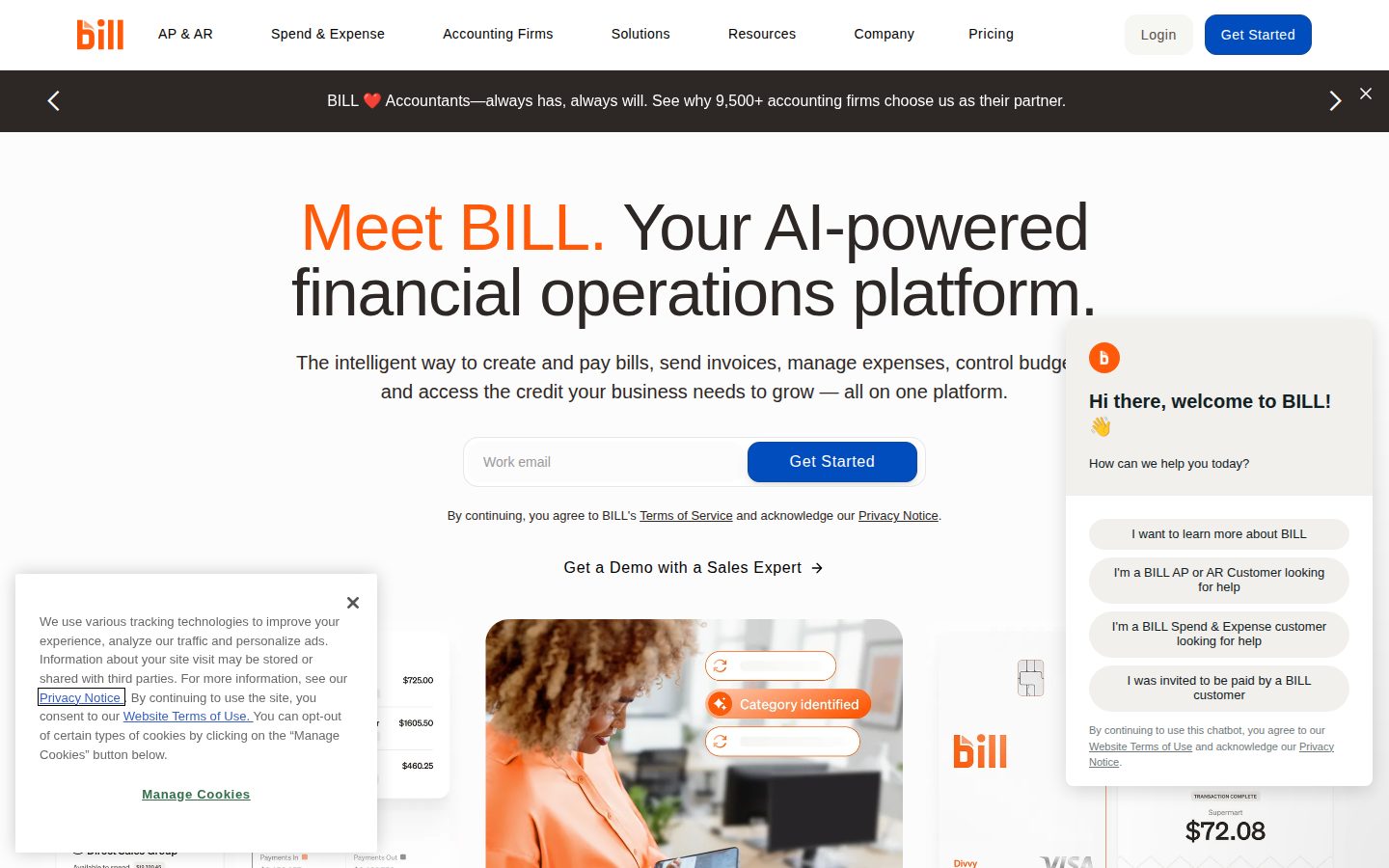
Accounts payable and receivable automation platform for businesses
Bill.com is a cloud-based accounts payable and receivable automation platform for businesses.
AI Panel Score
6 AI reviews
Reviewed
AI Editor ApprovedApproved and published by our AI Editor-in-Chief after full panel analysis.Bill.com is a cloud-based financial operations platform that automates accounts payable and receivable processes for businesses of all sizes. The software digitizes and streamlines invoice processing, bill payments, and cash flow management through automated workflows and electronic payment capabilities.
The platform serves small to mid-sized businesses, accounting firms, and enterprise organizations looking to reduce manual financial processes. Key features include invoice capture and approval workflows, vendor management, electronic payments via ACH and check, accounts receivable automation, and integration with popular accounting software like QuickBooks, Xero, and NetSuite.
Bill.com offers role-based access controls, multi-entity support, and comprehensive reporting and analytics. The platform processes payments domestically and internationally, supporting various payment methods including ACH transfers, virtual cards, and traditional checks. Users can set up approval hierarchies, schedule recurring payments, and track payment status in real-time.
The software competes in the financial automation and B2B payments space alongside platforms like Tipalti, AvidXchange, and MineralTree. Bill.com has established partnerships with financial institutions and accounting software providers to expand its ecosystem and provide integrated financial management solutions for businesses seeking to modernize their financial operations.

Predicts cash flow to help businesses make informed financial decisions with confidence.
Automates invoice capture, approval workflows, and ACH payments to streamline the full AP process.
Routes bills and invoices through configurable approval chains before payment is authorized.
Allows employees to manage fund requests and approvals directly within Slack using slash commands.
Provides invoice tracking, reconciliation, and customizable invoices to manage money owed to the business.
Supports CSV import and export as an alternative data transfer option alongside direct accounting integrations.
Manages employee reimbursements, virtual cards, card controls, and spend visibility across the organization.
Supports cross-border payments as part of the accounts payable workflow.
Issues virtual cards with configurable controls to manage and restrict employee spending.
Provides two-way sync with QuickBooks, Oracle NetSuite, Sage Intacct, Microsoft Dynamics 365, and Xero for automated reconciliation and reduced manual entry.
Auto-imports and syncs employees from HRIS platforms like BambooHR, Rippling, Workday, UKG, and ADP to streamline onboarding.
Maintains an audit-ready digital record of transactions and invoice activity synced with connected accounting systems.
Spend 50% less time on AP or automate invoicing and get paid 2x faster.
Get more granular AP & AR controls and automatic 2-way sync with leading accounting software.
Get additional customization and confidently manage AP, AR, and Procurement—all in one place.
Enhanced security, multi-location accounting capabilities, and priority support for large or complex organizations.
Free plan with corporate cards, budgets, expense tracking, and access to credit lines.
BILL processes roughly 1% of US GDP across 493,800 businesses — that's a defensible incumbent moat.
“BILL Holdings is a public AP/AR automation incumbent serving 493,800 businesses, with FY2025 core revenue of $1.3B and the Divvy spend platform layered on top. The buying question is whether the BILL Network and accounting integrations hold the mid-market against Ramp and Brex pushing up from corporate cards.”
BILL Holdings is the incumbent SMBs already use through their accountant. FY2025 core revenue of $1.3B, up 16%, across 493,800 businesses processing roughly 1% of US GDP. The 3-year viability question doesn't apply.
The Divvy acquisition for $2.5B in June 2021 added spend management and corporate cards to AP/AR, and BILL Spend & Expense ships free with no per-user fee. AP Automation at $89/seat on the Corporate tier includes procurement, two-way matching, and 2-way sync with QuickBooks, Xero, NetSuite, and Sage Intacct.
But Ramp and Brex are eating the low end with sharper card-led UX, and Stampli and Tipalti are pressing mid-market AP. The tradeoff is incumbent breadth versus newer card-first design. Standardize on BILL where accounting-firm integrations matter; pilot Ramp side-by-side on the spend stack.
Peers split — accounting-led shops on BILL, card-led startups on Ramp or Brex; mid-market AP under pressure from Stampli and Tipalti.
Public NYSE incumbent with SOC 2, dual control, and SSO — the board-defensible choice for AP/AR.
Two-way sync with QuickBooks, Xero, NetSuite, and Sage Intacct shortens rollout; 4M-vendor BILL Network reduces onboarding friction.
Accountant-installed incumbent with AP, AR, procurement, and Spend & Expense in one platform; less innovation pace than Ramp.
Public since December 2019, FY2025 core revenue $1.3B up 16%, 493,800 customers — the durability question is closed.
Finance leaders who need accountant-ready AP/AR with deep QuickBooks and NetSuite integration.
Card-first teams who want Ramp's spend-management UX as the primary surface.
The accounting-firm channel is BILL's real moat, and that's the architecture Ramp can't easily replicate.
“BILL's distribution through 9,000 accounting firms plus an 8-million-member payment network is the architectural choice, not the AP feature set. The catch is Ramp's $32B card-led platform coming up-market and Capital One's January 2026 Brex deal reshaping the corporate-card landscape.”
Nine thousand accounting firms is the moat, not the AP feature set. For a CFO sizing a 3-year financial-operations bet, BILL's accounting-firm channel and 8-million-member payment network sit deeper in the stack than any invoice UI. Embedded inside QuickBooks Online, Xero, Sage Intacct, and NetSuite, BILL became the default firm referral.
The Invoice Coding Agent and the W-9 Agent on the Team tier at $65/user/month signal where the platform is going — agent-graded AP, not just OCR. FY2025 revenue hit roughly $1.5B with Divvy card AP volume up nearly 600% year-over-year, evidence the AP+Card bundle is finally compounding.
But the strategic catch is the squeeze. Ramp passed $1B ARR at a $32B valuation in late 2025, and Capital One's $5.15B Brex deal closes mid-2026, putting bank-grade distribution behind a corporate-card-first rival. BILL wins the accountant-led mid-market; Ramp owns the cards-first venture-backed cohort.
Public, profitable, FY2025 revenue near $1.5B with the dominant SMB AP network — defensible but contested.
Built around how mid-market controllers actually work — through the accounting firm and the GL sync.
Two-way sync with QuickBooks Online, Xero, Sage Intacct, NetSuite, plus HRIS sync and Slack approvals.
Ramp's $32B card-led platform and Capital One-backed Brex create real ceiling pressure over 3 years.
AP, AR, Procurement, and Divvy Spend & Expense bundled with agent-graded coding shows real platform depth.
CFOs and controllers who run AP through their accounting firm.
Startups who already standardize on a cards-first stack.
BILL prices seats at $49-$89 while Ramp and Brex give the same workflows away for interchange.
“BILL charges $49/$65/$89 per user monthly across Essentials, Team, and Corporate, plus $0.59 per ACH and $1.99 per mailed check. Ramp and Brex ship comparable AP workflows free and monetize the card interchange instead — that's the live procurement pressure.”
Procurement runs the seat-license math against a free comparable. Essentials at $49/user, Team at $65, Corporate at $89 — published, no sales call. Ramp and Brex ship Bill Pay free and earn on card interchange. Stampli quotes unlimited users; Tipalti starts at $99/month platform fee plus transaction lines.
Transaction fees stack on top. ACH at $0.59, mailed check $1.99, USD international wire $19.99, instant payment 1% capped at $100. Run a Team-of-15 on Corporate: 15 × $89 × 12 = $16,020/year before a single bill clears. The Invoice Coding Agent and 2-way NetSuite sync gate at Enterprise.
Auto-renewal terms and SSO live at Enterprise — standard hostage shape. But BILL ships a published price for AP plus AR plus Procurement at $89, which Ramp's free tier still can't match on AR depth. Procurement signs Corporate without a memo.
Public NYSE company with deep QuickBooks, Xero, Sage Intacct, and NetSuite sync paths.
SMB tiers run monthly published, but SSO, API, and Enterprise terms gate behind sales.
All three SMB tiers and transaction fees are published without a sales call.
Marketing cites 50% less AP time and 2x faster invoicing — measurable against cycle-time baselines.
Seat license plus per-transaction fees stacks against Ramp and Brex free-with-interchange.
Finance teams who need AP and AR in one published price.
Teams who want free AP funded by card interchange.
Invoice Inbox plus BILL Network depth makes BILL the boring correct answer for AP teams in QuickBooks.
“BILL anchors AP automation with Invoice Inbox capture, BILL Network vendor depth, and 2-way accounting sync from the Team tier. The friction is tier-gating — custom approval policies and NetSuite sync require Corporate and Enterprise, respectively.”
Ramp's bill pay UI is friendlier, but Ramp tops out fast on AP depth — multi-step approval routing, dual-control, multi-entity. BILL's Invoice Inbox catches that gap. Forward a vendor email to your org's unique address, IVA extracts header and line items, and the bill lands in the queue with a GL hint ready.
The BILL Network — 4M+ pre-onboarded vendors — kills the day-30 fight of chasing W-9s and bank details. Vendors keep their own payment data current. Invoice Coding Agent handles multi-line coding on Team at $65/month. The catch: custom approval policies and 2-way matching sit on Corporate at $89.
2-way QuickBooks Online sync ships from Team; NetSuite and Sage Intacct need Enterprise. Stampli reads invoices cleaner with its Billy bot, and Tipalti runs deeper on cross-border tax. For a US-domestic AP team in QuickBooks or Xero, BILL is the boring correct answer.
Invoice Inbox plus IVA extraction reduces daily manual entry on inbound vendor bills.
Help Center is thorough and written in accountant vocabulary, not marketing copy.
Features split across Essentials, Team, Corporate, and Enterprise creates real tier-gating friction.
Dual control, multi-entity, custom approval policies, and API access exist but cluster on Enterprise.
2-way sync with QuickBooks, Xero, NetSuite, and Sage Intacct covers every common accounting stack.
AP teams who run QuickBooks or Xero and need multi-step approvals.
Solo founders who want a single corporate card without subscription overhead.
BILL's v3 REST API is real, but API access lives on the Enterprise tier only.
“The BILL v3 API covers AP, AR, and Spend & Expense with a proper sandbox — power users get to actually build. But the keys are gated to the Enterprise plan, and that's the catch most teams won't see until contract time.”
The BILL v3 API is a proper REST surface — GET/POST/PUT/PATCH/DELETE across AP, AR, and Spend & Expense, with a sandbox that lets you wire up bill creation and payments without moving real money. That's the part power users will actually want.
The catch is the price wall. API access is an Enterprise-tier feature, same shelf as Oracle NetSuite two-way sync, SSO, and multi-entity. Corporate at $89/user/month gets you custom approval policies and the Invoice Coding Agent for AI multi-line bill coding, but the developer keys aren't in the box. Ramp gives a friendlier UX out of the gate; Stampli matches the AP API but doesn't do AR.
Three months in, the BILL Network of 4M+ vendors is the moat — vendor self-onboarding, W-9 Agent collecting forms, mobile receipt snap on iOS and Android. ACH costs $0.59 per transaction. Built in 2006, the company's earned its furniture.
Mature surface with solid micro-interactions, but tier-shift UI between AP, AR, and Spend & Expense shows seams.
Easy first hour with QuickBooks sync, but custom approval policies and procurement workflows take real time to set up.
iOS and Android apps handle receipt capture and approvals, not read-only mirrors of the web product.
Vendor self-onboarding and W-9 Agent help, but four paid tiers plus Spend & Expense make plan selection a chore.
Public since 2019, profitable, and durable since 2006 — the platform feels steady under real volume.
Mid-market finance teams who need API-driven AP and AR automation.
Small businesses who want developer access without an Enterprise contract.
Activist on the cap table at 8%, stock down 86%, but the 8M vendor network still routes payments.
“Starboard Value disclosed an 8% activist stake in November 2025 — the kind of move that arrives when growth slows from a five-year 64% average to 13% in FY2025. The 8M-member vendor network is still the moat, but Ramp at $32B and Capital One absorbing Brex for $5.15B changed the competitive frame.”
Starboard Value disclosed an 8% stake in November 2025. That's the signal that arrives after growth slows from a five-year 64% average to 13% in FY2025. Stock is off 86% from the $348.50 November 2021 peak. Public, profitable, real — but pressured.
The product is real. Approval Workflows, two-way sync with QuickBooks and Oracle NetSuite, BILL Divvy Corporate Card on a free Spend & Expense tier. The 8M-member network is the moat — 54% of payments route inside it. The catch: Ramp hit $32B in November 2025, Capital One absorbed Brex for $5.15B. Interchange-funded free competes hard with $49–$89/month seats.
Honest read: the AP rails won't disappear. The Divvy rebrand in September 2023 was messier than the deck suggested. Could go either way past 2027.
Vendor network is genuine moat, but Ramp at $32B and Capital One's $5.15B Brex deal eat the low-end card-led segment.
Deep QuickBooks, Oracle NetSuite, Sage Intacct and Xero sync makes data exits feasible, but approval-workflow rebuild is real switching cost.
Public and profitable, but growth deceleration from 64% to 13% triggered the Starboard 8% activist stake in November 2025.
Product claims map to documented features, though the Divvy integration story was smoother in the deck than the 2023 rebrand showed.
Public since 2019, profitable, 8M-member network — fits the survivor pattern in fintech AP, not the graveyard cohort.
Mid-market finance teams who need a unified AP and AR platform.
Lean startups who want interchange-funded free expense cards.
Common questions answered by our AI research team
The Corporate plan costs $89/user/month. It includes AP, AR, and Procurement in one place, plus custom approval policies, custom user roles, and automatic 2-way sync with QuickBooks Online, Pro, Premier, and Xero.
Yes, all paid plans include automatic 2-way sync with QuickBooks Online except Essentials, which only supports manual CSV import/export. Team, Corporate, and Enterprise plans all include automatic 2-way sync.
You can pay by ACH/ePayment, check, virtual card, credit card, debit card, international FX wire, international USD wire, instant payment, and Pay Faster ACH or check options.
Yes, Oracle NetSuite automatic 2-way sync is only available on the Enterprise plan. It is not included in Essentials, Team, or Corporate tiers.
ACH/ePayment costs $0.59 per transaction when paying from a bank, BILL Balance, or BILL Cash Account. If paying by card, ACH costs 2.9%. Receiving an ACH payment also incurs a $0.59 fee.
Company
Bill.comFounded
2006Pricing
From $39/moFree Trial
AvailableBILL is a San Jose-based financial operations platform offering accounts payable, accounts receivable, spend management, and expense tools for small and mid-sized businesses.