AI-powered customer engagement across every channel
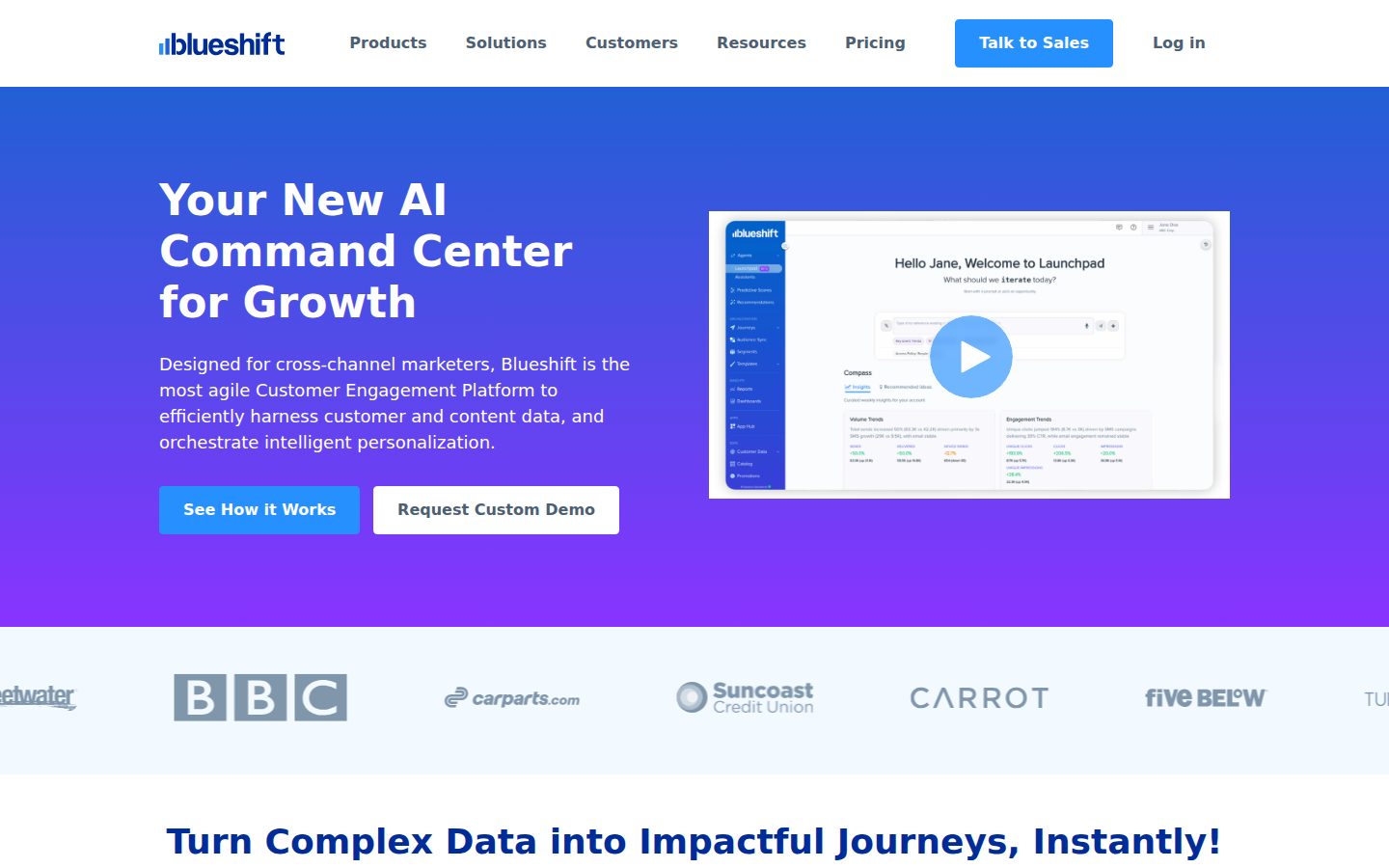
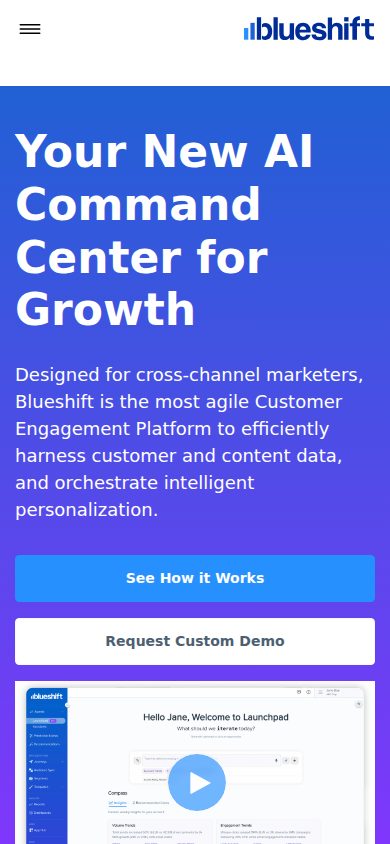
Blueshift is an AI-driven customer data and cross-channel marketing automation platform.
AI Panel Score
6 AI reviews
Reviewed
AI Editor ApprovedApproved and published by our AI Editor-in-Chief after full panel analysis.Blueshift is a customer engagement platform that functions as a SmartHub CDP, combining the data unification capabilities of a traditional customer data platform with built-in AI and cross-channel campaign orchestration. It collects and consolidates customer behavioral, transactional, and demographic data from multiple sources into unified customer profiles, which are then used to power personalized marketing automation.
The platform's core differentiator is its AI recommendation engine, which enables predictive audience segmentation, product and content recommendations, and send-time optimization. Marketers can build automated customer journeys triggered by real-time behavioral signals, allowing campaigns to respond dynamically to how individual users interact with a brand.
Blueshift supports campaign execution across a broad set of channels including email, SMS, push notifications, in-app messages, and paid media platforms such as Facebook and Google. This multi-channel reach is managed through a single interface, reducing the need for separate point solutions for each channel.
The platform is primarily targeted at mid-market and enterprise companies in industries such as e-commerce, retail, media, financial services, and travel. Its capabilities are oriented toward marketing and CRM teams that have significant volumes of customer data and need tools to activate that data in personalized, automated ways without heavy reliance on engineering resources.
Blueshift competes in the broader CDP and marketing automation space alongside platforms such as Braze, Iterable, Salesforce Marketing Cloud, and Segment. Its positioning emphasizes the combination of data unification, AI-driven personalization, and multi-channel activation within a single platform, rather than requiring separate tools for each function.

Built-in AI agents integrated into every step of the customer journey to deliver personalized moments and drive customer loyalty.
AI agents that automate and personalize customer engagement decisions across the marketing journey.
Delivers personalized messages to individual customers at the right moment using unified data and AI decisioning.
Supports launching and managing large-scale marketing experiments, enabling teams to run 50+ experiments in a single month.
Orchestrates messaging across email, SMS, push notifications, in-app, and more from a single AI-powered platform in real time.
Automates AI-driven lifecycle marketing journeys to increase revenue and engagement across channels.
Enables marketers to build and segment audiences independently without any IT help.
Unifies behavioral, transactional, and identity data into a single, real-time customer profile without requiring IT assistance.
Combines behavioral, transactional, and identity data into a single real-time profile to power intelligent personalization.
Dedicated onboarding, support, and success teams that act as an extension of the customer's team throughout the partnership.
For lean teams scaling cross-channel. Includes CDP, Customer AI and omni-channel campaigns.
For brands needing advanced data and control.
For regulated or multi-brand organizations.
Solid CDP-plus-automation bet for mid-market brands that have outgrown point solutions.
“Blueshift bundles data unification, AI decisioning, and cross-channel execution in one platform. At $1,250/month to start, it's a credible alternative to Braze or Iterable for teams that can't staff three separate tools.”
No public funding data, but Blueshift Labs has been in market long enough to have real enterprise customers and a mature integration library — 100+ native connectors is a category-competitive number. The pricing model is smart: you pay for engaged contacts, not your full database. That's a real differentiator vs. Salesforce Marketing Cloud, which will bill you for the graveyard.
The AI recommendation engine and send-time optimization are built into Starter. Running 50+ experiments in a single month is a meaningful capability signal, not just a slide. The tradeoff: Growth and Enterprise tiers are listed at 'Free' in their pricing data, which looks like a data error — contact pricing above Starter is the obvious reality.
No free trial. No changelog. That slows initial confidence. Pilot the Starter plan with one active lifecycle journey before committing the broader team.
Engaged-contact pricing and AI included at Starter tier is a structural edge over Salesforce Marketing Cloud and legacy CDPs that charge for total stored profiles.
Competes credibly against Braze and Iterable; a board question about vendor choice here is answerable without embarrassment.
Audience Builder and lifecycle journeys require no IT involvement per the feature set, which shortens time-to-first-campaign meaningfully.
Combines CDP, AI decisioning, and cross-channel orchestration in one platform — this advances a data activation strategy, it doesn't just automate what you already do.
No public funding stage or headcount data, but docs, blog, and dedicated onboarding teams suggest a functioning mid-sized operation — not a two-person side project.
Mid-market e-commerce or media brands with real customer data volume and a lean marketing team that needs AI personalization without a three-tool stack.
You need a free trial or transparent enterprise pricing before getting on a sales call.
A single-platform CDP-plus-activation bet that mid-market CMOs can actually defend to the board.
“Blueshift packages data unification, AI decisioning, and cross-channel execution under one contract — a meaningful operational consolidation for brands running separate CDP and automation stacks. At $1,250/month entry with Customer AI included on every tier, the unit economics open the door before you've proven the business case.”
The SmartHub architecture is the right strategic frame for where CDPs are going. Unifying behavioral, transactional, and identity data into real-time profiles and triggering campaigns from that same layer — without handing tickets to engineering — is exactly what modern growth teams need. The Audience Builder and self-serve segmentation signal that the product was designed around marketer autonomy, not IT dependency.
The AI recommendation engine and 50+ concurrent experiment support put Blueshift ahead of point solutions, but Braze and Iterable compete hard here with stronger mobile-native depth. If your channel mix skews toward in-app and push, pressure-test that feature parity before committing. The paid-media activation across Facebook and Google adds real reach, though the changelog absence makes it hard to gauge how aggressively that surface is evolving.
If we adopt this at mid-market and grow into enterprise, in three years we have a single customer intelligence layer instead of a patched CDP-plus-ESP stack. The risk is that contact-based pricing scales with engagement volume in ways that compress margin if campaign frequency climbs. Model that curve before renewal.
SmartHub CDP positioning differentiates from pure-play CDPs like Segment and from execution-only tools like Klaviyo, though Braze competes on similar all-in-one ground.
Self-serve Audience Builder and IT-free profile creation match how modern growth and CRM teams actually operate at mid-market scale.
100+ native integrations plus open API Integration Hub for on-premises sources covers most enterprise stack configurations without bespoke engineering.
Single-platform consolidation is durable upside, but engagement-based pricing creates cost exposure as activated contact counts grow year-over-year.
Predictive segmentation, send-time optimization, and agentic AI across the full lifecycle indicate genuine platform investment, not feature veneering.
Mid-market and enterprise brands that need to consolidate a fragmented CDP-plus-ESP stack without rebuilding their data infrastructure.
Your primary channel is mobile app with complex in-app messaging needs where Braze's native depth is a hard requirement.
$1,250/month floor with AI included — but year-3 math needs a pencil
“Starter at $1,250/month includes Customer AI across all plans — rare at this tier. No published seat counts or overage rates; the invoice you can't predict is the real budget risk.”
$1,250/month base. Growth and Enterprise tiers show $0 — that's placeholder pricing, not free. Three tiers visible without a sales call, which procurement appreciates. Customer AI included at every tier per their pricing page. Blueshift charges on actively engaged contacts, not full database — meaningful if your stored profiles dwarf your active segment.
Year-3 math: $1,250 × 12 = $15K/year at Starter. Mid-market teams typically land on Growth or Enterprise. No published rate for those tiers. Add 20-30% for mid-contract module additions — A/B testing and 1:1 recommendations are Growth-only. Realistic 3-year all-in sits $60K–$120K depending on tier, contact volume, and add-ons. Compare to Braze, where mid-market contracts routinely clear $100K annually.
Contracts are contact-volume based with prorated upgrades allowed mid-term — that's buyer-friendly. No published auto-renewal window or termination terms. That gap matters at negotiation. No free trial means no pre-commit validation.
Contact-based billing rather than full-database billing reduces padding, but no self-serve trial increases procurement friction.
Mid-contract upgrades allowed with proration per pricing page, but auto-renewal and termination terms aren't publicly documented.
Starter price published at $1,250/month; Growth and Enterprise show $0 — not real numbers, just tier labels.
Marketing experimentation supports 50+ experiments per month, giving measurable lift data to justify spend.
Active-contact billing model limits waste, but no published rates above Starter make 3-year modeling speculative.
Mid-market e-commerce or media teams with large customer databases needing CDP plus cross-channel automation in one contract.
You need full pricing transparency before engaging sales or want a free trial before committing $15K/year minimum.
One platform for CDP, AI, and cross-channel orchestration — at $1,250/month entry
“Blueshift bundles unified customer profiles, AI decisioning, and omni-channel campaign execution into a single platform that mid-market teams can actually operate without engineering on speed-dial. The pricing model charging only for actively engaged contacts is a genuine structural advantage over Braze and Iterable.”
The Audience Builder being self-serve — no IT required — is the kind of thing that changes a marketer's week. Building segments without filing a ticket is table stakes in 2024, but plenty of CDP-adjacent platforms still gate it. Blueshift doesn't. The CDP ingests behavioral, transactional, and identity data into unified profiles in real time, and 100+ native integrations means most stacks connect without custom engineering work. Running 50+ experiments in a single month is a real number from their feature list — that's a volume that separates serious experimentation from decoration.
The daily friction risk lives in the missing changelog and no public API documentation. Marketers building automated lifecycle journeys need to know when something changes underneath them. No changelog page is a workflow trust problem, not a features problem.
Starter at $1,250/month includes Customer AI across all plans — that's not a bait-and-switch upsell structure, which is refreshing. Growth and Enterprise tiers add 1:1 recommendations and A/B holdout testing. The tradeoff: no free trial means you're committing to a demo-to-contract decision cycle with no hands-on proof window.
Self-serve Audience Builder and real-time profiles reduce early frustration, but no changelog means workflow surprises arrive without warning.
Docs exist per the evidence, but no changelog and no visible API reference suggest documentation coverage skews toward getting started over staying operational.
No free trial and no public API docs create friction at onboarding and at the integration edge — two high-touch moments in any real deployment.
50+ concurrent experiments, predictive send-time optimization, and household-level identity resolution on Enterprise give advanced users real room to grow.
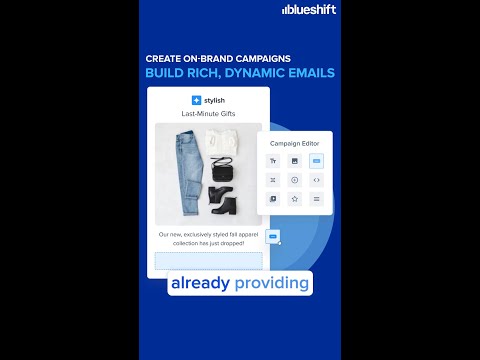
100+ native integrations and drag-and-drop templates fit existing martech stacks without demanding new habits from the team.
Mid-market e-commerce or media brands with real customer data volume who need CDP, AI personalization, and cross-channel orchestration without stitching together three separate tools.
You need a free trial or sandbox before committing, or you're a solo marketer without the data infrastructure to justify $1,250/month from day one.
A real CDP-plus-automation stack, but you'll feel the $1,250 floor every month
“Blueshift bundles data unification, AI decisioning, and cross-channel execution in one place — that's genuinely useful. The pricing floor and contact-sales model make it a mid-market commitment, not an experiment.”
The Audience Builder and unified customer profiles are doing real work here — marketers building segments without filing an IT ticket is the kind of thing that sounds small until you've waited three weeks for a query. The AI recommendation engine being included at the $1,250/month Starter tier is a meaningful call, especially when Braze and Iterable both push personalization features up-tier. Running 50+ experiments in a single month is a notable capability claim, and the pay-for-engaged-contacts pricing is a genuinely fair model.
No free trial though. No changelog visible. That combination tells me the team sells by demo and relationship, not by letting you poke around. Day three without a CSM holding your hand could feel like a lot. The dedicated onboarding partnership is a real asset, but it also signals this product doesn't fully stand alone.
Web-only platform, no mobile parity mentioned anywhere. For a tool billing itself as real-time engagement across every channel, that's a quiet irony. It'll reward teams who invest — and quietly punish teams who don't.
Drag-and-drop templates and no-IT audience building suggest care, but no changelog means you can't track what's improving.
The CDP, AI agents, and cross-channel orchestration are powerful but layered — the success partnership model exists precisely because this isn't pick-up-and-go software.
Web-only platform with no mobile app mentioned — for a cross-channel engagement tool, that's a real gap in the day-to-day experience.
No free trial and a contact-sales model means day one is a guided demo, not self-serve discovery — which slows that first-hour feel.
Dedicated onboarding and 24/7 phone support at Enterprise tier suggests they've built around keeping customers stable, but no public status page evidence.
Mid-market brands with real customer data volume who want CDP and automation in one platform without stitching together Segment plus Braze.
You need a free trial to justify the budget conversation or you're a small team without a dedicated marketing ops person.
Solid mid-market CDP play, but the graveyard in this category is full
“Blueshift bundles CDP, AI decisioning, and cross-channel orchestration into one platform starting at $1,250/month. The pitch is real, but so is the competition from Braze and Iterable — both better-capitalized and better-known.”
Three things I'd note upfront. No changelog listed. No API flagged in capabilities despite docs referencing an Integration Hub. And 'most agile' in the meta description — the kind of superlative that ages poorly. Marketing Honesty score takes a hit there.
The pricing model has a genuinely good angle: you pay only for actively engaged profiles, not your full database. That's a real differentiator vs. how Salesforce Marketing Cloud bills. The $1,250 Starter tier includes Customer AI — confirmed on the pricing page — which is better than the usual bait-and-switch. Growth and Enterprise tiers show '$0' in the scraped data, which is almost certainly a scrape error, not actual free tiers.
Exit portability is my real concern. CDP data locked in a proprietary profile model is never a clean migration. No public funding signals. No changelog cadence to validate shipping velocity. Could go either way on long-term viability — but I wouldn't bet the program on it without asking hard questions about Series funding and contract exit clauses.
Engaged-profile billing and AI included at Starter tier ($1,250/month) are concrete differentiators vs. Salesforce Marketing Cloud's volume-based pricing and Braze's AI add-on costs.
Proprietary unified profile model with custom merge rules makes clean data export painful — category norm is messy migration, and nothing in the docs suggests Blueshift is an exception.
No public funding data, no changelog cadence visible, no API listed — dedicated success team is a positive signal, but thin public evidence for a 3-year enterprise commitment.
'Most agile' in the meta and 'AI Command Center' H1 are aspirational language the product may not fully earn — no changelog or API listed publicly undermines the technical claims.
SmartHub CDP positioning matches patterns from survivors like Braze and Iterable, not the shuttered point-solution plays — but mid-market CDP is a brutal segment with heavy churn history.
Mid-market e-commerce or media brands with real customer data volume who want a single platform instead of stitching together a CDP plus Braze plus a recommendation engine.
You need proven enterprise SLAs, a clean API-first integration story, or any confidence in a sub-12-month evaluation cycle before committing budget.
Common questions answered by our AI research team
Customer AI is included in the Starter plan at $1,250/month. The pricing page explicitly states that 'Customer AI is included in all plans and products,' so it is not restricted to higher tiers.
Blueshift charges only for the profiles you actively engage with, not all profiles stored in the CDP. As stated on their pricing page: 'Unlike others, you only pay for contacts you actively engage with—not your full database.'
Yes, Blueshift can connect to on-premises systems or custom data sources. The content states: 'For on-premises systems or custom sources, leverage our Integration Hub (open APIs) or partner-led solutions' — so both options are available, and you can reach out to your Customer Success Manager for a custom integration plan.
Yes, you can upgrade mid-contract without waiting for renewal. The pricing page states: 'You can add new modules or upgrade your plan any time from the Blueshift dashboard,' with changes prorated on your next invoice. Features like 1:1 product recommendations and A/B testing are part of the Growth plan.


Blueshift is a San Francisco-based AI customer engagement platform that orchestrates personalized marketing across email, SMS, mobile, and web channels.