Bolt.new logo

Bolt.new Review

Visit

Build apps and websites by chatting with AI

Bolt.new is an AI-powered coding and app-building platform for product managers, entrepreneurs, marketers, agencies, and developers.

AI Panel Score

7.4/10

6 AI reviews

Reviewed

About Bolt.new

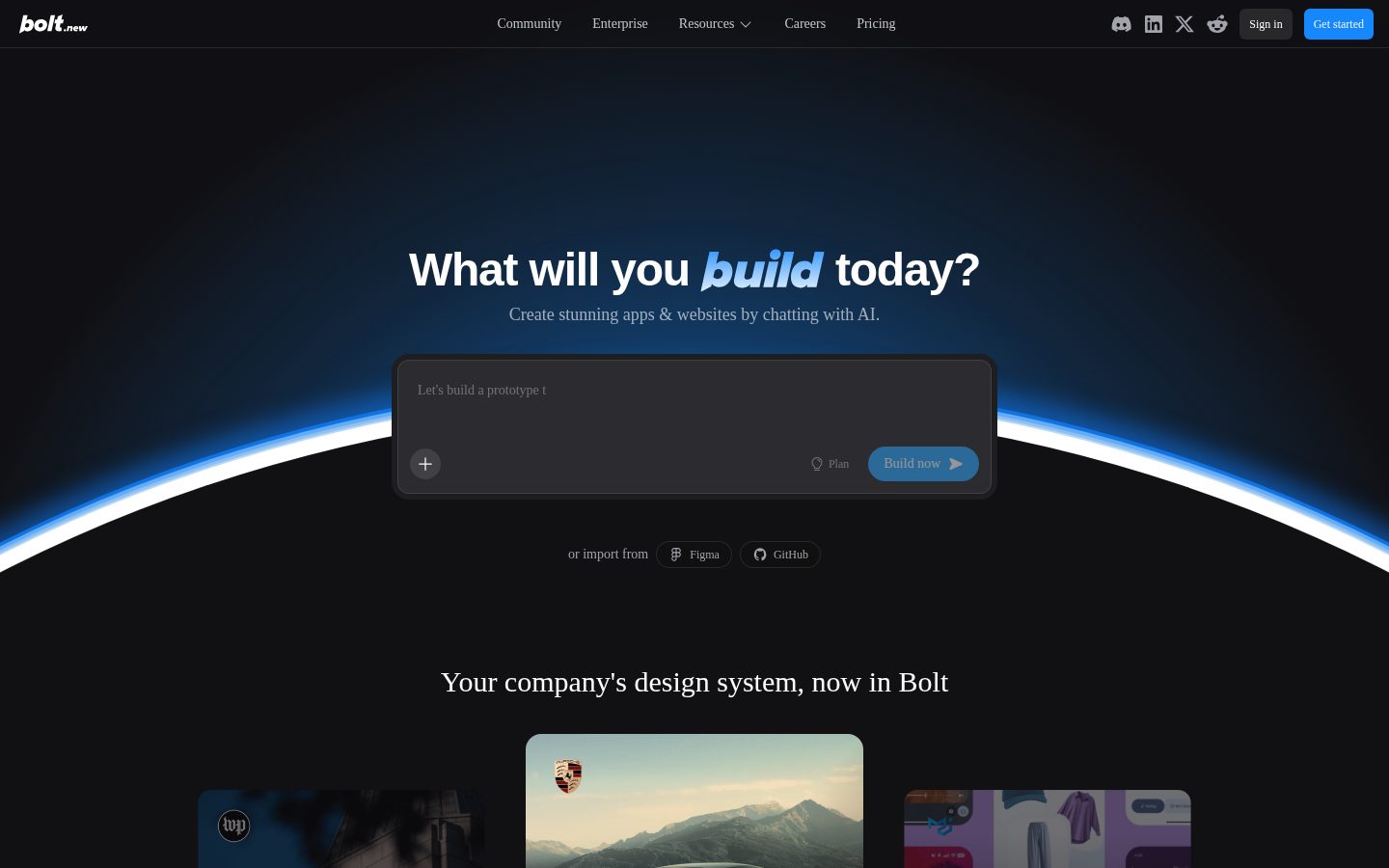
Bolt.new works through a chat-based interface where users describe an app or website they want to create. The AI agent writes the code, identifies errors, and iterates on the output automatically. Users can also import projects from Figma or GitHub, or start from one of the provided examples. The workflow is designed to take an idea to a live, functional product without requiring the user to write or debug code manually.

The platform supports importing custom design systems, including named systems such as Porsche Design System, Material UI, Chakra UI, Shadcn UI, and the Washington Post Design System, so teams can build on-brand from the start. Bolt.new includes built-in backend infrastructure under what it calls Bolt Cloud: unlimited databases, user management and authentication, SEO optimization, hosting with analytics, and custom domain support. Context management is highlighted as capable of handling large, complex projects without breaking down.

Bolt.new is positioned for non-engineers and semi-technical users — including product managers, entrepreneurs, marketers, agency staff, and students — as well as experienced developers who want to move faster. The website states a free tier is available. Paid plans exist but specific pricing figures are not disclosed on the homepage. Competing products in the AI app-building category include Lovable, Replit, and Cursor.

The platform runs entirely in the browser as a web application. It integrates directly with Figma and GitHub for project import and connects to AI models from multiple external AI labs. Hosting, databases, and authentication are bundled, removing the need for third-party services like Vercel, Supabase, or Auth0 for basic deployments.

Features

AI

  • AI-Powered App & Website Builder

    Users describe what they want to build in plain language and Bolt generates apps and websites through a chat interface.

  • Frontier Coding Agents Integration

    Bolt integrates frontier coding agents from multiple AI labs directly inside one familiar visual interface, eliminating the need to switch platforms.

Analytics

  • Hosting with Analytics & Custom Domains

    Bolt provides hosting with analytics and custom domain support built directly into the platform.

Automation

  • Automated Testing & Refactoring

    Bolt automatically tests, refactors, and iterates on code, reducing errors by 98% so users keep building instead of fixing.

Core

  • Enterprise-Grade Backend Infrastructure

    Bolt Cloud delivers enterprise-grade backend infrastructure including hosting, databases, and integrations in a single platform.

  • Large-Scale Project Context Management

    Built-in context management handles projects 1,000 times larger than before, maintaining complexity and keeping projects running smoothly.

  • SEO Optimization

    Built-in SEO optimization ensures projects rank from day one without requiring external tools.

  • Unlimited Databases

    Bolt Cloud provides enterprise-grade unlimited database infrastructure built into the platform.

Integration

  • Design System Import

    Users can import their company's design system, including systems like Porsche Design System, Material UI, Chakra UI, Shadcn UI, and Washington Post Design System, to build on-brand.

  • Figma & GitHub Import

    Bolt allows users to import designs and code directly from Figma and GitHub to start building.

Security

  • User Management & Authentication

    Built-in user management and authentication is included as part of Bolt Cloud's backend infrastructure.

Preview

Bolt.new desktop previewBolt.new mobile preview

Pricing Plans

Free

Free

For individuals getting started with Bolt

  • 300,000 token daily limit
  • 1 million token monthly limit
  • Access to Bolt AI project builder

AI Panel Reviews

The Decision Maker

The Decision Maker

Strategic bet, vendor viability, timing, adoption approval
7.8/10

Bolt.new ships real apps fast — but opaque pricing and unknown funding give me pause.

Millions of users, bundled backend, no-code-to-code range. Pricing wall kicks in fast and there's no public funding data to anchor a 3-year bet.

The free tier caps at 1 million tokens monthly. That's enough to prototype, not enough to build production apps. The real question is what paid plans cost — and they won't show you until you're in. That's a trap-pricing signal I've seen before.

Bolt Cloud bundles hosting, unlimited databases, and auth in one place. That's genuinely useful. No Vercel, no Supabase, no Auth0 duct tape. For a PM or founder who needs to ship and not babysit infra, this is a real workflow improvement over Lovable or early Replit.

Two things I can't resolve. One: no public funding data — no funding stage, no team size, no runway. Two: the "98% error reduction" claim has no methodology behind it. Pilot it for a prototype. Don't anchor your production stack here until the pricing math is visible.

Competitive Positioning7.8

Multi-lab AI agent integration and large-project context management differentiate it from Lovable and Replit, which have thinner backend stories.

Reputation Risk7.5

Design system imports including Porsche and Washington Post signal enterprise credibility; opaque pricing is the only board-room eyebrow-raiser.

Speed to Value8.5

Chat-to-live-app with built-in auth, hosting, and Figma import compresses prototype cycles from weeks to hours.

Strategic Fit8.2

Bundled backend via Bolt Cloud eliminates third-party glue work, which genuinely advances speed-to-market for non-engineering teams.

Vendor Viability6.5

No public funding stage or team size data; 'millions of users' is encouraging but not a runway number.

Pros

  • Bundled Bolt Cloud backend removes Vercel/Supabase/Auth0 dependency for most projects
  • Design system import — including Material UI and Shadcn — means on-brand output from day one
  • Figma and GitHub import makes it viable for teams with existing assets, not just greenfield builds
  • Multi-lab frontier agent integration in one interface is a real workflow improvement

Cons

  • Paid pricing not disclosed publicly — hard to model total cost before you're already inside
  • No public funding data makes a confident 3-year vendor bet difficult
  • Free tier's 1M monthly token cap will constrain any serious production workload
  • 98% error reduction claim has no cited methodology

Right for

Product managers and founders who need a working app fast without assembling a backend stack from scratch.

Avoid if

Your team needs auditable infrastructure costs before committing — the pricing opacity will create board friction.

The Domain Strategist

The Domain Strategist

Craft and strategy in the product's domain — adapts identity per category, same lens
7.8/10

Bolt bundles the full stack into the browser — powerful bet, real lock-in.

Bolt.new collapses app deployment infrastructure — databases, auth, hosting, domains — into a single browser-based environment. For non-engineers and fast-moving product teams, that's a genuine architectural simplification, not just a demo.

The Bolt Cloud stack is the real story here. Bundling unlimited databases, user management, auth, hosting with analytics, and custom domain support eliminates the Vercel-plus-Supabase-plus-Auth0 assembly tax that kills prototype velocity. If you adopt this, in 3 years your team's deployment muscle memory lives entirely inside Bolt's managed layer — that's leverage when it works and a migration problem when it doesn't. No public changelog and undisclosed paid pricing are yellow flags on operational maturity.

The design system import — named systems like Shadcn UI, Material UI, Washington Post — tells me someone thought about real engineering workflows, not just demos. The 1 million token monthly limit on the free tier is workable for proof-of-concept but will hit a ceiling fast on any serious codebase. Context management handling 'projects 1,000 times larger' is a marketing claim with no public benchmark to anchor it.

Against Cursor, Bolt trades IDE-depth for zero-setup deployment breadth. Cursor wins for engineering teams already in VS Code; Bolt wins when the buyer isn't an engineer at all. That's a defensible wedge — the ceiling question is whether Bolt Cloud matures fast enough to hold technical users once projects grow past MVP.

Category Positioning8.1

Bolt occupies a cleaner wedge than Replit (developer-first) or Cursor (IDE-first) by owning the full stack for non-engineer builders — 'millions' of users per the homepage suggests real traction.

Domain Fit8.2

Bundled backend infrastructure matches how non-engineers actually need to ship — no external Vercel or Supabase wiring required, which is the real friction point for this buyer.

Integration Surface7.9

Figma and GitHub import plus named design system support covers the two most common handoff points, though no public API means no programmatic integration into CI/CD pipelines.

Long-term Implications6.8

If Bolt Cloud becomes your deployment layer, the exit path gets expensive fast — databases, auth, and hosting are all proprietary-managed with no disclosed migration tooling.

Strategic Depth7.5

Design system import and automated testing-plus-refactoring show real craft, but no public changelog or API surface limits visibility into how fast the platform is deepening.

Pros

  • Full backend stack bundled — databases, auth, hosting, custom domains in one platform
  • Named design system imports including Shadcn UI and Material UI signal real engineering intent
  • Figma and GitHub import covers the two highest-friction handoff points
  • Multi-lab AI agent integration reduces single-model dependency risk

Cons

  • Paid pricing not disclosed — makes enterprise budget planning and TCO comparison impossible
  • No public API or changelog reduces confidence in platform operational maturity
  • Bolt Cloud lock-in is real: proprietary managed layer with no visible migration path
  • Free tier's 1M token monthly cap is a fast ceiling for anything beyond early prototypes

Right for

Product teams and non-engineer founders who need to ship functional apps without assembling a cloud infrastructure stack.

Avoid if

Your engineering team needs CI/CD pipeline integration or IDE-level code control that a browser-based managed platform can't provide.

The Finance Lead

The Finance Lead

Money, total cost of ownership, contracts, procurement math
6.5/10

Free tier exists; paid pricing is hidden — classic freemium trap.

Bolt.new publishes a $0 free tier with a 1M token monthly limit. Paid plan costs aren't on the pricing page — you hit a wall before you see numbers.

Free plan: 300K token daily limit, 1M monthly. That's real usage for prototypes. But the moment a team of 5 starts shipping production apps, token burn accelerates fast. No published overage rate. That's the invoice you can't predict in year 2.

Bolt Cloud bundles hosting, unlimited databases, auth, and analytics. If that replaces Vercel at ~$20/month plus Supabase at ~$25/month plus Auth0 at ~$23/month, the stack savings are real — roughly $800/year per project. But without paid tier pricing, the 3-year TCO model has a blank in column B. Lovable and Replit both publish tiered pricing. Bolt doesn't. Procurement teams will stall here.

The "98% error reduction" claim has no methodology attached. ROI story is hand-wavy by design. For solo builders the free tier is a genuine on-ramp. For a 50-person org buying seats? No contract terms, no published SLA, no auto-renewal language visible. Can't model it. Won't recommend it at scale until pricing surfaces.

Billing & Procurement4.5

Token-based billing model with no published overage rate creates unpredictable invoices — a procurement blocker for teams above 10 seats.

Contract Flexibility5.0

No auto-renewal terms, cancellation policy, or SLA are publicly visible — web-only SaaS with no contract documentation found.

Pricing Transparency4.0

Free tier is published at $0 with token limits; paid plan pricing is absent from the pricing page entirely.

ROI Clarity5.5

Stack consolidation (hosting + DB + auth) offers measurable savings, but the '98% error reduction' claim has no supporting methodology.

Total Cost of Ownership5.5

Bundled backend infrastructure offsets third-party costs, but no paid tier numbers means year-3 TCO is unmodelable.

Pros

  • Free tier is real: 1M tokens/month, no credit card required
  • Bolt Cloud bundles hosting, auth, and databases — eliminates ~$800/year in third-party tools per project
  • Figma and GitHub import reduces ramp time for design-to-build workflows
  • Named design system support (Material UI, Shadcn UI) is a concrete differentiator

Cons

  • Paid pricing not published — Lovable and Replit both show tiers openly
  • No overage rate disclosed; token burn on production apps is unpredictable
  • No contract terms, SLA, or auto-renewal language visible publicly
  • '98% error reduction' is unsubstantiated marketing math

Right for

Solo builders and small teams prototyping fast on the free tier who can tolerate pricing opacity.

Avoid if

Your procurement team needs a signed contract, published SLA, or predictable per-seat pricing before approval.

The Domain Practitioner

The Domain Practitioner

Daily hands-on reality in the product's domain — adapts identity per category, same lens
7.2/10

Bolt.new ships the full stack in browser — but the token ceiling bites fast

Bolt.new bundles hosting, auth, and databases into one browser-based build loop, which is genuinely impressive for prototyping velocity. The free tier's 1 million monthly token limit will run out mid-project for anything serious.

The GitHub and Figma import paths are the right instinct. Engineers don't want to re-describe existing codebases — they want to hand the agent something real and iterate. Bolt Cloud bundling Supabase-style auth, databases, and hosting removes the usual multi-tab setup sprint. That's real friction eliminated, not marketing copy. The '98% error reduction' claim is unverifiable marketing math, but automated refactoring in-loop is a legitimate workflow win versus Cursor, where you're still context-switching to terminal.

The free tier caps at 300,000 tokens daily and 1 million monthly. For a non-trivial app, that monthly cap dissolves inside two focused build sessions. No changelog on the site tells me iteration transparency is low — I can't track what the agent behavior actually changed week to week. Docs presence is confirmed but practitioner depth is unknown from evidence.

No API listed publicly. That's the ceiling for power users: you can't script Bolt into a pipeline, can't trigger builds from CI, can't treat it as a component. Replit at least exposes more programmatic surface. Bolt lives as a product prototyping tool, not a developer platform — which is honest positioning, but engineers hitting month two will feel that wall.

Day-3 Reality6.5

Token limits surface fast on real projects; no changelog means agent behavior changes silently under you.

Documentation Practitioner-Fit6.0

Docs exist but no changelog, no API reference surface, and no public depth signals — looks marketer-maintained.

Friction Surface6.8

Browser-only with no API and opaque pricing tiers means hitting walls without clear escape hatches.

Power-User Depth6.2

No public API, no CLI, no scriptability — advanced users will outgrow the chat interface quickly.

Workflow Integration7.5

GitHub and Figma import plus bundled Bolt Cloud backend removes the typical multi-service wiring sprint.

Pros

  • Bolt Cloud bundles auth, unlimited databases, and hosting — no Vercel/Supabase/Auth0 assembly required
  • GitHub and Figma import means you're handing it real artifacts, not just prompts
  • Design system support (Material UI, Shadcn, Chakra) keeps enterprise teams on-brand from first build
  • In-loop automated refactoring beats context-switching to terminal mid-session

Cons

  • Free tier's 1 million monthly token cap runs out fast on any non-trivial project
  • No public API means you can't pipe Bolt into a CI workflow or script builds
  • No changelog on the site — agent behavior changes are invisible to you
  • Specific AI lab integrations unnamed, so you can't reason about model quality or swap strategies

Right for

Product teams and technical PMs who need a working prototype deployed fast without assembling a backend stack.

Avoid if

You need scriptable CI integration or plan to graduate the project into a real engineering pipeline.

The Power User

The Power User

Daily human experience, onboarding, polish, learning curve, reliability
8.1/10

Bolt.new turns chat into shipped product, and that's genuinely impressive

For non-engineers who want a real app without touching code, Bolt.new is the most complete package in the category. Bundled hosting, auth, and databases mean you're not stitching together four other tools just to launch.

The pitch is simple: describe it, get it. And based on the feature set, Bolt.new actually delivers on that further than most. Figma import, GitHub import, design system support for things like Material UI and Shadcn UI, unlimited databases, auth, hosting, analytics, custom domains — that's a lot bundled together. Lovable and Replit make you reach for Vercel or Supabase the moment things get real. Bolt mostly doesn't.

The 1 million token monthly limit on the free tier is generous for kicking the tires, but the moment you hit a complex project, you'll want to know paid pricing — which the homepage doesn't show you. That opacity is a small but real annoyance. The '98% error reduction' claim is marketing math and worth taking loosely.

The tradeoff worth naming: this is a browser-only tool. No mobile building, no offline mode. For a product aimed at entrepreneurs moving fast, that's fine. But day-to-day, if your laptop's not nearby, you're waiting.

Daily Polish7.8

Chat-first interface with design system import suggests thoughtful daily UX, but no changelog or docs portal is a small tell that some rough edges may exist.

Learning Curve8.2

Natural language entry with Figma and GitHub import paths means both beginners and developers can find their footing fast without a steep ramp.

Mobile Parity5.0

Web-only platform with no mobile app means you're not building or editing anything from your phone — period.

Onboarding Experience8.5

Plain-language chat entry and example projects means first-time users have a real on-ramp, not a blank screen — that's the right call.

Reliability Feel7.5

Context management handling projects '1,000 times larger than before' signals real investment in stability, but the 98% error reduction claim is unverifiable marketing.

Pros

  • Hosting, databases, and auth bundled — no Vercel/Supabase juggling
  • Design system imports including Material UI and Shadcn UI for on-brand builds
  • Free tier with 1M token monthly limit is genuinely usable for small projects
  • Figma and GitHub import covers both design-first and code-first starting points

Cons

  • Paid pricing not disclosed on the homepage — frustrating when you're ready to commit
  • Web-only, no mobile experience at all
  • Specific AI labs powering the agents aren't named, which matters for enterprise trust
  • 98% error reduction claim has no methodology behind it

Right for

Non-technical founders, product managers, or agency teams who want to ship a real working app without assembling their own cloud stack.

Avoid if

You need to build or review your work from a phone, or your organization requires knowing exactly which AI models are handling your code.

The Skeptic

The Skeptic

Contrarian. Watch-outs, deal-breakers, broken promises, category patterns
6.8/10

3 superlatives, 0 pricing transparency — classic pre-churn setup

Bolt.new bundles hosting, auth, and unlimited databases into one browser tab — genuinely useful for non-engineers. But '98% error reduction' and '1,000x context' are the kind of claims that age poorly without methodology attached.

Two tells before I read the features. One: no changelog listed. Two: paid pricing is hidden — the evidence confirms a pricing page exists but won't surface numbers. The free tier caps at 1 million tokens monthly, which sounds big until your project scales. That ceiling will matter.

The bundled Bolt Cloud story is actually defensible. Dropping Vercel, Supabase, and Auth0 for a single interface is real value — Lovable doesn't match it out of the box, and Replit's backend story has been messier. Design system imports including Shadcn UI and Material UI are a genuine differentiator for agency buyers.

Exit portability is the watch item. No API listed, no docs confirmed. If Bolt pivots or prices up, your project lives inside their cloud. GitHub export might save you — but that's not confirmed in the evidence. I'd verify before committing production workloads.

Competitive Differentiation7.5

Bundled backend infrastructure plus named design system imports like Washington Post Design System and Porsche Design System is a real differentiator vs. Lovable and Replit.

Exit Portability5.0

No API confirmed, no docs listed — projects hosted on Bolt Cloud with their auth and databases create real lock-in with no clear exit path in the evidence.

Long-term Viability6.0

No changelog, no public funding data, no API — 'millions' of users is a marketing claim without verifiable signal on team size or shipping cadence.

Marketing Honesty5.5

'98% error reduction' and '1,000 times larger context' are presented as facts with zero methodology — the kind of superlatives that don't survive scrutiny.

Track Record Match6.5

Matches Glide and early Bubble in positioning — both survived but with significant pivot scars; no-code app builders have a mixed survival record past year three.

Pros

  • Bundled hosting, auth, and unlimited databases removes three vendor relationships instantly
  • Named design system imports — Shadcn UI, Material UI — are legitimately useful for agency workflows
  • Figma and GitHub import reduces friction for teams with existing assets
  • Free tier exists at $0 with a defined 1M monthly token limit — testable before commitment

Cons

  • Paid pricing not disclosed — a yellow flag for any serious evaluation
  • No API, no docs page confirmed — portability risk is real
  • No changelog means no visibility into shipping cadence or product health
  • Marketing claims like '98% error reduction' have no sourcing — hard to trust at face value

Right for

Non-technical founders or agency teams who need a fast, hosted prototype with their own design system and don't plan to self-host.

Avoid if

You need a production app with clear data portability, SLA guarantees, or pricing transparency before signing.

Buyer Questions

Common questions answered by our AI research team

Integration

Which AI coding agents does Bolt integrate?

Bolt integrates frontier coding agents from multiple AI labs directly inside one visual interface, but the specific AI labs or agent names are not listed.

Features

How does Bolt reduce errors by 98%?

Bolt automatically tests, refactors, and iterates on code, keeping the build process moving instead of requiring manual error fixing.

Features

What project size can Bolt handle?

Bolt handles projects 1,000 times larger than before, using improved built-in context management to handle complexity and keep projects running smoothly.

Also in AI Coding Tools