Brave Search logo

Brave Search Review

Visit

Web search with its own independent index, no Google or Bing dependency

Brave Search is a privacy-focused web search engine for users who want search results built on an independent index.

AI Panel Score

7.6/10

6 AI reviews

Reviewed

AI Editor Approved

About Brave Search

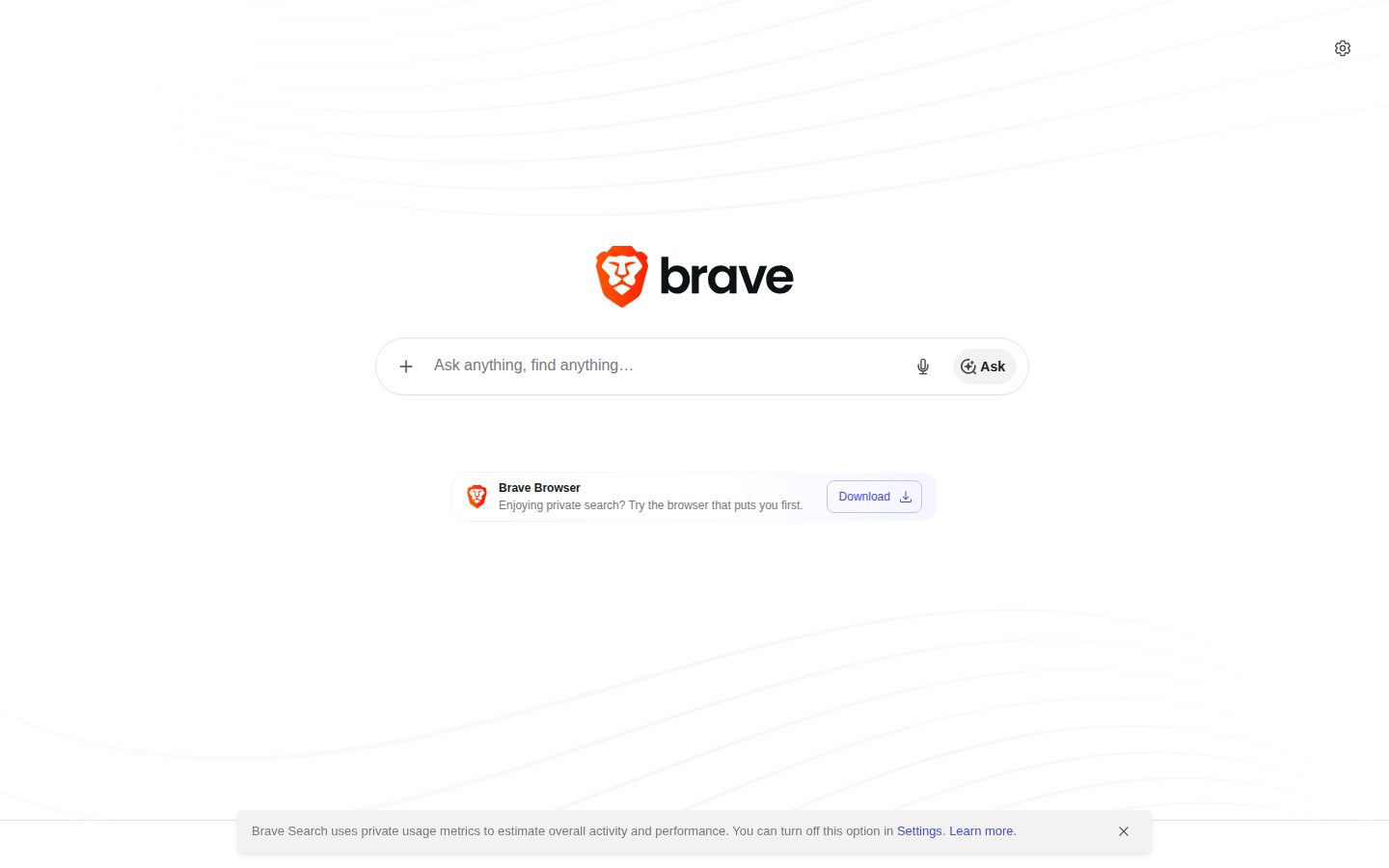
Users interact with Brave Search through a standard search interface at search.brave.com or via the Brave browser's default search setting. A query returns organic results ranked by Brave's own index, supplemented in some cases by an AI-generated summary above the links. Users can toggle between web, news, images, and video tabs, and adjust settings for safe search, country, and language without creating an account.

Brave Search highlights its independence from Big Tech indexes as a core differentiator. It publishes a metric called the Independence Score, reflecting what percentage of results come from its own crawl versus third-party fallback sources. Additional features include Goggles, a system that lets users or communities apply custom re-ranking rules to results; a Discussions section that surfaces forum and community content; and a News search tab with no personalization or filter bubbles. An API is available for developers who want to query Brave's index programmatically.

Brave Search is aimed at privacy-conscious individuals who want a functional general-purpose search engine without behavioral tracking or profiling. The core search product is free to use without an account. A paid tier called Brave Search Premium removes the AI answer usage limits and eliminates all ads from results; it is priced at $3 per month. Competing products in the privacy-search category include DuckDuckGo, Startpage, and Kagi, the last of which also operates an independent index under a paid-only model.

Brave Search is accessible on any modern web browser and is the default engine in the Brave desktop and mobile browser. A public API allows third-party developers to retrieve web, news, image, and video results programmatically, with usage-based pricing. No native desktop application exists; access is entirely web-based.

Features

AI

  • AI Answers

    Brave Search provides concise, sourced AI-generated summary answers at the top of the results page for questions spanning code, news, language, and people.

  • AI-Powered Result Descriptions

    Brave Search uses an in-house Question Answering model to generate context-aware descriptions for search results, indicating each result's relevance to the user's query.

  • Ask Brave (Deep Research Mode)

    Ask Brave delivers longer, detailed answers with follow-up chat capability and a Deep Research mode, enriched with contextual results like videos, news, and shopping.

  • Featured Snippets

    For direct-answer queries, Brave Search analyzes web pages and extracts the most relevant text snippet to surface an immediate answer at the top of results.

Core

  • Discussions

    Brave Search automatically detects discussion-worthy queries and surfaces additional results from forums such as Reddit and StackExchange directly within the SERP.

  • Independent Search Index

    Brave Search operates on its own proprietary web index of 40+ billion pages, requiring no reliance on Google or Bing to power search results.

  • Search Operators

    Brave Search supports advanced query filtering commands including site:, filetype:, intitle:, lang:, loc:, and logical AND/OR/NOT operators to narrow search results.

Customization

  • Goggles (Custom Re-ranking)

    Users and the community can create or apply custom ranking models called Goggles to re-rank search results according to specific criteria, ensuring diversity and personalization.

Integration

  • Brave Search API

    A developer-facing REST API providing access to Brave's independent index across web, news, image, video, local business, and AI summarization endpoints.

  • LLM Context API

    Launched in February 2026, this API endpoint is purpose-built for AI applications, delivering structured web content extraction and direct synthesized answers for LLM grounding.

Security

  • Privacy by Default

    Brave Search does not collect, store, or transmit any personal information, device data, or search history that could be used to profile or track users.

  • Privacy-Preserving Ads & Search Premium

    Brave Search delivers ads without tracking, data collection, or user profiling, and offers an ad-free Search Premium subscription tier for users who prefer no ads.

Preview

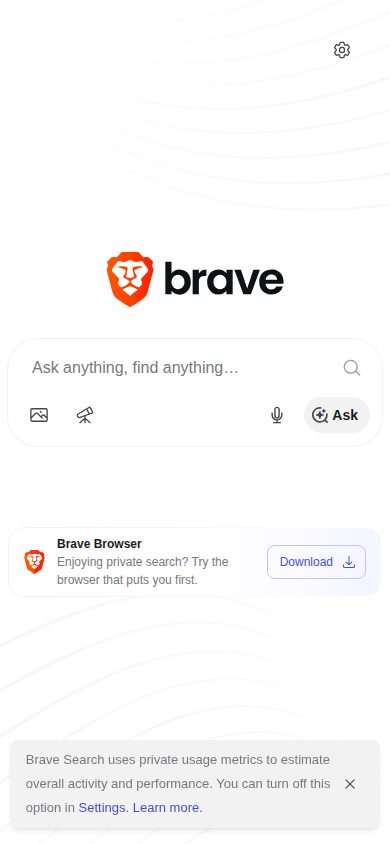
Brave Search desktop previewBrave Search mobile preview

Pricing Plans

Popular

Search

$5/usage

Pay-as-you-go web search API for developers and LLM grounding; $5 per 1,000 requests with $5 in free credits every month.

  • $5 per 1,000 requests
  • $5 in free credits monthly
  • Goggles: custom reranking & result filtering
  • Schema-enriched results with added metadata
  • Up to 50 queries per second

Answers

$4/usage

Summarized, citation-grounded answers built on search results; $4 per 1,000 requests plus $5 per million input/output tokens.

  • $4 per 1,000 requests + $5 per million tokens
  • $5 in free credits monthly
  • Citation-grounded summarized answers
  • Streaming responses
  • OpenAI SDK compatible

Enterprise

Contact sales

Bespoke plan for large-scale deployments. Pricing requires contacting the vendor.

  • Full-funnel Zero Data Retention
  • Custom agreements & NDAs
  • Invoicing & enterprise-grade support
  • Custom rate limits and capacity

AI Panel Reviews

The Decision Maker

The Decision Maker

Strategic bet, vendor viability, timing, adoption approval
7.8/10

Independent index, real privacy, and $3/month beats DuckDuckGo's dependency problem.

Brave Search runs on its own 40-billion-page index — no Google, no Bing, no profiling. That independence is genuine differentiation, not just a marketing claim.

Forty-plus billion pages crawled independently. That's what separates Brave from DuckDuckGo, which still leans on Bing. The Independence Score metric is a smart move — it's a public accountability mechanism, and that kind of transparency tends to hold up in board conversations about vendor trust.

The Goggles system is the sleeper feature here. Custom re-ranking rules let teams or communities shape results without waiting on an algorithm change. The LLM Context API, launched February 2026, shows they're building for where AI tooling is heading, not just wrapping a search box. $5 per 1,000 requests is fair for grounding LLM outputs.

The tradeoff: result quality on long-tail queries still trails Google. For broad consumer or research use cases, that gap matters. Premium at $3/month is easy to defend. The API pricing won't raise eyebrows either. Pilot it for privacy-sensitive workflows before pushing it org-wide.

Competitive Positioning7.5

Stronger index independence than DuckDuckGo, cheaper than Kagi's paid-only model, but Google still wins on result depth for complex queries.

Reputation Risk8.5

Privacy-first, Big Tech-independent, transparent about methodology — this is a neutral-to-positive story for any board conversation about data stewardship.

Speed to Value8.2

No account required, free tier available immediately, and $5 in monthly API credits mean a developer can validate fit in a single afternoon.

Strategic Fit7.8

The LLM Context API and OpenAI SDK-compatible Answers endpoint make this a forward-looking pick for teams building AI-grounded search, not just a cost swap.

Vendor Viability7.5

Brave is a funded company with a live browser product, ad revenue, and a developer API — no public funding data on runway, but they're not a vapor startup.

Pros

  • Own 40B-page index — no Bing or Google dependency, which is the real differentiator
  • Goggles system enables custom re-ranking without engineering a search stack from scratch
  • LLM Context API positions it for AI grounding use cases at $5 per 1,000 requests
  • $3/month Premium is an easy approval — no procurement drama

Cons

  • Long-tail query quality still trails Google for specialized research needs
  • No changelog or public roadmap visibility makes it harder to track what's coming
  • Enterprise pricing requires a sales call — no self-serve for large deployments

Right for

Privacy-conscious teams or developers who need an independent search index for AI grounding without Big Tech data exposure.

Avoid if

Your use case depends on best-in-class long-tail result depth and Google-level query coverage.

The Domain Strategist

The Domain Strategist

Craft and strategy in the product's domain — adapts identity per category, same lens
7.2/10

Independent index with real API depth, but not built for enterprise knowledge workflows.

Brave Search's 40+ billion page independent index and LLM Context API make it a credible signal source for knowledge teams building RAG pipelines or competitive intelligence feeds. It's a privacy-clean data layer, not a knowledge management system.

The February 2026 LLM Context API launch is the most telling architectural signal here. Structured web content extraction plus synthesized answers at $4 per 1,000 requests with OpenAI SDK compatibility — that's purpose-built for grounding, not casual search. Someone on the product team understands how knowledge engineers actually consume web signals.

Goggles is genuinely interesting for KM use cases. Custom re-ranking lets a knowledge team privilege authoritative sources, suppress noise, and build domain-specific result sets without owning a crawler. That's a real workflow affordance. The tradeoff: no glossary management, no taxonomy layer, no contributor-side controls. Brave is a retrieval primitive, not a knowledge architecture.

Versus Kagi, which also runs an independent index, Brave's free tier and API economics favor teams building at scale. But if your KM mandate includes surfacing, organizing, or governing internal knowledge — Brave doesn't touch that problem. It's an excellent external signal layer for teams who already have the governance stack above it.

Category Positioning7.5

Sits between DuckDuckGo (no independent index) and Kagi (paid-only, narrower API) — strongest option for teams that need privacy-clean web retrieval at API scale with transparent pricing.

Domain Fit6.0

Useful as an external retrieval source, but lacks the organizational knowledge features — glossaries, contributor workflows, schema governance — that KM practitioners need daily.

Integration Surface8.0

OpenAI SDK-compatible Answers API, REST endpoints for web/news/image/video, and $5 monthly free credits make this low-friction to wire into existing RAG or research pipelines.

Long-term Implications7.8

If you adopt the LLM Context API for grounding, in 3 years you have a vendor-clean, privacy-safe web signal layer that isn't Bing-dependent — a meaningful architectural advantage.

Strategic Depth7.5

Independent 40B-page index plus LLM Context API shows genuine infrastructure investment, though no taxonomy or knowledge graph layer exists.

Pros

  • 40+ billion page independent index with published Independence Score — no Google or Bing dependency
  • LLM Context API (Feb 2026) is purpose-built for grounding with OpenAI SDK compatibility
  • Goggles custom re-ranking lets knowledge teams shape result sets without owning infrastructure
  • API pricing is transparent: $5/1K web requests, $4/1K answer requests with monthly free credits

Cons

  • No taxonomy, glossary, or schema governance — it's retrieval only, not knowledge architecture
  • No changelog or public docs surfaced in evidence, making vendor trajectory hard to track
  • Pricing page not publicly indexed, adding friction for procurement and budget justification

Right for

Knowledge teams needing a privacy-clean, Big-Tech-independent web retrieval layer for RAG pipelines or competitive intelligence feeds.

Avoid if

Your KM mandate includes internal knowledge governance, contributor workflows, or taxonomy management.

The Finance Lead

The Finance Lead

Money, total cost of ownership, contracts, procurement math
7.8/10

$3/month consumer tier, $5/1K API calls — pricing page does the work for procurement

Brave Search runs on an independent 40+ billion page index with zero account required on the free tier. API pricing is published and usage-based — no surprise invoices if you read the docs.

Free tier costs $0. Premium is $3/month — $36/year. 50 users on Premium: $1,800/year, $5,400 at year 3. Add zero seat-creep risk; it's a consumer subscription, not per-seat SaaS. Negligible TCO for end-user privacy use cases.

API math is different. $5 per 1,000 requests with $5 in free monthly credits. High-volume LLM grounding adds the Answers endpoint at $4/1K plus $5 per million tokens. 100K monthly API calls = ~$500/month = $6K/year. The LLM Context API launched February 2026 — no long invoice history to validate overage behavior. That's the real unknown.

Kagi charges more, targets power users. DuckDuckGo costs nothing but licenses Bing. Brave's independent index is the moat. Tradeoff: enterprise pricing requires a sales call, breaking the otherwise clean self-serve model. Procurement teams will wait on that quote.

Billing & Procurement7.5

Self-serve API with usage-based billing and $5 free credits monthly is clean; Enterprise requires contacting vendor, adding procurement friction.

Contract Flexibility8.0

Monthly consumer subscription implies low lock-in; no published auto-renewal window or termination clause visible for the Enterprise tier.

Pricing Transparency8.5

API and Premium tiers fully published at visible rates — $3/month, $5/1K, $4/1K — no sales call needed for two of three tiers.

ROI Clarity7.2

Privacy and independence are real but hard to quantify; API value is measurable by cost-per-query versus alternatives like Google Custom Search at $5/1K.

Total Cost of Ownership8.8

Consumer TCO is near-zero; API TCO is calculable with published per-request rates, though the February 2026 LLM Context API has no invoice track record.

Pros

  • $3/month Premium — lowest sticker in the privacy-search category
  • API pricing fully published: $5/1K web, $4/1K answers
  • 40+ billion page independent index — no Bing/Google licensing exposure
  • Usage-based API billing with monthly free credits reduces entry cost

Cons

  • Enterprise tier requires sales contact — no published rate
  • LLM Context API launched Feb 2026 — no overage history to validate
  • ROI on privacy value is qualitative, not a CFO-ready number

Right for

Teams or developers needing privacy-safe search API at published, predictable per-request pricing.

Avoid if

Your procurement team needs enterprise SLA pricing without a sales call.

The Domain Practitioner

The Domain Practitioner

Daily hands-on reality in the product's domain — adapts identity per category, same lens
7.8/10

Independent 40-billion-page index that actually works, with privacy you don't have to configure

Brave Search runs on its own index — no Bing fallback for primary results — and the Goggles system gives researchers genuine control over result composition that no other free engine offers. The AI layer is real and citation-grounded, not decorative.

The 40+ billion page independent index is the core claim, and it holds. For researchers who've hit Kagi's paywall or gotten burned by DuckDuckGo's reliance on Bing, Brave's independence score metric at least makes the sourcing visible. Discussions surfacing Reddit and StackExchange in-SERP is a genuine workflow accelerator — secondary source triangulation without opening four tabs.

Goggles is the power-user feature most researchers won't discover on day one. Custom re-ranking rules let you weight sources by domain, exclude SEO farms, or apply community-built filters. That's a literature review tool hiding inside a search engine. The LLM Context API launched February 2026 signals serious grounding infrastructure for research pipelines.

The tradeoff: no account means no persistent search history, no saved query sets, no cross-session note-taking. Researchers who build iterative search trails will fight this daily. $3/month Premium removes ads but doesn't solve the stateless workflow problem.

Day-3 Reality7.5

Organic results are competitive and the Discussions section earns its keep, but the stateless no-account model creates real friction for iterative research workflows.

Documentation Practitioner-Fit6.8

API docs exist and the LLM Context API has structured endpoint documentation, but Goggles documentation based on available evidence skews toward developers, not research practitioners.

Friction Surface8.0

No account required, no tracking popups, no consent walls — daily friction is genuinely low for pure retrieval; the $3/month Premium tier eliminates ads cleanly.

Power-User Depth8.2

Search operators (site:, filetype:, intitle:, lang:), Goggles custom re-ranking, and the Deep Research mode in Ask Brave form a real power-user stack that Kagi competitors at higher price points struggle to match.

Workflow Integration7.2

Drops into any browser as default engine with zero setup, but no session persistence or saved searches means it doesn't integrate with how researchers actually track inquiry threads.

Pros

  • Goggles custom re-ranking lets researchers filter SEO noise without browser extensions
  • Discussions surfaces Reddit and StackExchange directly in SERP — saves tab-switching
  • 40+ billion page independent index with a published Independence Score metric
  • LLM Context API at $4/1,000 requests is credible grounding infrastructure for research pipelines

Cons

  • No account means no search history, no saved queries, no cross-session workflow continuity
  • Goggles discovery is poor — most researchers will never find the feature organically
  • AI summarizer citation quality is unverified against primary sources — trust-but-verify overhead remains
  • No changelog or blog evidence makes it hard to assess how actively the index and AI layer are improving

Right for

Privacy-conscious researchers who need a capable free default engine with advanced operators and source-diversity controls.

Avoid if

Your research workflow depends on saved searches, persistent query history, or cross-session trail-building.

The Power User

The Power User

Daily human experience, onboarding, polish, learning curve, reliability
7.8/10

Finally a search engine that isn't renting results from the same duopoly it's fighting

Brave Search runs on its own 40+ billion page index — not Google, not Bing. At $3/month for Premium, the privacy argument is genuinely cheap.

The core pitch is real and it's different: Brave Search isn't just DuckDuckGo with a privacy badge slapped on. It actually owns its index. That Independence Score metric they publish is the kind of thing that earns trust over time, not just on day one. Goggles — the custom re-ranking feature — is the thing I'd be thinking about at month three. Not every user will touch it, but the fact it exists signals the team built for people who eventually want more control, not just people who want to feel good about their search engine.

The AI Summarizer and Ask Brave deep research mode are genuinely useful additions. Kagi does similar and charges more for it. The $3/month Premium tier is hard to argue with for an ad-free, no-tracking experience. The Discussions feature surfacing Reddit and StackExchange results is a small thing that adds up daily.

The tradeoff is result freshness and breadth. An independent index can miss things Google wouldn't. Power users will notice that occasionally, especially on niche or breaking queries.

Daily Polish7.5

Standard search interface with AI Summarizer and Discussions integration feels considered, though the scraped site shows no changelog — hard to tell how actively the daily feel is being iterated.

Learning Curve7.5

Goggles and Search Operators reward users who dig in, but they're not surfaced aggressively, so the depth is there for month three without cluttering day one.

Mobile Parity8.0

Available on iOS and Android and is the default engine in Brave browser's mobile app, so mobile isn't an afterthought here — it's a primary delivery channel.

Onboarding Experience8.5

No account required, no setup friction — you just search, and the product explains itself through use, which is exactly right for a search engine.

Reliability Feel7.8

An independent 40+ billion page index is serious infrastructure; category norm for search reliability is high and Brave's architecture suggests they've invested to match it.

Pros

  • Truly independent index — no Google or Bing dependency, backed by 40+ billion pages
  • $3/month Premium removes ads entirely with no tracking at any tier
  • Goggles system offers real long-term customization most search engines won't touch
  • Discussions feature surfaces Reddit and StackExchange results natively, no extra steps

Cons

  • Independent index means occasional gaps on niche or very fresh queries vs. Google
  • No changelog or blog evidence makes it hard to track how fast the product is improving
  • Goggles is discoverable only if you go looking — newer users may never find it

Right for

Privacy-conscious users who want a functional daily search engine that isn't built on Big Tech infrastructure.

Avoid if

You depend on Google's freshness and breadth for research-heavy or breaking-news work.

The Skeptic

The Skeptic

Contrarian. Watch-outs, deal-breakers, broken promises, category patterns
7.2/10

40 billion pages and actual independence — but Kagi already exists

Brave Search has real infrastructure most privacy-search competitors can't match. The independent index is genuine, not a DuckDuckGo-style Bing wrapper.

Three tells up front. One: 'No profiling, no bias, no Big Tech' — the kind of meta-claim that invites scrutiny. Two: no changelog listed in the scraped evidence, which makes shipping cadence hard to verify. Three: the Independence Score metric is self-reported. Could be honest. Hard to audit externally.

The differentiation is real, though. A 40-billion-page proprietary index, Goggles for custom re-ranking, and an LLM Context API launched February 2026 — that's genuine product velocity. DuckDuckGo doesn't have this. Startpage certainly doesn't. The $3/month Premium tier is fair. The API at $5 per 1,000 requests competes squarely with Kagi's developer offering.

The honest tradeoff: Kagi is the paid-first independent-index competitor, and its result quality is the benchmark serious privacy users compare against. Brave Search wins on price and free-tier accessibility. It doesn't obviously win on depth. That's the ceiling.

Competitive Differentiation7.0

The independent index and Goggles system are real gaps vs. DuckDuckGo and Startpage; the gap vs. Kagi's index quality is less clear based on public evidence.

Exit Portability9.0

Web-based, no account required, standard search interface — switching to DuckDuckGo or Google costs literally zero migration effort.

Long-term Viability7.0

Brave Browser provides distribution and revenue diversification, but no public funding data for Search specifically and no changelog visibility makes a 3-year bet uncertain.

Marketing Honesty7.0

Independence claims are structurally verifiable via the published Independence Score metric, but 'no bias' is unfalsifiable marketing language that ages poorly.

Track Record Match7.5

Brave has shipping history, an API, browser distribution, and a named paid tier — patterns from search engines that survive, not ones that quietly shut down.

Pros

  • Genuinely independent 40B-page index — not a Bing reseller
  • Goggles custom re-ranking is a differentiated feature with no direct analog in DuckDuckGo or Startpage
  • LLM Context API launched 2026 signals active developer investment
  • $3/month Premium is hard to argue with for the value offered

Cons

  • No changelog evidence makes shipping cadence impossible to verify
  • Independence Score is self-reported — no external audit visible
  • Kagi is the sharper benchmark for paid independent-index quality and Brave doesn't clearly beat it
  • Ask Brave deep research mode competes with Perplexity, where Brave is not the default choice

Right for

Privacy-conscious users who want a functional free search engine without routing queries through Google or Bing infrastructure.

Avoid if

You need best-in-class AI answer quality and will pay for it — Kagi or Perplexity are the stronger bets there.

Buyer Questions

Common questions answered by our AI research team

Features

Does Brave Search use Google or Bing results?

Brave Search does not rely on Google or Bing APIs. It retrieves results from its own independent web index, giving it direct control over ranking and result composition.

Features

What is the Brave Search Summarizer feature?

Summarizer is an optional AI feature that generates direct answers at the top of search results pages, drawing on information from Brave's indexed web content.

Integration

Can developers access Brave Search via API?

Yes, Brave Search offers API access, as indicated by the API link on the Brave Search homepage.

Integration

Can I advertise on Brave Search?

Yes, advertising on Brave Search is available, with an Advertise link featured directly on the Brave Search homepage.

Also in AI Search & Knowledge