Bria AI logo

Bria AI Review

Visit

Controllable visual AI for enterprise teams, trained only on licensed data

Bria is a visual generative AI platform for enterprises building image and video generation into their products.

AI Panel Score

7.9/10

6 AI reviews

Reviewed

AI Editor Approved

What is Bria AI?

Bria is an enterprise visual generative AI platform for developers and brands that need controllable, production-ready image and video generation. Instead of text prompts, it uses Visual Generative Language, a JSON format that sets lighting, camera, composition, and objects for reproducible results. Pricing is usage-based on the pay-as-you-go Development plan, starting around $0.02 to $0.03 per image, with a free trial of 100 generations and custom Business and Enterprise contracts. Core capabilities include the Fibo text-to-image model, background removal, generative fill, product shots for e-commerce, per-second video editing, and Tailored Generation that fine-tunes custom models on brand assets. Because every model is trained exclusively on licensed data from Getty Images, Alamy, and Envato, outputs ship with IP indemnification and SOC 2, ISO 27001, and EU AI Act compliance. Bria fits teams that need commercial safety at scale, competing with Adobe Firefly, Getty Images, Shutterstock, and Stability AI.

About Bria AI

Bria replaces prompt engineering with Visual Generative Language (VGL), a JSON format that specifies lighting, camera angle, composition, and objects directly. Developers call the Fibo text-to-image model, apply edits, and get the same result every time from the same instructions, which makes outputs reproducible across a production pipeline.

Beyond generation, the platform covers background removal, generative fill, image upscaling, product shots, and per-second video editing. Tailored Generation fine-tunes custom models on a brand's own assets for consistent on-brand visuals, while an attribution engine issues a provenance record and distributes revenue to the data contributors behind each result.

It targets developers and enterprises embedding visual generation into apps, catalogs, and ad workflows. Pricing is usage-based, starting around $0.02-$0.03 per image on the pay-as-you-go Development plan, with custom Business and Enterprise contracts. Alternatives include Adobe Firefly, Getty Images Generative AI, Shutterstock, and Stability AI, which Bria counters with fully licensed training data and IP indemnification.

Bria integrates through a REST API, SDK, MCP server, ComfyUI nodes, an embeddable iFrame, and Figma and Photoshop plugins. It deploys on Bria's cloud, in a customer's own cloud (BYOC), on-premises, or air-gapped, and holds SOC 2 Type II, ISO 27001, GDPR, and EU AI Act compliance.

Features

Compliance

  • Attribution Engine

    Tracks provenance and issues a visual birth certificate per project while distributing revenue to the data contributors behind each result.

Control

  • Visual Generative Language (VGL)

    A JSON format that specifies lighting, camera, composition, and objects directly, replacing text-prompt engineering with deterministic control.

Customization

  • Tailored Generation

    Fine-tunes custom models on a brand's own assets so generated visuals stay consistent and on-brand.

Deployment

  • Flexible Deployment

    Runs on Bria's cloud, a customer's own cloud (BYOC), on-premises, or in air-gapped environments.

E-commerce

  • Product Shots

    Places product cutouts into generated lifestyle scenes and backgrounds for catalog and advertising imagery.

Editing

  • Background Removal

    Automatically cuts subjects from their backgrounds to produce clean cutouts for further composition.

  • Generative Fill

    Fills or extends image regions with generated content that matches the surrounding scene.

  • Increase Resolution

    Upscales images to higher resolution for production-ready output without visible loss of detail.

  • Video Editing

    Applies background operations, object eraser, and resolution changes to video, billed per second of footage.

Generation

  • Fibo Text-to-Image

    Generates images from structured prompts using Bria's licensed-data Fibo model, with a faster, lower-cost Fibo Lite variant.

Integration

  • Developer Integrations

    Embeds Bria through a REST API, SDK, MCP server, ComfyUI nodes, an iFrame, and Figma and Photoshop plugins.

Security

  • IP Indemnification

    Provides legal indemnity for outputs because the underlying models are trained exclusively on licensed data.

Preview

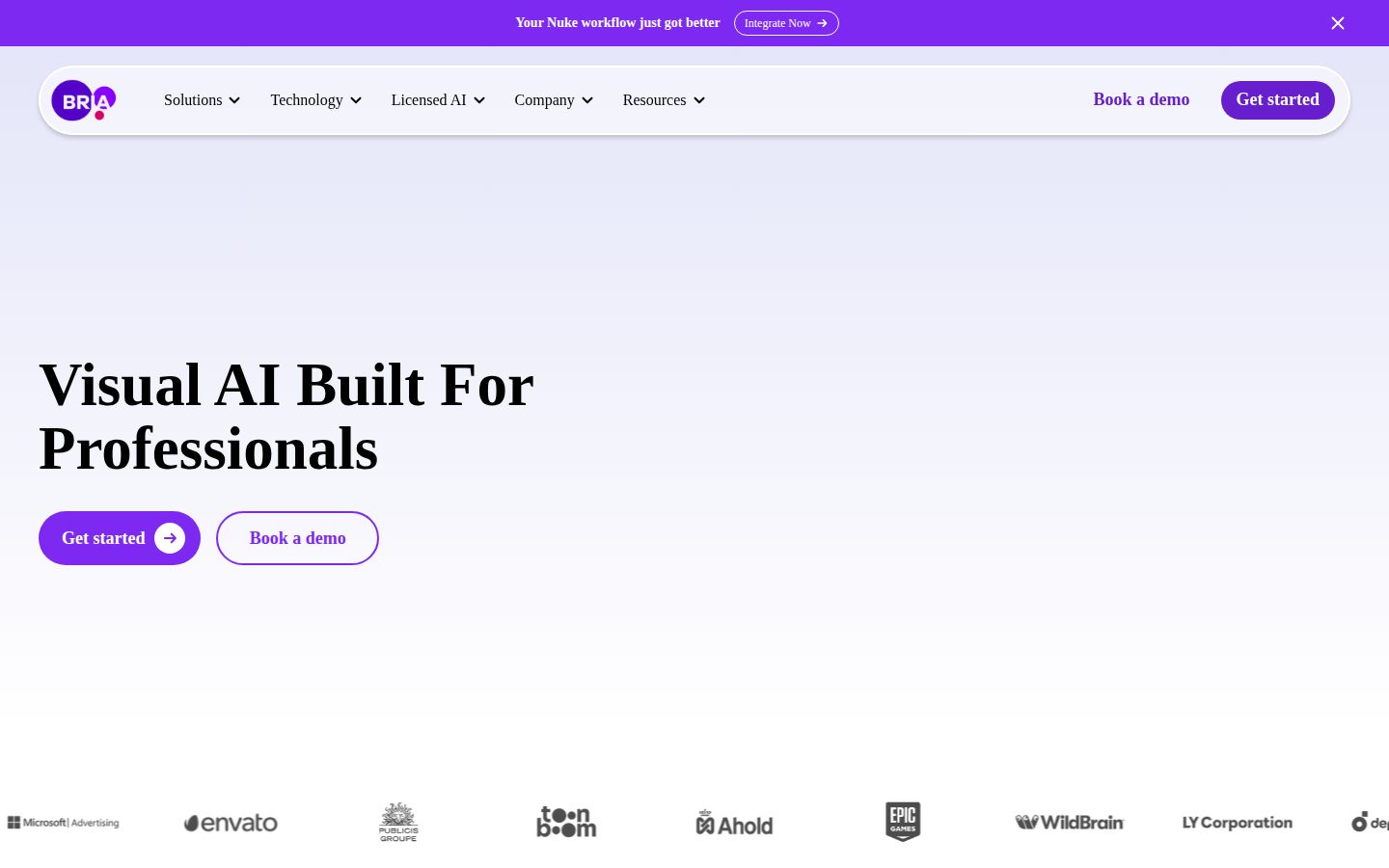
Bria AI desktop previewBria AI mobile preview

Pricing Plans

Free Trial

Free

New users building and testing Bria before moving to production.

  • 100 free generations
  • All integration methods (API, MCP, ComfyUI, iFrame, Figma)
  • Self-service fine-tuning
  • Basic services

Development

$0/usage

Builders integrating and testing Bria in production, paying only for usage.

  • Pay-as-you-go, $0.02-$0.03 per image
  • 10 actions per minute throughput
  • Standard indemnification
  • All integration methods
  • Extended services

Business

Contact sales

Production-scale deployment with full IP protection and volume pricing.

  • Volume pricing
  • 60 actions per minute throughput
  • Source code and model weights
  • Live video streaming
  • Full IP and privacy indemnity
  • Dedicated customer success and premium support

Enterprise

Contact sales

Private hosting and flexible, air-gapped deployment for regulated teams.

  • Private cloud or on-premises deployment
  • Customized throughput and latency
  • Copyrightability report
  • Best pricing
  • Everything in Business

AI Panel Reviews

The Decision Maker

The Decision Maker

Strategic bet, vendor viability, timing, adoption approval
8.2/10

Bria sells legal certainty as much as image generation, and enterprise buyers will pay for it.

Bria pairs a controllable, licensed-data image engine with the IP indemnification that lets legal teams approve generative AI in production. The backing is credible and the differentiation real, though the enterprise value sits behind custom contracts rather than the self-serve tier.

Most generative-AI vendors sell you images. Bria sells the right to use them without a lawsuit. It trains Fibo exclusively on licensed data from Getty Images, Alamy, and Envato, then ships every output with IP indemnification — the thing a general counsel actually signs.

The backers tell you something. Intel Capital and Getty Images put money into the $24M Series A in 2024, with $40M more the following year. That's a defensible 3-year bet for a 2020 company, and Getty being both investor and data partner is a moat competitors can't copy quickly.

The catch is speed to value. The self-serve Development plan starts at $0.02 per image, but the indemnity and deployment that justify choosing this over Adobe Firefly live behind a custom Business contract and a sales call. Pilot it on the API, then negotiate.

Competitive Positioning8.2

Licensed data plus a Getty partnership differentiates it clearly from Adobe Firefly and Stability AI.

Reputation Risk8.4

IP indemnification and licensed-only training directly de-risk brand and legal exposure.

Speed to Value7.8

A REST API and 100 free generations start fast, but full value needs a custom contract.

Strategic Fit8.0

Fits enterprises embedding compliant visual generation into products and catalogs.

Vendor Viability8.3

Intel Capital and Getty Images backing plus a $64M raise since 2020 signal staying power.

Pros

  • Models trained only on licensed Getty, Alamy, and Envato data, with IP indemnification on outputs.
  • Credible backers including Intel Capital and Getty Images across a $64M raise.
  • Deployment spans cloud, BYOC, on-premises, and air-gapped for regulated buyers.
  • SOC 2 Type II, ISO 27001, GDPR, and EU AI Act compliance already in place.

Cons

  • Full indemnity and deployment options require a custom Business or Enterprise contract.
  • Usage-based pricing makes total cost harder to forecast than a flat seat license.

Right for

Enterprises who need legally indemnified visual generation at production scale.

Avoid if

Solo creators who want a cheap one-off image generator.

The Domain Strategist

The Domain Strategist

Craft and strategy in the product's domain — adapts identity per category, same lens
8.2/10

Deterministic, on-brand generation built on licensed data, if your team accepts a more structured way of working.

Bria treats brand consistency as an architecture problem, using Visual Generative Language and Tailored Generation to make outputs reproducible and governable. It is a genuinely differentiated bet for creative teams, provided they are willing to trade free-form prompting for structured control.

Brand consistency is where most generative tools fall apart, and it's what Bria designs for. Visual Generative Language swaps prompt roulette for a JSON spec covering lighting, camera angle, and composition, so the same instruction returns the same frame every time. For a design system, reproducibility is the whole game.

Tailored Generation fine-tunes a model on your own assets, so a campaign stays on-brand across thousands of renders without art-directing each one. The Attribution Engine issues a provenance record per project — a governance story Adobe Firefly only gestures at, built on a licensed library of over 1 billion visuals.

The tradeoff is authorship. VGL gives a creative team deterministic control, but it also asks designers to think in structured parameters rather than free-form intent, which is a craft shift. Over three years that discipline pays off; on day one it's friction.

Category Positioning8.2

Licensed-data provenance clearly separates it from Adobe Firefly and Stability AI.

Domain Fit8.0

Purpose-built for creative and brand teams producing catalog and ad visuals at scale.

Integration Surface8.3

REST API, SDK, MCP server, ComfyUI, iFrame, and Figma and Photoshop plugins cover most pipelines.

Long-term Implications8.1

Licensed data and indemnification reduce legal risk that compounds over a multi-year commitment.

Strategic Depth8.2

VGL and Tailored Generation address reproducibility and brand consistency at a system level.

Pros

  • Visual Generative Language delivers deterministic, repeatable control over lighting and composition.
  • Tailored Generation keeps large campaigns visually on-brand without manual art direction.
  • Licensed-only training and the Attribution Engine give a real provenance and governance story.
  • Broad integration surface reaches into Figma, Photoshop, and ComfyUI workflows.

Cons

  • Structured VGL control is a craft shift away from familiar prompt-based tools.
  • Deepest brand and deployment features sit behind custom Business and Enterprise plans.

Right for

Creative teams who need reproducible, on-brand visuals at scale.

Avoid if

Designers who prefer fast free-form prompting over structured control.

The Finance Lead

The Finance Lead

Money, total cost of ownership, contracts, procurement math
7.8/10

At two cents an image the sticker is fair, but the real cost lives in usage.

Bria's self-serve pricing is transparent and cheap per image, starting at $0.02 on the Development plan. Real spend is usage-driven and the enterprise indemnity everyone actually wants sits behind custom quotes.

The unit is the image, not the seat, and that changes the whole model. Bria's Development plan runs $0.02 to $0.03 per generation, with editing like background removal from $0.018. No per-user license anywhere on the page.

Usage-based is the exposure. A team rendering 50,000 catalog images a year sits around $1,000 to $1,500 in generation alone, before Tailored Generation training and video-per-second billing. Adobe Firefly bundles generative credits into a Creative Cloud seat; Bria meters everything, so forecasting depends on volume discipline you have to enforce yourself.

Business and Enterprise pricing is custom, which means no published volume rate and a negotiation. The catch is that full IP indemnity and model weights only unlock at those tiers. The value is real; the number just isn't on the page.

Billing & Procurement7.8

Self-serve Free and Development tiers clear procurement without a sales call.

Contract Flexibility7.5

Pay-as-you-go avoids lock-in, but Business and Enterprise require negotiated contracts.

Pricing Transparency8.0

Free and Development tiers publish exact per-image rates; higher tiers stay custom.

ROI Clarity7.7

Indemnification and reuse rights carry real value that is hard to price precisely.

Total Cost of Ownership7.6

Usage-based metering makes multi-year totals depend on volume you must control.

Pros

  • Free Trial and Development pricing are public and cheap at $0.02 to $0.03 per image.
  • No seat licenses means cost scales with actual usage, not headcount.
  • Editing operations start low at $0.018 per image.

Cons

  • Business and Enterprise rates are custom with no published volume pricing.
  • Metered billing makes annual totals harder to forecast than a flat plan.
  • Full IP indemnity is gated to the paid custom tiers.

Right for

Finance teams who can model usage-based rather than seat-based spend.

Avoid if

Buyers who need a fixed, predictable annual license.

The Domain Practitioner

The Domain Practitioner

Daily hands-on reality in the product's domain — adapts identity per category, same lens
8.0/10

Native Figma and Photoshop plugins make Bria feel like part of the design workflow, not a detour.

Bria meets designers where they already work, with Figma, Photoshop, and ComfyUI integrations plus deterministic re-renders that survive revisions. The upfront cost is learning Visual Generative Language, which trades quick prompting for precise, repeatable control.

The plugins are what make this real for a working designer. Bria drops into Figma and Photoshop directly, so Background Removal and Generative Fill happen inside the file you're already in, not in a separate tab. For anyone living in Adobe's canvas, that's the difference between a tool you use and a tab you forget.

Product Shots is the standout for e-commerce work — cutout in, generated lifestyle scene out, at $0.018 to $0.03 an image. The ComfyUI nodes signal they take pipeline builders seriously, not just click-through users. Determinism helps too; the same VGL instruction rerenders the same frame, so a revision doesn't reroll the whole comp.

The friction is the input model. Writing structured VGL for precise control is more upfront work than typing a prompt into Midjourney, however much cleaner the result. Great for repeatable production, heavier for quick exploratory sketches.

Day-3 Reality7.8

Deterministic renders and in-app plugins hold up past the demo for daily production.

Documentation Practitioner-Fit7.7

Multiple integration methods and 100 free generations support hands-on evaluation.

Friction Surface7.6

Structured VGL input adds upfront effort compared with plain prompting.

Power-User Depth8.2

VGL exposes lighting, camera, and composition control most tools hide.

Workflow Integration8.2

Figma, Photoshop, and ComfyUI integrations sit inside existing design pipelines.

Pros

  • Native Figma and Photoshop plugins keep editing inside existing files.
  • Product Shots turns cutouts into lifestyle scenes for catalogs quickly.
  • Deterministic VGL re-renders make revisions predictable instead of a reroll.
  • ComfyUI nodes support real pipeline building, not just one-off clicks.

Cons

  • Writing structured VGL is more upfront work than a plain prompt.
  • Better suited to repeatable production than fast creative exploration.

Right for

Designers who produce repeatable production visuals inside existing tools.

Avoid if

Designers who mostly want fast exploratory image sketches.

The Power User

The Power User

Daily human experience, onboarding, polish, learning curve, reliability
7.8/10

Bria takes the legal fear out of AI images, but you'll trade easy prompts for JSON.

Bria's licensed-only training and built-in indemnification remove the will-this-get-us-sued worry that hangs over most AI image tools. The catch is a steeper input model, since Visual Generative Language wants structured JSON rather than a quick sentence.

So the thing that stands out isn't the generation, it's that you won't worry whether the image gets you sued. Everything Bria makes is trained on licensed data from Getty and Alamy, and outputs come with real legal cover. For anyone who's had that client conversation, that's a weight off.

The 100 free generations to start is the right move — you get to poke at it before any card. Product Shots looked handy for dropping a product into a scene. But the honest catch is Visual Generative Language means writing JSON, not just typing what you want. That's more setup than Canva or Adobe Firefly, where you type a sentence and go.

This isn't a phone-in-your-pocket tool; it's built for people wiring it into an app or catalog. Three days in, the payoff is the same instruction gives the same image, every time. Boring in the best way.

Daily Polish7.7

Deep integrations and clean cutouts suggest a considered day-to-day experience.

Learning Curve7.4

Visual Generative Language demands structured input beyond typing a prompt.

Mobile Parity7.5

A developer-and-catalog platform where mobile use isn't the point.

Onboarding Experience7.8

100 free generations and multiple integration paths lower the barrier to start.

Reliability Feel8.0

Deterministic re-renders make results feel dependable rather than random.

Pros

  • Licensed-only training plus indemnification removes real legal anxiety.
  • 100 free generations let you test before entering a card.
  • Deterministic output means the same instruction gives the same image.
  • Product Shots makes catalog-style scenes easy to assemble.

Cons

  • Visual Generative Language is more setup than a plain text prompt.
  • Built for builders and catalogs, not casual phone-based use.

Right for

Working people who value legally safe, repeatable image output.

Avoid if

Casual users who just want quick one-line prompting.

The Skeptic

The Skeptic

Contrarian. Watch-outs, deal-breakers, broken promises, category patterns
7.5/10

The licensed-data claim actually checks out, which is rarer in this category than the marketing admits.

Bria's core differentiator — training only on licensed data with real indemnification — holds up to scrutiny and is backed by Getty and Intel Capital. The watch items are proprietary VGL lock-in and indemnity that only matters at custom pricing tiers.

The central claim is checkable, which is more than most. Bria says it trains only on licensed data from Getty Images, Alamy, and Envato — and Getty is also an investor, which makes the sourcing story hard to fake. That's the differentiator Stability AI got sued for not having.

Money's real too. $24M Series A in 2024, another $40M in 2025, Intel Capital on the cap table. Not a weekend project. Founded 2020, so this is a five-year-old vendor in a category that's still consolidating.

The yellow flag is lock-in shape. Visual Generative Language is proprietary; the REST API is standard, so you can leave, but every VGL instruction you've written is Bria-specific and doesn't port to Adobe Firefly. Indemnification also only gets serious at custom tiers. Solid, but read the Business contract before you commit the pipeline.

Competitive Differentiation8.0

Licensed-only training and indemnification separate it sharply from Stability AI.

Exit Portability7.4

Standard REST API eases exit, though proprietary VGL instructions don't transfer.

Long-term Viability7.2

Credible backers help, but generative-AI shakeout risk remains real.

Marketing Honesty7.6

The licensed-data claim is specific and checkable, with named partners and an investor overlap.

Track Record Match7.2

Founded 2020 with $64M raised, but still young in a volatile category.

Pros

  • Licensed-data claim is verifiable and reinforced by Getty as an investor.
  • Funding and named backers signal this is not a fragile startup.
  • Indemnification and compliance certifications address the category's core legal risk.

Cons

  • Visual Generative Language is a proprietary format that won't port to rivals.
  • Meaningful indemnity is gated to custom Business and Enterprise contracts.

Right for

Buyers who need a defensible, verifiable data-sourcing story.

Avoid if

Teams who want a portable, vendor-neutral prompt format.

Buyer Questions

Common questions answered by our AI research team

Pricing

How much does Bria AI cost per image?

The Development plan is pay-as-you-go: image generation runs $0.02-$0.03 per image with the Fibo model, and editing like background removal starts at $0.018. Business and Enterprise use custom volume pricing.

Security

Is Bria AI safe for commercial use?

Yes. Bria trains its models exclusively on licensed data from Getty Images, Alamy, and Envato, and provides full IP indemnification. The platform is SOC 2 Type II, ISO 27001, GDPR, and EU AI Act compliant.

Integration

How do I integrate Bria into my app?

Bria offers a REST API, SDK, MCP server, ComfyUI nodes, an embeddable iFrame, and Figma and Photoshop plugins. The free trial includes 100 generations so you can build and test before moving to production.

Features

Can Bria generate product photos for e-commerce?

Yes. The Product Shots tool drops product cutouts into generated lifestyle scenes and backgrounds for catalogs and ads, priced $0.018-$0.03 per image. Tailored Generation keeps those visuals on-brand.

Setup

Does Bria offer on-premise or private cloud deployment?

The Enterprise plan runs Bria's API on private cloud, on-premises, or air-gapped environments with customized throughput and latency. The Business plan adds access to source code and model weights.

Also in AI Image Generation