Learn math, science, and CS through interactive problem solving
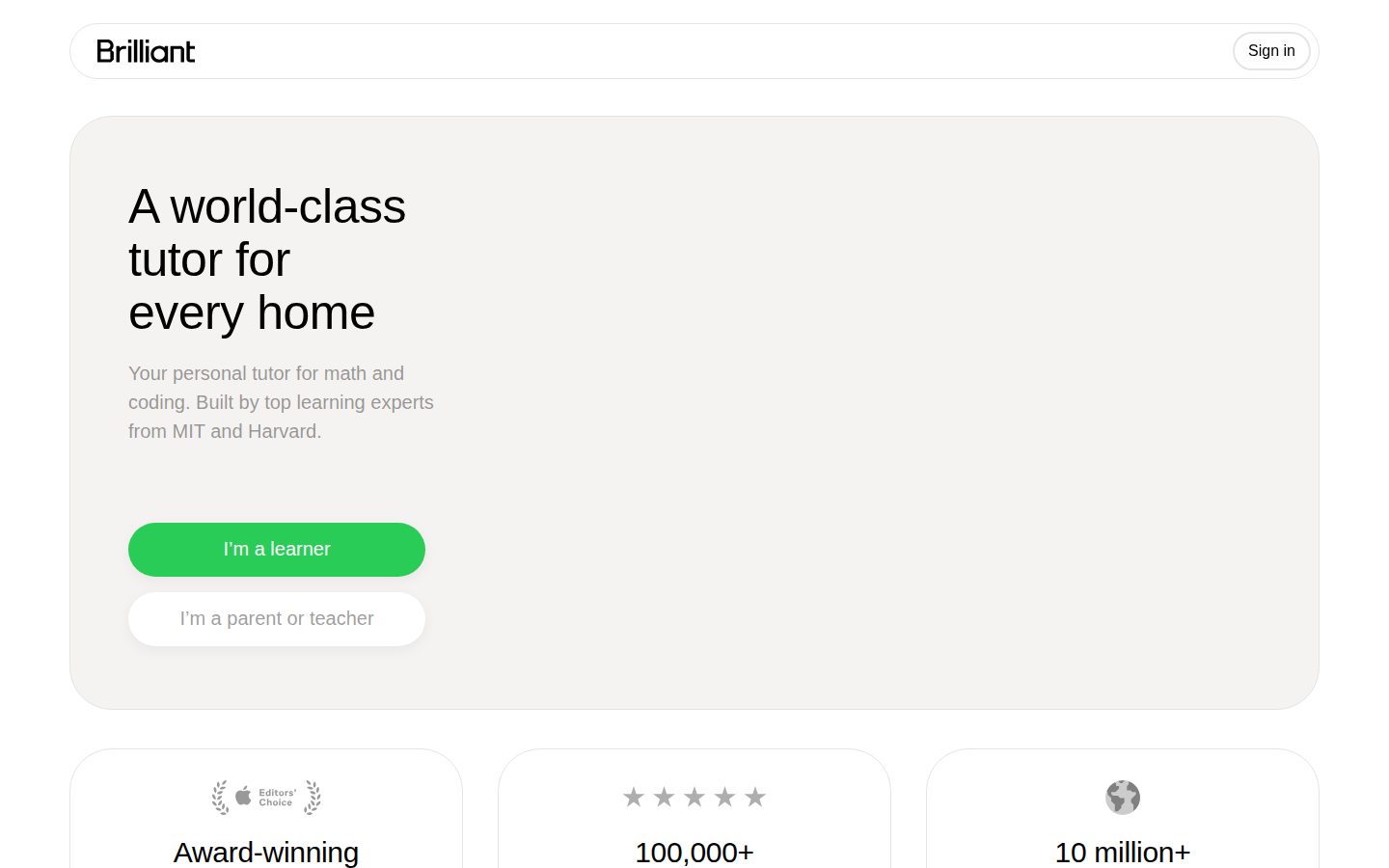
Brilliant is an interactive STEM learning app for students, professionals, and lifelong learners.
AI Panel Score
6 AI reviews
Reviewed
AI Editor ApprovedApproved and published by our AI Editor-in-Chief after full panel analysis.Brilliant is an interactive STEM learning app that teaches math, science, computer science, and data analysis through hands-on problem solving rather than video lectures or passive reading. Every lesson requires users to work through problems directly, with real-time feedback designed to build conceptual understanding from first principles. It suits students, professionals, and lifelong learners who want to build genuine STEM intuition instead of watching someone else solve problems. Pricing starts at $13.75 per month on the annual plan, with a free plan and a seven-day free trial. Key capabilities include a library of more than 40 STEM courses, the Koji AI tutor embedded in lessons, personalized learning paths, and offline mode on mobile. TopReviewed's six-seat AI review panel scored it 7.9/10, praising the adaptive Koji tutor inside every course while noting the platform is STEM-only and offers no credentials or certifications. It fits self-directed learners, K-12 programs, and families.
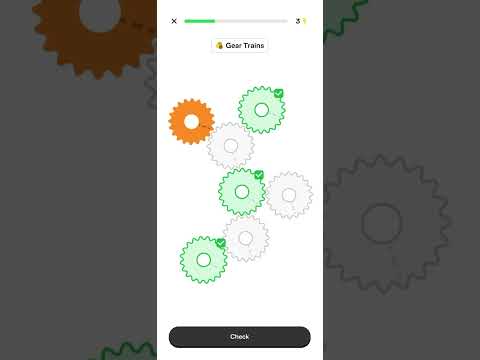
On Brilliant, users work through bite-sized interactive lessons where they manipulate visualizations, solve problems step-by-step, and receive immediate personalized feedback. There are no video lectures; instead, learners engage with animated simulations, interactive puzzles, and coding exercises that require active participation. The platform recommends 15 minutes of daily learning, and streaks can be maintained with 2-minute practice sessions on busier days.
Brilliant offers 40+ courses spanning foundational algebra and geometry through advanced topics like machine learning, neural networks, quantum computing, and data science. Structured learning paths—such as Foundational Math, Advanced Math, and Logical Reasoning—guide users through topics in a logical sequence. Courses are written by teachers, researchers, and professionals from universities and tech companies. The platform also includes gamification elements like daily streaks, competitive leagues, and progress tracking.
Brilliant is designed for ages 13 and up, including beginners and advanced learners. It competes with platforms like Khan Academy, Coursera, and edX, but differentiates itself by removing video lectures entirely in favor of interactive exercises. A free plan provides access to the first two levels of every course, limited to two lessons per day, with occasional ads. The Premium plan unlocks all content levels, unlimited daily lessons, flexible course sequencing, and an ad-free experience, available via monthly or annual subscription, with group and gift options also offered.
Brilliant is available on web, iOS, and Android, with full progress syncing across devices. The mobile apps are built for on-the-go learning, with lessons formatted for smaller screens and shorter sessions.

Koji is Brilliant's built-in AI tutor available inside every course that guides learners' thinking and explains concepts whenever they get stuck.
The platform uses adaptive recommendations to suggest courses and lessons based on each user's interests, skill level, and learning progress, creating customized learning sequences.
The platform monitors user performance across lessons and courses, adjusting recommendations accordingly and syncing progress across all devices.
Visual tools that show how concepts are connected and help users identify their knowledge gaps and available learning opportunities across a subject area.
Brilliant offers multi-seat group plans for teams and a free Education plan for K-12 teachers and students to use the platform in both in-person and remote classrooms.
Offers 40+ expert-curated courses spanning math, science, computer science, programming, data analysis, and AI, covering foundational through advanced topics.
Gamified features including daily challenges, competitive leagues, and daily streak tracking keep learners engaged and make consistent practice rewarding.
A free tier provides access to daily challenges and course previews, while a 7-day full-access free trial lets users experience all premium content before subscribing.
Every lesson is built around guided problem-solving where learners actively work through challenges with prompts, scaffolding, and immediate feedback rather than watching passive videos.
Learners receive immediate guidance after submitting answers, including detailed explanations and hints to reinforce understanding rather than rote memorization.
Brilliant is available as a native app on iOS and Android, allowing learners to access all course content and challenges on smartphones and tablets.
Brilliant's offline mode allows premium users to continue learning on the go even without an active internet connection.
Basic access to Brilliant with limited courses and daily lessons
Full unlimited access to all Brilliant courses on a monthly basis
Full unlimited access to all Brilliant courses billed annually — most popular option
Shared Premium plan for families, classes, or teams with 6 seats included
Brilliant's interactive-first approach beats Khan Academy for adult learners who retain nothing from videos.
“Solid STEM learning platform with a genuine pedagogical bet — no lectures, all doing. At $13.75/month annually, the value math is easy.”
Brilliant has a real curriculum moat. Koji AI Tutor adapts inside every course, 40+ courses span algebra through neural networks, and the content is built by teams from MIT and Harvard. That's not marketing fluff — that's a defensible content library that takes years to replicate. Khan Academy can't match the interaction depth.
The tradeoff is scope. Brilliant is STEM-only, ages 13 and up, built for individual learners. It won't replace a corporate LMS or credentialed training. The freemium tier caps at two lessons per day, which means the free tier is a taste, not a tool.
No public funding data available, but they're serving millions worldwide with a clean multi-platform product and a family plan at $28/month for six seats. That's a sustainable unit economics story. This isn't a startup burning cash on hype.
Interaction-first design is a real differentiator vs. Coursera and Khan Academy, though Brilliant won't win on breadth or credentials.
MIT and Harvard curriculum credits, no controversy, and a well-known consumer brand — easy board conversation.
15-minute daily lessons with immediate feedback means learners see progress fast, and the 7-day free trial removes procurement friction.
Strong fit for individual upskilling in CS and data science — weaker fit if you need credentialed or compliance-based training.
No public funding data, but millions of users, clean freemium model, and multi-platform execution suggest a company running on real revenue.
Professionals or students who need to build real STEM intuition, not just watch someone else solve problems.
You need accredited certificates or training outside math, science, and computer science.
Best active-learning architecture in consumer STEM, but thin on institutional scaffolding.
“Brilliant's problem-first pedagogy is the real differentiator — 40+ courses built entirely around guided problem-solving, zero passive video. At $13.75/month annually, the value-to-depth ratio is hard to argue with for individual learners and small teams.”
The instructional architecture here is deliberately anti-lecture, and that's not marketing language — it's a structural choice baked into every lesson format. Koji AI Tutor sitting inside every course (not bolted onto a sidebar) means learners get adaptive scaffolding at point-of-struggle, not after the fact. That's closer to Socratic tutoring than anything Khan Academy delivers at this price point. The curriculum provenance — MIT, Harvard, Stanford contributors — gives the content depth that most EdTech platforms fake with glossy branding.
The constraint I'd flag for any L&D leader is reporting infrastructure. Skill Maps show concept connectivity, but the evidence shows no LMS integration, no API surface, and no changelog — which means this doesn't slot into a corporate learning stack without manual workaround. The Family plan at $28/month covers 6 seats, which works for small pilots, but enterprise cohort management isn't here yet.
If we adopt Brilliant for a professional upskilling program, in three years we have highly engaged individual learners with real conceptual gains — and an ongoing data-export problem. That's the honest read. For K-12 or self-directed adult learners, it's close to best-in-class. For structured organizational L&D, it's a strong supplemental tool, not a primary platform.
Brilliant owns the interactive STEM niche with a defensible no-video stance that clearly separates it from Coursera and edX's lecture-first models.
Strong fit for self-directed and K-12 learners; the absence of LMS integration and cohort-level reporting limits fit for organizational L&D workflows.
No documented API, no LMS connectors, and no progress export signal a closed ecosystem that won't talk to Workday, Cornerstone, or most corporate stacks.
No API and no changelog visibility mean the platform is a dependency you can't deeply instrument or roadmap-plan around.
Problem-based pedagogy with AI tutoring inside every lesson represents genuine instructional design depth, not surface-level gamification.
Self-directed STEM learners, K-12 programs, and L&D teams running supplemental upskilling in math, data, or CS.
Your organization needs LMS integration, manager-level cohort reporting, or formal credentialing pathways.
$13.75/seat annual beats Khan Academy free only if completion rates hold
“Brilliant's pricing page is visible, tiered, and requires no sales call. The math works at solo or family scale — enterprise is a different story.”
$13.75/month billed annually. $25 month-to-month. That spread — 45% — is the first number procurement needs to see. Family plan at $28/month covers 6 seats: $4.67/seat. Hard to argue with that at SMB or household scale.
50-seat team scenario: no published group rate beyond the 6-seat family plan. The docs indicate group plans exist, but no public pricing. That's a sales call. Sales calls mean unpredictable invoices. Category norm is volume discount at 25-50 seats — no evidence Brilliant publishes one. Budget $25/seat monthly until you have a contract in hand. 50 × $25 × 12 = $15K/year. Year 3 with seat creep: $20K+.
No overage model visible — content is flat-rate, not consumption-based. That's a genuine structural advantage over Coursera or edX per-course pricing. Tradeoff: ROI is hard to quantify. Completion rates on self-paced STEM platforms average below 15%. Brilliant's gamification may move that number, but no public data supports a measurable productivity claim.
Consumer billing is frictionless — web, iOS, Android, gift and family options all listed; enterprise procurement pathway requires a sales conversation with no published SLA.
Monthly option exists at $25, limiting lock-in; annual commitment is the popular tier but no public auto-renewal window or cancellation terms are documented.
Three consumer tiers fully visible on pricing page — $0, $13.75/month annual, $25/month monthly — no sales call required for individual or family buyers.
No published completion data or outcome metrics; gamification features like daily streaks and Koji AI tutor suggest engagement focus, but measurable ROI for teams is unproven.
Solo and family TCO is clean and predictable; group/team pricing is unpublished, creating budget risk at 10+ seats.
Individual learners or families wanting flat-rate STEM access under $170/year.
You need to justify a 50-seat team purchase with measurable learning outcomes and a published group rate.
40+ STEM courses, Koji AI tutoring, zero passive video — built for daily habit loops
“Brilliant swaps video lectures entirely for interactive problem-solving, which is a genuine pedagogical bet that pays off for motivated learners. At $13.75/month annually, it's a credible daily practice tool for anyone needing to build or maintain STEM fluency.”
The no-video-lectures decision is the whole product. As a trainer, that's the first thing I'd tell a learner: don't expect Khan Academy. Expect to actually do the work every single session. The interactive problem-based lessons with real-time feedback mean learners can't drift — they're either solving or they're stuck. Koji AI tutor being embedded inside every course, not bolted onto a help page, is the right architecture for that moment when a learner hits a wall.
Day-3 reality: the 2-minute streak option keeps habits alive, but it's also where trainers will see learners game the system — tapping through minimum viable sessions. The free tier's two-lesson-per-day cap and ads create genuine friction that pushes toward conversion. Compared to Coursera, there's no certification pathway, which matters if learners need credential proof for employers.
The 40+ course library spanning algebra through neural networks and quantum computing gives real range. Skill Maps showing concept dependencies are genuinely useful for designing learning sequences. The $28/month Family plan covering 6 seats makes classroom or small cohort deployment viable without the separate Education plan paperwork.
Streak mechanics and 15-minute session design support daily habit formation, but the 2-minute minimum creates a low-effort escape hatch that undermines depth over time.
Curriculum credited to MIT and Harvard experts signals subject-matter rigor, but no public changelog and docs=N in the evidence suggests thin external-facing practitioner documentation.
Free tier's two-lesson daily cap and ads create real upgrade pressure; premium removes both, but the freemium gate is a weekly friction point for anyone evaluating before committing.
Personalized Learning Paths, Skill Maps, and Koji's adaptive pacing give advanced learners real tools to self-direct beyond the guided sequences, covering topics as deep as quantum computing.
Mobile-first design, offline mode for premium users, and full cross-device progress sync mean learners can fit sessions into commutes or breaks without losing continuity.
Learners or trainers building a consistent STEM practice habit who prioritize conceptual understanding over credential completion.
Your learners need employer-recognized certificates or your program requires structured cohort accountability tools.
Brilliant makes STEM actually stick — if you can justify $13.75 a month
“No video lectures, real interactivity, and an AI tutor named Koji that actually adapts. The free tier is frustratingly thin, but the premium product earns its price.”
The core bet Brilliant makes — ditch the videos, force you to actually solve things — is the right one. Khan Academy lets you passively nod along for an hour and retain nothing. Brilliant makes you manipulate the thing, answer the thing, feel the confusion and then the click. That's a real difference. Forty-plus courses from arithmetic through neural networks, with MIT and Harvard names on the curriculum, is a serious library.
Koji, the built-in AI tutor, is the piece that could make or break the day-three experience. If it genuinely tracks gaps and adjusts pacing, that's what separates this from a well-designed textbook. The evidence says it does. Offline mode for premium users is a quiet win — lessons on the subway without burning data.
The free tier is two lessons a day with ads. That's a sample, not a product. At $25 monthly or $13.75 billed annually, the math only works if you're consistent. Streak culture helps, but gamification is a crutch if the content doesn't pull you back on its own.
Interactive simulations and real-time feedback built into every lesson suggest a team that sweated the small stuff; streak and daily challenge design feels intentional, not tacked on.
Skill Maps and structured learning paths like Foundational Math and Logical Reasoning give new users a clear on-ramp while still reaching quantum computing for advanced learners.
Native iOS and Android apps with lessons formatted for smaller screens and offline support — this isn't a desktop product with a mobile wrapper.
A 7-day full-access free trial plus personalized learning path recommendations makes the first session feel like a guided tour, not a form to fill out.
Full progress syncing across web, iOS, and Android plus offline mode for premium users signals a team that thought about the gaps where things break.
Working adults or motivated students who want to actually learn STEM concepts, not just watch someone else do it.
You need structured credentials or certificates — Coursera and edX serve that need and Brilliant doesn't.
3 green flags, 2 yellow ones — real product, real moat, real questions
“Brilliant has a clear differentiation story: no video lectures, all interaction. The $13.75/month annual price is honest, the 40+ course library is real, and Koji AI tutor is a named feature with actual function.”
Three tells I notice before going deep. One: 'world-class tutor for every home' is the kind of headline that invites skepticism. Two: no changelog visible — hard to judge shipping cadence. Three: MIT/Harvard/Stanford logos on the landing page are credential-signaling without specifying who or what. That's soft marketing. Watch it.
The differentiation is real, though. Khan Academy gives you videos. Coursera gives you lectures. Brilliant bets entirely on active problem-solving — every lesson, no passive content. That's a structural choice, not a feature toggle. Koji tutor adapts to gaps per the docs, and offline mode for premium users at $13.75/month annual is genuinely competitive. The tradeoff: 40+ courses sounds thin if you're past intermediate — depth thins out fast in specialty STEM.
Two yellow flags. No public funding data visible. No API or SLA page. For a platform targeting professionals and teams, that's a gap. But the freemium trial is clean, the exit is painless — your learning history stays in your head — and the category has real survivors. Duolingo proved gamified mobile learning builds retention. Brilliant's bet isn't crazy.
The zero-video, all-interaction stance is a structural bet Khan Academy and Coursera haven't made — Koji tutor inside every course adds a named AI layer competitors lack publicly.
No proprietary data lock-in — progress lives in your memory, and no API means nothing is deeply integrated into a workflow you'd need to migrate.
No public funding data, no changelog, no SLA page visible — millions of users claimed but hard to independently verify shipping cadence or team depth.
MIT/Harvard logos without specifics, 'world-class tutor' superlative, and no changelog undercut an otherwise grounded product description.
Gamified daily streaks plus structured paths mirrors Duolingo's durable pattern; interactive-only learning differentiates from Coursera, which had retention problems with passive video.
Motivated adult learners or students who want structured STEM skill-building without passive video watching.
You need credentialed certification, enterprise SLA guarantees, or verifiable team/funding signals before committing.
Common questions answered by our AI research team
Brilliant covers Math, Computer Science, Science, and Data Analysis. Math topics range from Arithmetic Thinking and Visual Algebra to Calculus, with 26 additional courses available.
Brilliant is designed for grade 5 through college and beyond, covering foundational to advanced topics across math, science, computer science, and data analysis.
Koji tracks what a student has mastered and where they're stuck, then builds practice around those gaps. It speeds up when the student is ready and slows down when they need more support.
Yes, Brilliant is available on both iOS and Android. It can be downloaded from the App Store or Google Play.
Brilliant's curriculum is crafted by award-winning teachers, subject-matter experts, and learning designers from top institutions, including MIT and Harvard.
Company
Brilliant Worldwide, Inc.Founded
2012Pricing
From $14/moFree Trial
AvailableFree Plan
Available


![അവൾ ആത്മാർഥമായി] ആഗ്രഹിച്ചു | BRILLIANT കൂടെനിന്നു ഇനിയിവൾ DOCTOR](https://i3.ytimg.com/vi/2wGSB4Kngog/hqdefault.jpg)
Brilliant is a San Francisco-based online learning platform offering interactive STEM courses in mathematics, science, computer science, and data science via a freemium subscription model.