Reference-guided AI image and video generation for character and object consistency
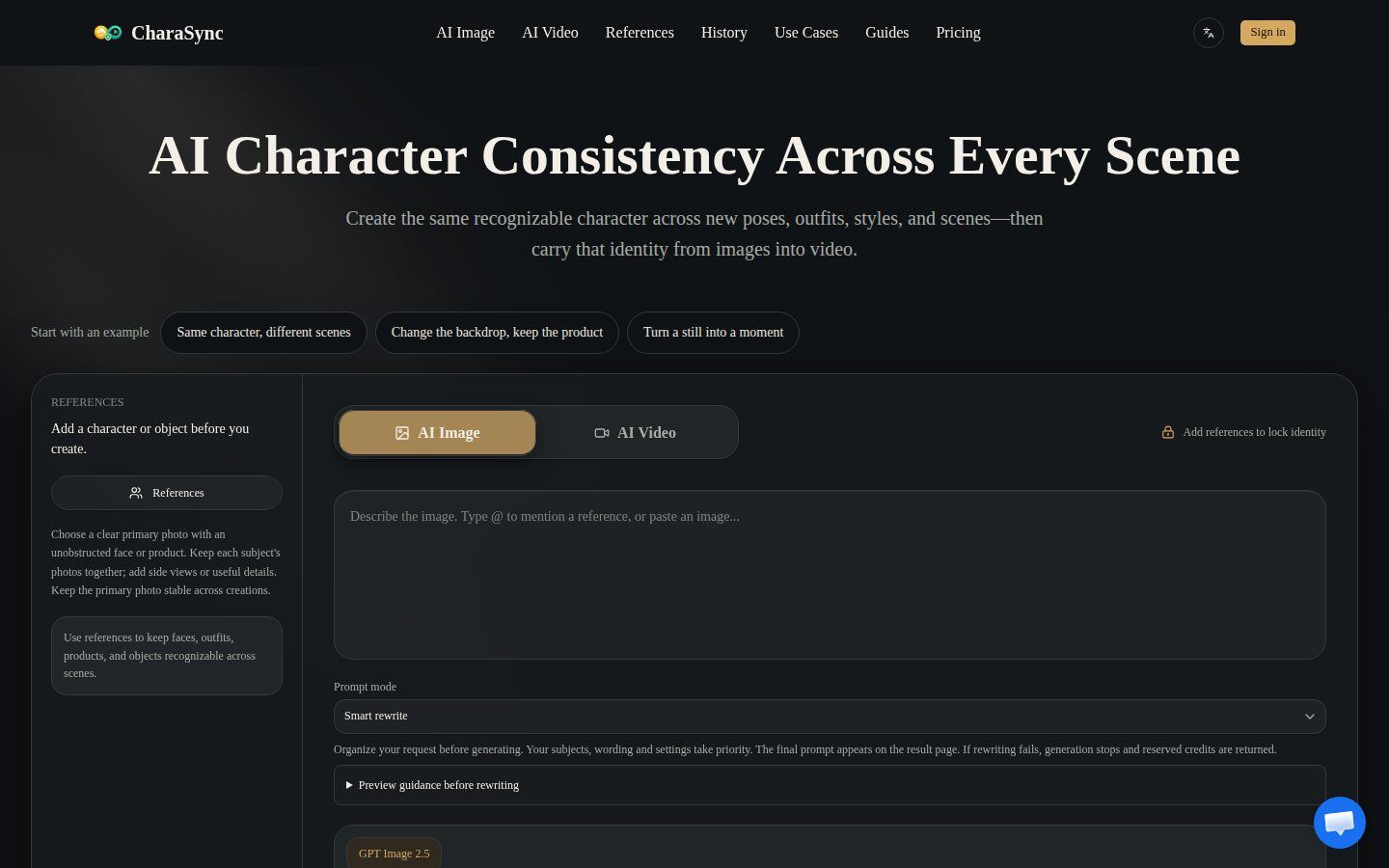
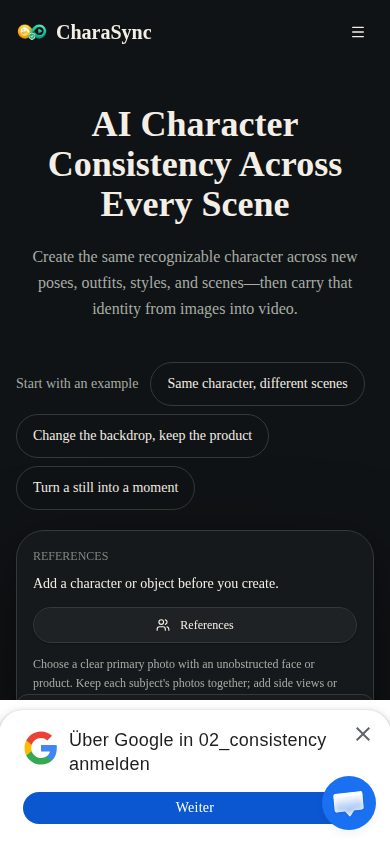
CharaSync is a web-based AI tool for generating consistent characters, products, and videos from reference images.
AI Panel Score
6 AI reviews
Reviewed
Facts checked against charasync.com
CharaSync is built around a reference-guided workflow: a user supplies one or more reference images of a character, product, or object, then describes what should stay the same and what should change in the new output. Image generation is handled by GPT Image 2.5, while short video generation uses Seedance 2.0. A smart prompt rewriting feature is available to help convert plain-language instructions into prompts suited to these underlying models.
The site documents its own case studies rather than relying on generic demos. One example shows a single fictional character reference sheet reused to generate both a cafe portrait and a beach portrait with GPT Image 2.5. Another shows a product shot of a white cup with blue "SYNC" lettering having its background changed from yellow to light green while the cup itself was kept consistent. A third case study takes the saved cafe portrait and uses it as the image reference for a five-second Seedance 2.0 video. Each case study discloses the original prompts, settings, and generation dates used, and the site is explicit that these are individual API samples rather than model-wide benchmarks, and that model outputs require human review since consistency is not guaranteed.
CharaSync publishes guides covering how to choose between reference-based, prompt-only, and trained AI workflows for character consistency, a six-step process for keeping a character consistent across angles, scenes, outfits, images, and video, and how to select an approach for character design based on the specific work needed. Current subscription and one-time credit package pricing is listed on a dedicated pricing page, though specific figures are not disclosed in the material reviewed here.

Generates new images from an uploaded reference image and user description of what should change or stay the same, using GPT Image 2.5.
Creates short videos from an uploaded image reference and prompt using Seedance 2.0, such as turning a saved portrait into a five-second video.
Translates user instructions into model-ready prompts to improve generation results.
Discloses original prompts, settings, and generation dates for individual API sample outputs, noting limitations and variability.
Uses a single character reference sheet to produce new scenes (e.g., cafe and beach portraits) while aiming to preserve the subject's appearance.
Edits an image to change the background while keeping the referenced product (e.g., a cup) consistent.
Provides subscription and one-time credit package terms on a dedicated pricing page.
Offers English as the default language with Chinese-language pages available under /zh for homepage, case studies, guides, and about sections.
Provides guides such as a 6-step workflow and comparisons of reference-based, prompt-only, and trained AI methods for character consistency and design.
Try CharaSync with one-time starter credits
For creators who generate regularly
For power users and studios
A narrow, well-documented wrapper on GPT Image 2.5 and Seedance 2.0 for character consistency.
“CharaSync bets on reference-guided workflows instead of raw model access. The case studies showing actual prompts and settings are the most honest thing about it.”
$19.90 a month for 3,000 credits, built on GPT Image 2.5 for stills and Seedance 2.0 for five-second video. That's not CharaSync's own model — it's an orchestration layer with a smart prompt rewriter on top, and the pricing reflects a thin margin on someone else's compute.
What earns trust here: the published case studies show real prompts, settings, and dates, and the FAQ admits consistency isn't guaranteed. Most tools in this category oversell. This one tells you outputs vary with pose and lighting changes, which is the kind of disclosure that saves support tickets later.
The tradeoff is dependency. If GPT Image 2.5 or Seedance 2.0 pricing or access shifts, CharaSync's entire economics move with it. Free tier gives 50 one-time credits — fine for a test, not for evaluating real workflows. Pilot it for a specific character or product-shot use case before committing a team.
The documented six-step consistency workflow and transparent case studies differentiate it from generic prompt-only generators, though the underlying models aren't proprietary.
Terms require users to hold rights to inputs and disclaim exclusivity on outputs, which pushes commercial-use risk onto the buyer.
Reference-image upload plus prompt rewriting gets a usable image or 5-second video fast, and failed generations auto-refund credits.
Useful for teams needing repeatable character or product imagery, but it's a workflow layer on existing models, not a new capability.
Pricing page is detailed and the product ships guides and dated case studies, but I couldn't find docs or a changelog to gauge build cadence.
Creators or small studios needing repeatable character or product imagery without training a custom model.
Skip it if you need guaranteed pixel-level consistency or want a vendor that owns its own generation model.
A workflow layer with genuine craft discipline, built on a foundation it doesn't own.
“CharaSync's library-and-reference system is the right shape for character work, but the creative ceiling is set by two outside models, not by CharaSync's own R&D. That's a studio-dependency problem, not a tooling problem.”
A character reference sheet feeding both a cafe portrait and a beach portrait — that's how an art director actually keeps continuity, not a single magic prompt. CharaSync's whole interaction model, upload-and-describe-what-changes, mirrors how a studio maintains a style bible across scenes. That's the right instinct, and it shows in the guide content on sequencing angles, outfits, and scenes rather than treating each generation as a one-off.
The ceiling, though, is someone else's. Image quality rides GPT Image 2.5, video rides Seedance 2.0 capped at five-second clips per the published case studies — CharaSync's craft contribution is the reference workflow and prompt rewriting layered on top, not the pixels themselves. For a creative lead, that means your output quality roadmap is only as ambitious as two vendors you don't manage.
The Max tier's 4K/1080p and early-model-access at $39.90/month suggests they're tracking the frontier, which matters more than the current ceiling. Still, there's no proprietary model moat here — competitors with the same API access could replicate this workflow layer quickly.
Positions itself as the consistency layer on top of frontier models rather than a frontier model itself, a credible niche at $19.90-$39.90/month.
Upload-reference-then-describe-change matches how art directors maintain character bibles across scenes and shots.
Character & object library and generation history give it studio-adjacent bones, but I found no mention of export tooling into a broader pipeline.
A 3-year bet here is really a bet on GPT Image 2.5 and Seedance 2.0's own roadmaps, which CharaSync doesn't control.
Reference-guided workflow and six-step consistency guide show real craft thinking, but the generation quality itself isn't CharaSync's to improve.
A creative lead who needs fast, documented character or product continuity across still images and short clips without building an in-house pipeline.
Avoid if your studio needs longer-form video or a differentiated visual style that a reference-wrapper over third-party models can't guarantee.
$19.90/mo for 3,000 credits. Math's clean. Credit burn rate is the real unknown.
“Pro tier prices in public at $19.90/mo, no sales call. Three-year TCO depends on a variable neither buyer nor vendor fully controls: per-generation credit cost.”
$19.90/mo Pro, $39.90/mo Max. 3,000 vs 9,000 credits. Dollar-per-credit math isn't published anywhere I found, so cost-per-output stays a guess until you run it. 50 users doesn't apply here — this reads as single-seat pricing, not team licensing. No per-seat multiplier, so team deployment means N separate subscriptions, not a volume tier.
Free plan: 50 one-time credits, no refresh. Fine for a demo, thin for a 3-year projection. Real cost exposure sits in credit consumption against GPT Image 2.5 and Seedance 2.0 — pricing CharaSync doesn't set and can reprice if upstream model costs shift.
No contract terms, auto-renewal windows, or cancellation language visible on the pricing page itself. Monthly billing suggests low lock-in risk, but I couldn't confirm term length or refund policy beyond failed-generation credit refunds. Procurement friction should be low — self-serve, card-based, no sales call required at this price point.
Self-serve subscription plus one-time credit packages, no sales call needed at $19.90/mo entry.
Monthly billing implies low lock-in, but no renewal or cancellation terms are visible to confirm it.
Two paid tiers with exact prices and credit counts listed; no quote-gated tier visible.
Case studies disclose prompts and settings, which helps estimate output quality, but credits-to-usable-asset ratio is unmeasured.
Credit cost per generation isn't disclosed, so output volume at scale is a guess, not a number.
Solo creators or small studios comfortable testing credit burn rate before committing budget.
Avoid if you need published per-generation cost to model spend before signing up.
A reference-to-render pipeline that's honest about the five-second ceiling and the drift problem.
“CharaSync builds a real production workflow around GPT Image 2.5 and Seedance 2.0, not just a prompt box. The six-step consistency guide and object/background editing feature are genuinely useful for a sizzle reel or product shoot, but video output tops out short and the pipeline is only as deep as two models it doesn't own.”
On day three, the thing I'd actually be testing is whether the reference sheet workflow survives a real shot list. Uploading one character sheet to generate a cafe portrait and a beach portrait is a clean demo — the question is what happens at shot forty when lighting and angle swing hard, which the product itself flags as the breaking point for consistency.
The object/background editing case (the blue 'SYNC' cup, yellow to green background) is the more production-relevant feature for me — that's a commercial still workflow, not a character workflow, and it's the kind of task I'd actually bill hours for. Smart prompt rewriting is a nice guardrail for anyone who isn't fluent in Seedance-speak.
The real friction is architectural: every output rides on GPT Image 2.5 and Seedance 2.0, so my render quality and my feature roadmap both move on someone else's schedule, not CharaSync's. For short-form social or product variants that's a fair trade. For anything needing shots past five seconds, I'm still stitching clips elsewhere.
Consistency is explicitly not guaranteed once pose, lighting, or angle shift, which the case studies admit outright.
Case studies disclosing actual prompts and generation dates read like production notes, not marketing copy.
Reference-guided generation reduces re-prompting, but every video clip appears capped at five seconds per the published case study.
Max tier unlocks 4K/1080p and priority generation at $39.90/mo, but I found no finer render controls beyond resolution and priority.
Character & object library plus generation history suggest a real asset pipeline rather than one-off prompting.
A solo creator or small studio producing short social clips and product stills who needs repeatable character or product likeness without a full video pipeline.
Avoid if your deliverables run longer than a few seconds of video or need frame-level control beyond reference-image guidance.
A tool that shows its homework, which is rarer than it should be
“CharaSync leans on two outside models and is upfront about that. The first ten minutes feel like a product, not a sales pitch, but there's no mobile story I could find anywhere.”
First impression matters here, and CharaSync does something most tools skip: it shows you real case studies with actual dates and settings instead of a generic demo reel. That's the kind of thing that makes the first ten minutes feel less like homework. You upload a reference, you say what to keep, you get something back, and if it flops on a genuine failure the credits come back automatically. That's a small mercy a lot of generation tools don't bother with.
Where it gets murky is anything past day one. The free tier's 50 one-time credits with no refresh means you burn through your honeymoon period fast, and then you're deciding on a $19.90 or $39.90 plan without much runway to learn the quirks of GPT Image 2.5 or Seedance 2.0 first.
I couldn't find anything about a mobile app or responsive workflow, which for an image-and-video tool matters more as you go from hour one to month three. The smart prompt rewriting helps flatten the learning curve early, but long-term mastery still depends on two models CharaSync doesn't build or fully control.
Published case studies with real prompts and dates signal more care than typical marketing demos.
The six-step consistency guide and method-comparison docs read as practical rather than promotional, but consistency across pose and angle still takes trial and error.
I couldn't find any mention of a mobile app or dedicated mobile experience on the site.
No credit card needed and 50 starter credits let you try image generation immediately, though the one-time nature cuts exploration short.
Automatic credit refunds on genuine generation failures suggest the team planned for things going wrong, not just when they go right.
Solo creators and small studios who want character or product consistency without building their own prompt pipeline.
Skip it if you need a mobile-first workflow or guaranteed pixel-perfect consistency across scenes.
A wrapper on two models it doesn't own, pricing it honestly
“CharaSync is GPT Image 2.5 and Seedance 2.0 with a reference-guided workflow stitched on top. The case studies are refreshingly honest about failure modes. Whether that's enough to survive a model vendor's next price change is the real question.”
No guaranteed consistency, stated plainly in the FAQ. That's rarer than it should be in this category, and it buys trust. The cafe-portrait-to-beach-portrait case study and the cup background swap are concrete, dated, disclosed. Fine.
But strip the branding and what's underneath? GPT Image 2.5 and Seedance 2.0, both someone else's models. CharaSync's moat is the workflow layer and the prompt rewriter. I've seen that pitch before, from wrapper tools that looked sharp until the underlying API changed terms or pricing overnight. Maybe CharaSync survives that. Maybe it doesn't. Nothing here tells me.
Exit story: your character library and generation history are proprietary to the account. If CharaSync folds, you're not taking a model with you, just prompts and reference images you likely still have locally anyway. Not a disaster, not clean either.
Max tier at $39.90/mo adds 4K and priority queue. Pro at $19.90 is the real product. Fair pricing, thin moat.
The core generation work runs on GPT Image 2.5 and Seedance 2.0 — the same models a rival wrapper could license tomorrow.
Your reference library and history sit in CharaSync's account, not portable beyond re-downloading images you supplied yourself.
I couldn't find a changelog or docs site; the guides and pricing page are the only maintenance signals visible to me.
The H1 claims consistency "across every scene" but the FAQ immediately qualifies it as not guaranteed — that's unusually candid copy.
Dated case studies with real prompts back the core claim, though they're individual samples, not a benchmark, per the vendor's own framing.
Solo creators who want honest, disclosed case studies before paying $19.90/mo for image and video generation.
Avoid if you need a vendor that controls its own model stack rather than reselling GPT Image 2.5 and Seedance 2.0.
Common questions answered by our AI research team
The free plan gives every new account 50 one-time starter credits for AI image generation with GPT Image 2.5, plus access to the character & object library and generation history. No credit card is required, and support is community-based only with no early access to new models.
Pro costs $19.9/mo with 3,000 credits/month, AI image & video generation, character & object library, and email support. Max costs $39.9/mo with 9,000 credits/month, 4K & 1080p HD generation, highest priority generation, priority support, and early access to new models.
No. Reference images help preserve a character's identity, but results can still vary, especially with large changes in pose, lighting, clothing, or camera angle. Case studies explicitly note that generation is variable and using the same prompt does not guarantee the same result.
If a generation genuinely fails, the credits used are automatically refunded to your account.
Commercial use is allowed but subject to CharaSync's Terms of Service, the model provider's terms, and the rights attached to your inputs. CharaSync does not guarantee exclusive rights or that every output is suitable for commercial use, so you must have permission for any people, brands, or protected content used.
Company
CharaSyncPricing
From $19.90/moFree Plan
AvailableCharaSync is an AI tool for generating consistent character appearances across images and videos using reusable reference sets.