Clari Forecast logo

Clari Forecast Review

Visit

AI sales forecasting inside Salesloft with deal-level risk and pipeline momentum

Clari Forecast is Salesloft's AI sales forecasting product for enterprise revenue teams, and the one Clari-branded product that kept its name after the merger.

AI Panel Score

7.6/10

6 AI reviews

Reviewed

AI Editor Approved

What is Clari Forecast?

Clari Forecast is the AI sales forecasting product of the Salesloft platform, and the one Clari-branded product that kept its name after Clari and Salesloft merged in December 2025. The broader revenue intelligence, deal management and conversation intelligence capabilities continue under Salesloft branding; the vendor states the consolidation is not a product discontinuation. An AI Forecast Agent analyses historical deal data alongside live rep activity and validates the forecast against deal stage, size and velocity rather than accepting what a seller typed into a CRM field. A unified dashboard carries individual and team forecasts, pipeline momentum is tracked week over week, and forecasts can be cut by bookings, renewals, region, segment, account size or time period. Risk identification surfaces the deals behind a projected miss and routes them into the seller workflow with a next step attached. No price is published: there is a single quote-only tier and no trial, so the forecasting module's standalone cost is not disclosed. TopReviewed's six-seat AI review panel scored it 7.6/10, crediting the validated forecast and the closed loop into seller action while flagging that the product's own domain now redirects to a company homepage and that the 4.5/5 G2 rating shown beside the product name is Salesloft platform-wide. It best fits enterprise revenue teams already standardised on Salesloft.

About Clari Forecast

Clari Forecast is the sales forecasting product of the Salesloft platform. Clari and Salesloft merged in December 2025, and of the Clari line this is the product that kept the Clari name — the broader revenue intelligence, deal management and conversation intelligence capabilities continue under Salesloft branding. The vendor states plainly that the consolidation is not a product discontinuation and that product integration is ongoing.

The forecast itself is the object of the product. An AI Forecast Agent analyses historical deal data alongside live rep activity, and the forecast is AI-validated against deal stage, size and velocity rather than taken from what sellers type into a CRM field. A unified dashboard carries both individual and team forecasts, and pipeline momentum is tracked week over week so a slipping number is visible before the quarter closes rather than after.

Forecasts can be cut by bookings, renewals, region, segment, account size or time period, which is what separates this from a single roll-up figure. Risk identification surfaces the deals behind a miss and routes them to the seller workflow, so a flagged opportunity carries a next step instead of only a warning. There is no published price: the product is sold through Salesloft's enterprise motion and access begins with a sales conversation.

Features

core

  • AI Forecast Agent

    Analyses historical deal data alongside live rep activity to produce and validate the forecast.

  • AI-validated forecasting

    Checks the forecast against deal stage, size and velocity rather than accepting CRM-entered values.

  • Custom forecast dimensions

    Forecast by bookings, renewals, region, segment, account size or time period.

  • Full pipeline visibility

    Pipeline coverage and opportunity scoring across the funnel.

  • Pipeline momentum tracking

    Week-over-week movement, so a slipping number shows before the quarter closes.

  • Risk identification

    Surfaces the deals behind a projected miss and routes them into the seller workflow with a next step.

  • Unified forecast dashboard

    Individual and team forecasts in one view.

integration

  • Salesloft platform integration

    Sold and delivered as part of the Salesloft platform following the December 2025 merger.

Preview

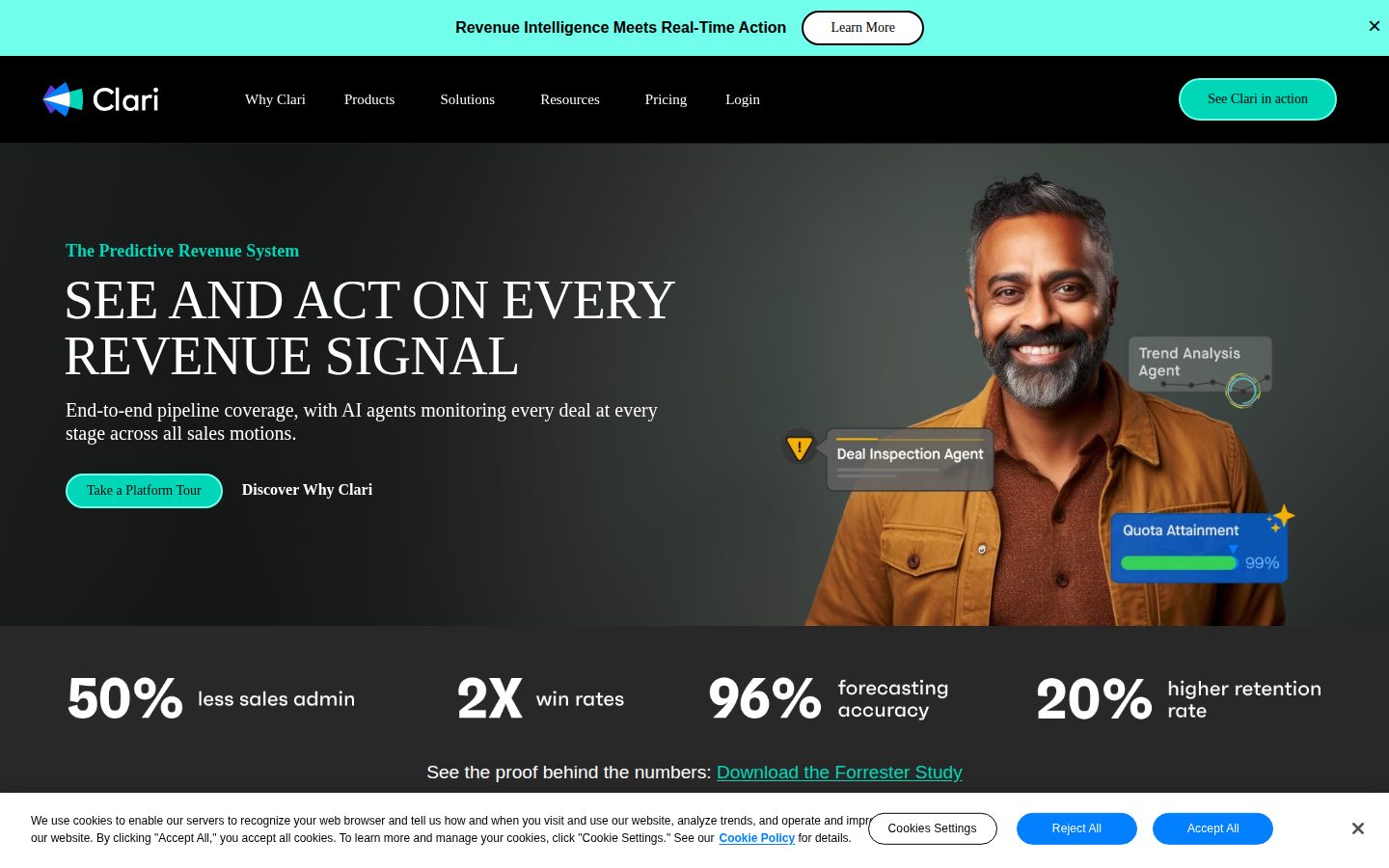
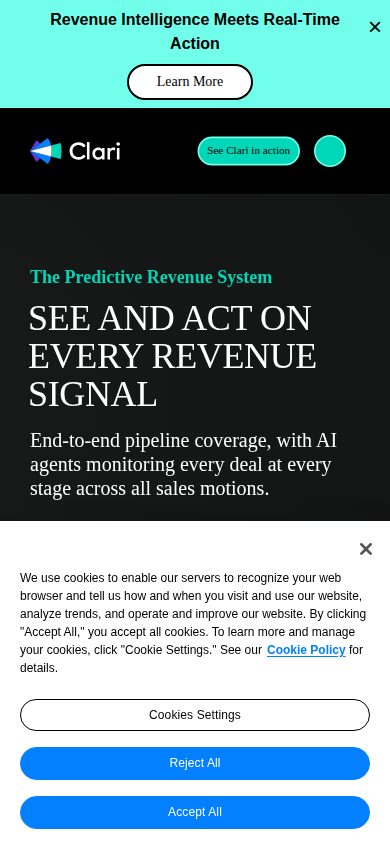
Clari Forecast desktop previewClari Forecast mobile preview

Pricing Plans

Contact Sales

Contact sales

No price is published. Clari Forecast is sold through Salesloft's enterprise motion, so access begins with a sales conversation and the forecasting module's standalone cost is not disclosed.

  • Quote-only — no public price
  • AI Forecast Agent
  • Forecasts cut by bookings, renewals, region, segment, account size or time period
  • Week-over-week pipeline momentum
  • Risk identification routed into the seller workflow

AI Panel Reviews

The Decision Maker

The Decision Maker

Strategic bet, vendor viability, timing, adoption approval
7.8/10

Clari Forecast checks the number against deal stage and velocity, but the price only comes by quote.

“Clari Forecast is the forecasting product of the Salesloft platform, built on an AI Forecast Agent that reads deal history and live rep activity rather than CRM fields. Six forecast cuts and week-over-week momentum are the substance; no published price is the friction.”

A flagged deal arrives in the seller's workflow with a next step attached, not just a warning. That's the part that changes behavior. Underneath it, the AI Forecast Agent reads historical deal data and live rep activity, then validates the number against deal stage, size and velocity.

Six cuts — bookings, renewals, region, segment, account size, time period — turn one roll-up into a number each leader owns. Pipeline momentum tracks week over week, so a slipping quarter shows mid-quarter rather than at close. Neither is the CRM forecast field with AI painted on it.

But the scope narrowed: forecasting is what carries the Clari name, while revenue intelligence, deal management and conversation intelligence now sit under Salesloft branding. You're buying a module, not a revenue platform — and there's no published price, enterprise quote only. Make them line-item Forecast before you sign the platform.

Competitive Positioning8.0

Cutting the forecast six ways and routing flagged deals into the seller workflow with a next step is more than the roll-up field the obvious alternative offers.

Reputation Risk6.8

No published price, no stated cancellation or data-portability terms, and forecasting delivered inside a larger platform is real entanglement to explain in 18 months.

Speed to Value7.2

Once CRM data is connected the weekly momentum view pays back fast, but there's no trial or self-serve path, so the clock starts with a sales conversation.

Strategic Fit8.2

Validating the forecast against deal stage, size and velocity advances forecast credibility rather than cutting the cost of reporting you already do.

Vendor Viability7.5

The forecasting page is current and names concrete agent capabilities, and the vendor states integration is ongoing, but I couldn't find a changelog or developer docs for Forecast itself.

Pros

  • The AI Forecast Agent validates the forecast against deal stage, size and velocity instead of accepting what reps type into a CRM field.
  • Forecasts cut six ways — bookings, renewals, region, segment, account size and time period — so each leader owns a number, not a roll-up.
  • Pipeline momentum tracked week over week surfaces a slipping quarter before it closes.
  • Risk identification routes flagged deals into the seller workflow with a next step attached.

Cons

  • Forecast gets quoted inside a Salesloft platform deal, so you have to force a line item to see its cost.
  • Forecasting is the scope here — revenue intelligence, deal management and conversation intelligence sit under Salesloft branding.
  • I couldn't find a changelog or developer documentation for the forecasting product.
  • No free trial and no self-serve path means every evaluation starts with a sales conversation.

Right for

Enterprise revenue leaders who need a forecast they can defend line by line.

Avoid if

Sales teams who need a published price before a vendor call.

The Domain Strategist

The Domain Strategist

Craft and strategy in the product's domain — adapts identity per category, same lens
8.0/10

The forecast now ends in a seller's next step, which is the argument for the narrower product.

“Clari Forecast is scoped to the forecast itself, with an AI Forecast Agent validating the number against deal stage, size and velocity rather than CRM entries. Flagged deals route into the seller workflow with a next step, but the depth of that handoff depends on integration the vendor still calls ongoing.”

Most forecast calls are a roll-up of what sellers typed into a CRM field. The AI Forecast Agent reads historical deal data next to live rep activity, then checks the number against deal stage, size and velocity. The number is the product, not a report off the side of one.

Forecasts cut six ways — bookings, renewals, region, segment, account size, time period — with pipeline momentum tracked week over week, so a slipping quarter gets localised before close, not explained after it. Risk identification is the strategic piece: a flagged deal routes into the seller workflow with a next step, so the forecast ends in an action, not a slide.

That routing is why the forecast sits inside a sales-engagement platform. But the vendor calls product integration ongoing, so how deep the loop runs is a roadmap item, and with no published price procurement negotiates without a benchmark.

Category Positioning7.5

It sits as the forecasting layer of a sales-engagement platform rather than a standalone revenue suite, a narrower box with a tighter act-on-it story.

Domain Fit8.5

Segment cuts, week-over-week momentum and the deals behind a projected miss match how a revenue leader actually runs a forecast call.

Integration Surface7.8

Risk identification hands flagged deals straight to the seller workflow, though I could not find public API or developer documentation for the forecasting product on its own.

Long-term Implications7.2

Adopting the forecast means adopting the platform it is delivered inside, and the vendor describes that integration as ongoing.

Strategic Depth8.3

Validating the number against deal stage, size and velocity, then cutting it six ways, is real forecasting craft rather than a CRM roll-up.

Pros

  • The AI Forecast Agent checks the number against deal stage, size and velocity instead of accepting what a rep typed into the CRM.
  • The forecast sits inside the sales-engagement platform, so the number and the follow-up share one system.
  • Pipeline momentum is tracked week over week, which surfaces a slipping quarter before close rather than after it.
  • At-risk deals route into the seller workflow carrying a next step, so a flag produces an action rather than a warning.
  • Individual and team forecasts sit in one dashboard, so the roll-up and the rep-level view reconcile in the same place.

Cons

  • No published accuracy figure for the agent's validation, so it has to earn trust over a quarter.
  • It is sold and delivered as part of the Salesloft platform, so you are taking on a platform relationship rather than a point tool.
  • The vendor calls product integration ongoing, so how deeply forecasting couples to the seller workflow is still developing.
  • I could not find public documentation or an API reference for the forecasting product by itself.

Right for

Enterprise revenue leaders who need a forecast that survives a board question.

Avoid if

Buyers who need a published price before they will start an evaluation.

The Finance Lead

The Finance Lead

Money, total cost of ownership, contracts, procurement math
6.5/10

With zero published prices, the first number on Clari Forecast arrives after a 15-minute sales call.

“Clari Forecast publishes no price: one tier labelled Contact Sales, no trial, and a 15-minute sales call to start. The December 2025 merger changed what is being priced, because the quote now covers the Salesloft platform rather than a standalone forecasting tool.”

The first number arrives after a 15-minute call. One tier, Contact Sales, no figure attached, and no trial to price against — I couldn't find a published rate anywhere. Fifty revenue seats, three annual invoices, nothing to multiply. Quote-only is category norm; the benchmark is yours to source.

The December 2025 merger left Clari Forecast with its name and moved the rest of the line to Salesloft branding. So a quote now covers a platform, not a forecasting module. However, I couldn't find renewal terms, term length, or what an existing agreement does mid-integration. The vendor says integration is ongoing.

ROI is the one number you can build yourself. The AI Forecast Agent validates against deal stage, size and velocity, not a CRM field. Six cuts: bookings, renewals, region, segment, account size, period. Score it on forecast-versus-actual over one quarter.

Billing & Procurement6.5

Buying runs through Salesloft's enterprise motion, which adds a sales cycle but leaves a single platform contract.

Contract Flexibility6.3

I couldn't find renewal or cancellation terms, though a quote-only enterprise motion leaves negotiation room.

Pricing Transparency4.0

One tier labelled Contact Sales, no figure attached, and no trial to price against.

ROI Clarity8.0

Forecast against actual close is measurable in one quarter, with no vendor study needed.

Total Cost of Ownership4.5

With no published seat rate, floor or overage, a three-year model has nothing to multiply.

Pros

  • The AI Forecast Agent validates the number against deal stage, size and velocity instead of a CRM field.
  • Forecasts cut six ways — bookings, renewals, region, segment, account size and time period.
  • Pipeline coverage and opportunity scoring are included, so coverage ratios need no second tool.
  • One tier carries the whole feature set, so no premium edition gates the risk routing.
  • Value is measurable in-house: compare the forecast to actual close for one quarter.

Cons

  • No price is published, so procurement negotiates without a benchmark.
  • No trial and no self-serve path — the first look needs a sales call.
  • I couldn't find renewal, term-length or cancellation terms.
  • The quote covers the Salesloft platform, so the forecasting module isn't priced on its own.

Right for

Enterprise revenue teams who can run a sales-led procurement cycle.

Avoid if

Buyers who need a modellable price before the first call.

The Domain Practitioner

The Domain Practitioner

Daily hands-on reality in the product's domain — adapts identity per category, same lens
8.2/10

The forecast is checked against deal stage, size and velocity — not against whatever the rep typed.

“The AI Forecast Agent validates the number against deal stage, size and velocity, and a flagged deal reaches the rep with a next step attached. Accuracy depends on live rep activity actually flowing in, and no price is published.”

A commit in a CRM field is a rep's opinion with a date on it. The AI Forecast Agent won't take it at face value — it checks deal stage, size and velocity against historical deals and live rep activity, then shows where the two disagree.

The dashboard carries the columns a manager defends: Quota, Commit, Commit Coverage, Best Case, gap-to-go. Pipeline momentum runs week over week, so a slipping quarter shows in week two. Forecasts cut six ways — bookings, renewals, region, segment, account size, time period. A flagged deal reaches the seller workflow with a next best action attached; category norm stops at the warning.

The catch is upstream. Validation is only worth what the rep activity feeding it is worth — if call and email capture isn't wired across the team, you're grading CRM fields again. No published price either, so the first number comes from a sales conversation.

Day-3 Reality8.3

Quota, Commit, Commit Coverage, Best Case and gap-to-go are the columns a forecast call actually runs on, and they sit on one dashboard with individual and team numbers.

Documentation Practitioner-Fit7.0

I could not find practitioner docs or release notes for the forecasting product on its own, so this dimension stays neutral.

Friction Surface7.6

Week-over-week pipeline momentum removes the manual roll-up chase, but the forecast is only as honest as the rep call and email capture feeding it.

Power-User Depth8.2

Forecasts cut by bookings, renewals, region, segment, account size or time period give a segment lead their own number instead of a single roll-up.

Workflow Integration8.5

Risk identification routes a flagged deal into the seller workflow with a next best action, so the warning lands where the work already happens.

Pros

  • The forecast is AI-validated against deal stage, size and velocity rather than taken from a CRM field a seller filled in.
  • Risk identification hands a flagged deal to the rep with a next best action attached, not just a flag.
  • Pipeline momentum is tracked week over week, so a slipping quarter is visible mid-quarter instead of at close.
  • Six forecast cuts — bookings, renewals, region, segment, account size, time period — let each segment read its own number.
  • Individual and team forecasts share one dashboard alongside Commit Coverage and gap-to-go.

Cons

  • The AI validation is worth only what the live rep activity flowing into it is worth.
  • No published price, so the first real number comes out of a sales conversation.
  • I could not find practitioner documentation or release notes for the forecasting product specifically.
  • Integration with the wider Salesloft platform is ongoing, so expect the surfaces around the forecast to keep moving.

Right for

Sales managers who run a weekly forecast call they have to defend.

Avoid if

Teams who have no rep activity data flowing into the platform.

The Power User

The Power User

Daily human experience, onboarding, polish, learning curve, reliability
8.0/10

Risk flags arrive with a next step attached, which makes this a dashboard you work in.

“The AI Forecast Agent validates the number against deal stage, size and velocity, and a flagged deal routes into the seller workflow with a next step. Six ways to re-cut the forecast is real power and real argument, and there's no published price to check before the sales call.”

A flagged deal here doesn't just glow red and wait. Risk identification pushes a next best action into the seller workflow, and the task gets cut from the same screen. That's a dashboard you work in, not one you read on Monday.

The AI Forecast Agent reads historical deal data next to live rep activity, so the number doesn't rest on whatever a rep typed into a CRM field. Five fields carry quarter and month — Quota, Commit, Commit Coverage, Best Case, Pipeline. Then six ways to re-cut the whole thing: bookings, renewals, region, segment, account size, time period.

But six cuts is six habits nobody agrees on, and by month three the Tuesday call argues about which slice is the real one. No price is published, and I couldn't find a way in that skips the sales conversation. You meet the dashboard after you've signed for it.

Daily Polish8.3

Rep-level gap-to-go, commit trend charts and a task you can create straight from the forecast are the details a manager touches every day.

Learning Curve7.8

One dashboard holds individual and team forecasts on day one, and the six custom dimensions are the part that takes a quarter to settle.

Mobile Parity7.0

Delivery is web and I couldn't find a mobile app, so there's nothing concrete to judge field use on.

Onboarding Experience6.8

No published price and no self-serve path I could find, so the first ten minutes is a sales call rather than the product.

Reliability Feel7.2

I couldn't find anything concrete on load behaviour, error states or uptime commitments, so this one stays neutral.

Pros

  • Risk identification routes a flagged deal into the seller workflow with a next step, so the warning comes with somewhere to go.
  • One dashboard carries both individual and team forecasts, so a manager isn't reconciling two views.
  • The forecast re-cuts by bookings, renewals, region, segment, account size or time period instead of collapsing to one roll-up number.
  • Week-over-week pipeline momentum makes a slipping quarter visible before it closes.
  • Five fields carry quarter and month: Quota, Commit, Commit Coverage, Best Case, Pipeline.

Cons

  • No price is published, so you negotiate without a public benchmark.
  • I couldn't find a self-serve path, which means the first look at the dashboard comes after a sales conversation.
  • Six forecast dimensions means six opinions about which cut is the real one, and a team has to settle that habit itself.
  • I couldn't find a mobile app, so a manager checking the number away from a desk is in a browser.

Right for

Revenue teams who need a forecast that pushes work back to sellers.

Avoid if

Sales managers who want to try the dashboard before talking to procurement.

The Skeptic

The Skeptic

Contrarian. Watch-outs, deal-breakers, broken promises, category patterns
7.0/10

clari.com now redirects to a company homepage, and the 4.5/5 G2 rating belongs to the platform.

“The forecasting work itself is specific: an agent that validates the number against deal stage, size and velocity, and six ways to cut it. What sits around it is thinner — no published price, one quote-only tier, and a G2 figure that is the whole platform's rather than this module's.”

clari.com/pricing now redirects to a form called see-it-live. The root lands on the Salesloft homepage. The module kept the Clari name through the December 2025 merger; its own site didn't.

The product underneath is concrete. The AI Forecast Agent validates the number against deal stage, size and velocity, not a CRM field a rep filled in, and the forecast cuts six ways — bookings, renewals, region, segment, account size, period. But one tier, Contact Sales. And it's now a module inside a platform. You negotiate the platform. What this piece costs alone, nobody can say.

The 4.5/5 and 4,200+ G2 reviews sit under the Clari Forecast name. That's the platform's rating — the badge beside it reads Enterprise Sales Engagement Leader. An AI-validated forecast leans on rep activity arriving clean, and I couldn't find what happens when it doesn't.

Competitive Differentiation7.0

Six forecast dimensions plus risk routed into the seller workflow with a next step is more than a roll-up figure, though the module is now one tile in a broader platform.

Exit Portability5.5

A quote-only enterprise contract on a module that reads CRM records and rep activity, and I couldn't find an export path or API reference for the forecast data.

Long-term Viability7.0

The vendor states the consolidation is not a product discontinuation and that integration is ongoing, and Clari Forecast keeps its own product login; I couldn't find a changelog or public docs.

Marketing Honesty6.0

The forecasting page calls this the market's most complete and most accurate forecast, and prints a platform-wide G2 rating directly under the Clari Forecast name.

Track Record Match7.0

Named capabilities are specific and the validation criteria are stated, but no accuracy figure or stated limit sits behind the AI-validated claim.

Pros

  • The AI Forecast Agent validates the number against deal stage, size and velocity rather than accepting what a rep entered in the CRM.
  • Forecasts cut six ways — bookings, renewals, region, segment, account size and time period — instead of one roll-up figure.
  • Risk identification routes a flagged deal into the seller workflow with a next step attached, not only a warning.
  • Pipeline momentum is tracked week over week, so a slipping number shows before the quarter closes rather than after.
  • The vendor states plainly that the December 2025 consolidation is not a product discontinuation, and Clari Forecast still has its own login on the platform.

Cons

  • No published price and a single quote-only tier, so procurement negotiates without a public benchmark.
  • clari.com now redirects to the Salesloft homepage and its pricing URL lands on a demo form, so the product's own starting point is gone.
  • The 4.5/5 and 4,200+ G2 reviews shown beside the Clari Forecast name are the platform's rating, not this module's.
  • The forecast depends on rep activity flowing in correctly, and I couldn't find what it does when that data is thin.

Right for

Enterprise revenue teams who already run on the Salesloft platform.

Avoid if

Buyers who need a published price before a sales call.

Buyer Questions

Common questions answered by our AI research team

general

Is Clari still a separate product?

Clari and Salesloft merged in December 2025. Clari Forecast retains the Clari name and is sold as part of the Salesloft platform; the broader revenue intelligence, deal management and conversation intelligence capabilities continue under Salesloft branding.

Features

What does the AI Forecast Agent actually do?

It analyses historical deal data together with live rep activity, then validates the forecast against deal stage, size and velocity. The intent is a number that does not rest on what sellers typed into a CRM field.

Features

Can Clari Forecast break the forecast down by segment?

Yes. Forecasts can be cut by bookings, renewals, region, segment, account size or time period, rather than presenting a single roll-up figure.

Pricing

How much does Clari Forecast cost?

No price is published. It is sold through Salesloft's enterprise motion, so access begins with a sales conversation and procurement negotiates without a public benchmark.

Features

Does Clari Forecast flag deals at risk?

Yes. Risk identification surfaces the deals behind a projected miss and routes them into the seller workflow, so a flagged opportunity arrives with a next step rather than only a warning.

Alternatives to Clari Forecast

Who Clari Forecast competes with, and how each one differs

Gong logo
Gong7.5/10

Gong built its conversation-intelligence engine natively rather than through acquisition (Clari's came via the 2022 Wingman deal) and competes directly with Clari for the same revenue-intelligence and forecasting budget.

Outreach logo
Outreach7.7/10

Outreach is sales-engagement-first (sequencing, dialer) and has pushed into forecasting and deal intelligence, overlapping with the sales-engagement ground Clari entered via its 2023 acquisition of Groove.

A
Aviso

Aviso markets itself explicitly as an AI-native alternative to Clari, emphasizing a proprietary time-series forecasting engine and natively-built conversation intelligence rather than Clari's acquired stack.

T
Terret (formerly BoostUp.ai)

Terret, rebranded from BoostUp.ai in September 2025, is a forecasting-first revenue intelligence platform aimed at the same enterprise RevOps buyer as Clari, competing on multi-dimensional forecast modeling and AI revenue agents.

Also in AI Sales Tools