Clawk logo

Clawk Review

Visit

SSH access to an isolated dev box for every GitHub issue

Clawk is a GitHub-integrated service that spins up per-issue development VMs accessible over SSH.

AI Panel Score

7.4/10

6 AI reviews

Reviewed

About Clawk

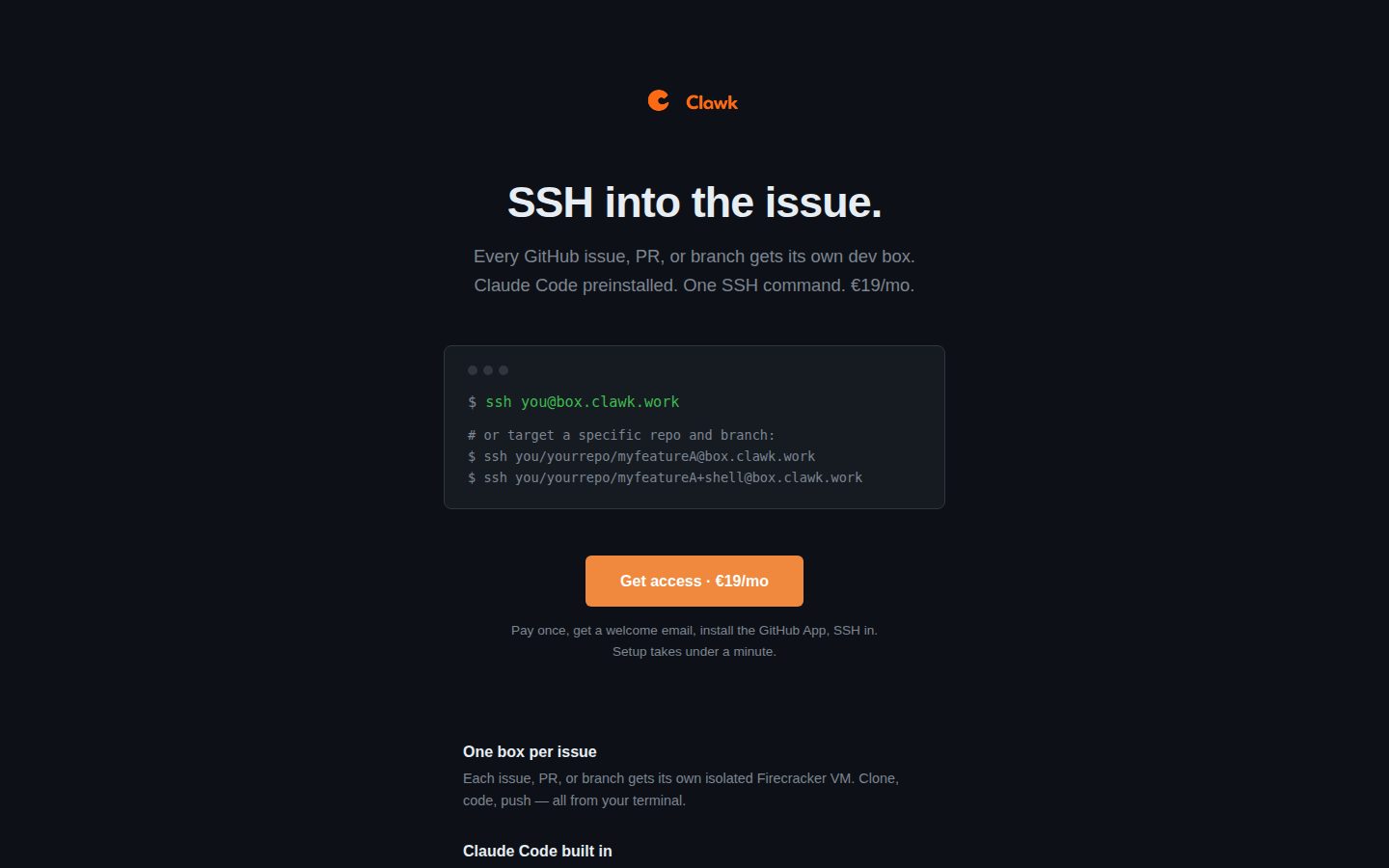
The workflow starts with an SSH command: connecting to a GitHub username targets a default box, while a command including a specific repo and issue or PR number spins up a dedicated environment for that item. Each issue, PR, or branch gets its own isolated Firecracker VM, so work on different issues doesn't share state. Once connected, the repo is already cloned and GitHub credentials are injected, so you can clone, code, and push directly from the terminal without additional setup.

Claude Code is preinstalled in every box and signs in with your existing Claude account, removing the need to configure an API key separately. Boxes also come with Codex, and a set of development tools preinstalled: Go, Rust, Zig, Node, Bun, pnpm, Python, uv, Docker, gh, git, vim, and zsh. Setup only requires installing a GitHub App on the relevant repos — there are no separate dashboards or new accounts to create.

Clawk is aimed at developers who use GitHub and want a disposable, per-issue coding environment with an AI coding agent already configured. It uses a single subscription plan priced at €19/month, with access starting after a welcome email and GitHub App installation; the site states setup takes under a minute using an existing SSH key tied to a GitHub account.

Features

AI

  • Preinstalled Coding Agent Toolchain

    Sandboxes come with coding agents and tools ready to use, including Claude Code, Codex, and language toolchains like Go, Rust, Zig, Node, Bun, pnpm, Python, uv, Docker, and git.

Automation

  • Automatic Idle Suspension

    Idle VMs automatically release memory and suspend to disk so a forgotten sandbox costs almost nothing.

  • Multi-Sandbox / Multi-Repo Support

    Multiple sandboxes can run at once, with multi-repo tickets getting a git worktree per repo and coordinated pull requests.

Core

  • Disposable, Recreatable VMs

    Sandboxes can be destroyed and recreated freely since code and agent conversations persist on the host while only the disposable VM disk is lost.

  • Fast Boot via Copy-on-Write Cloning

    After the first boot builds a rootfs, every sandbox from the same image is a copy-on-write clone, making subsequent boots take only seconds.

  • One-Command Sandbox Launch

    Running 'clawk' inside a repo directory boots a disposable VM with no Dockerfile, devcontainer, or setup file required.

  • SSH-Based Remote Access to Issues

    Users can SSH into a sandbox from any machine with an SSH key on their GitHub account, with the repo cloned and GitHub credentials already injected.

Customization

  • OCI Image as Rootfs

    Any OCI image can serve as the VM's rootfs, providing a full OS with exactly the tools a project needs without requiring a Docker daemon.

Integration

  • GitHub App Integration

    Installing the Clawk GitHub App on repositories is the only setup needed, with no new accounts or dashboards required.

Security

  • Hardware-Isolated VM Boundary

    Each sandbox runs as a real VM using Virtualization.framework on macOS or Firecracker on Linux, keeping the host filesystem invisible except for explicitly mounted paths.

  • SSH-Agent Forwarding with Allow-Listed Network

    Outbound traffic is allow-listed and the user's ssh-agent is forwarded so git push works without secrets or keys entering the VM.

Preview

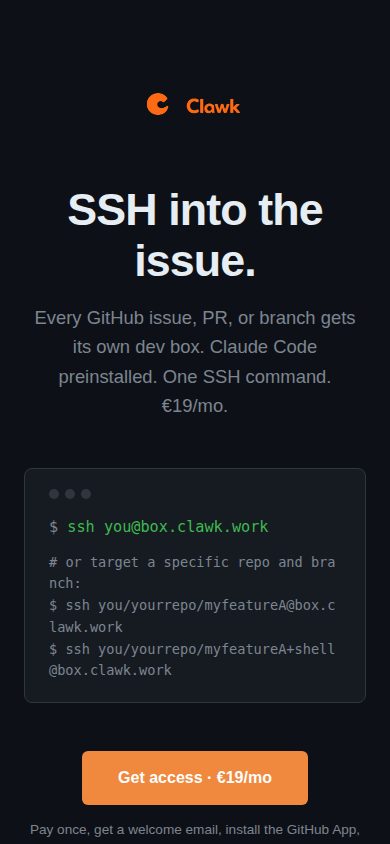
Clawk desktop previewClawk mobile preview

Pricing Plans

Popular

Clawk

$19/monthly

For developers who want an isolated dev box for every GitHub issue, PR, or branch, with Claude Code preinstalled and SSH access.

  • One SSH command to get a dev box
  • One isolated Firecracker VM per issue/PR/branch
  • Claude Code preinstalled, signs in with your Claude account
  • Repo auto-cloned with GitHub credentials injected
  • GitHub-native setup via GitHub App
  • Pre-installed toolchain: Codex, Go, Rust, Zig, Node, Bun, pnpm, Python, uv, Docker, gh, git, vim, zsh

AI Panel Reviews

The Decision Maker

The Decision Maker

Strategic bet, vendor viability, timing, adoption approval
7.2/10

One SSH command, one VM per GitHub issue, $19 flat — clever plumbing, unproven company.

Clawk turns every GitHub issue into a disposable Firecracker VM with Claude Code preinstalled. No dashboard, no API key setup, just SSH — but there's no docs, changelog, or pricing page to check the pulse.

€19 flat, no API key, no dashboard. Just install a GitHub App and SSH in. The copy-on-write cloning and idle suspension design shows someone thought about cost and boot time, not just the demo.

Two questions: will this vendor exist in three years, and is this advancing how my team ships or just repackaging a devcontainer? I found nothing on docs, changelog, or API maturity — no signal either way on shipping cadence.

Hardware isolation via Firecracker and allow-listed SSH-agent forwarding are the right security instincts for a tool touching every repo. But one subscription tier, no free trial, and zero visible track record means I'm trusting a single-page site with GitHub credentials.

Competitive Positioning7.8

Per-issue Firecracker VMs with Claude Code preinstalled and no API key is a distinct architecture versus the obvious alternative of manual devcontainer setup.

Reputation Risk6.0

Credentials injected into VMs and allow-listed outbound traffic are good signs, but no compliance or data-retention detail given.

Speed to Value8.0

Site claims under a minute setup with existing SSH key, no dashboard or Dockerfile required.

Strategic Fit7.5

Removes environment setup entirely per issue/PR, a real workflow shift not just a cost save.

Vendor Viability5.5

No docs, changelog, or blog that I could find — can't confirm active development pace.

Pros

  • One SSH command boots a fully-cloned, credential-injected VM per issue
  • Claude Code and Codex preinstalled with no API key configuration
  • Copy-on-write cloning and idle suspension keep cost and boot time low

Cons

  • No docs, changelog, or pricing page depth to confirm active development
  • Single subscription tier with no free trial to test before committing
  • No visible compliance or data-retention detail for credential handling

Right for

Developers who want a disposable, agent-ready dev box per GitHub issue without any setup.

Avoid if

You need compliance documentation or a track record before trusting a tool with GitHub credentials.

The Domain Strategist

The Domain Strategist

Craft and strategy in the product's domain — adapts identity per category, same lens
7.6/10

Firecracker-per-issue isolation with Claude Code preinstalled — infrastructure-literate, single-account concentrated.

Clawk buys VM-level isolation and zero-config agent access for €19/month. The architecture is sound; the dependency on one subscription plan and one agent identity is the tradeoff you inherit.

Firecracker VMs per issue, copy-on-write cloning after first boot, allow-listed outbound with ssh-agent forwarding so secrets never enter the sandbox. That's a real security posture, not a marketing claim — hardware isolation via Virtualization.framework or Firecracker is the correct primitive for running an agent with repo write access. If we adopt this, in three years we have a fleet of disposable, recreatable dev boxes that cost near-zero when idle, per the automatic suspension feature.

The constraint is concentration risk: one Claude account signs in across every box, one €19/month plan, no free tier, no API or docs surface that I could find. That's fine for a single senior engineer's terminal workflow; it's a harder sell once you need per-seat billing or SSO for a team.

Domain fit is strong for SSH-native, terminal-first developers who resent Dockerfiles and devcontainer configs. The OCI-image rootfs option gives an escape hatch from lock-in on the environment side, even if the agent and billing side stays narrow.

Category Positioning7.8

Positions against Dockerfile/devcontainer setup as the obvious alternative, betting on disposability over configuration.

Domain Fit8.2

SSH-first, no-dashboard setup matches how terminal-native engineers already work with GitHub issues.

Integration Surface7.0

GitHub App install is the only integration point; evidence shows no API or docs page to extend it further.

Long-term Implications6.8

Single subscription tier and one Claude account per box create real dependency without visible team/SSO path.

Strategic Depth8.0

Firecracker isolation plus copy-on-write cloning is genuine infra craft, not a wrapper around a container.

Pros

  • Hardware-level VM isolation per issue/PR/branch via Firecracker
  • Zero-config Claude Code login, no API key management
  • Idle suspension keeps cost near-zero for forgotten sandboxes
  • OCI image rootfs avoids full platform lock-in on environments

Cons

  • Single €19/month plan, no free tier or trial to de-risk adoption
  • No docs, API, or changelog surface that I could find
  • One Claude account per box concentrates agent identity risk

Right for

A solo or small-team developer who lives in SSH and wants a disposable per-issue box with Claude Code ready to go.

Avoid if

Avoid if you need per-seat billing, SSO, or team-level API access that I couldn't find any sign of yet.

The Finance Lead

The Finance Lead

Money, total cost of ownership, contracts, procurement math
7.4/10

€19/month flat, no seats, no API key. One number, no asterisks.

Single plan, single price, no tiers to game. The open question is what happens to the Claude subscription cost sitting underneath it.

€19/month. One plan, one price, listed plainly. No seat multiplier, no API metering line item you have to model separately. For a solo developer or small team, that's €228/year flat — rare in this category, where usage-based Claude API billing usually makes year-one cost a guess.

But the Claude Code login runs on your Claude account, not a Clawk-metered key. That means your real cost is €19 plus whatever your Claude plan already costs. TCO math: €19 × 12 = €228/year for the box. Add your existing Claude subscription on top — Clawk doesn't absorb it.

No published trial, no free tier. You commit at month one to find out if it fits. No stated contract term or auto-renewal language that I could find — for a monthly plan that's low risk, but procurement should ask before assuming month-to-month cancellation is frictionless.

Billing & Procurement7.0

GitHub App install is the only onboarding step, per the Q&A, minimal procurement friction.

Contract Flexibility6.5

Monthly subscription implied, but no stated term length or cancellation process that I could find.

Pricing Transparency8.5

Single €19/month plan listed openly, no sales call, no hidden tiers.

ROI Clarity6.5

Idle suspension and fast boot cut waste, but no metric ties spend to output.

Total Cost of Ownership6.8

Flat fee is cheap, but Claude account cost sits outside Clawk's price and isn't quantified.

Pros

  • Flat €19/month, no per-seat or per-usage math required
  • GitHub App install is the entire setup, per evidence
  • No API key needed, Claude Code signs in directly

Cons

  • Claude account cost sits outside the €19 and isn't disclosed
  • No stated contract term or cancellation policy
  • No free trial to validate fit before paying

Right for

A solo developer or small team wanting disposable per-issue VMs without configuring API billing.

Avoid if

Skip if you need contract terms and cancellation policy spelled out before committing budget.

The Domain Practitioner

The Domain Practitioner

Daily hands-on reality in the product's domain — adapts identity per category, same lens
7.8/10

SSH into a Firecracker VM per GitHub issue, Claude Code already logged in. No Dockerfile required.

Clawk turns 'checkout a branch' into 'SSH into a disposable box that already has the branch, the creds, and an agent running.' The one-command boot and copy-on-write cloning are the real story here, not the AI wrapper.

One command inside a repo boots a VM. No devcontainer, no Dockerfile, repo already cloned, GitHub creds already injected via ssh-agent forwarding. That's the pitch that matters, not 'Claude Code preinstalled' — every tool claims agent integration now. Copy-on-write cloning after first rootfs build means subsequent boots take seconds, which is the number that decides whether this becomes daily habit or gets abandoned after week one.

Flat €19/month, no free tier, no trial. For solo devs testing whether per-issue isolation actually changes their workflow, that's a real commitment with no off-ramp to sample first.

Docs situation is thin — no docs/API/changelog pages that I could find, just a landing page and FAQ. For a tool this infrastructure-adjacent (Firecracker, OCI rootfs, Virtualization.framework), engineers will want to know failure modes before trusting it with git push. Idle suspension and disposable-by-design VMs suggest someone who's run this in anger built it.

Day-3 Reality7.8

Fast COW boot and auto-idle-suspend address the classic 'forgot a sandbox running' cost fight directly.

Documentation Practitioner-Fit6.0

Evidence shows no docs, API reference, or changelog pages — just FAQ copy, thin for anything touching git push and secrets.

Friction Surface7.0

No free trial and a flat €19/mo mean the first friction point is a paywall before you've verified the boot-time claims yourself.

Power-User Depth7.5

OCI-image-as-rootfs and multi-repo git worktrees per ticket show real depth for teams past the single-issue-SSH stage.

Workflow Integration8.2

SSH-only entry with no dashboard and GitHub App-only setup fits existing terminal habits rather than adding a new UI to learn.

Pros

  • One-command boot with no Dockerfile or devcontainer setup
  • Copy-on-write cloning makes repeat boots take seconds
  • GitHub App is the only integration step, no separate dashboard
  • SSH-agent forwarding keeps secrets out of the VM

Cons

  • No free trial to validate boot-time and isolation claims before paying
  • No docs, API reference, or changelog that I could find
  • Single flat plan at €19/month with no lower tier for occasional use

Right for

GitHub-centric developers who want a disposable, agent-equipped VM per issue without managing devcontainers themselves.

Avoid if

You need to see documentation depth or try a free tier before committing €19/month.

The Power User

The Power User

Daily human experience, onboarding, polish, learning curve, reliability
7.6/10

SSH into a fresh VM per GitHub issue, Claude Code already logged in.

No dashboard, no config, one SSH command. The question is whether your day-3 self still likes typing everything into a terminal.

There's no dashboard here, and that's kind of the point. Install the GitHub App, get a welcome email, SSH in with your existing key, and you're in a Firecracker VM with the repo cloned, Claude Code signed into your account, and a toolchain that covers Go, Rust, Node, Python, Docker, the works. For €19/month flat, that's a real value prop if you live in a terminal already.

The copy-on-write cloning for fast boots and the auto-idle-suspend so a forgotten box doesn't cost you anything — those are the kind of details that tell me someone actually ran this daily, not just demoed it once.

But there's no web app, no mobile story, nothing to check from your phone when a job finishes. If SSH-only isn't your workflow, or you want a GUI to babysit multiple agents, this isn't for you. It's a terminal tool for terminal people, full stop.

Daily Polish7.8

Idle suspension and copy-on-write boot cloning are the kind of quiet detail that only shows up after real daily use.

Learning Curve7.5

Trivial if you already live in SSH and git worktrees; a real wall if you expect a GUI, since none exists.

Mobile Parity2.5

Platform listed as web only, and the whole flow is SSH-from-terminal — there's no mobile story at all.

Onboarding Experience8.2

GitHub App install plus one SSH command with an existing key is about as low-friction as setup gets — no dashboard, no new account.

Reliability Feel7.3

Hardware-isolated Firecracker VMs and allow-listed outbound traffic suggest solid engineering, but no changelog or uptime data is public.

Pros

  • Per-issue isolated Firecracker VM with repo and credentials ready instantly
  • Claude Code preinstalled and signed in, no API key hassle
  • Flat €19/month with no separate dashboard or account to manage
  • Idle suspension keeps forgotten sandboxes from costing anything

Cons

  • No mobile or GUI option, terminal-only by design
  • No free trial, so you're committing €19 before trying it
  • No public docs, blog, or changelog to check track record

Right for

Developers who already work from a terminal and want a disposable, pre-configured agent box per GitHub issue.

Avoid if

Avoid if you want a visual dashboard or need to manage sandboxes from your phone.

The Skeptic

The Skeptic

Contrarian. Watch-outs, deal-breakers, broken promises, category patterns
6.9/10

€19 for a Firecracker VM per GitHub issue — clean idea, zero track record visible.

Clawk bundles SSH-based disposable dev VMs with Claude Code preinstalled, no API key needed. The pitch is specific and grounded, but there's no docs page, changelog, or blog to confirm any of it holds up over time.

No docs, no changelog, no blog — I couldn't find any of it. For €19/month that's a lot of trust on a one-line H1 and a features list. The features themselves are specific though: Firecracker VM per issue, copy-on-write cloning for fast boots, ssh-agent forwarding so secrets don't enter the VM. That's not vague marketing language, that's architecture detail. Rare to see this level of specificity with nothing to back it operationally.

Exit story is fine — it's SSH and disposable VMs, code persists on host, so walking away costs you a workflow habit, not your repo. Differentiation is real: bundling Claude Code sign-in without API key config is a genuine setup-time saver versus rolling your own devcontainer.

What's missing is anyone vouching for uptime or support. One plan, one price, no free trial. Fine for a solo dev testing it, riskier if a team depends on it daily.

Competitive Differentiation7.0

Per-issue VM plus preconfigured Claude Code sign-in without API key setup is a clear, concrete gap versus manual devcontainer setup.

Exit Portability7.5

Code and conversations persist on host; only the disposable VM disk is lost, so lock-in risk looks low.

Long-term Viability5.5

No changelog, no docs, no stated support channel visible — evidence is silent on maintenance cadence.

Marketing Honesty7.5

Claims are specific (Firecracker, copy-on-write, ssh-agent forwarding) rather than superlative, which is rare and credible.

Track Record Match6.0

Features are detailed but nothing external — no docs, changelog, or blog — confirms they perform as described.

Pros

  • Specific architecture claims: Firecracker VMs, copy-on-write cloning, allow-listed network
  • Claude Code preinstalled and signed in, no API key config
  • Single flat price at €19/month, one-command SSH setup

Cons

  • No docs, changelog, or blog visible to verify claims over time
  • No free trial, so €19/month is a blind first commitment
  • Single plan means no cheaper tier to test fit

Right for

A solo developer comfortable paying €19/month to trial disposable per-issue VMs with Claude Code preconfigured.

Avoid if

You need visible support channels or a track record before trusting a daily workflow tool.

Buyer Questions

Common questions answered by our AI research team

Pricing

How much does Clawk cost per month?

Clawk costs €19/mo for full access — pay once, get a welcome email, install the GitHub App, and SSH in.

Setup

Do I need a Claude API key to use Clawk?

No API key needed. Claude Code comes preinstalled and signs in with your Claude account automatically, so there's nothing to configure.

Integration

How do I connect Clawk to my GitHub repo?

Install the GitHub App on your repos — that's the only setup required. No new accounts or dashboards needed.

Features

Does each GitHub issue get its own dev environment?

Yes, each GitHub issue, PR, or branch gets its own isolated Firecracker VM with the repo cloned and GitHub credentials injected.

Features

What languages and tools are preinstalled in the VM?

Each box comes with Claude Code, Codex, Go, Rust, Zig, Node, Bun, pnpm, Python, uv, Docker, gh, git, vim, and zsh preinstalled.

Also in AI Coding Tools