Open-source MLOps and LLMOps platform for managing the full AI lifecycle
ClearML is an open-source MLOps/LLMOps platform for teams building, training, and deploying AI and machine learning models.
AI Panel Score
6 AI reviews
Reviewed
AI Editor ApprovedApproved and published by our AI Editor-in-Chief after full panel analysis.In practice, users connect ClearML to their existing Python training scripts with minimal code changes. The platform automatically captures experiment metadata, metrics, artifacts, and environment details. From a central UI or CLI, teams can queue and schedule training jobs, monitor resource usage across GPU clusters, version datasets using Hyperdatasets, and build reproducible pipelines.
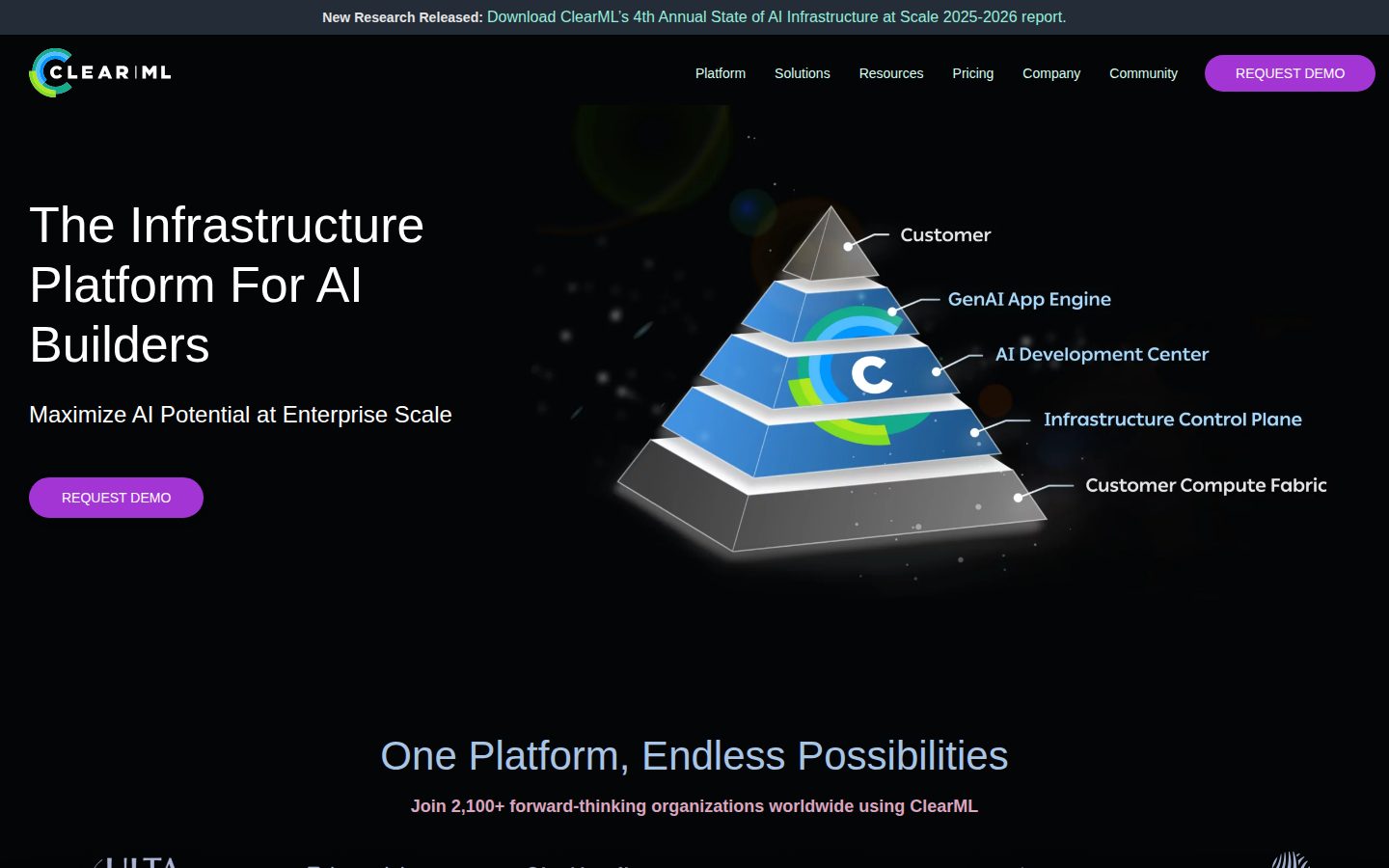
ClearML highlights several specific capabilities on its website: an AI Infrastructure Control Plane for managing GPU clusters (including GPU-as-a-Service for both cloud service providers and enterprise on-prem deployments), an AI Development Center for managing the end-to-end ML lifecycle, and an AI Application Gateway for securing production model serving. The platform integrates with AWS autoscaling, Kubernetes, ArgoCD, Google Colab, and PyTorch, among others.
ClearML targets ML engineers, data scientists, and AI platform teams at companies scaling AI workloads—documented users include Nucleai, Lensor, UVEye, and WSC Sports. The core product is open-source and self-hostable, with a managed cloud offering (ClearML Hosted) that includes a free tier. Paid enterprise plans are available. Competitors in the MLOps category include MLflow, Weights & Biases, Neptune.ai, and Kubeflow.
The platform is accessible via web UI, Python SDK, and CLI. It can be deployed self-hosted on any infrastructure or used as a fully managed SaaS. It supports integration with major cloud providers and container orchestration systems including Kubernetes.

Tracks AI/ML experiments as Tasks, capturing runs, parameters, and results to establish reproducible and scalable data science frameworks.
Automates the construction and execution of data ingestion and processing pipelines to feed AI model training workflows.
Orchestrates ML/AI training pipelines and workflows, enabling teams to schedule, run, and manage model training jobs at scale.
A complete solution for managing the full AI lifecycle including experiment tracking, orchestration, and model deployment in a single platform.
Provides centralized management and visibility over AI infrastructure resources including GPU clusters and compute environments.
Integrates with cloud service providers to provision and manage GPU resources for AI/ML training and inference workloads.
Delivers on-demand GPU compute resources for enterprise AI workloads without requiring teams to manage physical hardware directly.
Manages versioned datasets with rich metadata for efficient data pipeline management, enabling reproducible and scalable ML workflows.
Integrates with AWS autoscaling to dynamically provision and release compute resources based on workload demand.
Integrates with Kubernetes and ArgoCD to enable scalable machine learning pipeline execution on container orchestration infrastructure.
Secures production model serving endpoints, providing access control and protection for deployed GenAI and ML models.
Tracks system activity and model operations with audit trails to support enterprise compliance and governance requirements.
For teams up to 3. Best for individuals, researchers, academia, and small teams working on projects.
For teams up to 10. Best for growing AI teams that require enhanced features and more automation. Price is per user/month plus usage.
For organizations with 8-48 GPUs. VPC only. Custom quote required. Includes AI Development Center Pro features plus infrastructure control plane.
For organizations with multiple large projects. VPC or on-prem cluster. Custom quote required.
ClearML bundles what MLflow and W&B charge separately for, at $15/seat.
“Solid open-source MLOps stack with real GPU orchestration baked in. Best bet for teams tired of stitching together four point solutions.”
The $0 Community tier is genuine — experiment tracking, pipelines, artifact storage, agent orchestration. Most competitors gate that stuff. Weights & Biases doesn't. ClearML does, which is a real acquisition advantage for cost-conscious teams. The Hyperdatasets feature plus single-click LLM deployment via the GenAI App Engine puts this ahead of MLflow on raw capability.
Two things I'd flag. One: no public funding data — company size and runway are opaque, which matters for a 36-month infrastructure bet. Two: the Scale and Enterprise tiers are custom-quoted VPC deployments, so your actual cost is unknown until you're already in the sales cycle.
Pilot the Pro tier at $15/seat with your ML engineers for 90 days. If GPU orchestration and experiment tracking consolidate onto one dashboard, the ROI is obvious. Don't standardize the full org until you've seen the enterprise renewal math.
Undercuts Weights & Biases on price while matching core MLOps features; Kubernetes and AWS autoscaling integrations are table stakes, but GPU-as-a-Service isn't.
Open-source with enterprise deployment options reads as a credible, defensible choice to a technical board.
Minimal code changes to connect existing Python training scripts means engineers see experiment tracking value in days, not quarters.
AI Infrastructure Control Plane plus Hyperdatasets plus model serving in one stack genuinely advances AI platform teams, not just cuts cost.
No public funding data or headcount — open-source traction and named enterprise customers like WSC Sports help, but runway is unverifiable.
ML engineering teams scaling GPU workloads who want one platform instead of MLflow plus W&B plus a separate orchestrator.
Your AI work is exploratory and small-scale — the Community tier fits, but the platform's depth will go unused.
One integrated MLOps stack that covers GPU orchestration, experiment tracking, and model serving without stitching five tools together.
“ClearML's architecture bets on consolidation — Hyperdatasets, the AI Infrastructure Control Plane, and the AI Application Gateway in a single platform rather than best-of-breed sprawl. For a data science org that's tired of gluing MLflow to Kubernetes to W&B to a custom serving layer, this is a serious contender.”
The integrated stack is the real story here. Experiment tracking plus GPU cluster management plus model serving in one control plane isn't what Weights & Biases or Neptune.ai are offering — those tools go deep on observability but punt on infrastructure orchestration. ClearML's Control Plane covering on-prem, cloud, and hybrid GPU environments is the kind of capability that matters at year two, not day one.
The $15/month Pro tier is almost suspiciously affordable — but the Scale and Enterprise tiers where Kubernetes integration, multi-cluster orchestration, Slurm/PBS support, and RBAC actually live are custom-quoted. That's where real ML platform teams operate, so budget accordingly. Hyperdatasets with versioned metadata is library-grade thinking; most competitors treat data versioning as an afterthought.
The tradeoff is self-hosting complexity. Open-source self-hostable sounds like freedom, but managing the ClearML stack on-prem for a 20-person team is real operational overhead. If you don't have platform engineering support, the managed cloud offering is the pragmatic path.
ClearML sits between pure experiment trackers like W&B and pure orchestration platforms like Kubeflow — that full-stack positioning is differentiated and increasingly where the market is heading.
Minimal-code-change Python integration that auto-captures metrics, artifacts, and environment details maps exactly to how practitioners actually instrument training runs.
AWS autoscaling, Kubernetes, ArgoCD, PyTorch, and Google Colab integrations cover the standard ML infrastructure surface; no public API docs page noted in scraped evidence is a minor flag.
Consolidating on one vendor for orchestration plus serving plus data versioning creates leverage but also meaningful switching cost if ClearML's roadmap diverges from your needs in year three.
Hyperdatasets, GenAI App Engine, and the Infrastructure Control Plane show genuine systems thinking — someone on the team has shipped real ML infrastructure at scale.
ML platform teams at scaling AI orgs who want to consolidate infrastructure orchestration and experiment management without managing five separate vendor relationships.
You're a solo researcher or tiny team that only needs experiment tracking — MLflow or W&B free tier is far less complexity for that scope.
$15/seat Pro tier, SSO gated to Scale — know that before you sign
“ClearML's Community tier is genuinely free for teams of 3. Scale and Enterprise pricing disappear behind a sales call, which is where the real budget lands for GPU-heavy teams.”
$0 Community tier covers 3 users, 100GB storage, 1M API calls monthly. Pro is $15/seat up to 10 users — $15 × 10 × 12 = $1,800/year, plus pay-as-you-go artifact storage. Add 30% seat creep by year 3 and actual cost lands closer to $2,800 before GPU compute charges.
Scale and Enterprise require custom quotes. SSO isn't available until Scale. Category norm is SSO taxation at the Enterprise tier — ClearML gates it one level lower, which is better than Weights & Biases but still a budget surprise for security-conscious procurement teams. No published overage rate on API calls above 1M is the real opacity risk.
Self-hosted deployment can flatten the SaaS cost entirely. That's the structural tradeoff: engineering time to maintain the stack versus predictable vendor invoices. For teams with 8+ GPUs already on-prem, the Scale VPC tier may pencil out cheaper than W&B at scale, but you won't know until the quote arrives.
Community and Pro tiers are self-serve with low procurement friction; Scale and Enterprise require vendor onboarding and custom SLA negotiation, adding weeks to the process.
No public auto-renewal terms or cancellation policy visible on the pricing page; custom-quote tiers carry standard negotiation risk.
Community and Pro prices are visible; Scale and Enterprise require a sales call, hiding the cost tier where most serious GPU teams will actually land.
Experiment tracking, GPU utilization monitoring, and chargeback billing based on compute hours give measurable cost-attribution hooks — ROI math is traceable.
Self-hosting eliminates SaaS fees but adds ops labor; Pro at $15/seat is cheap entry, but pay-as-you-go storage and undisclosed GPU compute rates make year-3 TCO hard to model.
ML engineering teams managing 8+ GPUs who want a unified MLOps stack and can absorb a custom-quote procurement process.
Your security policy requires SSO and your budget is fixed — you won't know the number until you're in a sales cycle.
ClearML packs the full MLOps stack into one place — and mostly pulls it off
“Experiment tracking, GPU orchestration, Hyperdatasets, and model serving in a single integrated platform is a real value prop for teams tired of duct-taping MLflow to Kubernetes to W&B. The $15/seat Pro tier is honest pricing for what you get.”
The two-line SDK integration story is credible — `clearml.init()` in your training script and the platform starts capturing parameters, metrics, and artifacts automatically. That's day-one. Day three is about queue management, agent configuration, and whether the CLI is scriptable. The docs indicate a Python SDK plus CLI, and the changelog shows Kubernetes/ArgoCD integration. CLI shipping alongside the SDK is a good sign someone on the team actually runs jobs programmatically.
Hyperdatasets for versioned data plus the AI Development Center covering the full lifecycle is genuinely differentiated against MLflow, which stops well short of GPU orchestration. The tradeoff: Scale and Enterprise tiers require custom quotes and VPC-only deployment, so teams under 8 GPUs hit a feature cliff at the $15 Pro tier — no Kubernetes integration, no SSO, no multi-cluster support until you negotiate.
The 1M API calls/month on Community is generous for a small team. Power-user depth looks real — Slurm/PBS integration and Advanced Quota Management on Enterprise suggest someone has run actual HPC workloads, not just cloud demos.
Auto-capture of experiment metadata on script init is strong; agent and queue configuration complexity post-demo is the likely friction point based on category norms.
Docs confirmed present; Slurm/PBS and ArgoCD references in feature set suggest engineers, not marketers, wrote the integration specs.
No changelog visible from scraped evidence makes version-tracking harder; the Scale/Enterprise feature cliff at custom-quote tiers creates planning friction for growing teams.
Advanced Scheduling, Quota Management, LDAP, Slurm/PBS, and Vector Database integration on upper tiers signals genuine depth beyond experiment tracking basics.
Minimal-code-change integration with existing Python training scripts plus PyTorch, Google Colab, and AWS autoscaling support means it fits existing workflows rather than demanding rewrites.
ML engineering teams running GPU workloads who want experiment tracking, orchestration, and model serving without managing three separate vendor contracts.
Your team is under 3 engineers doing pure experimentation with no GPU orchestration needs — MLflow or W&B will cover that without the platform surface area.
A serious MLOps stack that rewards engineers willing to climb the setup hill
“ClearML packs experiment tracking, GPU orchestration, and model serving into one open-source platform without forcing you to stitch together four separate tools. The Community tier is genuinely free, but this is engineer territory from day one.”
The pitch is real: one platform instead of MLflow plus Weights & Biases plus a separate GPU scheduler. Hyperdatasets, pipeline automation, and the AI Infrastructure Control Plane are all there at $0 for teams of three or less, with 100GB artifact storage included. That's not a crippled free tier. That's a working product. The $15/seat Pro plan unlocks autoscaling across AWS, GCP, and Azure, which for a growing team is where the math actually starts making sense.
But this isn't something you hand to a data scientist on their first week and expect smiles. The docs indicate a Python SDK setup plus infrastructure decisions before you see much value. Day three, you'll know if your team has the patience. Day thirty, if you survived onboarding, the depth genuinely pays off. Mobile looks read-only at best — not a dealbreaker for this category, but don't expect field triage from your phone.
The tradeoff is setup cost versus tool consolidation. If you're already managing sprawl across three MLOps tools, ClearML is worth the friction. If you're a solo researcher, just start with the Community plan and see how far you get.
Central UI covers the core workflows but no changelog is publicly visible, which makes it hard to assess how actively small UX rough edges get addressed.
Minimal code changes to connect existing Python scripts is genuinely good, but the full feature surface — Hyperdatasets, multi-cluster orchestration, AI Application Gateway — takes real time to discover and configure.
No mobile app is listed and the platform is web-plus-CLI-first — monitoring a training run from your phone isn't something the evidence supports.
The docs-heavy setup and infrastructure decisions required before first value make the first 10 minutes feel like homework, not a welcome mat.
Documented users like WSC Sports and UVEye at scale suggest production-grade stability, and the self-hostable architecture means you control your own uptime.
ML engineering teams scaling AI workloads who want consolidated tooling and are comfortable with infra setup.
You need a no-code or low-friction setup for less technical data science users.
MLflow with GPU ambitions — real stack, real questions about staying power
“ClearML bundles experiment tracking, GPU orchestration, and model serving into one platform where most teams cobble together three. The open-source core is credible; the enterprise story is murkier.”
Three tells upfront. One: changelog capability shows 'N' — a platform shipping fast enough to matter should have a public changelog. Two: 'effortlessly' in the meta description. That word never ages well. Three: Scale and Enterprise pricing both listed as 'Free' with custom quote — classic bait-and-switch framing.
The actual feature set is more honest than the marketing. Hyperdatasets for versioning, AI Infrastructure Control Plane for GPU cluster management, and the AI Application Gateway for serving — that's a coherent stack. $15/month for the Pro tier is real pricing for real features. The Community plan at $0 with 1M API calls/month is a genuine on-ramp. MLflow doesn't touch GPU orchestration. Weights & Biases doesn't do cluster management. There's a real gap here.
Two flags: no public funding data visible, and no changelog signals slowing or accelerating pace. One watch: Kubeflow went enterprise-cold and fragmented — ClearML's hybrid GPU pitch points the same direction. If the enterprise motion stalls, the open-source core survives. That's actually the exit story worth noting.
GPU cluster management plus experiment tracking in one stack is a genuine gap — MLflow and Neptune.ai don't play in infrastructure orchestration.
Open-source and self-hostable core means teams can fork off the managed offering; Python SDK integrations stay in your codebase either way.
No public funding data visible, no changelog listed on the site — hard to calibrate how actively the platform is being maintained.
Scale and Enterprise plans labeled 'Free' when they require custom quotes; meta copy uses 'effortlessly' for GPU cluster management.
Named customers like WSC Sports and Nucleai suggest real production use, but no public funding data or changelog to confirm shipping velocity.
ML teams running GPU workloads who want experiment tracking and infrastructure management without stitching together MLflow plus Kubernetes tooling separately.
You need SLA guarantees in writing before signing — Enterprise terms aren't visible without a sales call.
Common questions answered by our AI research team
Yes, the Infrastructure Control Plane manages GPU resources across on-premise, cloud, and hybrid environments, ensuring high performance and cost efficiency.
ClearML's secure multi-tenancy provides isolated networks and storage for each tenant, eliminating the risk of data or information leakage across projects and teams.
Yes, the GenAI App Engine lets you launch any GenAI workload, including LLMs, onto compute clusters with a single click, with ClearML handling networking, authentication, and security.
Yes, the AI Development Center includes built-in CI/CD integration alongside tools for data integration, monitoring, automation, dashboards, pipelines, and a model repository.
ClearML offers granular, usage-based billing with chargebacks based on computing hours, storage consumption, and API calls.
Pricing
From $15/moFree Trial
AvailableFree Plan
Available