Modal logo

Modal Review

Visit

Run Python in the cloud — serverless GPUs, batch jobs, and AI model serving

Modal is a serverless cloud compute platform for running Python workloads, with a focus on GPU inference and AI model deployment.

Modal·Founded 2022·Usage-basedFree PlanMachine Learning PlatformsAI CloudAI DevOps

AI Panel Score

8.2/10

6 AI reviews

Reviewed

About Modal

In practice, a developer installs the Modal Python package, decorates a function with `@app.function()`, and runs it locally or deploys it remotely. Modal builds a container image, provisions the requested compute (CPU, GPU, memory), executes the function, and tears down the container when finished. Functions can be triggered on demand, via HTTP web endpoints, on a cron schedule, or from a job queue. The developer interacts primarily through Python code and the Modal CLI, with no need to write Dockerfiles or manage cloud provider accounts directly.

Modal exposes a range of specific capabilities beyond basic function execution. These include: dynamic input batching to maximize GPU throughput, memory snapshots to cut cold start times, distributed Volumes for storing model weights, cloud bucket mounts for S3-compatible storage, multi-node cluster support (beta) for distributed training, and Sandboxes for isolated code execution with networking controls. Web integration decorators support FastAPI, ASGI, WSGI, and raw HTTP servers, and streaming endpoints are supported natively. Integrations exist for Datadog, OpenTelemetry, Okta SSO, and custom SAML SSO.

Modal targets AI engineers, ML researchers, and Python developers who need on-demand GPU access without managing infrastructure. The pricing model is usage-based — users are billed only for resources consumed, with no idle costs. New accounts receive $30 per month in free credits, which functions as a permanent free tier for low-volume usage. Competitors in the serverless GPU and cloud ML compute category include Replicate, RunPod, and Banana (now defunct), as well as general-purpose serverless platforms like AWS Lambda and Google Cloud Run for non-GPU workloads.

Modal's API is Python-native, with additional JavaScript and Go SDKs noted as available. The platform supports RBAC, audit logs, service users, and workspace environments for team use. Region selection, proxy IP support (beta), and Tailscale VPN integration are available for networking and latency management. All workloads run in containers, and existing Docker/OCI images can be used as base images.

Features

AI

  • Dynamic Batching

    Enables automatic grouping of inputs into batches for high-throughput processing, with configurable concurrency and job queues.

  • Multi-Node Clusters

    Supports multi-node cluster networking for distributed training and inference workloads across multiple containers.

Automation

  • Scheduling and Cron Jobs

    Supports cron syntax and fixed-interval period scheduling to run functions automatically at specified times.

Core

  • Custom Container Images

    Allows defining custom container images or using existing ones from a registry, with fast pull support for deployment.

  • Distributed Volumes and Storage

    Provides persistent volumes, cloud bucket mounts, queues, and dicts for sharing and storing data across containers, including model weights.

  • GPU Acceleration

    Runs Python functions on GPU-accelerated containers in the cloud, with support for CUDA and configurable GPU resources.

  • Memory Snapshots

    Captures container memory state to dramatically reduce cold start times for frequently deployed functions.

  • Serverless Autoscaling

    Automatically spins up and scales containers on demand, billing only for resources actually used with no server configuration required.

  • Web Endpoints

    Exposes Python functions as HTTP web endpoints, including support for ASGI, WSGI, FastAPI, streaming endpoints, and configurable request timeouts.

Integration

  • Observability Integrations

    Connects Modal workspaces to Datadog, OpenTelemetry providers, and Slack for monitoring, tracing, and notifications, with audit log support.

Security

  • Modal Sandboxes

    Provides isolated sandboxed environments for restricted code execution, with controls for networking, file access, and Docker-in-sandbox support.

  • Role-Based Access Control (RBAC)

    Manages workspace permissions through role-based access control, with support for service users, Okta SSO, and custom SAML SSO.

Preview

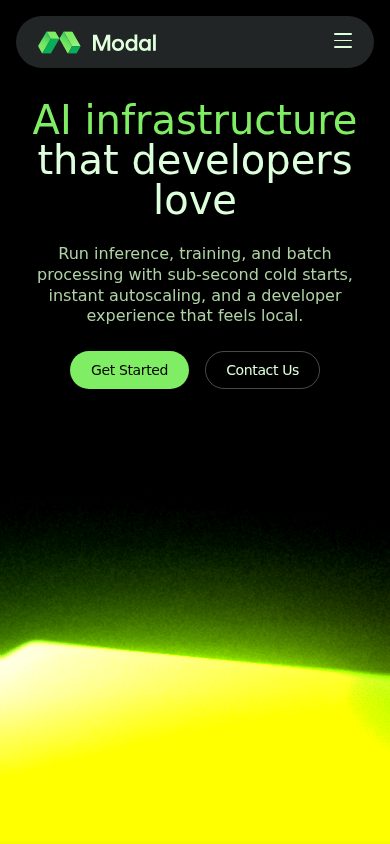
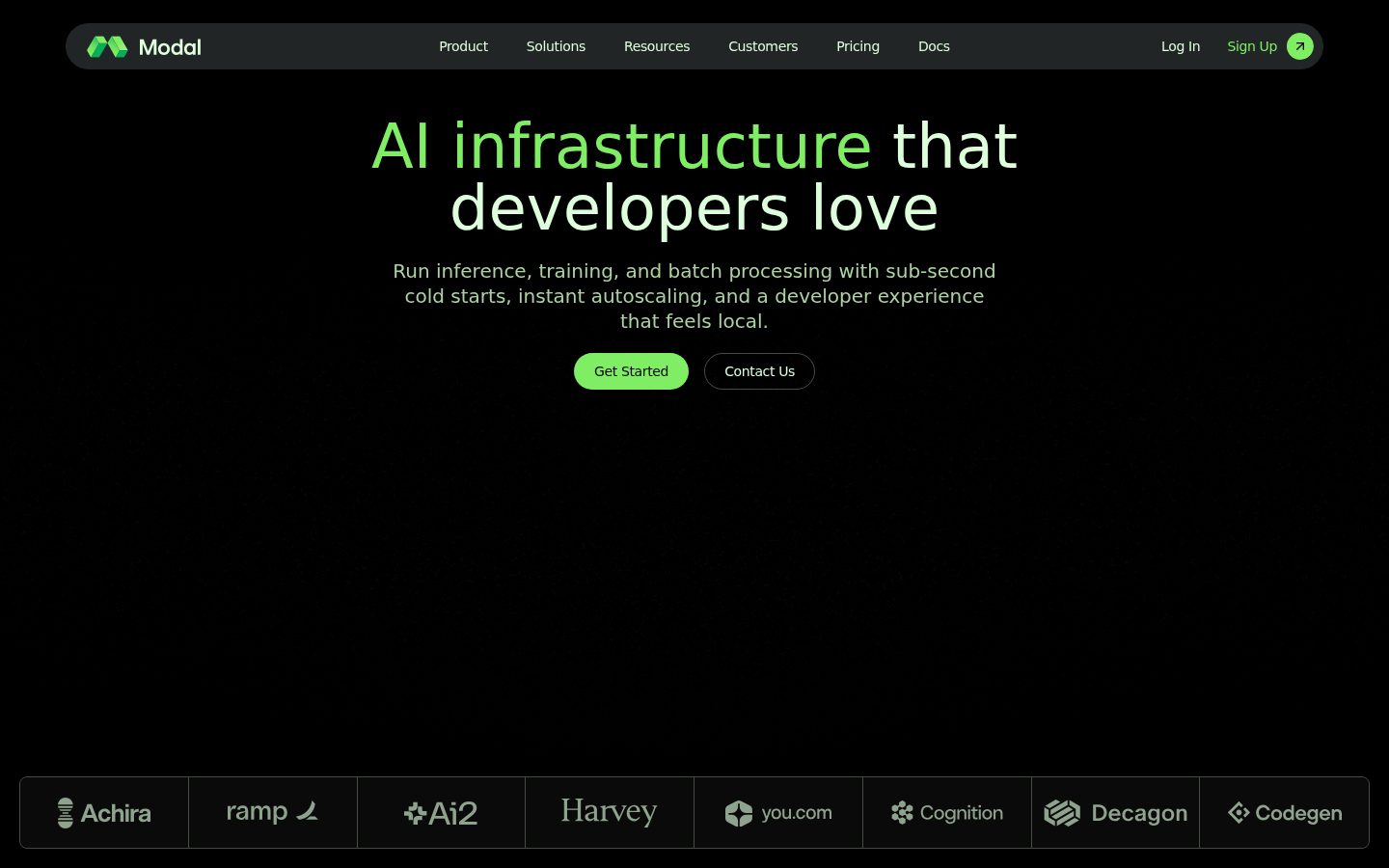
Modal desktop previewModal mobile preview

Pricing Plans

Free

Free

Get started with Modal for free with monthly credits included

  • $30/month of free credits
  • Serverless Python cloud execution
  • GPU inference support
  • Fast container spin-up on demand
  • Pay only for resources used

AI Panel Reviews

The Decision Maker

The Decision Maker

Strategic bet, vendor viability, timing, adoption approval
8.2/10

Serverless GPU compute that developers actually ship with, no YAML required.

Modal strips out the infrastructure nonsense and lets Python developers run GPU workloads in the cloud with a decorator. $30/month free tier, sub-second cold starts, and no Dockerfile required.

The pitch is simple: decorate a Python function, get GPU compute, pay only for what runs. Sub-second cold starts backed by memory snapshots, and dynamic batching for throughput-heavy inference jobs. That's not feature fluff — those are the two things that kill LLM inference economics on competitors like Replicate and RunPod.

No public funding data I can find, which is the real question here. The product is shipping — distributed volumes, multi-node clusters in beta, Datadog and OpenTelemetry integrations, HIPAA and SOC2 compliance. That's not a weekend project. Teams building this don't walk away easily.

The tradeoff: this is usage-based with no published ceiling. Batch jobs that scale hard can surprise your finance team. Pilot with one workload, watch the bill for 60 days, then decide whether to standardize.

Competitive Positioning8.0

Memory snapshots and dynamic batching differentiate it from Replicate and RunPod, where cold starts and throughput are the friction points.

Reputation Risk8.0

Well-regarded in the AI engineering community; adopting it reads as a smart technical decision, not a gamble.

Speed to Value9.0

No YAML, no Dockerfiles, $30 free credits — a developer can run a GPU workload in the same afternoon they sign up.

Strategic Fit8.5

If you're running LLM inference or model fine-tuning, Modal advances that work directly — it's not just a cost save on existing infrastructure.

Vendor Viability7.5

No public funding data, but HIPAA/SOC2 compliance, multi-node clusters, and enterprise SSO integrations suggest a serious operation — not a side project.

Pros

  • Sub-second cold starts via memory snapshots — real, documented, not marketing
  • Pure Python API, no YAML or config files, fast developer adoption
  • $30/month free tier works as a permanent low-volume tier for experimentation
  • HIPAA and SOC2 compliance ready for teams with compliance requirements

Cons

  • No public pricing ceiling — usage-based costs can spike fast on batch workloads
  • No public funding data makes 36-month viability a genuine open question
  • Multi-node cluster support is still in beta
  • Vendor lock-in risk: Modal primitives in your codebase are not portable

Right for

AI engineering teams who want GPU inference or batch jobs running in days, not sprints.

Avoid if

Your workloads are unpredictable at scale and your finance team has zero tolerance for variable compute bills.

The Domain Strategist

The Domain Strategist

Craft and strategy in the product's domain — adapts identity per category, same lens
8.4/10

Modal's Python-native primitives let ML teams skip infra entirely and ship faster.

Modal collapses the gap between experiment and production for GPU workloads by letting data scientists deploy with decorators, not DevOps tickets. It's purpose-built for the AI inference and fine-tuning loop that defines most ML team backlogs today.

Memory snapshots cutting cold starts to sub-second, dynamic input batching for throughput maximization, distributed Volumes for weight storage — that's not a feature checklist, that's someone who's actually debugged LLM serving pipelines. The architecture implies Modal was designed by practitioners who felt the pain of spinning up A100s on AWS for a 40-minute job and paying for idle time. Replicate solves a narrower slice of this; Modal's scope is meaningfully broader.

For a Head of Data Science, the domain fit is strong. No Dockerfiles, no YAML, no cloud account wiring — your researchers stay in Python, which is where they're productive. RBAC, Okta SSO, audit logs, and HIPAA compliance mean this isn't a playground tool; it can go to production and satisfy your security team.

The real strategic constraint is vendor coupling. Your inference logic, scheduling, and storage abstractions all run through Modal primitives. If pricing changes or a capability gaps opens at scale, extraction is nontrivial — you're not just migrating containers, you're refactoring orchestration. At $30/month free tier, the entry cost is zero; the exit cost deserves modeling before you're three years in.

Category Positioning8.3

Occupies a distinct lane between Replicate's model-serving focus and AWS Lambda's non-GPU genericism, with SOC2 and HIPAA compliance pushing it above RunPod for enterprise teams.

Domain Fit9.0

Python-decorator deployment with no Dockerfile or YAML requirement maps directly to how ML researchers actually work, not how DevOps teams want them to work.

Integration Surface8.0

Datadog, OpenTelemetry, S3 bucket mounts, Tailscale VPN, and SAML SSO cover the observability and networking stack most ML teams already run.

Long-term Implications7.2

Tight coupling to Modal primitives for orchestration and storage means migration costs compound over time if roadmap or pricing diverges from your needs.

Strategic Depth8.5

Memory snapshots, dynamic batching, and multi-node cluster support signal library-grade depth built for real ML workload patterns, not demos.

Pros

  • Sub-second cold starts via memory snapshots removes the biggest friction in iterative model serving
  • No YAML or Dockerfile requirement keeps ML researchers in their productive context
  • HIPAA and SOC2 compliance plus RBAC makes production and legal sign-off realistic
  • Usage-based pricing with $30/month permanent free tier lets teams prototype at zero cost

Cons

  • Vendor coupling through Modal primitives creates non-trivial extraction costs if you need to migrate
  • Multi-node cluster support is still in beta, limiting large-scale distributed training reliability
  • No changelog publicly surfaced makes it harder to track roadmap maturity over time

Right for

ML teams that need on-demand GPU inference and batch workloads without a dedicated MLOps engineer.

Avoid if

Your organization requires fully portable, cloud-agnostic orchestration with no proprietary runtime dependencies.

The Finance Lead

The Finance Lead

Money, total cost of ownership, contracts, procurement math
8.2/10

$30/month free tier, usage-based billing, zero idle cost — the math is honest.

Modal runs GPU workloads on pure consumption billing with no seat fees and no configuration overhead. The pricing page is public; the invoice is predictable until it isn't.

$30/month in permanent free credits. No seat tax, no idle cost. GPU containers spin up on demand, tear down when finished. Sub-second cold starts via memory snapshots — that's a real TCO lever, not a marketing claim. No published per-GPU-hour rate on the pricing page, which is the one number procurement actually needs.

Year-3 math is hard to model without public GPU rates. Usage-based billing can spike. A team running LLM inference at scale could see $5K/month or $50K/month — the evidence doesn't bound it. Compare Replicate: also usage-based, also opaque on overage. RunPod publishes per-hour GPU rates. Modal doesn't. That gap matters at contract review time.

SSO via Okta and SAML is included — no SSO tax noted, rare in this category. HIPAA and SOC2 listed. RBAC and audit logs present. Procurement friction is low: no YAML, no Dockerfiles, no cloud account management. The tradeoff is cost predictability — consumption billing rewards efficiency but punishes runaway jobs.

Billing & Procurement8.5

No YAML, no cloud account setup, SSO included at no apparent add-on cost — procurement friction is genuinely low.

Contract Flexibility8.5

Usage-based with no term commitment implied — no auto-renewal hostage contract, no minimum seat floor based on available evidence.

Pricing Transparency7.0

Free tier and consumption model are public, but per-GPU-hour rates aren't visible on the pricing page — RunPod publishes these; Modal doesn't.

ROI Clarity8.0

Compute-only billing means cost-per-job is measurable; sub-second cold starts and dynamic batching are quantifiable throughput levers.

Total Cost of Ownership7.5

Zero idle cost and memory snapshots reduce TCO meaningfully, but no published overage or GPU rate caps make year-3 modeling speculative.

Pros

  • $30/month permanent free credits — real usage, not a trial clock
  • No SSO add-on tax: Okta and SAML included
  • Zero idle billing — containers tear down when finished
  • HIPAA and SOC2 listed, reducing compliance procurement steps

Cons

  • No published per-GPU-hour rate — invoice is hard to pre-model
  • Usage-based billing creates cost variance; runaway jobs have no visible cap
  • Overage policy absent from public pricing page

Right for

AI/ML teams running intermittent GPU workloads who need zero infrastructure management and predictable per-job cost tracking.

Avoid if

Your finance team requires fixed monthly commitments and published rate cards before signing any vendor.

The Domain Practitioner

The Domain Practitioner

Daily hands-on reality in the product's domain — adapts identity per category, same lens
8.6/10

Modal's Python-native GPU infra is the fastest path from local script to cloud inference

Decorator-based deployment with sub-second cold starts and no Dockerfile wrangling. Built for ML engineers who want to stay in Python and never touch a YAML file.

The `@app.function()` pattern is genuinely good. You're not context-switching to a CLI config or rewriting your inference code — you decorate it, push it, and Modal handles image builds, GPU provisioning, and teardown. Memory snapshots cutting cold starts matters for LLM serving where every warm-up second costs money. Dynamic batching with configurable concurrency is the kind of feature that shows someone on the Modal team has actually debugged throughput on a T4.

The usage-based billing with $30/month free credits is usable for low-volume experiments, but the unknown starting price on paid tiers is a red flag for production budget planning. Replicate has the same opacity. Multi-node cluster support is still in beta, so if you're running distributed training across nodes today, you're betting on a feature that isn't GA.

For solo ML engineers or small teams doing inference, fine-tuning, and batch embedding jobs, this is close to the ideal workflow. The gap is observability depth — Datadog and OpenTelemetry integrations exist, but how much per-function GPU utilization you can actually surface mid-run isn't clear from the docs.

Day-3 Reality8.4

No Dockerfiles, no YAML, decorator-first API means daily deployment stays in the editor — not in config files.

Documentation Practitioner-Fit8.5

Docs-enabled per the evidence, and the feature set specificity — configurable concurrency, Docker-in-sandbox, memory snapshots — reads like practitioner-authored content.

Friction Surface8.2

Sub-second cold starts and automatic image builds eliminate the biggest daily fights, but pricing opacity adds friction at budget-review time.

Power-User Depth8.0

Distributed Volumes, multi-node clusters, Sandboxes, and RBAC show real depth, though multi-node is still beta which caps the ceiling for serious distributed training use cases.

Workflow Integration9.0

Python-native primitives with CLI and web endpoints means the tool fits how ML engineers already write code, not a new abstraction to learn.

Pros

  • Decorator-based deployment: no Dockerfiles, no YAML, no cloud provider accounts to manage
  • Memory snapshots for cold start reduction — critical for LLM inference economics
  • Dynamic batching with configurable concurrency built in, not bolted on after the fact
  • $30/month free credits as a permanent tier, not a trial countdown

Cons

  • Paid tier pricing not publicly listed — makes production cost modeling a guessing game
  • Multi-node distributed training is still beta, not a production commitment
  • GPU utilization observability depth unclear — Datadog integration exists but per-function granularity isn't documented in the evidence

Right for

ML engineers running inference, fine-tuning, or batch embedding jobs who want to stay in Python and skip infrastructure management entirely.

Avoid if

Your team needs GA distributed training across nodes or transparent per-tier pricing before signing a production budget.

The Power User

The Power User

Daily human experience, onboarding, polish, learning curve, reliability
8.2/10

No YAML, no Dockerfiles, no nonsense — Modal earns its reputation

Modal strips away the infrastructure friction that makes GPU compute miserable for most developers. The Python-native approach is the real product here, not a gimmick.

Decorating a function with `@app.function()` and having Modal handle container builds, GPU provisioning, and teardown automatically — that's not a small thing. That's a Tuesday morning saved. The $30/month free tier isn't a trial gimmick either; it's a real permanent allowance that means you can prototype without a credit card anxiety spiral. Sub-second cold starts with memory snapshots is the kind of detail that makes the difference between a tool you reach for and one you dread.

Compared to Replicate or RunPod, Modal feels like it was built by people who actually write Python all day. No YAML config hunting. No Dockerfile archaeology. The distributed Volumes for storing model weights and native dynamic batching for GPU throughput are genuinely thoughtful — not checkbox features.

The tradeoff: this is a developer tool, full stop. Mobile is effectively decorative. And if you're not comfortable in Python and CLI environments, the learning curve isn't steep — it's vertical. Right tool, right hands.

Daily Polish8.5

Python-native primitives with no config files required suggests a team that has actually used this daily — the memory snapshots feature alone shows attention to real pain points.

Learning Curve7.5

Python-native and no-config is welcoming on day one, but multi-node clusters, sandboxes, and RBAC mean month three still has terrain to explore.

Mobile Parity3.5

Platform listed as web-only with a CLI-first developer workflow — mobile is essentially nonexistent for actual work.

Onboarding Experience8.8

Install a package, decorate a function, run it — the docs indicate no YAML or Dockerfiles needed, which is about as low-friction as serverless GPU onboarding gets.

Reliability Feel8.0

Sub-second cold starts and billing only for resources used point to solid infrastructure discipline, though no public changelog makes it harder to assess incident history.

Pros

  • No YAML or Dockerfiles — everything in Python code
  • $30/month permanent free tier, not a trial
  • Sub-second cold starts via memory snapshots
  • Dynamic batching and distributed Volumes are real GPU-focused features, not filler

Cons

  • Mobile experience is nonexistent — CLI and web only
  • No public changelog visible, harder to track reliability history
  • Enterprise pricing is opaque — no public higher tiers
  • Steep wall if you're not comfortable in Python and terminal environments

Right for

AI engineers and Python developers who want GPU compute without touching cloud infrastructure config.

Avoid if

Your team needs a visual no-code interface or expects to manage workloads from a phone.

The Skeptic

The Skeptic

Contrarian. Watch-outs, deal-breakers, broken promises, category patterns
7.8/10

Three green flags, one funding blind spot — worth watching closely

Modal's Python-native approach and sub-second cold starts fill a real gap that Replicate and RunPod don't fully own. The $30/month free tier is generous enough to validate before committing.

Three tells from the landing page. One: 'developers love' in the H1 — the kind of warm-fuzzy framing that sidesteps performance claims. Two: no changelog listed in the scraped capabilities. Three: no funding data visible anywhere public. Could be deliberate. Could be a signal.

What holds up: the feature set is legitimately specific. Memory snapshots for cold start reduction, dynamic input batching for GPU throughput, Distributed Volumes for model weights — these aren't vague promises, they're real infrastructure primitives. Banana died doing something adjacent. Modal has survived that shakeout, which means something.

The exit story is decent but not clean. Your logic lives in Python decorators tied to Modal's runtime. Porting to AWS Lambda or Cloud Run means rewriting orchestration. Not catastrophic, but not one-click either. Usage-based billing with no idle cost is honest pricing — that part checks out.

Competitive Differentiation8.1

Memory snapshots and dynamic batching are concrete differentiators vs. RunPod and Replicate, which don't offer comparable developer-native orchestration depth.

Exit Portability6.2

Workloads are decorator-wrapped Python tied to Modal primitives — migrating off means rewriting scheduling, scaling, and storage integrations.

Long-term Viability7.0

SOC2 and HIPAA compliance plus SAML SSO suggest real enterprise traction, but no public funding data and no visible changelog create uncertainty about shipping cadence.

Marketing Honesty7.5

'100x faster than Docker' is a claim that needs a benchmark citation — no public evidence provided to verify it.

Track Record Match7.8

Banana shut down in this exact category; Modal has outlasted that wave and added enterprise features like RBAC and SAML SSO, suggesting durability.

Pros

  • No YAML, no Dockerfiles — pure Python deployment is a real workflow improvement
  • $30/month free credits makes real validation possible before any commitment
  • Memory snapshots for cold start reduction is a feature Replicate doesn't match
  • HIPAA + SOC2 + SAML SSO means enterprise deals are plausible, not just dev toys

Cons

  • No public funding data visible — runway is a genuine unknown
  • No changelog in scraped evidence makes shipping cadence impossible to verify
  • Exit requires rewriting Modal-specific orchestration primitives — not a free migration
  • '100x faster than Docker' is a headline number with no public benchmark to back it

Right for

AI engineers who want GPU inference and batch jobs without touching cloud provider consoles.

Avoid if

Your team needs a clean migration path or can't tolerate vendor dependency in core orchestration logic.

Buyer Questions

Common questions answered by our AI research team

Pricing

How much free compute does Modal include monthly?

Modal includes $30 free compute per month.

Security

Does Modal support HIPAA compliance?

Yes, Modal supports HIPAA compliance, listed alongside SOC2 under security and governance.

Features

How fast are Modal container cold starts?

Modal delivers sub-second cold starts, with an AI-native runtime described as 100x faster than Docker.

Integration

Can I connect existing cloud buckets to Modal?

Yes, you can mount existing cloud buckets via first-party integrations.

Setup

Do I need YAML or config files to deploy?

No YAML or config files are needed — everything is defined in Python code.

Product Information

  • Company

    Modal
  • Founded

    2022
  • Pricing

    Usage-based
  • Free Plan

    Available

Platforms

web

About Modal

Modal is a New York-based serverless cloud platform that allows developers and data teams to run Python code, including GPU workloads, without managing infrastructure.

Resources

Documentation
Blog

Also in Machine Learning Platforms