A control layer that maps, tests and monitors AI-written code changes
Coldtea is a control layer for AI-written software that helps engineering teams understand, test and monitor code changes.
AI Panel Score
6 AI reviews
Reviewed
Facts checked against coldtea.ai
AI Editor ApprovedApproved and published by our AI Editor-in-Chief after full panel analysis.Coldtea works alongside coding agents and existing version control platforms to give engineering teams visibility into what AI-generated code changes actually affect. On GitHub, GitLab or Bitbucket, it builds and maintains a live map of the system, and updates it with each pull request so reviewers can see what a change touches and how data moves through it before reading the diff.
Beyond mapping changes, Coldtea runs agentic testing: because it understands the system map, it knows which flows a given change could break, and it automates agents to test those flows like a real user would, on both web and mobile. For web, testing runs against the live site and on pull request preview URLs so regressions surface before merge; for mobile, it spins up simulators and loads real builds. After release, Coldtea watches production monitoring providers including Sentry, Datadog, Grafana, New Relic, PostHog and Vercel for issues tied to the code a change touched, and when something breaks it reproduces the problem and opens a pull request with a fix. Coldtea also offers a desktop IDE that brings these capabilities — running coding agents, reading changes, testing and production monitoring — into one working environment.
Coldtea is aimed at engineering teams using AI coding agents who need a way to review, test and monitor the resulting code changes. It is free for open source projects, and teams can start using it for free, with a demo available for teams wanting deeper monitoring and fix-automation capabilities.
Runs AI agents that automatically test the flows a change affects, acting like a real user on web and mobile, with results posted in the pull request.
When a production issue is detected, reproduces the problem and opens a pull request with a fix.
Watches monitoring tools like Sentry, Datadog, and PostHog after release for problems in the code each change touched.
Allows critical user flows to be fully automated for release testing across both web and mobile.
Runs tests against the live preview URL on every pull request so regressions are caught before they merge.
A desktop app that brings coding agent execution, change review, testing and production monitoring together in one place.
Maintains a live map of the codebase that updates with every pull request, showing reviewers what a change touches and how data flows through it before they read the diff.
Connects with a wide range of monitoring providers including Sentry, Datadog, Grafana, New Relic, PostHog and Vercel.
Runs on GitHub, GitLab and Bitbucket to connect directly into existing code review workflows.
Spins up simulators and loads real builds to test mobile app flows the way a person would use the app.
For solo builders and side projects getting started with agentic development.
For teams shipping every day who need shared boards, assignment and review across the team.
Add-on for teams that want Coldtea to watch production signals and raise what matters most.
A live system map plus agentic testing for AI-written PRs, priced like a team tool not a toy.
“Coldtea maps how a change flows through the codebase, then tests and monitors it after merge. The $20/month Pro tier and 2,000 free monthly credits make it cheap to find out if it earns its keep.”
Two things stand out: PR Lens, the live system map that updates every pull request, and the agentic testing that knows which flows a change can break because it reads that map. That's a real architectural bet, not a wrapper around a diff viewer.
Pricing is honest. Free gets you 2,000 agentic credits a month, roughly 200 test runs. Pro is $20/month with first seat free, and the $49/month monitoring add-on watches Sentry, Datadog and PostHog, then opens a fix PR when something breaks.
The tradeoff: letting an agent both diagnose production regressions and open the fix PR is powerful, but it's also the step I'd want a human gate on before trusting it at scale. Runs on GitHub, GitLab, Bitbucket. Pilot it on one repo first.
The combination of a live data-flow map plus agentic flow testing on both web and mobile is a distinct architecture, not a feature bolt-on.
Auto-generated fix PRs for production regressions raise accountability questions I couldn't resolve from what I saw; cancellation and data terms weren't visible to me.
No credit card needed on the free tier and a 7-day self-driving trial per project let a team see value inside a week.
Directly addresses the review bottleneck teams hit once coding agents ship faster than humans can verify, not just a cheaper version of existing code review.
Docs and blog are live, features span mapping, testing and monitoring with real integration depth across six monitoring providers and three VCS platforms.
Engineering teams shipping AI-generated code daily who need visibility before and after merge.
Skip it if your team isn't yet running coding agents at a pace that outstrips manual review.
A system-map dependency you're choosing to bolt into your review pipeline for the next three years, not just a PR plugin.
“Coldtea inserts itself between your VCS and your monitoring stack as the source of truth for what code touches. That's architecturally significant — and it means you're now coupled to how well it keeps that map correct.”
PR Lens means Coldtea has to maintain an accurate dependency graph of your system continuously, across GitHub, GitLab or Bitbucket. That's a hard problem at scale — the kind that degrades quietly as a monorepo grows or a team ships a big refactor, and nobody notices until the map is wrong at the worst moment.
The integration surface is wide: six monitoring providers (Sentry, Datadog, Grafana, New Relic, PostHog, Vercel) plus three VCS platforms plus a desktop IDE. Wide surface is good for adoption, but it's also more seams where a schema change on Grafana's end or an API shift on GitHub's side can quietly break the map or the test loop.
Three-year question: does the live map become your team's actual mental model of the system, or a second source of truth that drifts from your architecture docs? If it holds up, Coldtea becomes load-bearing infrastructure you can't easily rip out. If it drifts, you've added a dependency without the payoff.
Positioned as infrastructure for AI-generated code review rather than another coding agent, a distinct lane with room to define itself.
Reviewing diffs via system impact rather than line-by-line matches how senior engineers already reason about change risk.
Three VCS platforms and six named monitoring providers (Sentry, Datadog, Grafana, New Relic, PostHog, Vercel) is a genuinely broad stack footprint.
Adopting PR Lens as your team's review source of truth creates a dependency you'll need to trust for years, with real cost if the map ever drifts from reality.
Building a live, PR-updating system map with data-flow tracing is a genuinely hard engineering problem, not a thin wrapper.
Engineering teams running multiple AI coding agents who need a shared system map to keep PR review from becoming a bottleneck.
Avoid if your team ships from a single small repo where a live dependency map adds overhead without meaningful review-time savings.
Free seat, then $20. Monitoring is a separate $49 bill. Do the math before you demo.
“Base pricing is public and cheap to start. The real cost shows up when monitoring gets added.”
Free tier: 2,000 credits, about 200 test runs, no card required. Pro: $20/month, first seat free, every teammate after pays. Team of 50 at $20 × 49 = $980/month, $11,760/year, before add-ons.
Essentials monitoring add-on is $49/month on top. That's not a line item buried in a sales call — it's listed. Credit is for showing the number, not for the structure. Stack Pro plus Essentials across 50 seats and year-one cost moves well past $12K before counting the 10,000-credit testing bump teams will likely need at scale.
No contract terms, auto-renewal windows, or term length visible anywhere I checked. Monthly billing implied, but cancellation process and invoicing details for larger teams aren't posted. ROI math is plausible — fewer regression fires, fewer broken PRs — but I found no customer-reported numbers to size it. Procurement will want that filled in before signing.
Self-serve signup with no credit card required lowers friction, but invoicing terms for larger teams aren't listed.
No auto-renewal terms, term length, or cancellation process posted that I could find.
Free, Pro at $20/month, and a $49/month add-on are all posted with inclusions, though unit basis isn't fully spelled out.
The fix-PR and monitoring loop implies measurable value but no customer outcome numbers are shown.
Base seat cost is cheap but the monitoring add-on and credit overages compound fast at team scale.
Small teams that want to start free and can absorb a second bill once monitoring becomes necessary.
Avoid if your procurement process requires published contract terms before signing.
The system map inside the PR diff is the right instinct, but notification volume is the open question.
“PR Lens puts data-flow context where I actually read code, not in a separate tab I'll forget to open. The real cost shows up in whether agentic test output and monitoring alerts stay signal or turn into noise by week two.”
What I want to know on day three: when PR Lens flags what a change touches, is that annotation terse enough to scan in ten seconds, or am I reading a paragraph on every PR? Live maps that update per-PR are only useful if they don't become another wall of text to triage alongside the diff itself.
Integration-wise, running on GitHub, GitLab and Bitbucket means it slots into review habits I already have instead of forcing a new tool tab. That's the right call. Agentic testing results landing in the pull request itself, rather than a separate CI dashboard, keeps context in one place — closer to how Linear keeps state next to the work instead of a bolted-on tracker.
My worry is credit math under real usage. 2,000 credits for roughly 200 test runs on the free tier sounds fine until a team ships multiple PRs a day across web and mobile flows. I couldn't find docs detailing what a 'flow' costs in credits, which matters more than the monthly price once you're past solo-project scale.
PR-embedded map context is the right place to put it, but alert volume at daily PR cadence is untested from what I can see.
I found docs and a blog but no clear breakdown of what counts as a credit per test run, which is the number engineers actually need.
Credit-metered testing plus a monitoring add-on means two separate consumption models to track in one week of shipping.
Critical Flow Release Automation and the desktop IDE suggest real depth, but discoverability of advanced config isn't clear from the surface.
Runs on GitHub, GitLab and Bitbucket directly, no separate dashboard habit required.
Teams already shipping multiple AI-agent PRs a day who need change context inline rather than in a side dashboard.
You need predictable monthly costs before committing, since credit consumption per test flow isn't clearly spelled out.
A tool you live inside all day, which means the small stuff matters a lot here
“Coldtea wants to sit in your PR flow and your IDE every single day, so the usual day-one versus month-three gap matters more than usual. The parts I can see look thought through, but I can't tell yet if it stays calm under real usage.”
This isn't a once-a-week tool, it's meant to live in your pull requests constantly, which raises the bar on daily feel. PR Lens updating the system map on every PR is the kind of feature that's either quietly reassuring or quietly annoying depending on how fast it renders and how often it's stale. I couldn't find detail on map load times or what happens on a huge monorepo, and that's exactly the thing that decides whether this feels solid at 4pm on a Friday deploy.
Onboarding looks low-friction on paper: free tier, no credit card, 2,000 monthly credits to start. That's a real welcome, not homework. But a desktop IDE plus a PR-level map plus production monitoring hookups across six providers is a lot to absorb in week one even if nothing demands payment up front.
Mobile testing against real builds and simulators is a genuinely different claim than most CI tools make, worth crediting. The tradeoff is you're trusting automated agents to behave like real users reliably enough to catch regressions before your team does, and that trust gets built slowly, not in a demo.
PR Lens folding map context into the diff itself is a thoughtful daily-use decision, but I couldn't find detail on render speed or behavior on large repos.
Starting on GitHub, GitLab or Bitbucket with existing workflows keeps the first hour simple, but credit-based testing and multiple integrations mean month three involves real tuning.
Spinning up simulators and loading real builds for mobile testing is a real mobile investment, not a bolted-on checkbox feature.
Free tier with no credit card and 2,000 monthly credits removes the usual sales-call friction, though the IDE plus map plus monitoring stack is a lot to learn at once.
Automated fix PRs after production issues is a bold reliability promise; I couldn't find any error-state or rollback detail to know how it behaves when it's wrong.
Engineering teams already shipping AI-generated code daily who want change context inside the PR itself.
Avoid if your team needs proven reliability data before trusting automated fix PRs in production.
A control layer that writes its own fix PRs. That's the part I'd watch.
“Coldtea bundles mapping, testing and monitoring into one subscription, which is ambitious. Ambitious is also how a lot of category entrants describe themselves right before they get acquired for the team.”
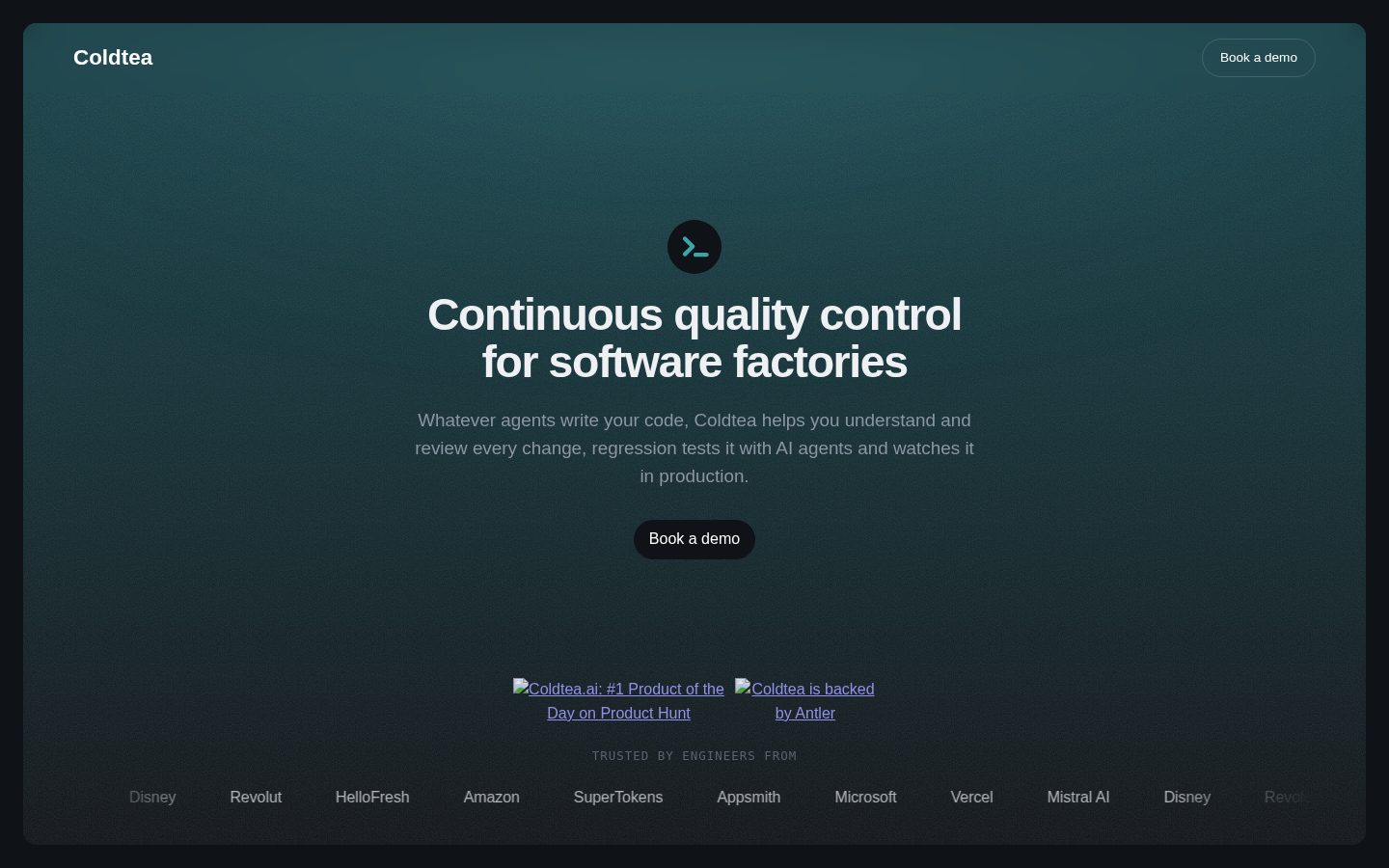
"Continuous quality control for software factories" is a big H1 for a product with three visible pricing tiers and a $20/month entry point. Not dishonest, exactly — the feature list backs most of it, PR Lens, the six monitoring integrations, mobile simulator runs. But 'software factories' is the kind of framing that assumes scale the pricing page doesn't yet show evidence of.
The automated fix-PR loop is the real differentiator here, reproducing production issues and opening a pull request against them. I haven't seen another tool promise that specific loop. Also the part I'd pressure-test hardest before trusting it near main.
Exit portability is the quiet problem. The system map and monitoring context live inside Coldtea's own view of your PRs — pull the plug and you're back to reading diffs cold, no transition layer. Fine if it stays maintained. I'd want to see a changelog before betting a release process on it.
Tying a live data-flow map and six monitoring integrations (Sentry, Datadog, Grafana, New Relic, PostHog, Vercel) into one PR view is a distinct combination, not just another CI wrapper.
The live map and monitoring context are native to Coldtea's workflow; nothing suggests an export path if you leave.
Docs and a blog exist; I couldn't find a changelog, which makes update cadence hard to judge either way.
'Software factories' and 'continuous quality control' are aspirational phrasing; the feature list mostly backs it but the tone outruns the proof.
Named capabilities like Agentic Flow Testing and Automated Regression Fix PRs are specific, but there's no visible record of them holding up at volume.
Teams running AI coding agents who want fix-automation and monitoring tied directly into pull requests.
Avoid if you need a clean exit path or proof of reliability before trusting automated fix PRs near production.
Common questions answered by our AI research team
Coldtea runs on GitHub, GitLab and Bitbucket.
Coldtea watches Sentry, Datadog and PostHog for problems in the code each change touched after release.
Because Coldtea knows your system from its live map, it knows what each change can break. AI agents then test the flows a change touches automatically, acting like a real user on web and mobile, with results landing in the pull request.
Yes, PR Lens keeps a live map of your system that updates with every pull request, showing reviewers what a change touches and how data moves through it before they read the diff.
Yes, Coldtea is free for open source projects.
Coldtea builds tools for engineering teams to review, test, and monitor AI-generated code changes before and after release.