Python-native data orchestration built around data assets
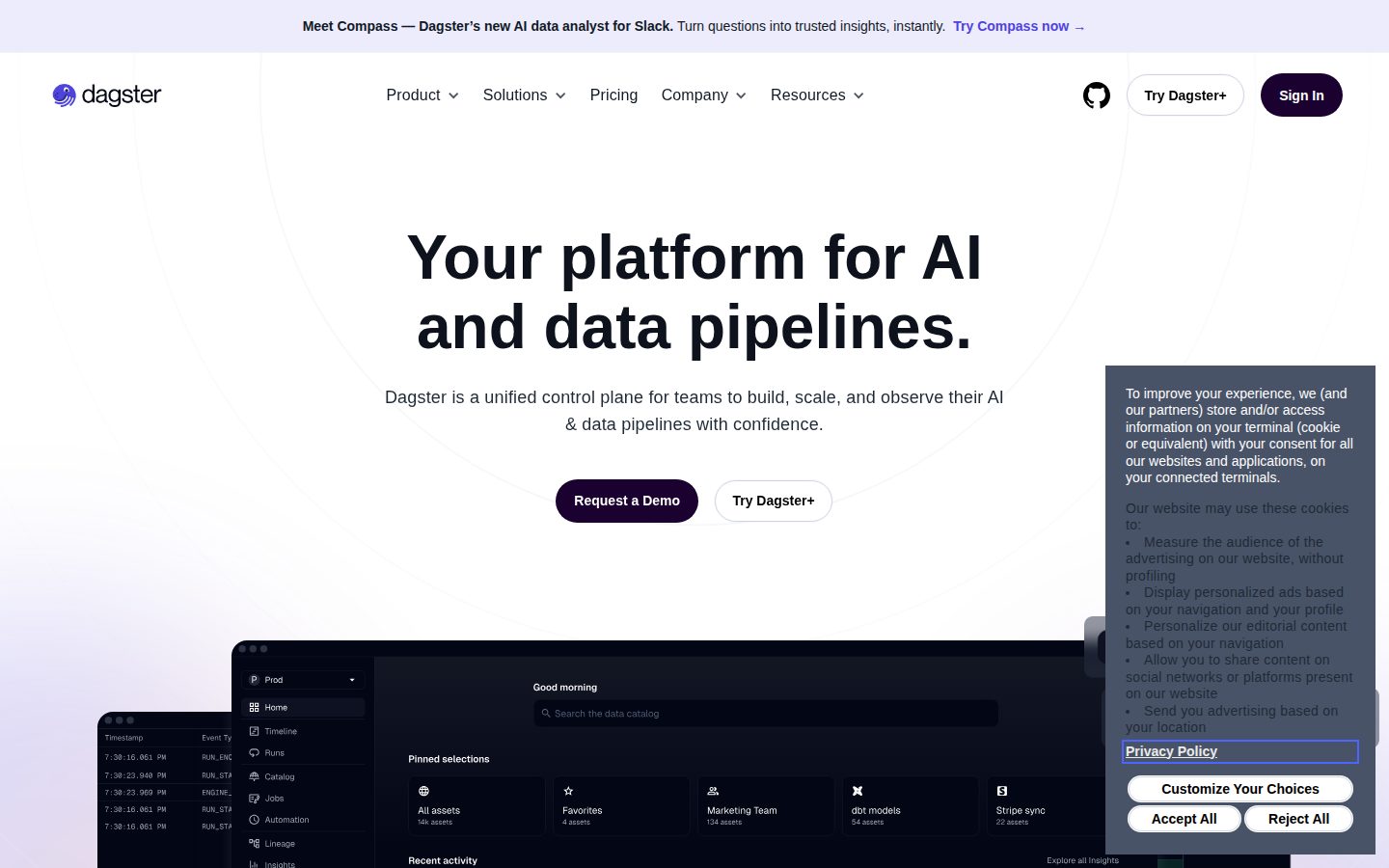
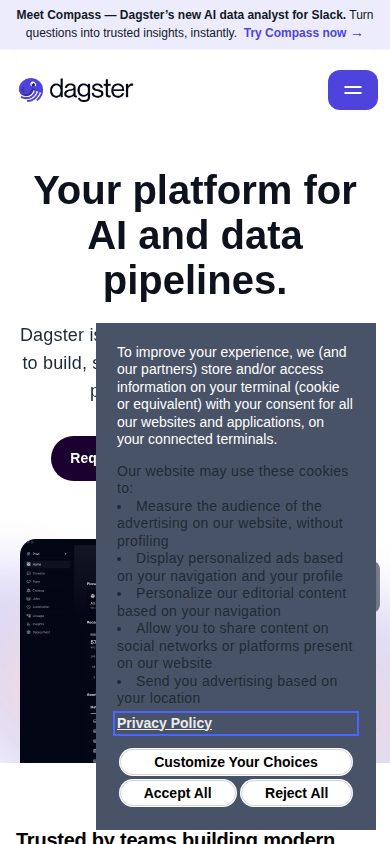
Dagster is a data orchestration platform for data engineers who build and maintain pipelines, data assets, and ML workflows.
AI Panel Score
6 AI reviews
Reviewed
AI Editor ApprovedApproved and published by our AI Editor-in-Chief after full panel analysis.In practice, users write Python functions decorated to declare data assets, then compose those assets into jobs. Dagster manages when and how those jobs run—via schedules triggered at set intervals or sensors that fire based on external events. The local development experience mirrors production, so engineers can unit-test and integration-test pipelines before deploying to staging or production clusters.
Dagster's built-in observability layer tracks data lineage, monitors data quality, and surfaces operational metadata without requiring external tooling. Partitions allow batch computations to be sliced by time or other dimensions. The platform includes a data catalog for discovering and organizing assets, cost insights for tracking compute spending, and Compass—a Slack-integrated assistant that answers data questions in plain language. Integrations exist for dbt, Snowflake, Spark, Databricks, Airflow, and AWS, among others.
Dagster targets data engineering teams across industries including finance, life sciences, retail, and software. It positions itself against task-centric orchestrators such as Apache Airflow, Prefect, and dbt Cloud. Pricing is tiered, with options ranging from local development use up to an Enterprise plan with additional security and support. A free tier is available for getting started.
Dagster is open source and hosted on GitHub. It can be deployed locally, on self-managed infrastructure, or via Dagster's managed cloud offering. The platform is Python-native and accessed primarily through a web-based UI alongside Python SDKs.
An AI-powered tool that lets users ask plain-language questions inside Slack and receive instant insights, visualizations, and data definitions governed by the data team.
Tracks workflow spending, identifies resource usage, and surfaces opportunities to cut unnecessary costs across data pipelines.
Catches data issues early, validates data in real-time, and ensures pipelines run reliably by surfacing quality problems.
Provides built-in lineage tracking, data quality monitoring, and operational metadata so users can understand data flow and pipeline health.
Allows users to define time-based schedules to run pipelines at a specific frequency and sensors to trigger pipeline runs based on external events.
Lets users define data assets—tables, ML models, reports—as Python functions and orchestrates their execution to keep those assets up-to-date.
Enables users to find, organize, and trust their data assets all in one place within Dagster's platform.
Organizes and executes batch computations over datasets sliced by time or other dimensions using partition sets.
Enables code-native pipeline authoring using Python, supporting local development, unit tests, integration tests, staging environments, and production deployments.
Configurable objects that connect pipelines to external services such as databases and APIs, enabling reusable and environment-aware pipeline definitions.
Connects Dagster with tools including dbt, Snowflake, Spark, Databricks, Airflow, and AWS to keep data workflows running across existing stacks.
Provides enterprise-grade security controls, scalable orchestration, and dedicated human support for teams running production-scale data workflows.
For individual builders shipping simple pipelines.
For growing teams running production pipelines with essential platform features.
For enterprise teams operating production-grade data platforms at scale. Contact sales for pricing.
Asset-first orchestration that makes Airflow look like it's from 2015.
“Dagster's asset-centric model is a genuine architectural step forward from task-based orchestrators. SOC 2 Type II, HIPAA, dbt and Databricks native — this isn't a science project.”
Open source, Python-native, ships with built-in lineage and a data catalog. That's three things most teams bolt together from separate vendors. At $100/month for the Starter tier, the Airflow migration conversation becomes easy math to bring to the board. The asset-first model — defining tables and ML models as Python functions, not just tasks — is the real differentiator versus Prefect and Airflow.
Two things I'd pressure-test. One: the Pro tier is contact-sales, no public number, which means pricing power shifts to them at renewal. Two: Compass, the Slack AI assistant, is clever but unproven — category norm is that AI overlays on data tools take 12-18 months to earn trust.
For teams already running dbt and Databricks together, this is the obvious control plane. The tradeoff is real though: asset-centric thinking requires engineers to reframe how they model pipelines, and that onboarding cost is non-trivial.
Peers running dbt and Databricks at scale are already evaluating this; being late to Dagster is a more defensible risk than being late to Airflow was.
Dagster is the credible Airflow alternative the data engineering community actually debates — your board won't raise an eyebrow.
Local dev mirrors production and the 30-day free trial is real, but the asset-first mental model adds ramp time versus dropping in Airflow DAGs.
Asset-centric orchestration plus built-in lineage and catalog advances data platform maturity, not just pipeline cost.
Open source with a managed cloud offering, SOC 2 Type II and HIPAA certified — these aren't checkboxes a pre-revenue startup clears.
Data engineering teams running dbt and Databricks who need a single orchestration layer with observability built in.
Your team is deep in Airflow DAGs and doesn't have the bandwidth to retrain around asset-first thinking.
Asset-first orchestration that finally makes data lineage a first-class citizen, not an afterthought.
“Dagster's asset-centric model is a genuine architectural shift from Airflow's task-graph thinking—it produces a data catalog with auto-generated lineage as a byproduct of how you write pipelines. For teams who've spent years bolting observability onto task-based DAGs, that's a meaningful change in foundation.”
The asset-first model isn't a UI preference—it's a schema choice that changes what your pipelines produce. When engineers decorate Python functions as assets rather than tasks, the platform accumulates lineage, ownership, and freshness metadata automatically. That's the kind of observability that Airflow requires three additional tools to approximate.
The integration surface is production-grade: dbt, Snowflake, Databricks, Spark, and Airflow migration paths all documented. SOC 2 Type II and HIPAA certification means regulated industries aren't blocked. The Starter tier caps at 3 users for $100/month, so mid-size teams hit the Pro tier quickly—and Pro requires a sales conversation, which is a real friction point for budget cycles.
If we adopt this, in 3 years we have a platform where the data catalog is a living artifact maintained by the pipelines themselves, not a documentation project that decays. The ceiling here is high—closer to Monte Carlo plus Airflow collapsed into one system than to any single-purpose orchestrator.
Dagster sits ahead of Airflow on observability architecture and ahead of Prefect on catalog depth, with a credible enterprise compliance story via SOC 2 Type II and HIPAA.
Python-native authoring, local-to-production parity, and unit-testable pipelines match how senior data engineers actually build and validate workflows.
Named integrations with dbt, Databricks, Snowflake, Spark, and Airflow migration support cover the dominant modern data stack without gaps.
Adopting Dagster creates a self-maintaining data catalog as a structural byproduct, but locks orchestration logic tightly into Dagster's asset decorator pattern.
Asset-centric orchestration with built-in lineage, partitioning, and Cost Insights represents genuine architectural depth—not feature accumulation.
Data engineering teams who need orchestration, lineage, and cataloging from a single platform without stitching three tools together.
Your team runs lightweight Airflow DAGs with no lineage requirements and no appetite for rewriting pipelines in Dagster's asset model.
Asset-first orchestration at $100/month starter — Pro pricing is a black box.
“Dagster's Solo and Starter tiers are fully visible at $10 and $100/month. Pro is contact-sales, which means 50-seat enterprise deals land wherever the AE wants them.”
Solo at $10/month, Starter at $100/month — both published, both honest. $0.040/credit on Solo drops to $0.035 on Starter. That's real tiered pricing, not theater. Three tiers visible without a sales call. Procurement won't fight the entry tiers.
50-user data engineering team on Pro: no public rate. Category norm for orchestration platforms at that scale runs $30K-$80K/year. Add SSO — included at Enterprise per the docs, not a tax line. SOC 2 Type II and HIPAA certified, which avoids a $15K-$40K compliance audit burden. Compare to Apache Airflow self-hosted: zero license, but ops cost at 50 users easily exceeds $60K/year in engineering hours.
The real TCO risk is compute credits. $0.040/credit with no published overage cap means the invoice isn't fully predictable at scale. Partitions and Databricks orchestration can spike usage fast. Year 3 cost on a growing team depends entirely on credit consumption — and that number isn't on the pricing page.
30-day free trial on both Solo and Starter removes procurement friction at entry; Enterprise requires a sales cycle.
No public auto-renewal terms or termination-for-convenience clauses found on the pricing page.
Solo and Starter fully published; Pro is contact-sales with no floor or ceiling disclosed.
Cost Insights feature tracks workflow spending directly, and built-in lineage replaces external tooling spend.
Credit-based compute at $0.040/credit creates unpredictable year-3 costs as pipeline complexity grows.
Data engineering teams of 3-15 needing production orchestration with predictable entry-tier pricing.
Your team can't tolerate unpredictable compute bills or needs firm contract terms before engaging sales.
Asset-first orchestration that finally matches how data engineers actually think about their work.
“Dagster flips the Airflow mental model—assets instead of tasks—and that shift pays off fast in lineage clarity and pipeline observability. The $100/month Starter cap of 3 users is tight for a growing team, but the open-source path sidesteps it.”
The asset-centric model is the real differentiator. Defining a Snowflake table or a dbt model as a Python-decorated function, then letting Dagster track its freshness and lineage, cuts a class of debugging that Airflow users fight weekly. Built-in lineage and observability without bolting on a separate catalog tool is a genuine workflow win. Partitions handling time-sliced batch loads natively removes boilerplate most data engineers write and rewrite across every new pipeline.
Day-3, the friction surface is the learning curve around Resources and code locations. Airflow DAGs are conceptually flat; Dagster's asset graph plus partition sets plus sensor logic is a richer mental model that takes a real sprint to internalize. The Starter plan at $100/month caps at 3 users and 5 code locations—real teams hit that ceiling fast before needing Pro pricing, which requires a sales call.
The dbt and Databricks orchestration story is strong—cross-workspace control plane across multiple Databricks workspaces is a specific capability competitors can't easily match. Compass, the Slack AI assistant, reads more like a stakeholder-facing feature than a practitioner one. The docs appear code-first based on the Python-native framing, which is the right call.
Asset graph model pays off quickly in lineage clarity, but Resources and sensor configuration introduce real ramp time after initial setup.
Python-first, code-native framing in the docs suggests engineers wrote them; public GitHub presence and open-source codebase support that read.
Starter plan's 3-user and 5-code-location limits create an awkward pricing cliff before the sales-gated Pro tier.
Partitions, sensors, Resources, cross-workspace Databricks orchestration, and SOC 2/HIPAA compliance stack into a genuinely deep platform for advanced data engineering use cases.
Python-native definitions, local dev mirroring production, and native dbt/Databricks/Airflow integrations fit existing data engineering stacks without demanding wholesale rewrites.
Data engineering teams running modern stacks with dbt, Snowflake, or Databricks who want lineage and observability without stitching in a separate catalog.
Solo engineers or very small teams who need simple scheduling and don't want to invest in the asset-graph mental model.
Airflow for people who've suffered through Airflow
“Dagster's asset-first model is a genuine rethink, not just a rebrand. Engineers who've wrestled with task graphs in Airflow will feel the difference fast.”
The asset-centric model is the whole bet here, and it mostly pays off. Instead of thinking about tasks that run, you think about tables and ML models that need to exist and stay current. That's a more honest mental model for what data engineers actually care about. Compass, the Slack AI assistant, plus built-in lineage and a data catalog means you're not duct-taping four tools together just to answer 'why did this pipeline fail last Tuesday.'
Pricing is a little weird. The Solo plan is $10/month with pay-as-you-go compute, Starter is $100/month for up to 3 users, and then Pro is 'contact sales.' That middle tier feels thin for teams between 3 and enterprise scale.
The learning curve is real. Python-native is a feature AND a warning label — non-engineers are not walking in here. Mobile is essentially read-only, which makes sense for a developer tool but worth knowing. Day three you'll either love the local-mirrors-production workflow or be deep in docs.
Built-in observability and auto-generated docs suggest a team that thought beyond the happy path, though changelog isn't public so it's hard to track iteration pace.
Asset model is intuitive once it clicks, but Partitions, Sensors, Resources, and Code Locations all need to click before you're productive at scale.
Web-primary developer tooling — mobile isn't the audience, but 'always with you' this is not.
30-day free trial and local dev parity are solid starting conditions, but Python-native authoring means the first 10 minutes feels like setup, not delight.
SOC 2 Type II and HIPAA certification, plus uptime SLAs on Pro, suggests the team takes production reliability seriously.
Data engineering teams who've outgrown Airflow and want observability baked in, not bolted on afterward.
Your team isn't Python-fluent or you need something a business analyst can actually operate solo.
Asset-first model is real differentiation — but Airflow's graveyard is littered with 'better orchestrators'
“Dagster's asset-centric model genuinely separates it from task-first tools like Airflow and Prefect. SOC 2 Type II, HIPAA, dbt/Databricks integrations, and a built-in catalog suggest a real engineering team shipping real product.”
Three tells going in. One: the pricing page lists 'Pro' as 'Free' with 'contact sales' — that's not free, that's enterprise with hidden costs. Two: no changelog linked despite docs being present. Three: Compass, the Slack AI assistant, reads like a feature added for the AI cycle rather than core value. Watch that one.
The asset-first model is the actual story. Airflow is task-centric and aged badly at scale. Prefect copied some of Dagster's ideas. Dagster's Partitions feature and built-in lineage without external tooling are legitimately differentiated — not just marketing copy. SOC 2 Type II and HIPAA certification at $100/month Starter tier is surprisingly strong for the price.
Exit portability is decent — Python-native definitions mean your logic isn't trapped in proprietary config formats. The tradeoff: the asset decorator pattern creates soft lock-in over time. Migration off is possible, not painless. Based on what's visible, this looks like a 3-year bet worth making for data engineering teams.
Asset-first model vs. Airflow's task-first approach is a genuine architectural distinction, not a feature checkbox — Partitions and integrated lineage reinforce the gap.
Python-native definitions reduce hard lock-in, but asset decorator patterns and the built-in catalog create soft migration friction over 18+ months.
No public funding data visible, but SOC 2 Type II audit, HIPAA certification, enterprise SLAs, and a $100/month Starter tier suggest an organization with operational maturity.
H1 says 'AI and data pipelines' — the AI pivot framing is newer than the product, but core claims around asset-centric orchestration and integrations appear grounded in actual features.
Open source GitHub presence, SOC 2 Type II certification, dbt/Snowflake/Databricks integrations, and tiered pricing all match patterns of orchestrators that survived — not the ones that didn't.
Data engineering teams running production pipelines who've outgrown Airflow's task-centric model and need built-in lineage without a separate catalog tool.
You're a solo analyst or small team needing simple scheduling — $10/month Solo tier caps at 1 user and 1 deployment, and Airflow is free.
Common questions answered by our AI research team
Yes. Dagster's Enterprise tier includes SSO, RBAC, and SCIM provisioning, with support for Google, GitHub, and SAML identity providers.
Yes. Dagster can orchestrate dbt, Databricks, and Python transformations together, including building a cross-workspace control plane across multiple Databricks workspaces.
Yes. Dagster is independently audited and certified for SOC 2 Type II and HIPAA, along with additional compliance standards.
Yes. Dagster supports flexible deployment options, allowing you to run it on your own cloud or on Dagster's cloud, with support for North American and European regions.
Yes. Dagster includes a built-in Data Catalog & Lineage feature with clear ownership, lineage tracking, and auto-generated documentation that stays current.
Company
Dagster LabsFounded
2019Pricing
From $10/moFree Trial
AvailableFree Plan
AvailableDagster Labs is a San Francisco-based data orchestration company developing the open-source Dagster framework for building and operating data pipelines.