Darwinbox logo

Darwinbox Review

Visit

Enterprise HRMS for managing people, payroll, and talent across global operations

Darwinbox is a Human Capital Management (HCM) platform for mid-to-large enterprises managing HR across multiple geographies.

AI Panel Score

7.5/10

6 AI reviews

Reviewed

AI Editor Approved

What is Darwinbox?

Darwinbox is a Human Capital Management platform for mid-to-large enterprises managing HR across multiple geographies. It covers the full HR lifecycle, from recruitment, onboarding, and core HR record-keeping through payroll, time and attendance, performance management, and talent development. The platform is built around a skills intelligence layer embedded across hiring, development, and succession planning, plus AI-powered people analytics that connect data across modules. Unified payroll orchestration consolidates native payroll engines and ADP or SAP partners into one view, and the mobile-first design includes facial recognition and geo-fencing for deskless workers. Pricing is quote-based on annual contracts, with no free plan or trial. TopReviewed's six-seat AI review panel scored it 7.5/10, praising the unified payroll view as rare at this price point while noting procurement requires a full sales cycle with no hands-on evaluation. It best fits enterprises running distributed teams across APAC or the Middle East.

About Darwinbox

In practice, HR teams use Darwinbox to centralize employee data, run payroll across countries, manage shifts and attendance, and execute performance cycles — all within one platform. Employees interact through a mobile-first interface to submit expenses, request time off, track goals, raise HR tickets, and access an AI-powered support agent for policy queries and task execution.

Darwinbox distinguishes itself with a built-in Skills Ontology that spans hiring, development, succession, and internal mobility decisions. Its Unified Payroll layer orchestrates multi-country payroll by connecting both native payroll engines (India, Philippines, GCC, Thailand) and third-party payroll providers such as ADP Workforce Now, ADP Vista, Paycor, and SAP into a single consolidated view. The platform also includes no-code workflow automation, configurable org modeling, facial recognition and geo-fencing for attendance, AI-powered OCR for expense claims, and a native employee helpdesk with JIRA and HubSpot integrations.

Darwinbox targets enterprise and large mid-market organizations, particularly those operating across Asia-Pacific, the Middle East, and globally distributed teams. It competes with SAP SuccessFactors, Workday, Oracle HCM, and regional players such as Keka and greytHR. Pricing is not publicly listed; organizations are required to contact Darwinbox for a quote, indicating a contract-based pricing model.

Darwinbox is available as a web application with iOS and Android apps for mobile access. It offers REST APIs and low-code configuration tools for integration with third-party systems, and supports role-based access controls, multi-entity org structures, and multi-language interfaces for global deployments.

Features

AI

  • HR Service Management & Employee Support Agent

    Context-aware AI-powered employee support agent with integrated helpdesk that handles HR queries, performs tasks on Darwinbox, and executes actions on external systems like JIRA and HubSpot.

  • Recruitment & ATS

    AI-powered, autonomous applicant tracking system that supports end-to-end hiring including high-volume, bulk, and evergreen requisitions with automated candidate evaluation and compliance tracking.

  • Skills Intelligence Platform

    Dynamic enterprise-grade skills ontology that assesses real workforce capabilities, identifies skill gaps, and embeds skills-first decisions across hiring, development, mobility, and succession.

Analytics

  • People Analytics

    AI-powered analytics layer that unifies data across HR, payroll, time, and talent modules to deliver real-time dashboards, predictive trends, and anomaly detection for workforce decision-making.

  • Succession Planning

    Intelligence-led succession planning module that identifies successors for critical roles using integrated talent insights, skills data, and real-time talent demand and supply alignment.

Automation

  • Travel & Expense Management

    Automates travel requests, bookings, advances, and expense claims using AI-powered OCR, mobile submissions, real-time policy checks, and direct payroll and finance system integrations.

Core

  • Compensation Planning

    Enables HR teams to design and execute salary reviews, merit increases, bonuses, and sales incentive plans with flexible compensation models, budget controls, and real-time spend visibility.

  • Core HR & Org Management

    Centralizes employee data, organizational structures, and HR workflows across geographies, entities, and worker types with no-code automation and pre-seeded global compliance.

  • Performance Management

    Provides configurable, skills-based goal setting, continuous performance tracking, and AI-powered insights to run objective performance reviews at scale.

  • Talent Development

    AI-powered, skills-led learning and development platform with configurable workflows that supports employee-led and manager-guided growth while tracking real-time talent insights.

Integration

  • Unified Payroll Orchestration

    Centralized payroll layer that manages multi-country payroll across Darwinbox native engines and integrated partners such as ADP, SAP, and Paycor from a single platform with consolidated reporting.

Mobile

  • Time & Attendance

    Mobile-first attendance tracking module using facial recognition, geo-fencing, and biometric integrations to capture time and shifts across distributed and deskless teams, tightly linked to payroll.

Preview

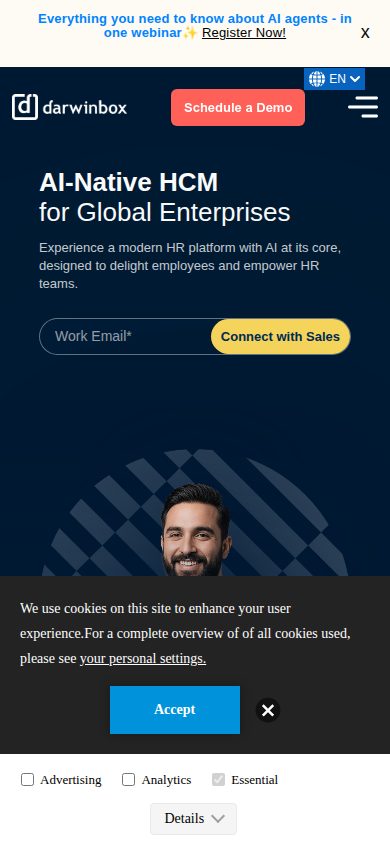
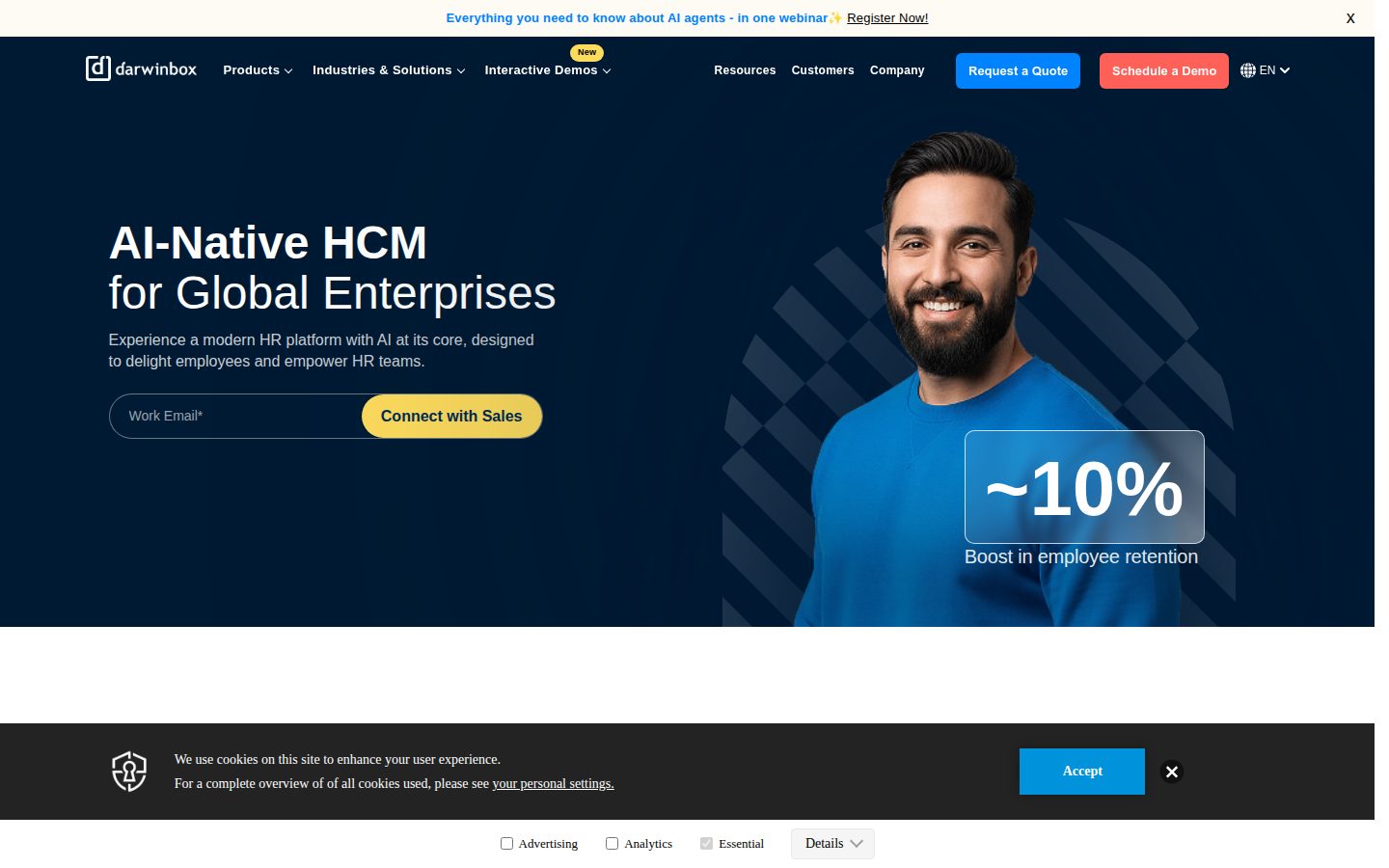
Darwinbox desktop previewDarwinbox mobile preview

Pricing Plans

Contact Sales

Contact sales

Darwinbox is a fully sales-led, enterprise HCM platform with no publicly listed pricing. All pricing is custom and based on organization size, number of employees, modules selected, and specific feature requirements. No free trial or freemium tier is available. Prospective buyers must contact Darwinbox directly for a quote. Third-party transaction data (Vendr) indicates average annual contract values around $120,000, with a ceiling near $200,000 for large enterprises. A separate analyst source estimates per-employee costs in the range of $3–$5/employee/month depending on headcount scale, but these figures are not confirmed by the vendor.

  • Core HR & employee data management
  • Recruitment & applicant tracking (end-to-end ATS)
  • Payroll & compensation management with local statutory compliance
  • Time & attendance with geofencing, facial recognition, and biometrics
  • Performance management, OKRs, and 360-degree feedback
  • Learning management system (LMS)
  • Employee engagement, rewards & recognition
  • Expense and travel management
  • AI-powered analytics and workforce insights (Darwinbox Sense)
  • Mobile-first apps with WhatsApp and MS Teams integration
  • Configurable workflows and extensibility via RESTful APIs

AI Panel Reviews

The Decision Maker

The Decision Maker

Strategic bet, vendor viability, timing, adoption approval
7.8/10

Darwinbox is a serious Workday alternative for APAC-heavy enterprises at lower cost.

Full HCM stack — payroll, ATS, skills ontology, analytics — in one platform built for distributed global teams. No public pricing and no trial means procurement is a commitment, not an experiment.

Third-party data puts average contracts around $120K annually, with $3–$5/employee/month as the per-seat estimate. That's meaningfully cheaper than Workday or SAP SuccessFactors for comparable coverage. The Unified Payroll Orchestration — connecting native engines for India, GCC, and Philippines alongside ADP and SAP — is the real differentiator for orgs running payroll across Asia-Pacific and the Middle East.

The Skills Ontology threading through hiring, succession, and internal mobility is notable. Most HCMs bolt on a skills module late. Darwinbox built it into the data layer from the start. The tradeoff: no free trial, no pricing page, and limited public changelog. You're flying partly blind until procurement.

They compete directly with Workday and Oracle HCM. For APAC-first enterprises, that's a real fight they can win. If your workforce is North America-heavy, look elsewhere.

Competitive Positioning8.0

APAC-native payroll coverage and a built-in skills layer give real separation from Workday and Oracle for regionally distributed enterprises.

Reputation Risk7.5

Credible competitor to SAP SuccessFactors and Workday in APAC; the board won't wince, but it's not a household name in North America.

Speed to Value6.8

Full HCM implementations never close fast — no free trial and sales-led procurement add months before any team sees the product.

Strategic Fit8.2

Skills Ontology connecting hiring through succession is a structural advance, not just cost savings on existing HR ops.

Vendor Viability7.5

No public funding data, but $120K average contracts and multi-region enterprise deployments suggest sustainable revenue; they've been in market long enough to build native payroll engines across four countries.

Pros

  • Unified Payroll across native engines and ADP/SAP in one view — rare at this price point
  • Skills Ontology built into core data layer, not a separate module
  • Mobile-first with facial recognition and geo-fencing for deskless and distributed workers
  • Competitive pricing vs Workday and SAP SuccessFactors based on third-party contract data

Cons

  • No free trial or public pricing — procurement is a black box until you're deep in sales
  • Weaker brand recognition outside APAC and Middle East
  • No public changelog or API docs visible, making technical due diligence harder
  • North America payroll coverage depends on third-party partners, not native engines

Right for

Mid-to-large enterprises running distributed teams across APAC or the Middle East who need payroll, core HR, and skills intelligence in one platform.

Avoid if

Your workforce is primarily North America-based and you need native US payroll without a third-party dependency.

The Domain Strategist

The Domain Strategist

Craft and strategy in the product's domain — adapts identity per category, same lens
8.1/10

A genuine Workday challenger built for APAC-first enterprises that need one platform, not a patchwork.

Darwinbox covers the full people lifecycle — hire to retire — with a skills ontology that actually connects talent decisions across modules. At an estimated $3–$5 per employee per month, it undercuts SAP SuccessFactors and Workday on price while matching them on functional breadth for mid-to-large enterprise needs.

The Skills Intelligence Platform is the architectural decision I'd want to pressure-test first. Most HCMs bolt on a skills layer after the fact; Darwinbox claims it runs across hiring, succession, mobility, and development from a single ontology. If that's real and not just a shared data field, it changes how I run talent reviews and internal mobility — no more manually reconciling JD competencies against L&D records.

Unified Payroll Orchestration connecting native engines for India, Philippines, GCC, and Thailand alongside ADP and SAP integrations is a legitimate differentiator for distributed APAC teams. That's the kind of multi-country payroll complexity that breaks most platforms. The tradeoff: no public pricing page, no free trial, and average contract values around $120,000 annually mean this is a significant procurement cycle, not a pilot-first decision.

Against Workday and SuccessFactors, Darwinbox wins on regional compliance depth and price. It loses on ecosystem maturity and the breadth of third-party integrations those platforms have accumulated over a decade. For a 2,000-person enterprise with APAC headcount concentration, that's an acceptable tradeoff.

Category Positioning8.0

Sits between regional players like Keka and global incumbents like Workday — a real alternative for enterprises priced out of Workday but outgrown by greytHR.

Domain Fit8.4

Facial recognition attendance, geo-fencing, multi-entity org modeling, and mobile-first design reflect how large distributed workforces actually operate, not how Western SaaS imagines they do.

Integration Surface7.5

REST APIs, JIRA, HubSpot, ADP, and SAP integrations are credible, but no public API docs and limited changelog visibility make depth hard to verify pre-contract.

Long-term Implications7.8

Centralizing payroll, core HR, and talent on one platform creates efficiency gains but deep module adoption makes switching costly by year two.

Strategic Depth8.2

Skills ontology spanning hire-to-succession plus AI-powered People Analytics suggests platform-level thinking, not feature accumulation.

Pros

  • Skills ontology embedded across hiring, development, and succession — not a standalone module
  • Unified Payroll across native engines and ADP/SAP partners in one consolidated view
  • Mobile-first design with facial recognition and geo-fencing built for deskless and distributed workforces
  • AI-powered OCR on expense claims and a context-aware employee support agent reduce HR ops load

Cons

  • No public pricing, no trial — procurement requires a full sales cycle before you can evaluate hands-on
  • ~$120K average annual contract is a serious budget commitment for mid-market buyers
  • Ecosystem maturity trails Workday and SAP SuccessFactors by years on third-party integrations
  • Docs and changelog not publicly available, making technical due diligence harder pre-contract

Right for

Enterprise and large mid-market people teams running distributed workforces across APAC or the Middle East who need unified payroll, core HR, and skills-led talent decisions in one platform.

Avoid if

Your headcount is under 500, your payroll is single-country, or you need a fast pilot before committing to a six-figure contract.

The Finance Lead

The Finance Lead

Money, total cost of ownership, contracts, procurement math
6.2/10

$120K average contract, zero pricing visibility — budget blind before you sign

Darwinbox is a credible enterprise HCM competing with Workday and SAP SuccessFactors, but every procurement number is opaque. Vendr data suggests $120K average ACV, ceiling near $200K — that's the ballpark, not the invoice.

Vendr transaction data puts average ACV at $120K. Third-party estimates suggest $3–$5/employee/month at scale. Neither is confirmed by Darwinbox. For a 1,000-employee org at $4/seat: $4,000 × 12 = $48K/year. Add implementation, integration to ADP or SAP, training, and customization — year 1 total likely doubles. Year 3, with seat creep and module expansions, could approach $180K–$200K all-in.

No pricing page. No free trial. No published tier structure. That's three procurement friction points before the first conversation. Compare to Workday, equally opaque, or Oracle HCM — same sales-led model, same unpredictable invoicing. Darwinbox isn't worse than peers here, but it isn't better either. Module-based pricing means the Skills Intelligence and Unified Payroll Orchestration features you actually want may cost extra.

No published auto-renewal terms. No termination-for-convenience clause visible in public docs. Category norm for enterprise HCM is 12–36 month terms with 60–90 day cancellation windows. Assume that here. ROI measurement depends on Darwinbox Sense analytics — real feature, but self-reported dashboards don't constitute independent value proof.

Billing & Procurement4.0

Fully sales-led, no self-serve, no trial — procurement friction is high before a single line item is visible.

Contract Flexibility4.5

No public auto-renewal or cancellation terms; category norm is 12–36 month terms with 60–90 day exit windows — assume that applies.

Pricing Transparency2.5

Zero published pricing, no tiers, no trial — must contact sales for any number.

ROI Clarity5.5

Darwinbox Sense provides real analytics, but ROI proof relies on vendor-supplied dashboards with no independent benchmark.

Total Cost of Ownership5.0

Vendr suggests $120K ACV; implementation and module add-ons push year-3 TCO toward $180K–$200K for large deployments.

Pros

  • Unified Payroll Orchestration covers native engines plus ADP, SAP, and Paycor in one view
  • Skills Intelligence spans hiring, development, and succession — genuinely cross-module
  • Vendr ACV data gives at least a rough budget anchor ($120K) before the sales call
  • Mobile-first with facial recognition and geo-fencing — relevant for deskless, distributed workforces

Cons

  • No published pricing, tiers, or overage rates — invoice is unpredictable until contract signature
  • No free trial or freemium — zero low-risk evaluation path
  • Module-based model likely means Skills Intelligence and advanced analytics cost extra
  • Contract terms, auto-renewal windows, and exit clauses are not publicly disclosed

Right for

Large enterprises (500+ employees) in APAC or the Middle East running multi-country payroll who have budget for a $120K+ ACV and a dedicated HRIS implementation team.

Avoid if

You need transparent pricing, a trial before commitment, or contract flexibility — this is a locked, sales-led purchase from first contact.

The Domain Practitioner

The Domain Practitioner

Daily hands-on reality in the product's domain — adapts identity per category, same lens
7.8/10

Enterprise-grade HRMS with serious recruiting depth — but no self-serve anything

Darwinbox is a full-lifecycle HCM built for 500+ headcount operations across APAC, the Middle East, and globally distributed teams. The ATS, skills ontology, and unified payroll are the real story — but you won't touch any of it without a sales call first.

The Recruitment & ATS module covering high-volume, bulk, and evergreen requisitions signals that someone actually mapped recruiter workflows, not just product manager assumptions. Automated candidate evaluation plus compliance tracking in one place is where Workday and SAP SuccessFactors typically make you stitch together separate configurations. The Skills Intelligence layer connecting hiring to succession and internal mobility is genuinely differentiated — most ATS platforms treat skills as a tag cloud, not an ontology.

Day three reality: no public docs, no changelog, no self-serve trial based on available evidence. That means every configuration question goes through a CSM. For recruiters used to tweaking screening questions or updating requisition workflows on the fly in Greenhouse or Lever, that dependency will sting. Vendr data puts average ACV around $120,000 — you're buying a platform relationship, not a SaaS subscription.

The tradeoff is real: Darwinbox gives you depth that point solutions can't match, but it demands enterprise implementation patience. Right for a 1,000-person company consolidating fragmented HR tools across three countries. Wrong for a talent team that needs to iterate posting workflows next Tuesday.

Day-3 Reality7.0

No free trial, no self-serve docs, and contact-only pricing mean day-three experience is entirely shaped by implementation quality — not the product alone.

Documentation Practitioner-Fit5.5

Website evidence shows docs=N, changelog=N — no publicly visible practitioner documentation to evaluate; that's a real gap for independent troubleshooting.

Friction Surface7.0

Mobile-first interface and WhatsApp/MS Teams integration reduce daily friction for end users, but recruiter-side config changes appear to require admin or CSM involvement.

Power-User Depth8.5

No-code workflow automation, configurable org modeling, multi-entity structures, and a full skills ontology spanning hiring through succession indicate serious power-user surface area.

Workflow Integration8.2

Native ATS, Skills Ontology, and JIRA/HubSpot integrations suggest recruiter workflows were actually modeled, not retrofitted from a generic HR module.

Pros

  • ATS covers high-volume, bulk, and evergreen requisitions — not just standard pipeline management
  • Skills ontology connects hiring to internal mobility and succession, not siloed per module
  • Unified payroll across ADP, SAP, and Paycor from one dashboard is a genuine operational win for global teams
  • Mobile-first with facial recognition and geo-fencing handles deskless and distributed workforce realities

Cons

  • No public pricing, no trial, no self-serve — every question routes through sales or CSM
  • No visible public documentation means solo troubleshooting is difficult to assess
  • Average ACV around $120,000 per Vendr data puts this out of reach for most sub-500 headcount orgs
  • Recruiter workflow agility suffers when config changes depend on implementation support cycles

Right for

Enterprise TA and HR ops teams managing 1,000+ employees across multiple geographies who need one platform for ATS, payroll, and skills-based talent decisions.

Avoid if

Your team needs to iterate recruiting workflows independently and quickly without routing every change through a vendor CSM.

The Power User

The Power User

Daily human experience, onboarding, polish, learning curve, reliability
8.1/10

The APAC enterprise HR stack that actually competes with Workday on its own terms

Darwinbox is a full-lifecycle HCM built for complex, multi-country operations — not a starter tool. At an estimated $3–5/employee/month, it's meaningfully cheaper than SAP SuccessFactors or Workday for what you get.

The feature breadth here is real. Unified Payroll across ADP, SAP, and Paycor. Facial recognition and geo-fencing for attendance. An AI support agent that can actually execute tasks in JIRA and HubSpot, not just answer FAQs. The Skills Ontology threading through hiring, succession, and mobility is the thing that separates this from legacy HCMs that bolt modules together and call it a platform. That's not marketing — that's architecture.

The tradeoff is onboarding complexity. There's no free trial, no pricing page, no docs in the public evidence. You're walking into a sales cycle before you've touched the product. For the Workday switcher with an IT team and a dedicated rollout budget, fine. For anyone expecting to poke around first, this will feel like homework before the first day of school.

Mobile-first is a real claim here — iOS and Android with WhatsApp and Teams integration suggests deskless and distributed workers aren't an afterthought. Day three inside a 10,000-person deployment probably feels different than day three at a 500-person company. Know which one you are.

Daily Polish7.5

No public changelog or docs to validate, but the AI OCR for expense claims and context-aware helpdesk agent suggest someone thought about the daily grind, not just the demo.

Learning Curve6.5

A platform spanning payroll, ATS, LMS, succession, and expense management across multiple countries is not going to be intuitive on week one — no-code workflow tools help, but this takes time.

Mobile Parity8.2

Mobile-first attendance with facial recognition, geo-fencing, and WhatsApp integration reads like a genuine mobile product, not a responsive web page in disguise.

Onboarding Experience6.0

No free trial, no self-serve pricing, no public documentation — you're fully sales-gated before you see a single screen.

Reliability Feel7.8

Consolidated payroll orchestration across native and third-party engines at enterprise scale implies the infrastructure is serious, though no public uptime data to confirm.

Pros

  • Skills Ontology connecting hiring, mobility, and succession in one data layer — not siloed modules
  • Unified Payroll view across ADP, SAP, and Paycor is genuinely useful for multi-country ops
  • Mobile-first with real deskless-worker features like geo-fencing and facial recognition attendance
  • At ~$3–5/employee/month it undercuts Workday and SAP SuccessFactors meaningfully

Cons

  • No free trial, no pricing page — full sales cycle required before you touch the product
  • Average contract around $120,000/year means this is not a small-team decision
  • No public docs or changelog visible — hard to assess how fast they ship or support customers
  • Learning curve on a platform this wide is real; expect a long ramp before month three feels smooth

Right for

Mid-to-large enterprises running distributed teams across APAC or the Middle East who need payroll, HR, and talent in one platform.

Avoid if

You want to self-serve, trial before committing, or you're under a few hundred employees.

The Skeptic

The Skeptic

Contrarian. Watch-outs, deal-breakers, broken promises, category patterns
7.2/10

Solid APAC-first HCM challenger — but the opacity will cost you at renewal

Darwinbox has real differentiation for Asia-Pacific and Middle East deployments where Workday and SAP SuccessFactors are overpriced and under-localized. The black-box pricing and zero public documentation make it a harder sell to skeptical procurement teams.

Three tells upfront. One: no pricing page, no docs, no changelog — the website is a brochure. Two: 'AI-Native HCM' is the kind of headline that every vendor printed in 2023. Three: third-party data (Vendr) puts average contract value at $120K annually, which is enterprise-weight spend with zero self-serve validation.

That said — the Skills Ontology spanning hiring through succession is a real differentiator, not a relabeled feature. Native payroll engines for India, Philippines, GCC, and Thailand is specific and hard to fake. Unified Payroll Orchestration connecting ADP and SAP into one view solves a real pain that Workday charges extra to approximate. Geo-fencing and facial recognition attendance for deskless workers? That's where APAC deployment actually wins.

Exit portability worries me. Proprietary payroll engines plus custom org modeling equals painful migration. No public API docs visible. If this relationship sours at month 18, you're negotiating with leverage you don't have. Worth the bet for the right APAC enterprise. A hard no for anyone who needs easy out clauses.

Competitive Differentiation7.8

Native payroll for India, Philippines, GCC, and Thailand is a concrete moat vs. Workday and SAP SuccessFactors, which rely on local partners for the same coverage.

Exit Portability4.5

Proprietary payroll engines across four countries, custom org modeling, and no visible public API docs make migration a serious undertaking.

Long-term Viability7.0

Series D funding and APAC enterprise traction are solid signals, but no public changelog or shipping cadence is visible — can't confirm execution velocity.

Marketing Honesty5.5

'AI-Native HCM for Global Enterprises' with no docs, no changelog, and no pricing page is aspiration dressed as substance.

Track Record Match7.5

Darwinbox raised a Series D (Tiger Global-backed) and has named enterprise customers across APAC — pattern matches regional challengers that survived, not ones that quietly shut down.

Pros

  • Native payroll engines in four high-complexity markets (India, Philippines, GCC, Thailand) — not just partner integrations
  • Skills Ontology embedded across hiring, development, mobility, and succession — not a standalone module
  • Unified Payroll Orchestration consolidates ADP, SAP, and Paycor into one view — real operational value
  • Mobile-first with geo-fencing and facial recognition for deskless and distributed workforces

Cons

  • Zero public pricing, docs, or changelog — $120K average contract with no self-serve validation is a procurement risk
  • Exit portability is poor — proprietary engines plus custom config equals locked-in
  • 'AI-Native' marketing is loud; specific AI proof points in public materials are thin
  • No free trial means you're negotiating blind against a sales team before you've seen the product

Right for

Large enterprises with complex APAC or Middle East payroll needs who want a single platform instead of Workday plus local partners.

Avoid if

You need transparent pricing, strong exit options, or operate primarily outside Asia-Pacific and the Middle East.

Buyer Questions

Common questions answered by our AI research team

Features

Does Darwinbox handle payroll and HR in one platform?

Yes, payroll and HR are handled in a single platform. Darwinbox covers payroll alongside recruitment, onboarding, core HR record-keeping, workforce management, performance, and talent development.

Features

What AI capabilities does Darwinbox include?

Darwinbox is AI-native, with AI at its core including a skills intelligence layer and AI-powered analytics that surface workforce insights and support talent decisions across modules.

Features

Can Darwinbox support global enterprise workforces?

Yes, Darwinbox is built for global enterprises. The platform is explicitly positioned as an AI-native HCM for global enterprises.

Features

Does Darwinbox cover the full employee lifecycle?

Yes, Darwinbox covers the full HR lifecycle — from recruitment, onboarding, and core HR record-keeping through payroll, workforce management, performance, and talent development.

Features

How does Darwinbox use skills intelligence for talent decisions?

A skills intelligence layer connects data across modules to surface workforce insights, enabling HR teams to make informed talent decisions based on skills data spanning the full employee lifecycle.

Also in AI HR & Recruiting