dat.ai logo

dat.ai Review

Visit

Real Chrome browsers on real hardware, dispatched via one API

dat.ai is a browser infrastructure platform for web automation and AI agents.

AI Panel Score

7.0/10

6 AI reviews

Reviewed

About dat.ai

dat.ai works as an infrastructure layer that sits behind a single API endpoint: a developer sends a task, and dat.ai dispatches it to a distributed network of real browsers running on actual consumer devices rather than datacenter virtual machines. Sessions execute on real CPUs with real network interfaces, and results are returned with visibility into execution events, retry handling, and performance metrics. According to the site, browsers close after each task by default to limit memory and CPU use on the end device, though persistent profiles can be arranged for specific clients on request.

The platform's stated differentiators center on fingerprint authenticity and IP sourcing: TLS, canvas, WebGL, and screen-resolution profiles are drawn from real devices rather than fabricated, and traffic routes through residential IPs across 100+ countries instead of datacenter proxies or a centralized proxy layer. dat.ai also markets built-in AI-driven on-site decision making intended to reduce manual scripting for tasks like navigating dynamic page flows. Listed use cases include large-scale web monitoring behind logins or shifting access rules, autonomous data extraction from sites with changing DOM structures, and compliance/audit workflows that need to observe regulated websites over time.

Public FAQs note the product is in early-stage beta, with profile creation currently copying real device profiles for authenticity during testing and moving to automated per-task profile generation in production; rate-limit policies are still being finalized for general availability.

The company positions dat.ai for travel and booking companies doing price or competitor monitoring, teams building AI agents that need reliable web access, companies expanding into GDPR-relevant markets, and teams replacing brittle in-house scraping infrastructure. Pricing has two published paid tiers plus a quote-only option: a $99/month Starter plan including 2,000 browser actions, 5 GB of traffic and 100 node-hours (then $0.055 per browser action, $4.00 per GB, $0.01 per node-hour), a $499/month Pro plan including 12,000 browser actions, 30 GB of traffic and 600 node-hours (then $0.045 per browser action, $2.00 per GB, $0.01 per node-hour), and a Custom tier (price on request) offering up to 1M concurrent browsers with no proxy dependency.

Features

AI

  • AI-Driven Decision Making

    Enables built-in on-site decision making by AI agents to reduce manual scripting and workflow maintenance.

  • Autonomous Data Extraction

    Runs AI-driven agents that navigate complex web flows, adapt to DOM changes, and extract structured data at scale.

Analytics

  • Real-Time Session Monitor

    Provides live visibility into session execution and results across WebRTC, canvas, WebGL, and TLS fingerprint data.

Automation

  • Large-Scale Web Monitoring

    Continuously monitors thousands of web sources in parallel, tracking changes across dynamic sites even behind logins or shifting access rules.

  • Unlimited Parallel Sessions

    Launches thousands of concurrent browser sessions in parallel without requiring users to manage underlying infrastructure.

Core

  • Compliance & Audit Workflows

    Observes regulated websites and platforms over time to capture changes, disclosures, and signals for compliance and audit purposes.

  • Physical Hardware Sessions

    Runs Chrome browser sessions on real CPUs and network interfaces on physical consumer devices rather than virtual machines or headless browsers.

  • Real Device Fingerprints

    Provides authentic TLS, canvas, WebGL, and screen profiles drawn from real consumer devices instead of fabricated data.

  • Residential IP Routing

    Routes sessions through real residential IPs spanning 100+ countries for global ISP coverage and stronger trust scores.

Customization

  • Persistent Browser Profiles

    Creates reusable, persistent browser profiles for specific clients that can be reused across multiple tasks.

Integration

  • Simple API Integration

    Connects to the platform through a single API endpoint to launch and manage Chrome sessions on real hardware.

Preview

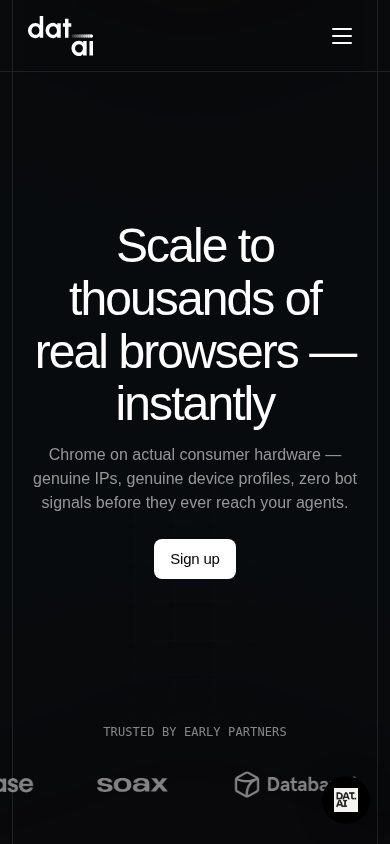
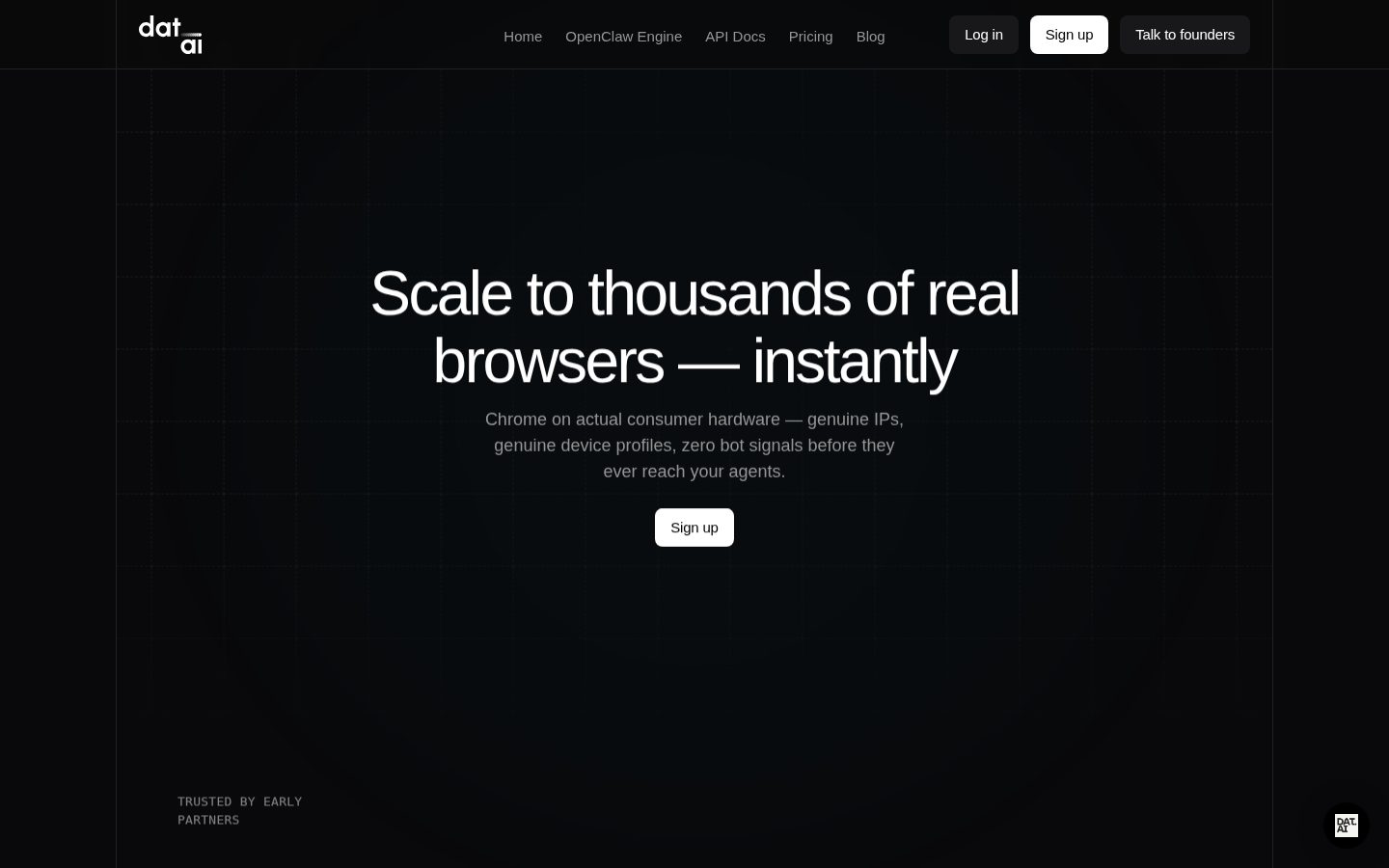
dat.ai desktop previewdat.ai mobile preview

Pricing Plans

Starter

$99/monthly

Entry tier for teams starting with real-device browser sessions; usage beyond the included quotas is metered.

  • 2,000 browser actions included
  • 5 GB traffic included
  • 100 h node time included
  • Then $0.055 per browser action
  • Then $4.00 per GB traffic
  • Then $0.01 per node-hour

Pro

$499/monthly

Higher included quotas and lower per-unit overage rates for sustained browser-agent workloads.

  • 12,000 browser actions included
  • 30 GB traffic included
  • 600 h node time included
  • Then $0.045 per browser action
  • Then $2.00 per GB traffic
  • Then $0.01 per node-hour

Custom

Contact sales

Price on request - request-based access at early-access pricing with no long-term commitment; talk to the founders.

  • Up to 1M concurrent browsers
  • Significantly lower operational costs
  • No proxy dependency
  • Scales horizontally from day one
  • Complete visibility over agent actions

AI Panel Reviews

The Decision Maker

The Decision Maker

Strategic bet, vendor viability, timing, adoption approval
7.2/10

Real browsers on real hardware is a genuine architecture bet, but it's still beta.

dat.ai swaps headless browsers and datacenter proxies for physical consumer devices with authentic fingerprints. Compelling idea, thin production evidence.

$99/mo buys 2,000 browser actions, 5 GB of traffic and 100 node-hours; AI-Driven Decision Making and real-device fingerprinting ship as product capabilities rather than tier upsells. The pitch: real TLS, canvas, WebGL fingerprints from actual consumer hardware, residential IPs across 100+ countries, no datacenter VM tell. That's a real architectural difference versus the obvious headless-browser alternative, not just a repackaging.

Two things give me pause. One: the FAQs admit profile creation is still "copying real device profiles for testing," with automated generation and rate-limit policy still pending for general availability. Two: the API reference is published but there is no changelog, and the Custom tier's 1M-browser claim has no verification path shown.

Compliance and audit workflows need certainty, not beta caveats. The Starter plan is cheap enough to test without a procurement fight.

Competitive Positioning7.8

Physical hardware sessions with real fingerprints and 100+ country residential IPs is a distinct architecture versus headless/VM-based scraping tools.

Reputation Risk6.0

No SLA, security, or data-handling detail shown despite targeting GDPR-relevant and compliance/audit workflows.

Speed to Value7.5

Single API endpoint and instant token with no card required per FAQ, fast to trial at $99.

Strategic Fit7.5

Advances agent-web-access capability rather than just cutting scraping infra cost, per the compliance and monitoring use cases listed.

Vendor Viability7.0

A complete metered pricing page and a published API reference with authentication and endpoint detail are real shipping signals, though there is no changelog and the product self-describes as early-stage beta.

Pros

  • Real device fingerprints and residential IPs across 100+ countries, not fabricated data
  • AI-driven decision making and real-device fingerprinting bundled into the $99 Starter plan
  • Single API endpoint with instant token, no card required to start

Cons

  • Explicitly in early-stage beta with rate-limit policy still unfinalized
  • Profile generation still relies on copying real devices rather than automated production process
  • No changelog or visible API/SDK maturity signals from the outside

Right for

Teams needing authentic fingerprint browser sessions for monitoring or compliance work who can tolerate beta rough edges.

Avoid if

Skip if you need contractual SLA guarantees or finalized rate limits today.

The Domain Strategist

The Domain Strategist

Craft and strategy in the product's domain — adapts identity per category, same lens
7.0/10

Real-hardware browser fleets solve a legitimate detection problem, but this is beta infrastructure you'd wire into production carefully.

dat.ai swaps headless Chrome and datacenter proxies for real consumer devices and residential IPs across 100+ countries. Compelling architecture for anti-bot resilience, but early-stage maturity signals mean you're absorbing platform risk alongside the capability.

Physical hardware sessions instead of VMs is the right architectural bet if bot detection is your actual bottleneck. TLS, canvas, WebGL fingerprints from real devices attack the problem at the signal layer rather than trying to spoof it after the fact — that's a materially different approach than headless-Chrome-plus-proxy stacks most teams already run.

The FAQ admits it's early-stage beta: profile creation currently copies real device profiles, moving to automated per-task generation 'in production,' and rate limits are still being finalized. If I build agent infrastructure against this today, I'm coupling my extraction pipeline to a system whose core generation mechanism and throughput guarantees are both still in flux.

Single API endpoint at $99 for 2,000 browser actions is a clean integration surface — low switching cost to trial. But the jump past Pro to the Custom tier's 1M concurrent browsers with no published pricing means your 3-year cost curve is a black box until you're deep enough to need it.

Category Positioning6.5

Positions against generic headless/VM scraping infra; category is crowded but the real-hardware angle is a distinct lane.

Domain Fit7.2

Matches how teams actually fight bot detection today — signal authenticity over evasion scripting — per the real-device fingerprinting and AI-decision-making features.

Integration Surface7.8

Single API endpoint and instant token onboarding is low-friction, and docs.dat.ai publishes the browsing endpoints, Bearer-token auth and an MCP path for agent clients.

Long-term Implications5.8

Beta status with rate limits 'still being finalized' and profile generation still changing means real platform-risk exposure over a 3-year build.

Strategic Depth7.0

Real-device fingerprinting plus residential IP routing is genuine architectural differentiation, not just marketing language over a standard headless stack.

Pros

  • Real consumer-hardware sessions with authentic TLS/canvas/WebGL fingerprints, not fabricated signals
  • Residential IP coverage across 100+ countries reduces proxy-layer dependency
  • Single API endpoint with thousands of parallel sessions and no infra to manage
  • $99 entry tier makes trialing the architecture cheap

Cons

  • Publicly labeled early-stage beta with rate limits and profile generation still being finalized
  • Custom tier pricing for 1M-browser scale is opaque, complicating 3-year cost planning
  • No changelog or public API reference I could find, making integration maturity hard to verify

Right for

Teams hitting hard bot-detection walls with headless scraping who can tolerate beta-stage infrastructure risk.

Avoid if

Avoid if you need finalized SLAs and rate-limit guarantees before committing production scraping workloads.

The Finance Lead

The Finance Lead

Money, total cost of ownership, contracts, procurement math
7.2/10

Two published tiers with real overage rates make the bill modelable until you need the Custom quote.

Starter at $99 and Pro at $499 both publish their included quotas and their per-unit overage rates. Only the 1M-browser Custom tier is still quote-only.

Pro costs five times Starter and buys six times the actions: $99/mo for 2,000 browser actions, 5 GB and 100 node-hours, against $499/mo for 12,000 actions, 30 GB and 600 hours. On actions alone the break-even sits near 9,300.

Overages are published on both tiers, which makes the invoice modelable: $4.00 per GB on Starter against $2.00 on Pro, $0.01 per node-hour either way. Residential IP Routing means every page load bills as traffic, so that GB rate is the line to watch. However, rate limits are still being finalized per the FAQ, so the throughput ceiling isn't contractual yet.

No card required and an instantly issued token keep procurement light. Custom is still 'talk to founders,' so the 1M-browser case stays quote-only — but at Starter and Pro a budget owner can now build the bill from published rates.

Billing & Procurement6.5

No card needed, instant token cited in FAQ, but Custom tier requires a sales conversation.

Contract Flexibility6.0

No term-length or auto-renewal detail that I could find; usage-based framing suggests month-to-month but unconfirmed.

Pricing Transparency8.0

Both paid tiers publish included quotas and per-unit overage rates; only the Custom tier is quote-only.

ROI Clarity6.5

Session monitoring and execution visibility give measurable output, but no benchmark numbers provided.

Total Cost of Ownership7.5

Overage rates are published at $0.055 and $0.045 per browser action, so the bill above the included quota is computable, though rate limits are still being finalized.

Pros

  • $99 Core tier is public with no card required to start
  • Instant token issuance per FAQ, low onboarding friction for the entry tier
  • Single API endpoint simplifies integration cost

Cons

  • Custom tier — the one built for real scale — has no published price
  • No overage rate disclosed; usage-based billing with an undefined ceiling
  • Rate-limit policy still being finalized per public FAQ, beta status

Right for

Teams metering browser automation who need a per-action rate they can forecast.

Avoid if

Buyers who need a flat monthly figure rather than a metered bill.

The Domain Practitioner

The Domain Practitioner

Daily hands-on reality in the product's domain — adapts identity per category, same lens
7.0/10

Real hardware fingerprints are the pitch. Beta status is the catch.

dat.ai swaps headless Chrome and datacenter proxies for physical devices and residential IPs, which is the right instinct for anti-bot evasion. But the FAQ admits rate limits aren't finalized and profile generation is still copying real devices in beta.

Single API endpoint, token issued at signup, no card required. That's a low-friction start. The pitch — real CPUs, real TLS/canvas/WebGL fingerprints, residential IPs across 100+ countries — solves the actual daily fight with headless detection, which anyone who's fought Cloudflare or PerimeterX knows is a losing arms race with fabricated fingerprints.

The API reference is public at docs.dat.ai — Bearer-token auth, browsing endpoints, an MCP path — so the first integration sprint is a docs read, not a sales call. The FAQ does say profile generation is still 'copying real device profiles' in beta, moving to automated per-task generation 'in production' — that's a moving target under your code today. Rate limits are explicitly unfinalized.

Persistent profiles exist but only 'on request for specific clients' — not self-serve, so session-state workflows need a support ticket, not a config flag. $99 for 2,000 actions is fine for prototyping; Pro covers 12,000 at $499; the 1M-browser Custom tier is quote-only, meaning your cost model at that scale is opaque until a founder call.

Day-3 Reality6.0

Beta status plus unfinalized rate limits means the contract you integrate against today may shift under you.

Documentation Practitioner-Fit7.5

docs.dat.ai carries authentication, browsing endpoints and an MCP integration path, which is what an engineer needs before the first call; a changelog is still missing.

Friction Surface7.2

No credit card and an instant token lower onboarding friction, and the public API reference means integration starts from docs rather than a sales conversation.

Power-User Depth7.0

Scaling path from $99 for 2,000 browser actions to Pro's 12,000 and then Custom's 1M is real, but pricing and limits at the top tier are quote-only.

Workflow Integration6.5

Single API endpoint fits standard agent tooling, but persistent profiles require a manual request rather than self-serve config.

Pros

  • Real device fingerprints (TLS, canvas, WebGL) avoid the fabricated-fingerprint arms race headless setups lose
  • Single API endpoint with instant token issuance, no card required to start
  • Real-device fingerprints and AI-driven navigation reduce brittle scraping-script maintenance

Cons

  • The public docs show no API reference that I could find, forcing guesswork on integration details
  • Profile generation and rate-limit policy explicitly unfinalized per the FAQ — beta instability risk
  • Persistent profiles are request-only for specific clients, not self-serve

Right for

Teams building AI agents or scrapers that keep getting blocked by anti-bot systems and need residential IP diversity across 100+ countries.

Avoid if

You need finalized rate limits before you write integration code.

The Power User

The Power User

Daily human experience, onboarding, polish, learning curve, reliability
6.8/10

Real browsers on real hardware sounds great — but this thing's still in beta

dat.ai swaps datacenter VMs for actual consumer devices to dodge bot detection, which is a genuinely different approach. But the site itself says rate limits aren't finalized and profile generation is still manual-ish, which is Day-3 nerves for a $99/month product.

The pitch here is real: Chrome on actual consumer hardware instead of headless VMs, with genuine TLS/canvas/WebGL fingerprints and residential IPs in 100+ countries. That's a smart answer to bot-detection, and the single API endpoint for dispatching thousands of parallel sessions is the kind of thing that sounds boring until you're the one maintaining scraper infra at 2am.

But the buyer FAQs admit it: profile creation currently copies real device profiles for testing, moving to automated per-task generation "in production" — meaning it's not fully there yet. Rate-limit policy is still being finalized too. That's not a dealbreaker, it's just early-beta honesty, and I respect that they said it out loud instead of burying it.

No free trial, no card-free sandbox beyond talking to the team, $99 gets you 2,000 browser actions and 5 GB of traffic. Fine for testing, thin for the "thousands of parallel sessions" headline. The Custom tier's 1M-browser claim is the kind of number that needs a real demo, not a page.

Daily Polish6.8

No changelog and profile generation is self-admittedly in progress, though docs.dat.ai does publish a real API reference with authentication and endpoint detail.

Learning Curve7.0

Single API endpoint keeps first-hour setup simple, but persistent profiles are only 'arranged on request,' meaning month-three workflows need a sales call.

Mobile Parity6.5

This is infrastructure accessed via API, not an app — evidence is silent on any client UI, so mobile isn't really the axis that matters here.

Onboarding Experience6.5

No card, instant token, one API endpoint — low friction to start, but no free trial means you're committing $99 before you really know.

Reliability Feel6.5

Live session visibility and retry handling are named features, but beta-stage rate limits still being finalized is a live-wire warning sign.

Pros

  • Real device fingerprints and residential IPs across 100+ countries, not fabricated data
  • Single API endpoint with instant token, no card required to start
  • AI decision-making and real-device fingerprinting bundled into the $99 Starter plan

Cons

  • Product is explicitly early-stage beta; rate limits and profile generation still being finalized
  • No free trial, so you're paying to find out if it fits
  • Persistent profiles require a special request, not a self-serve toggle

Right for

Teams tired of brittle in-house scrapers who need bot-detection resistance and can tolerate beta rough edges.

Avoid if

You need a polished, fully-baked product today rather than one still finalizing its rate-limit policy.

The Skeptic

The Skeptic

Contrarian. Watch-outs, deal-breakers, broken promises, category patterns
6.8/10

Hardware claims are checkable and the API docs are real; the beta caveats are the vendor's own.

Real-hardware fingerprinting is a legitimate differentiator against headless-browser scraping stacks. But the site itself admits rate limits and profile generation aren't finalized.

Physical Hardware Sessions and Residential IP Routing across 100+ countries are specific, checkable claims — not vapor. That's more grounding than most infra plays get this early.

But the FAQ says profile creation currently 'copies real device profiles for authenticity during testing' and moves to automated generation 'in production.' That's beta-speak for 'not built yet.' Rate limits are 'still being finalized.' The 'one API endpoint' pitch holds up — docs.dat.ai publishes auth and the browsing endpoints. A changelog doesn't.

The $99 Starter tier — 2,000 actions, 5 GB, then $0.055 each — is a fair, checkable price. The Custom tier's 'Up to 1M concurrent browsers' at price-on-request is the kind of claim with nothing behind it yet — no case study, no uptime number.

Exit is fine: it's just Chrome sessions behind an API, swap the endpoint. Whether there's anything to swap out of in 18 months is the open question.

Competitive Differentiation7.2

Real consumer hardware vs. datacenter VMs/headless is a genuine architectural difference, not just messaging.

Exit Portability7.0

Single API endpoint over standard Chrome sessions means low lock-in if you switch providers.

Long-term Viability6.8

docs.dat.ai publishes an API reference with authentication and endpoint detail and a blog exists, but there is still no changelog and the product self-describes as early-stage beta.

Marketing Honesty6.0

Landing page says 'zero bot detection' while FAQ admits profile generation is still in testing mode.

Track Record Match5.8

Specific fingerprint and IP claims are grounded, but rate-limit policy and production profile system are explicitly unfinished.

Pros

  • Real device fingerprints (TLS, canvas, WebGL) instead of fabricated ones
  • $99 tier is transparent and checkable, not gated behind sales calls
  • Simple single-API integration model keeps exit costs low

Cons

  • Rate limits and production profile generation still unfinalized per their own FAQ
  • No public API docs despite API-first positioning
  • 1M-browser Custom tier has zero evidence behind the number

Right for

Teams doing web monitoring or scraping who've hit bot-detection walls with headless setups and can tolerate beta rough edges.

Avoid if

You need SLA guarantees or finalized rate limits today, not 'coming to production.'

Buyer Questions

Common questions answered by our AI research team

Features

Does dat.ai use real devices or virtual machines?

dat.ai runs Chrome sessions on real consumer hardware with genuine CPUs and network interfaces, not virtual machines or headless browsers, giving authentic TLS, canvas, WebGL, and screen fingerprints.

Features

How many countries are covered for residential IPs?

dat.ai offers residential IP routing across more than 100 countries, covering any city or ISP for global coverage.

Features

How many parallel browser sessions can I run?

You can launch thousands of parallel sessions at once with no capacity cap and no infrastructure to manage, compared to traditional approaches with capped concurrency.

Integration

How do I integrate dat.ai into my system?

dat.ai connects through a single API endpoint — you sign up, receive a token instantly, then dispatch tasks through that one interface to run real Chrome sessions with full visibility into execution results.

Setup

Do I need a credit card to get started?

No card is needed to start — you talk to the team and receive your token instantly to begin using dat.ai.

Product Information

  • Company

    dat.ai
  • Pricing

    From $99/mo

Platforms

web

About dat.ai

dat.ai provides a browser infrastructure API that connects AI agents to real, undetected browser sessions across devices in over 100 countries via a single MCP connection.

Resources

Documentation
Blog

Also in AI Agents & Assistants