DataRobot logo

DataRobot Review

Visit

Enterprise platform to build, deploy, and govern AI agents and predictive models

DataRobot is an enterprise AI platform for building, deploying, and governing AI agents and predictive models at scale.

AI Panel Score

7.5/10

6 AI reviews

Reviewed

AI Editor Approved

What is DataRobot?

DataRobot is an enterprise AI platform for building, deploying, and governing AI agents and predictive models at scale. Its Agent Workforce Platform lets organizations design, run, and oversee enterprise agents on the automated machine learning, MLOps, and governance foundation the company built for predictive AI. Pricing is quote-based, with no published tiers; a free trial is available. Key capabilities include foundational agents and Business Agents for SAP, dynamic compute orchestration across edge, cloud, and on-premises environments, real-time agent monitoring, lifecycle tracking and governance, automated audit documentation, and NVIDIA Enterprise AI integration. TopReviewed's six-seat AI review panel scored it 7.5/10, praising the SAP-exclusive agentic AI certification that opens a channel into more than 400,000 SAP customer estates while noting that the absence of public pricing slows side-by-side evaluation. It best fits enterprise teams that need governed AI agents across SAP and hybrid environments.

About DataRobot

DataRobot is an enterprise AI platform that has evolved from automating predictive machine learning into an Agent Workforce Platform for building, running, and governing AI agents in production. It positions itself as a platform built for outcomes rather than open-ended pilots, letting data scientists, engineers, and business teams move both agentic and predictive AI into real operational use with enterprise controls.

The Agent Workforce Platform, expanded through 2025, provides foundational agents and tooling to design, deploy, observe, and govern fleets of AI agents. DataRobot has co-engineered enterprise agent infrastructure with NVIDIA and holds an exclusive agentic certification with SAP, embedding its agents into widely used enterprise systems. Underneath the agent layer, the platform retains DataRobot's long-standing strengths: automated machine learning (AutoML), feature engineering, model validation, and MLOps for deployment and monitoring.

The platform targets large organizations across financial services, healthcare, manufacturing, and retail that need to deploy AI at scale with governance. It supports use cases from agentic workflows and assistants to classic predictive tasks like fraud detection, demand forecasting, customer churn prediction, and risk assessment, with bias detection, explainability, and observability built in.

DataRobot competes in the enterprise AI platform market alongside vendors such as Databricks, H2O.ai, Palantir, and the cloud providers' AI services. It differentiates through end-to-end governance, the breadth of its agent and predictive tooling in a single platform, its NVIDIA and SAP partnerships, and pre-built enterprise solutions that help organizations move AI from prototype to production.

Features

AI

  • Foundational Agents

    Pre-built agents designed to be stood up quickly and infused into an organization's specific processes and systems.

  • LLM and Embedding Component Selection

    Allows teams to select from LLMs to embeddings to choose the right AI components for their specific data and use case.

Analytics

  • Real-Time Agent Monitoring

    Monitors agent quality and mitigates issues in real time to ensure safe and reliable agent performance in production.

Automation

  • Dynamic Compute Orchestration

    Orchestrates compute dynamically to deploy agents anywhere — edge, cloud, or on-premises environments.

Compliance

  • Automated Audit Documentation

    Uses testing frameworks and automated audit documentation to detect agent behavior issues before they create business risk.

Core

  • Agent Workforce Platform

    An end-to-end platform for building, operating, and governing secure, scalable, production-grade AI agents across the full agent lifecycle.

  • Lifecycle Tracking and Governance

    Tracks every asset and activity across the agent lifecycle to maintain global visibility and control over what agents are running and where.

Customization

  • Customizable Blueprints

    Pre-built blueprints with built-in integrations that allow teams to build enterprise-grade agents faster in their own or DataRobot's development environment.

Integration

  • Business Agents for SAP

    Integrations, data models, and UIs that enable building and integrating agents directly into SAP tools as the exclusive agentic AI partner certified to run inside the SAP ecosystem.

  • NVIDIA Enterprise AI Integration

    The Agent Workforce Platform is fully validated and embedded in the NVIDIA Enterprise AI Factory reference design, providing monitoring, guardrailing, and orchestration capabilities.

Security

  • Agent Authentication and Access Control

    Authenticates agents and users to control access to data and APIs across the platform.

  • Enforceable Compliance Controls

    Defines enforceable controls — from access to approvals — to meet enterprise and industry compliance requirements.

Preview

DataRobot desktop previewDataRobot mobile preview

Pricing Plans

Contact Sales

Contact sales

DataRobot is a fully sales-led platform with no public pricing listed. Prospective customers must request a demo or contact sales to get pricing. A free trial ('Try it') is available.

  • Agent Workforce Platform for end-to-end agentic AI
  • Foundational, business, and purpose-built agents
  • On-prem, hybrid, and cross-cloud deployment
  • Real-time agent monitoring and governance
  • SAP-certified agentic AI integration
  • Co-engineered with NVIDIA Enterprise AI

AI Panel Reviews

The Decision Maker

The Decision Maker

Strategic bet, vendor viability, timing, adoption approval
7.9/10

Debanjan Saha inherited a turnaround in 2022 and pivoted the platform from AutoML to agents — pragmatic bet.

DataRobot raised $1.05 billion total and hit a $2.7 billion valuation in 2020, but secondaries marked it down to roughly $500 million in early 2025. The July 2025 Agent Workforce Platform with NVIDIA is the reset move.

Debanjan Saha came over from Google Cloud and AWS to run this in July 2022. Co-founders Jeremy Achin and Tom de Godoy started it in Boston in 2012. Thirteen years in market, $1.05 billion raised, multiple layoff rounds. That's a survivor with scar tissue.

The Agent Workforce Platform launched July 31, 2025, co-engineered with NVIDIA and certified as the exclusive agentic partner inside SAP. Business Agents for SAP is the differentiator nobody else has. H2O.ai and Databricks own adjacent ground but neither has that SAP lane.

But the catch is the valuation reset — secondaries marked it near $500 million in Q1 2025, well below the 2020 peak. Pricing is contact-sales only. Pilot one SAP-adjacent workload for 90 days, get the enterprise quote in writing, then escalate.

Competitive Positioning8.0

H2O.ai and Databricks compete on AutoML and lakehouse, but neither has the SAP exclusivity or governance depth.

Reputation Risk7.5

Defensible board pick given the NVIDIA Enterprise AI Factory validation, though the public layoff history needs framing.

Speed to Value7.8

Foundational Agents and Customizable Blueprints are pre-built to deploy into existing systems quickly.

Strategic Fit8.0

Exclusive agentic AI partner certified inside SAP is a real strategic lane for enterprise buyers.

Vendor Viability7.5

Thirteen years in market and $1.05 billion raised offset multiple layoff rounds and the 2025 secondary markdown.

Pros

  • Exclusive agentic AI partner certified to run inside the SAP ecosystem.
  • Agent Workforce Platform co-engineered with NVIDIA and embedded in the NVIDIA Enterprise AI Factory reference design.
  • Thirteen years in market with $1.05 billion raised — durable enough for a 36-month bet.
  • Real-Time Agent Monitoring and Enforceable Compliance Controls close the enterprise governance loop.

Cons

  • Secondary markets marked the valuation near $500 million in Q1 2025, well off the 2020 peak.
  • Contact-sales pricing only — no public tiers to evaluate against budget before procurement.
  • Multiple rounds of layoffs since 2022 will show up in board diligence and need framing.

Right for

Enterprise teams who run SAP and need governed agents in production.

Avoid if

Startups who want self-serve pricing and a free tier to evaluate.

The Domain Strategist

The Domain Strategist

Craft and strategy in the product's domain — adapts identity per category, same lens
8.0/10

DataRobot's pivot from AutoML pioneer to Agent Workforce Platform turns a 2012 founder bet into enterprise agent governance.

Jeremy Achin and Tom de Godoy founded DataRobot in Boston in 2012 and raised $1.05B total, hitting a $6.3B valuation at the Altimeter-led Series G in July 2021. For a Chief AI Officer betting on an agent control plane through 2029, the call is whether DataRobot's NVIDIA-backed Agent Workforce Platform plus exclusive SAP certification beats Databricks' compute-first posture.

The pivot from AutoML pioneer to Agent Workforce Platform tells you what 2012-era category leaders do when the ground shifts. Jeremy Achin and Tom de Godoy founded the company in Boston in 2012, hit a $6.3B valuation at the Altimeter-led Series G in July 2021, then shipped the agent platform with NVIDIA in July 2025.

Dynamic Compute Orchestration deploys across edge, cloud, and on-prem. Customizable Blueprints ship with built-in integrations, and DataRobot is the exclusive agentic AI partner certified inside SAP. Lifecycle Tracking and Governance plus Enforceable Compliance Controls — enterprise shape that Databricks leans on infra instead of.

But the pivot is the risk. A platform that claims to replace 50+ AI tools is platform-shape rhetoric, and the moat now hinges on agent governance becoming a procurement category. The 3-year ceiling is enterprise agent control plane — strong fit if you've standardized on SAP, narrower if your stack lives on Databricks.

Category Positioning7.8

A 12-year survivor with $1.05B raised and 850+ customers, but now competing against H2O.ai, Databricks, and hyperscaler agent stacks in a crowded landscape.

Domain Fit8.2

Exclusive SAP certification plus on-prem, hybrid, and cross-cloud deployment matches how Chief AI Officers in regulated enterprises actually buy.

Integration Surface8.3

NVIDIA NIM and NeMo microservices, SAP exclusivity, and the Business Agents for SAP integration give a wide stack-fit surface.

Long-term Implications7.5

Pivoting from a proven AutoML moat to a forming agent-governance category carries more 3-year execution risk than a category leader at peak.

Strategic Depth8.0

The Agent Workforce Platform pivot is well-engineered with NVIDIA AI Enterprise, but agent governance as a craft ceiling is still forming.

Pros

  • Exclusive agentic AI partner fully certified to run inside the SAP ecosystem.
  • Agent Workforce Platform co-engineered with NVIDIA AI Enterprise including NIM and NeMo microservices.
  • Dynamic Compute Orchestration spans edge, cloud, and on-premises deployment.
  • 12-year operating history with $1.05B total funding and a 2021 valuation of $6.3B.

Cons

  • Pivot from AutoML to agents puts the moat into a forming procurement category, not a proven one.
  • The "replace 50+ AI tools" framing is platform-shape marketing more than architectural substance.
  • No public pricing — contact-sales motion slows side-by-side evaluation against Databricks.

Right for

Chief AI Officers who need an enterprise agent control plane across SAP environments.

Avoid if

Engineering leaders who run their AI stack natively on Databricks.

The Finance Lead

The Finance Lead

Money, total cost of ownership, contracts, procurement math
6.6/10

No published sticker, but Enterprise Cloud floors at $150K/year — the multi-year minimum is the real lock-in.

Enterprise Cloud access reportedly starts at $150K/year, with deployments scaling to $80K-$100K monthly at 100 users. The Agent Workforce Platform pivot adds NVIDIA and SAP procurement signals, but multi-year contracts and unclear ROI remain the buyer-side risk.

No published sticker. Enterprise Cloud access starts at $150K/year per third-party estimates — the floor procurement budgets against. Smaller deployments quote $2,500-$7,500/month. Hundred-user setups run $80K-$100K monthly. Founded 2012 by Jeremy Achin and Tom de Godoy; Series G hit $300M at a $6.3B peak in 2021.

Model 50 seats. Quotes land near $40K-$50K/month — roughly $500K/year all-in with compute. Compare H2O.ai, which prices flexibly for smaller teams, and Databricks, which bundles ML into broader data spend. The catch is the multi-year minimum. Enterprise contracts don't unbundle compute from licenses.

The Agent Workforce Platform pivot adds NVIDIA Enterprise AI Factory validation and exclusive SAP certification — real procurement signals. But ROI stays hand-wavy. Pre-built blueprints accelerate the first agent. Year-2 governance scope balloons spend. The Algorithmia acquisition tells you MLOps was bought, not built.

Billing & Procurement7.0

NVIDIA and SAP certifications plus on-prem/hybrid deployment reduce procurement friction at enterprise.

Contract Flexibility6.5

Enterprise multi-year contracts are typical; termination and export terms not public.

Pricing Transparency5.5

No published pricing anywhere — every quote requires a sales call.

ROI Clarity6.5

Pre-built blueprints help the first deployment, but blended platform ROI stays case-by-case.

Total Cost of Ownership6.5

Six-figure floor plus compute and prediction-volume variables make year-3 modeling hard.

Pros

  • NVIDIA Enterprise AI Factory validation gives a real enterprise procurement signal.
  • Exclusive SAP agentic AI certification opens a procurement-friendly channel for SAP shops.
  • On-prem, hybrid, and cross-cloud deployment options reduce data-residency risk.
  • Algorithmia acquisition strengthens MLOps depth for regulated industries.

Cons

  • Zero published pricing — every evaluation starts with a sales call.
  • Six-figure annual floor blocks mid-market evaluation entirely.
  • Valuation dropped sharply from the $6.3B peak in 2021 — vendor stability worth tracking.
  • Multi-year enterprise contracts are the norm; export and termination terms not public.

Right for

Enterprise teams who need governed AI at scale.

Avoid if

SMB analytics teams who lack a six-figure ML budget.

The Domain Practitioner

The Domain Practitioner

Daily hands-on reality in the product's domain — adapts identity per category, same lens
7.8/10

Agent Workforce Platform wraps SAP-certified agents in MLOps governance, but entry licenses start north of $150K.

DataRobot pivoted from AutoML to an agent control plane built with NVIDIA, and the SAP-exclusive certification is the real wedge. The catch is who actually logs in — this is a platform-team tool, not a data scientist's notebook.

Who logs in matters here. The Agent Workforce Platform isn't a notebook a data scientist boots Monday morning — it's a control plane an ML platform team operates so business users can deploy agents into SAP workflows. H2O.ai's Driverless AI still feels closer to a data scientist's desk; this feels closer to ServiceNow's.

The day-three friction is governance overhead. Lifecycle Tracking and Governance logs every agent asset, Automated Audit Documentation generates the compliance trail, and Agent Authentication and Access Control fronts every API. For a regulated bank, that work was happening in spreadsheets anyway. But for a 5-person ML team, the ceremony will swamp the model.

NVIDIA Enterprise AI Integration and the SAP-exclusive agent certification are the real moats — neither Databricks nor H2O.ai ships that combo. Enterprise pricing reportedly starts around $150K/year per Vendr. Docs lean marketing-deep, light on the per-flag CLI detail engineers actually need.

Day-3 Reality7.5

Heavy governance scaffolding pays off in regulated shops but feels like ceremony on small teams.

Documentation Practitioner-Fit7.2

Public materials lean marketing-deep on capability narrative, lighter on CLI flags and concrete error-message debugging.

Friction Surface7.4

Authentication, audit, and lifecycle steps are mandatory on every change — adds friction outside enterprise compliance contexts.

Power-User Depth8.0

LLM and Embedding Component Selection plus Customizable Blueprints give expert teams real control beyond AutoML defaults.

Workflow Integration8.4

SAP-exclusive agent certification and NVIDIA Enterprise AI Factory embedding fit enterprise stacks naturally.

Pros

  • SAP-exclusive agentic AI certification gives a structural channel into 400K+ SAP customer estates.
  • NVIDIA Enterprise AI Factory embedding means the validated stack ships with guardrails and orchestration built in.
  • Lifecycle Tracking and Governance plus Automated Audit Documentation cover the compliance trail regulated industries need.
  • Dynamic Compute Orchestration runs agents on edge, cloud, or on-prem from one control plane.

Cons

  • Entry-tier enterprise licensing reportedly starts around $150K/year — out of reach for smaller ML teams.
  • Governance ceremony is mandatory, not optional — overkill for unregulated experimentation.
  • Public docs are marketing-led; CLI and per-API engineering depth is harder to scout pre-sales.

Right for

Platform engineers at SAP-aligned enterprises operating regulated AI workloads.

Avoid if

Two-person data science teams shipping their first production model.

The Power User

The Power User

Daily human experience, onboarding, polish, learning curve, reliability
7.6/10

DataRobot rebranded from AutoML pioneer to Agent Workforce Platform, and the receipts mostly back it up.

The Agent Workforce Platform pitches itself as a replacement for 50+ AI tools, with Dynamic Compute Orchestration and NVIDIA Enterprise AI Factory validation behind it. The catch is no pricing page and a $150,000/year floor that makes this a procurement product, not a Day-3 one.

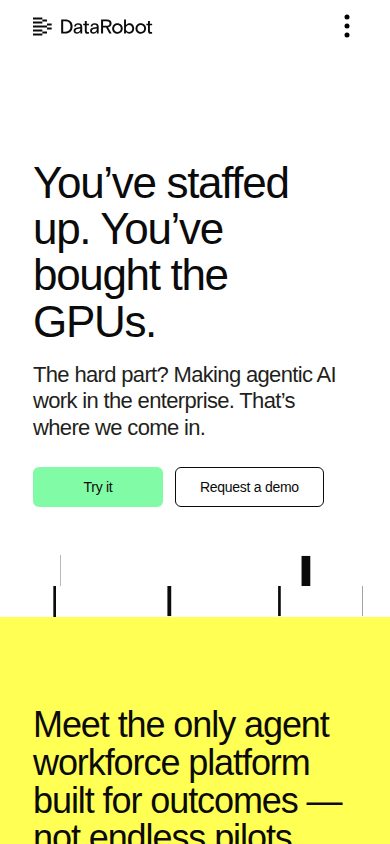
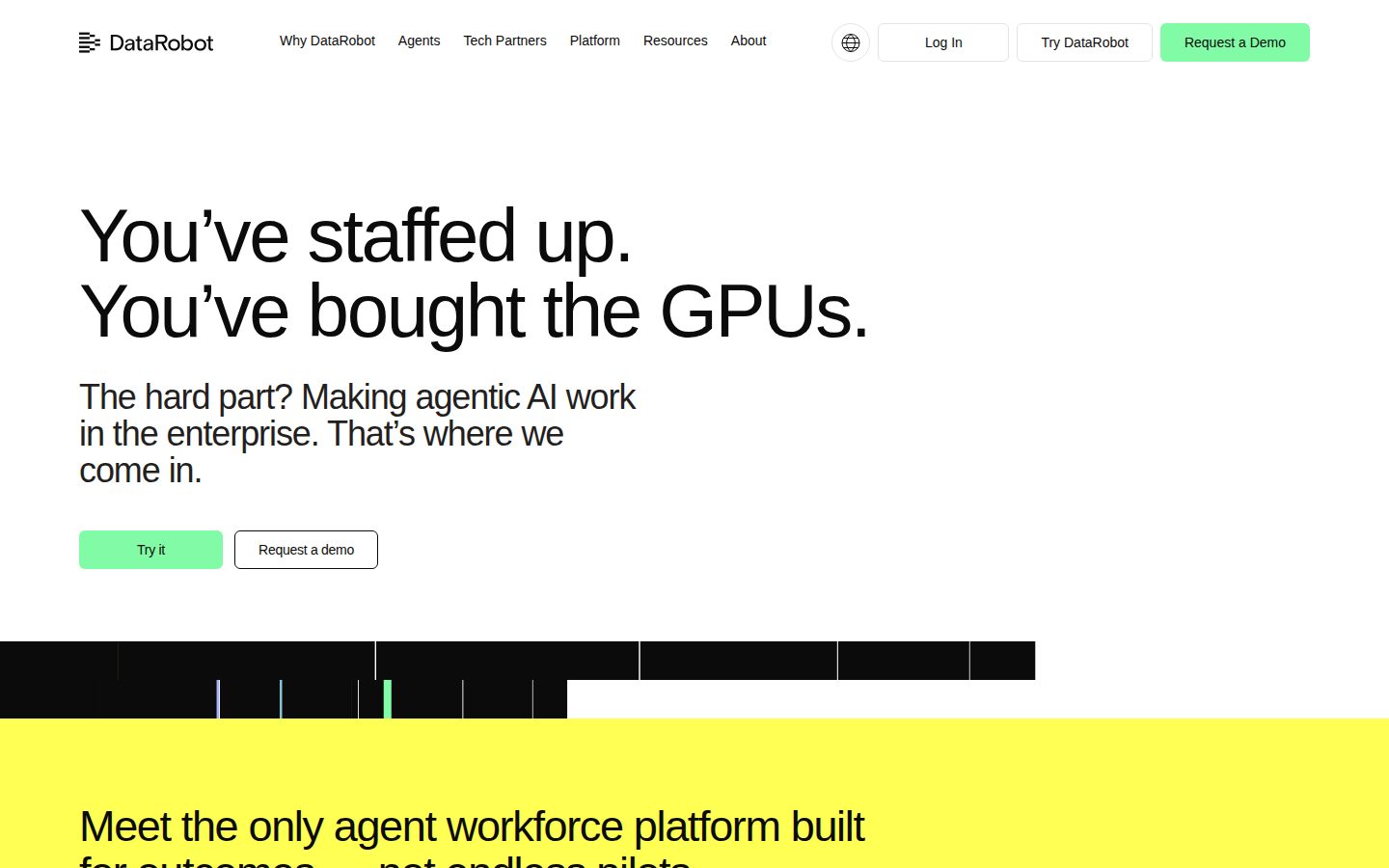
The homepage greets you with "You've staffed up. You've bought the GPUs." That's an honest tell — they know their buyer is drowning in half-bought AI stack. Founded 2012 in Boston by Jeremy Achin and Tom de Godoy, DataRobot rebranded from AutoML pioneer to Agent Workforce Platform. The old story was tired.

The pitch is replacing 50+ AI tools, and the receipts are there — Dynamic Compute Orchestration, Real-Time Agent Monitoring, Lifecycle Tracking and Governance. NVIDIA Enterprise AI Factory validation is the kind of badge enterprise buyers actually care about. H2O.ai has open source; Databricks owns the lakehouse. DataRobot owns the governance-shaped middle.

The catch is no pricing page. "Contact sales," with public estimates around $150,000/year for Cloud Enterprise Access. That's not a Day-3 product, that's a six-month-procurement product. SAP exclusivity is real leverage, but everyone else gets on a call before they see the canvas.

Daily Polish7.8

The homepage copy ("You've staffed up. You've bought the GPUs.") shows someone on the team noticed how their buyer actually feels.

Learning Curve7.2

Customizable Blueprints and Foundational Agents promise first launches in days, but 12 named platform capabilities means month-three discoverability depends on a CSM, not the UI.

Mobile Parity7.5

Mobile is a non-question for an enterprise agent orchestration platform — nobody approves a $150K contract from a phone.

Onboarding Experience6.8

Contact-sales gating means the first 10 minutes is a discovery call, not a product, which is exactly what enterprise AI buyers expect but everyone else hates.

Reliability Feel8.0

On-prem, hybrid, and cross-cloud support plus Automated Audit Documentation and Enforceable Compliance Controls signal serious operational engineering.

Pros

  • Agent Workforce Platform consolidates 12+ governance and lifecycle capabilities that most teams would otherwise stitch together from five vendors.
  • NVIDIA Enterprise AI Factory validation and exclusive SAP agentic AI certification are partnerships enterprise buyers actually weigh.
  • Real on-prem, hybrid, and cross-cloud deployment, not just a checkbox — Dynamic Compute Orchestration is the part that actually matters here.
  • Founded 2012 in Boston with over $1B raised — this isn't a 2024 demo, the durability story is real.

Cons

  • No public pricing page and an estimated $150,000/year Cloud Enterprise floor makes evaluation a procurement project, not a trial.
  • The homepage and the whole product story speak only to enterprise CIOs — nothing here for the practitioner who wants to try before they buy.
  • Twelve named platform capabilities with overlapping descriptions suggests the UX surface is large enough that month-three discoverability is a real question.

Right for

Enterprise teams who need governed AI agents across SAP and hybrid environments.

Avoid if

Solo builders who want to ship a prototype this weekend.

The Skeptic

The Skeptic

Contrarian. Watch-outs, deal-breakers, broken promises, category patterns
7.2/10

DataRobot raised $1B+ and survived a 33% staff cut — the pivot to agents is the real test.

Founded 2012, $6.3B valuation, $285M revenue — DataRobot is a survivor. But Dan Wright's 2022 exit, two layoff rounds, and the pivot from AutoML to Agent Workforce Platform make this a watch-the-execution call.

The interesting thing isn't the founding date. It's the pivot. Founded 2012 by Jeremy Achin and Tom de Godoy in Boston. Over $1B raised. $6.3B valuation at the 2021 Series G. Revenue near $285M in 2024.

But the homepage doesn't say AutoML anymore. It says Agent Workforce Platform. Databricks and H2O.ai squeezed the original wedge. The Business Agents for SAP certification — exclusive agentic AI partner inside SAP — is the new bet. Foundational Agents is the productization layer.

The catch is the turbulence behind the pivot. 7% layoff in May 2022, then 26% later that year. CEO Dan Wright resigned amid stock-sale controversy. Debanjan Saha steadied things from public signals. Exit depends on whether you build on the blueprints or the platform itself.

Competitive Differentiation7.5

Exclusive agentic SAP partner plus NVIDIA Enterprise AI Factory validation is a defensible wedge.

Exit Portability6.5

Platform lock-in is real once you build on Blueprints, governance, and SAP integration layers.

Long-term Viability7.2

$285M revenue and $6.3B valuation at 2021 Series G signal durability despite 2022 turmoil.

Marketing Honesty7.0

The "replace 50+ AI tools" claim is aspirational, but the NVIDIA and SAP certifications are concrete.

Track Record Match6.8

Survived 13 years and $1B+ raised, but mirrors the pattern of AI platforms forced into late pivots.

Pros

  • Survived 13 years and $1B+ in funding with roughly $285M revenue in 2024.
  • Exclusive agentic AI partner certified to run inside the SAP ecosystem.
  • NVIDIA Enterprise AI Factory reference design validation is a real distribution signal.
  • Foundational Agents and Customizable Blueprints shorten time-to-first-agent.

Cons

  • Two layoff rounds in 2022 totaling roughly 33% of staff.
  • CEO Dan Wright resigned amid stock-sale controversy before current leadership.
  • Pivot from AutoML to Agent Workforce Platform signals the original wedge got compressed.
  • Contact-only pricing makes budget planning harder for mid-market buyers.

Right for

Enterprises who need governed AI agents inside SAP environments.

Avoid if

Teams who want simple AutoML without agent-platform complexity.

Buyer Questions

Common questions answered by our AI research team

Setup

How long does it take to launch a first agent?

First agents can launch in days, not quarters.

Features

Does DataRobot run on-premises?

Yes, DataRobot runs on-prem, hybrid, and cross-cloud environments.

Integration

Can DataRobot integrate with SAP tools?

Yes, DataRobot offers integrations, data models, and UIs to build and integrate agents into SAP tools. It is the exclusive agentic AI partner fully certified to run inside the SAP ecosystem.

Security

How does DataRobot control access to data and APIs?

Agents and users are authenticated to control access to data and APIs, with enforceable controls covering access and approvals to meet enterprise and industry compliance requirements.

Features

Can DataRobot replace multiple existing AI tools?

Yes, DataRobot is designed to replace 50+ AI tools through its unified Agent Workforce Platform.

Also in AI Analytics