End-to-end data science and AI platform for teams
Dataiku is a collaborative data science and machine learning platform for building and deploying AI projects.
AI Panel Score
6 AI reviews
Reviewed
Dataiku is an end-to-end data science and AI platform that covers the entire machine learning lifecycle, from raw data ingestion through model deployment and ongoing governance. It provides a centralized workspace where data professionals can collaborate on projects, share datasets, build pipelines, and operationalize models at scale. The platform is used by enterprises across industries including finance, retail, healthcare, and manufacturing.
The platform accommodates users of varying technical skill levels. Data scientists can write code in Python, R, or SQL, while less technical users can work through a visual, point-and-click interface for data preparation and model building using AutoML capabilities. This dual approach allows organizations to involve both technical and business-facing team members in the same projects without requiring everyone to write code.
Dataiku connects to a wide range of data sources and infrastructure, including cloud storage systems, databases, Hadoop clusters, Spark, Snowflake, and major cloud providers such as AWS, Azure, and Google Cloud. It supports model deployment to REST API endpoints, batch scoring, and streaming pipelines, enabling teams to move from experimentation to production within the same tool.
On the governance side, Dataiku includes features for model monitoring, explainability, audit trails, and access controls, which are relevant for organizations operating under regulatory requirements or internal AI governance policies. These capabilities position the platform within the MLOps and responsible AI segments of the market.
Dataiku competes with platforms such as Databricks, SAS Viya, Alteryx, and cloud-native ML services from AWS and Azure. It is typically sold to mid-sized and large enterprises, with pricing available through direct sales. A free edition called Dataiku Free is available for individual users with limited features.

Allows users to build and deploy AI agents grounded in enterprise data, pipelines, and models, with governed execution and scalable impact.
Connects large language models to enterprise data and pipelines, enabling teams to build LLM-powered applications and research tools within the platform.
Breaks down organizational silos to allow more teams to build, reuse, and operationalize ML models within shared enterprise standards.
Enables construction of Retrieval-Augmented Generation chatbots that can be deployed to automate workflows and generate new revenue streams.
Tracks performance, cost, and risk across all AI systems within the platform to provide visibility into enterprise AI investments.
Moves analysts off spreadsheets and legacy desktop tools by automating pipeline creation with AI assistance while preserving institutional knowledge.
Connects data, AI, and applications to design and automate how enterprise workflows and AI systems run end-to-end.
Unites domain experts, data scientists, and engineers in a single platform where all user types can build and self-serve AI together.
Provides tools for sourcing, cleaning, and preparing data as part of the end-to-end AI and analytics pipeline.
Enables teams to turn isolated models into shared, production-ready ML that can be reused and operationalized within enterprise standards.
Applies consistent governance across all AI systems inside and outside Dataiku, including unified visibility, cost controls, and audit-ready oversight.
Try Dataiku's platform for AI success with a free trial, suitable for individuals exploring the platform
Full-scale enterprise AI platform for large organizations requiring governance, orchestration, and unified AI management
Morgan Stanley and Citigroup hired for the IPO — twelve-year-old Paris-born Dataiku is preparing to go public.
“Dataiku is the twelve-year-old Paris-born data-science platform now at $342.5M ARR and lining up a 2026 US IPO. The vendor-survival question is answered; the buying call is whether LLM Mesh and unified governance beat Databricks for your specific MLOps stack.”
Morgan Stanley and Citigroup are running the IPO process. That's the signal — Dataiku is preparing to be a public company in 2026, not just survive as a private one. Twelve years out of Paris, $342.5M ARR by September 2025, Series F closed.
LLM Mesh is the differentiated bet against Databricks — one governed routing layer for every model the enterprise calls, not a per-team experiment. AutoML for analysts, code notebooks for scientists, and a single audit trail underneath. Alteryx never built the model-deployment layer; Dataiku did.
However, contact-sales pricing means procurement runs 6-9 months and the Free edition is a single-user toy. Databricks owns the data-engineering-first buyer; SAS Viya owns the regulated-bank installed base. Run a 90-day pilot with one analytics team before the enterprise commit, then lock pricing before the IPO repricing.
Peer-used at enterprise scale; LLM Mesh and unified governance differentiate against Databricks, Alteryx, and SAS Viya.
Used by Novartis and named enterprises across finance, retail, healthcare, and manufacturing — a defensible board pick.
Contact-sales pricing and enterprise rollout pushes first production model 6-9 months out; Free edition is single-user only.
End-to-end MLOps with LLM Mesh, governance, and dual code/no-code modes fits enterprises consolidating AI investments.
Series F, $852M raised across 12 years, $342.5M ARR, and Morgan Stanley plus Citigroup hired for a 2026 IPO.
Mid-sized and large enterprises who need governed AI across mixed code and no-code teams.
Solo data scientists who want a self-serve cloud notebook without procurement.
Twelve years building the AI platform CDOs actually defend in board reviews, now hedging against Databricks gravity.
“Dataiku has been Paris-founded since 2013 and Tiger Global-backed through a $400M Series E that priced the company at $4.6 billion in 2021. LLM Mesh and Unified Governance give a Chief AI Officer the audit posture to scale agentic AI, but Databricks owns the lakehouse layer underneath.”
The mandate for enterprise AI changed once governance moved to the board agenda — CDOs now buy platforms that survive a regulator walkthrough, not notebooks that won a hackathon. Dataiku has been building toward that posture since 2013, well before the agentic wave forced everyone to retrofit.
The product surface holds up — LLM Mesh routes enterprise data into external model providers under a governed layer, and Unified Governance covers cost, audit trail, and access across all AI inside Dataiku and beyond it. Tiger Global led a $400M Series E in 2021 at a $4.6 billion valuation; cumulative raise is $1.04 billion across nine rounds.
However, the architectural ceiling sits at the substrate. Databricks owns the lakehouse the models actually train on, so a three-year Dataiku bet means living above someone else's data plane.
Clear leader in MLOps and responsible AI alongside Databricks, SAS Viya, and Alteryx.
Twelve years of CDO-shaped workflow with dual code and visual paths matches how data teams actually staff.
Native connectors to Snowflake, Spark, Hadoop, and AWS, Azure, GCP cover the enterprise stack.
Sits above the lakehouse, so three-year strategy depends on a substrate Dataiku does not own.
LLM Mesh plus Unified Governance show best-in-class craft for enterprise AI orchestration.
Chief AI Officers who need governed agentic AI on enterprise data.
Solo data scientists who want a notebook to ship one model.
Series F closed at $3.7B in December 2022 — a 20% markdown, but pricing stays contact-sales.
“Wellington led Dataiku's $200M Series F at $3.7B in December 2022, down from $4.6B. Expect roughly $25K/year for 10 seats and $150K for 100 — no public floor, no published overage.”
Wellington Management led the $200M Series F in December 2022 at $3.7B. Down from the $4.6B Series E in August 2021. Roughly a 20% markdown. Founded 2013. Runway is not the question; the discovery call is.
PriceLevel pegs the median at $26K per year. A 10-user license lands near $25K. 100 users runs $150K. No published per-seat anchor, no overage rate, no SSO line item. Procurement starts blind.
Databricks competes on Lakehouse depth and notebook breadth. Alteryx undercuts on desktop analyst workflows. Dataiku's LLM Mesh and Unified Governance pitch the audit-ready story enterprise legal teams ask for. The tradeoff is opacity — the platform breadth is real, but you can't model year-3 TCO without a sales call.
Enterprise invoicing with named-account sales — predictable but heavy onboarding for first-time buyers.
No public MSA terms; enterprise sales-led model implies multi-year commits and auto-renewal language.
Contact-sales only with no public tiers, per-seat anchor, or overage rate.
AI Performance & Cost Tracking surfaces per-project spend, supporting measurable ROI for governed deployments.
Third-party data suggests $25K for 10 seats and $150K for 100, but no published metering for compute or add-ons.
Enterprise data teams who need governed MLOps at scale.
SMB buyers who need published per-seat pricing.
Visual Flow plus Python recipes scale a team, but Free edition's three-user cap kills real pilot work.
“The Flow canvas and Python recipes let coders and analysts share one project without forking the pipeline. The catch is Free edition's 3-user ceiling, which forces a sales call before a squad of five can even pilot.”
The Flow canvas is where the daily work lives — a CSV lands, visual recipes handle prep, a Python recipe slots where logic gets thorny, and that DAG renders for whoever opens it next. Databricks notebooks force a code-first mindset; the Flow lets a SQL-heavy analyst commit alongside a scikit-learn engineer without rewriting the other's work.
LLM Mesh routes prompts through governed connectors to OpenAI, Anthropic, or a self-hosted endpoint with the same audit trail. That matters when a compliance review asks which model touched PII. AutoML scaffolds a baseline in minutes, then exports the generated Python — no black box once you want to tune.
However, Free edition caps at 3 users per project, so any squad of five hits a contact-sales wall before validating fit. No list pricing on Enterprise, founded 2013 in Paris with $1.04B raised through a 2022 Series F — durable, but procurement still owns the timeline.
Dual visual-plus-code Flow holds up past the demo, though the canvas gets dense on projects with many recipes.
doc.dataiku.com is dense, versioned, and code-example heavy — written for builders, not just buyers.
Free edition 3-user cap and contact-sales-only Enterprise pricing add procurement drag before practitioners can validate fit.
Python, R, and SQL recipes plus plugins and custom code recipes scale from AutoML baseline to bespoke production pipelines.
Native connectors to Snowflake, Spark, AWS, Azure, and GCP fit the common enterprise data stack without middleware.
Data teams who blend Python coders and SQL-fluent analysts on the same project.
Solo data scientists who want a notebook-first tool without enterprise scaffolding.
Dataiku's Free edition caps at three users — the rest is enterprise sales calls and visual recipes
“The LLM Mesh routes enterprise data into modern models while the visual recipe canvas keeps analysts and data scientists in one project. The catch is contact-sales pricing, a Free tier capped at three users, and a learning curve heavy enough to feel like homework on day one.”
Free edition tops out at three users. That's the first thing you notice trying to start. The hosted Free Trial maxes at two collaborators, the downloadable Free at three, everything beyond is contact-sales. Founded in Paris in 2013, $1.04B raised across nine rounds, CapitalG anchored the 2019 unicorn moment.
The LLM Mesh is the 2026 headline piece — a routing layer between enterprise data and whichever model is in fashion. Underneath, the visual recipe canvas does the boring data-prep work, and Python, R, and SQL drop into the same flow. Analysts and a data scientist can sit in one project.
But the platform is heavy. Versus Databricks for code-first teams or Alteryx for pure analyst flow, Dataiku is the both-at-once bet, and the first hour feels like homework. Month three is when governance starts paying off — if you survived month one.
Mature visual recipe canvas and a decade of UX iteration, though the marketing site feels heavier than the product.
Dual code-plus-visual interface is powerful but the first hour reads like coursework rather than welcome.
Enterprise ML platforms are desktop-first by nature; neutral score for category.
Free Trial spins up in two minutes but anything past three users routes you to sales.
Twelve-year-old platform with audit trails, governance, and enterprise customers across regulated industries.
Mid-size to large enterprises who want analysts and data scientists collaborating in one platform.
Solo practitioners who want to start without contacting a sales team.
Series F at $3.7B in 2022, IPO whispers in 2026 — the standalone story still has runway.
“Dataiku closed a $200M Series F at a $3.7B valuation in December 2022 and is reportedly prepping a 2026 IPO with Morgan Stanley and Citi. The LLM Mesh and 2013 Paris-vintage team are real differentiators, but contact-only pricing against Databricks lakehouse gravity makes the buyer math slow.”
Dataiku filed quiet IPO prep with Morgan Stanley and Citi for H1 2026. That's the lens. Series F closed December 2022 at a $3.7B valuation, roughly $350M ARR by 2025. Not flailing. Not flying either.
Founded 2013 in Paris by Florian Douetteau and three co-founders. LLM Mesh is the real differentiator — a governance layer between enterprise data and external LLMs, not yet-another-AutoML wrapper. Snowflake, Spark, and the big-three cloud connectors are named. The 2013 vintage matters: this team shipped before the generative-AI gold rush.
The catch is the buyer profile. Against Databricks lakehouse gravity and Azure ML bundled pricing, contact-only sales cycles get long. Exit travels — Python and SQL code is portable, models export. But the visual recipes don't, and that's where mid-tier analysts live.
LLM Mesh and the unified code-plus-visual workspace are genuinely different from Databricks lakehouse-first and Alteryx desktop-roots positioning.
Python, R, SQL code and trained models export cleanly, but visual recipes and pipeline metadata stay inside the platform.
13-year independent operator with Wellington-led Series F and Morgan Stanley/Citi IPO underwriters appointed — strong public signals.
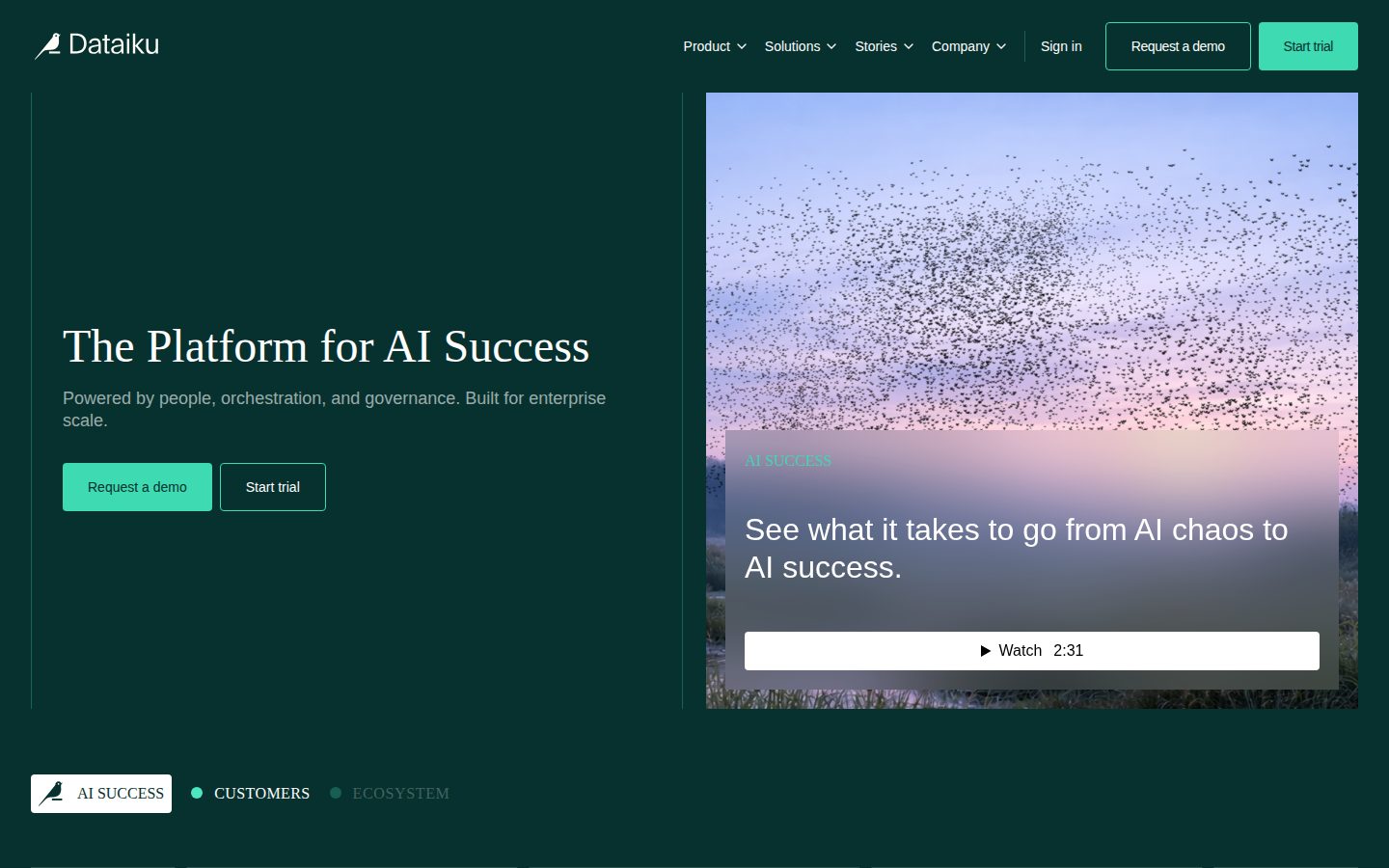
The Platform for AI Success tagline is buzzy, but the pillar breakdown (People, Orchestration, Governance) maps to shipped features.
2013 founding, $1B raised over nine rounds, ~$350M ARR — matches the survivor pattern, not the burn-and-vanish one.
Mid-to-large enterprises who need governed end-to-end ML on hybrid data.
Solo analysts who want a self-serve credit-card AutoML tool.
Common questions answered by our AI research team
The content mentions Dataiku's LLM Mesh in the context of Novartis using it to 'revolutionize healthcare market research,' but does not specify whether it supports integration with external LLM providers or is limited to models built within the platform.
Dataiku's governance capabilities include 'unified visibility, cost controls, and audit-ready oversight' applied 'across all AI inside Dataiku and beyond it.' The platform allows users to 'see everything, control cost, and mitigate risk' with consistent governance across AI systems, including agent execution.
The content states that Dataiku's People pillar enables 'domain experts to self-serve AI' while 'experts build and deploy faster,' but does not provide specific details about the setup process or whether engineering support is required during onboarding.
The content states that Dataiku helps 'move analysts off spreadsheets and legacy desktops without disruption,' with 'AI-assisted, governed pipelines' that 'preserve institutional knowledge and deliver trusted insights at enterprise scale.' This suggests existing analyst workflows can be modernized without disrupting current processes.
Company
DataikuFounded
2013Pricing
Contact for pricingFree Trial
AvailableFree Plan
AvailableDataiku is a New York-based enterprise AI and machine learning platform that unifies data preparation, modeling, and deployment for data science teams.