Enterprise AI agents for customer support across chat, SMS, email, and voice
Decagon is an enterprise AI customer support platform for companies that want to automate and resolve customer interactions at scale.
AI Panel Score
6 AI reviews
Reviewed
In practice, businesses connect Decagon to their existing support channels and knowledge sources. The AI agents handle incoming customer queries by generating context-aware responses, performing actions inside connected systems, and escalating to human agents when needed. The platform includes built-in routing, quality assurance tools, and an insights layer that tracks conversation outcomes.
Decagon's core differentiator is what it calls an AI agent engine that functions as a data flywheel — each resolved interaction feeds back into the system to improve future responses. The platform also emphasizes transparency, giving operators visibility into how and why the agent responded in a given way. Security and data privacy controls are positioned as first-class features, which the company highlights as reasons why financial services and other regulated industries use the product. Decagon has partnerships with both OpenAI and Anthropic.
Decagon targets enterprise and growth-stage companies, with documented customers including Rippling, Vanta, Substack, ClassPass, and Bilt. The platform appears to be sold on a contact-for-pricing basis, with no publicly listed subscription tiers. Competitors in the AI customer support agent category include Intercom Fin, Zendesk AI, and Sierra.
Decagon exposes an API for developers and provides dedicated API documentation. The platform is accessed via web and integrates into existing support stacks rather than replacing them wholesale.

A comprehensive AI agent engine that acts as a data flywheel, enabling continuous improvement and intelligent customer interactions.
AI agents learn from each interaction over time to improve response accuracy and personalization.
Deploys enterprise-grade AI agents that handle customer interactions with context-awareness and empathy across multiple channels.
Provides insights into customer support interactions and agent performance to inform decision-making.
Built-in QA capabilities to monitor and evaluate the quality of AI agent interactions.
Agents can automatically update knowledge bases in real time as part of resolving customer issues.
Agents can take real-time actions such as creating tickets and updating knowledge bases to resolve customer issues.
Routes customer conversations to the appropriate destination or agent based on context and need.
AI agents operate across chat, SMS, email, and voice channels to handle customer support interactions.
Offers transparency into AI decision-making to build trust with customers and avoid black-box behavior.
Provides a documented API enabling developers to integrate and extend Decagon features into their own systems.
Enterprise-grade security and scalability designed to meet high standards of data privacy for large organizations.
Enterprise-grade AI platform for world-class companies seeking to enhance customer experience with advanced conversational AI agents across chat, SMS, email, and voice channels.
Enterprise AI support with real traction, but pricing opacity makes the board conversation harder.
“Founded in 2023, Decagon has landed names like Rippling and Vanta. No public pricing means every conversation starts with a negotiation.”
Founded in 2023. Customers include Rippling, Vanta, Substack, and Bilt. That's not a demo reel — that's a company that can close. Partnerships with both OpenAI and Anthropic suggest they're not betting the architecture on one model provider, which is smart risk management at this stage.
The data flywheel framing is the real pitch. Each resolved interaction feeds back to improve future responses — that's not just a feature, that's a defensible moat if it actually compounds. Transparent AI decision-making and built-in QA give regulated-industry buyers a reason to say yes. That's why financial services shows up in their customer story.
The tradeoff: no public pricing, no free trial, and founded two years ago. Against Intercom Fin or Zendesk AI, procurement teams will ask hard questions about longevity. Pilot it with one support channel before any enterprise commit.
Differentiated from Zendesk AI and Intercom Fin on the data flywheel and dual OpenAI/Anthropic model flexibility.
Rippling and Vanta on the customer list makes this defensible to any board; peers won't raise eyebrows.
Agent Operating Procedures in natural language should compress implementation time, but contact-only pricing means discovery adds weeks.
Multi-channel AI agents with a continuous learning engine advance automation strategy, not just cost reduction on existing workflows.
Founded 2023 with marquee customer logos, but no public funding data and two years in-market is still early for enterprise bets.
Growth-stage or enterprise teams with complex multi-channel support volume and a budget for a negotiated contract.
You need transparent pricing upfront or can't absorb vendor risk on a two-year-old company.
Decagon's flywheel architecture and AOP framework make it a serious enterprise deflection bet.
“Founded in 2023, Decagon targets enterprises that need omnichannel AI resolution — not just containment. The AOP-based workflow definition and data flywheel model suggest a team that understands how CS operations actually mature over time.”
Agent Operating Procedures written in natural language is the right design call. Complex configuration languages are where AI support deployments go to die — implementation drags, QA ownership falls through the cracks, and the CS team ends up dependent on solutions engineers forever. The fact that Decagon's AOP layer lets operators define workflows without engineering handoffs signals that someone on their product team has lived inside a CS org.
The flywheel claim matters more than it sounds. Continuous learning tied to resolved interactions means CSAT and deflection rate compound over time — which is the actual ROI story I need to take to my CFO. Real-time action execution (ticket creation, KB updates) pushes resolution quality past what Intercom Fin does at its standard tier.
Contact-only pricing with no public tiers is the friction point. I can't build a business case without a number, and that slows my stakeholder process. Right fit for regulated-industry enterprises at scale — wrong fit for teams that need a fast procurement cycle.
Documented enterprise customers including Rippling and Vanta position Decagon above mid-market tools, competing directly with Zendesk AI on regulated-industry credibility.
AOPs, built-in QA, and escalation routing map directly to how enterprise CS teams structure their tier-1 automation programs.
API access and stack-augmentation positioning are right, but no public changelog or docs portal makes it hard to assess integration maturity pre-contract.
Dual partnerships with OpenAI and Anthropic reduce model lock-in risk, but deep platform integration means switching costs compound after year one.
Transparent AI decision-making plus the data flywheel model shows architectural thinking beyond basic LLM wrapping.
Enterprise CS leaders in regulated industries — fintech, SaaS, financial services — running high-volume omnichannel support who need auditable AI workflows and measurable deflection.
Your procurement process requires transparent public pricing or a sandboxed trial before budget approval.
Zero public pricing. 100% sales-gated. Budget unknown until Q4 crunch.
“No published tiers, no starting price, no trial. Every number lives behind a sales call.”
Contact-for-pricing in 2025 means one thing: you won't know the number until they know your budget. No tiers, no floor, no ceiling on their pricing page. Compare that to Intercom Fin, which publishes resolution-based pricing openly. Decagon gives you nothing to model before the demo.
TCO is opaque by design. For a 50-seat support team, category norms run $30-80/seat/month for AI-augmented platforms — that's $18K-$48K/year before integrations, onboarding, and the QA layer they're selling as a feature. Year 3 with seat creep and expansion channels could double that. No public overage rate. No published add-on costs. That's the real risk.
The data flywheel and multi-channel coverage across chat, SMS, email, and voice are legitimate enterprise features. Rippling and Vanta as named customers signals real deployment credibility. But no free trial, no self-serve, and no contract terms visible publicly. Procurement teams will spend 6 weeks in legal before a single agent goes live.
No free trial, no self-serve, no published invoicing model — procurement friction is high by design.
No public auto-renewal terms, cancellation policy, or term length — all negotiated behind closed doors.
No tiers, no floor price, no published rates — contact-only across the board.
Insights and QA features plus the data flywheel model provide measurable resolution metrics, but no published benchmarks to pre-validate the ROI story.
Category norms suggest $18K-$48K/year for 50 seats, but no public data confirms Decagon's actual structure or overage terms.
Enterprises with a defined AI support budget, procurement bandwidth, and 6+ weeks for legal review.
You need a budget number before next quarter's planning cycle.
Decagon's agentic depth is real, but opaque pricing walls out every SMB queue manager
“Founded in 2023, Decagon targets enterprise support orgs with genuine agentic capability across chat, SMS, email, and voice. The data flywheel differentiator is compelling, but zero public pricing and no free trial means you're flying blind until a sales call.”
The Agent Operating Procedures feature is the first thing I'd test on day three. Natural-language workflow definitions that don't require a config language — that's the difference between a support lead owning their own escalation logic versus waiting two weeks for a developer ticket. That's real daily leverage.
Workflow integration depends entirely on what your stack looks like. Real-time ticket creation, KB updates, and routing inside connected systems means Decagon is extending your queue, not replacing it. That's the right architecture. Compared to Zendesk AI, which lives inside Zendesk's own walls, Decagon's stack-agnostic posture matters. The transparent AI decision visibility also means QA review sessions won't turn into black-box arguments with your team.
The friction is structural: no public pricing, no changelog, no free trial, and the docs capability flag shows N. For a support agent trying to build a business case internally, that's a hard wall. Intercom Fin lets you pilot before committing. Decagon doesn't, based on available evidence.
AOPs and continuous learning suggest the tool gets more useful over time, but the absence of a changelog makes it impossible to know how fast improvements actually ship.
Docs capability is flagged N on the site scrape, and the buyer Q&A reads marketing-first — AOPs are described in value language, not task language.
No public docs, no self-serve trial, and contact-only pricing add friction before you even get to day one; the daily tool friction is unknowable from public evidence.
API access, QA tooling, transparent AI decision traces, and the data flywheel architecture all suggest real depth for operators who want to tune and audit at scale.
Real-time action execution across chat, SMS, email, and voice with native routing fits how multi-channel support queues actually run.
Enterprise or growth-stage support orgs with complex multi-channel queues and budget to evaluate through a sales process.
You need to pilot before buying or benchmark cost-per-resolution against Intercom Fin on a fixed budget.
Enterprise AI support that actually does things, not just talks
“Decagon is a serious enterprise play with real-action AI agents across chat, SMS, email, and voice. No public pricing, no free trial — this is a sales-call product, not a sign-up-and-explore one.”
Founded in 2023, Decagon is already running at companies like Rippling and Vanta, which tells you something. This isn't a demo-ware startup. The AI agent engine with its data flywheel claim — every resolved interaction feeding back to improve future ones — is the kind of thing that sounds like marketing until you see the customer list. Multi-channel from day one, including voice, which competitors like Zendesk AI still feel shaky on.
The transparency angle is genuinely interesting. Seeing *why* an agent responded a certain way matters when you're running support at scale and something goes sideways. That's not a feature most teams think about until month four, when a weird response goes viral.
The tradeoff is real though: no pricing page, no free trial, no changelog visible. You're flying blind until someone calls you back. For a solo operator or a lean startup, Intercom Fin exists and has a number attached to it. Decagon is for companies ready to buy, not evaluate.
The Transparent AI feature and QA layer suggest someone thought about the daily operator experience, but no changelog and no visible docs page makes the polish hard to verify.
Agent Operating Procedures in natural language is a genuinely smart call — lowers the configuration ceiling without requiring developers for every workflow change.
Listed as web-only platform — mobile parity for operators appears to be an afterthought, even though the agents themselves serve customers over SMS and voice.
No free trial and contact-for-pricing means onboarding starts with a sales call — that's homework before you've even seen the product.
Enterprise-grade security positioning and named financial services customers like Bilt suggest solid uptime expectations, though no public status page or changelog is visible.
Growth-stage or enterprise support teams ready to automate at volume and willing to engage a sales process.
You need to evaluate tools quickly, self-serve, or you're a small team without budget for an enterprise contract.
Founded 2023, no pricing page, no changelog — but the customer list is real
“Decagon has the right enterprise customers and a coherent differentiation story. The opacity around pricing, shipping cadence, and public funding makes a long-term bet harder to justify.”
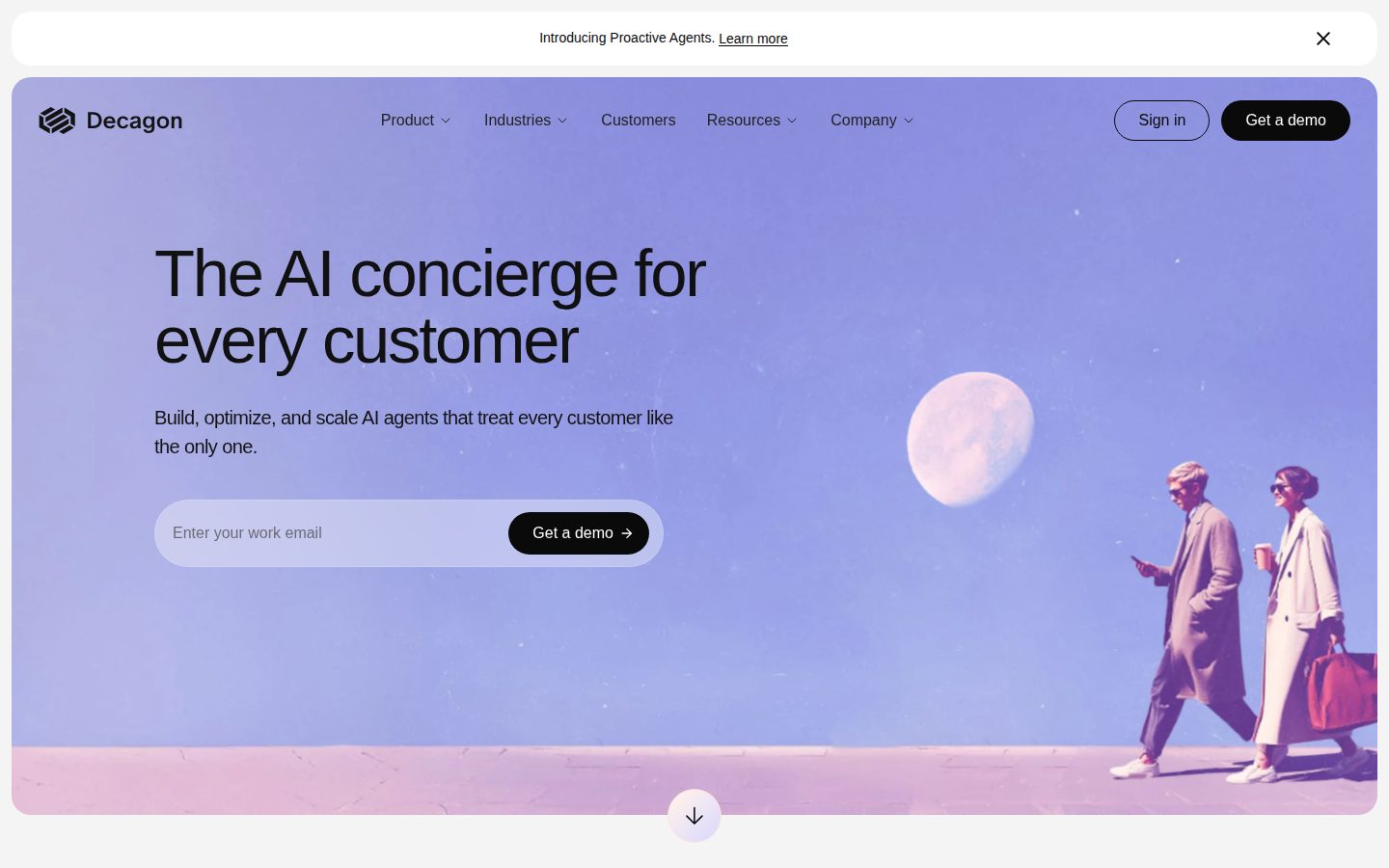
Three tells upfront. One: founded 2023, contact-for-pricing, no changelog visible. Two: 'AI concierge for every customer' is the kind of headline that sounds like a pitch deck round two. Three: docs=N on the scrape, despite an API claim. That last one I'd verify before signing anything.
The customer list softens my skepticism — Rippling, Vanta, Bilt aren't logos you slap on a landing page and survive. The data flywheel angle and Agent Operating Procedures in natural language are specific enough to not be vaporware. Intercom Fin and Zendesk AI are the obvious comparison; both have longer track records and public pricing. Sierra is the real competitor to watch — same 2023-era enterprise AI support play, similar opacity.
Exit portability is the real risk. Contact pricing, no public tiers, no changelog cadence — if direction shifts in 18 months, migration off a deeply embedded voice-plus-email-plus-chat agent stack is painful. Not impossible, but painful. Watch carefully.
Agent Operating Procedures and the data flywheel framing are specific differentiators vs. Intercom Fin's rule-based roots, though Sierra runs an almost identical play.
Multi-channel embedding across voice, chat, SMS, and email with contact-only pricing creates deep lock-in and no clear migration path.
No public funding data, no changelog, founded 2023 — OpenAI and Anthropic partnerships are a positive signal but don't substitute for shipping evidence.
'AI concierge for every customer' is aspirational language; no pricing page and no changelog undercut the enterprise credibility claim.
Named customers including Rippling and Vanta are credible 2023-era enterprise deployments, matching the pattern of category survivors rather than vaporware.
Mid-market or enterprise teams in regulated industries that need multi-channel AI support and have budget to absorb contact-pricing opacity.
You need transparent pricing, a visible shipping cadence, or a clean exit path before committing.
Common questions answered by our AI research team
Decagon supports voice, chat, and email channels, unified within a single intelligence layer to keep customer experiences consistent across every channel.
Agent Operating Procedures (AOPs) let you define agent workflows in natural language, enabling faster time to value, greater transparency, and trusted results at scale without complex configuration languages.
Yes, Decagon Voice agents are fully customizable to your brand, as noted in Chime's deployment where brand customization was combined with cross-channel memory.
Decagon is a San Francisco-based AI platform that builds autonomous customer service agents for enterprises, handling support interactions across chat, email, voice, and SMS channels.