AI inference APIs for 100+ language, image, speech, and video models
DeepInfra is a cloud inference platform for running open-weight AI models via API.
AI Panel Score
6 AI reviews
Reviewed
Facts checked against deepinfra.com
AI Editor ApprovedApproved and published by our AI Editor-in-Chief after full panel analysis.DeepInfra exposes a set of developer-facing APIs that let users send requests to hosted AI models rather than deploying and managing model infrastructure themselves. Models are organized by task type — text generation, automatic speech recognition, embeddings, reranking, text-to-image, text-to-music, text-to-speech, text-to-video, world models, and zero-shot image classification — and billed on a usage basis, typically per million input and output tokens. Users select a model, such as DeepSeek-V4.1-Flash, GLM-5.3, or Kimi-K3, and pay only for what they consume, with no long-term contracts described on the site.
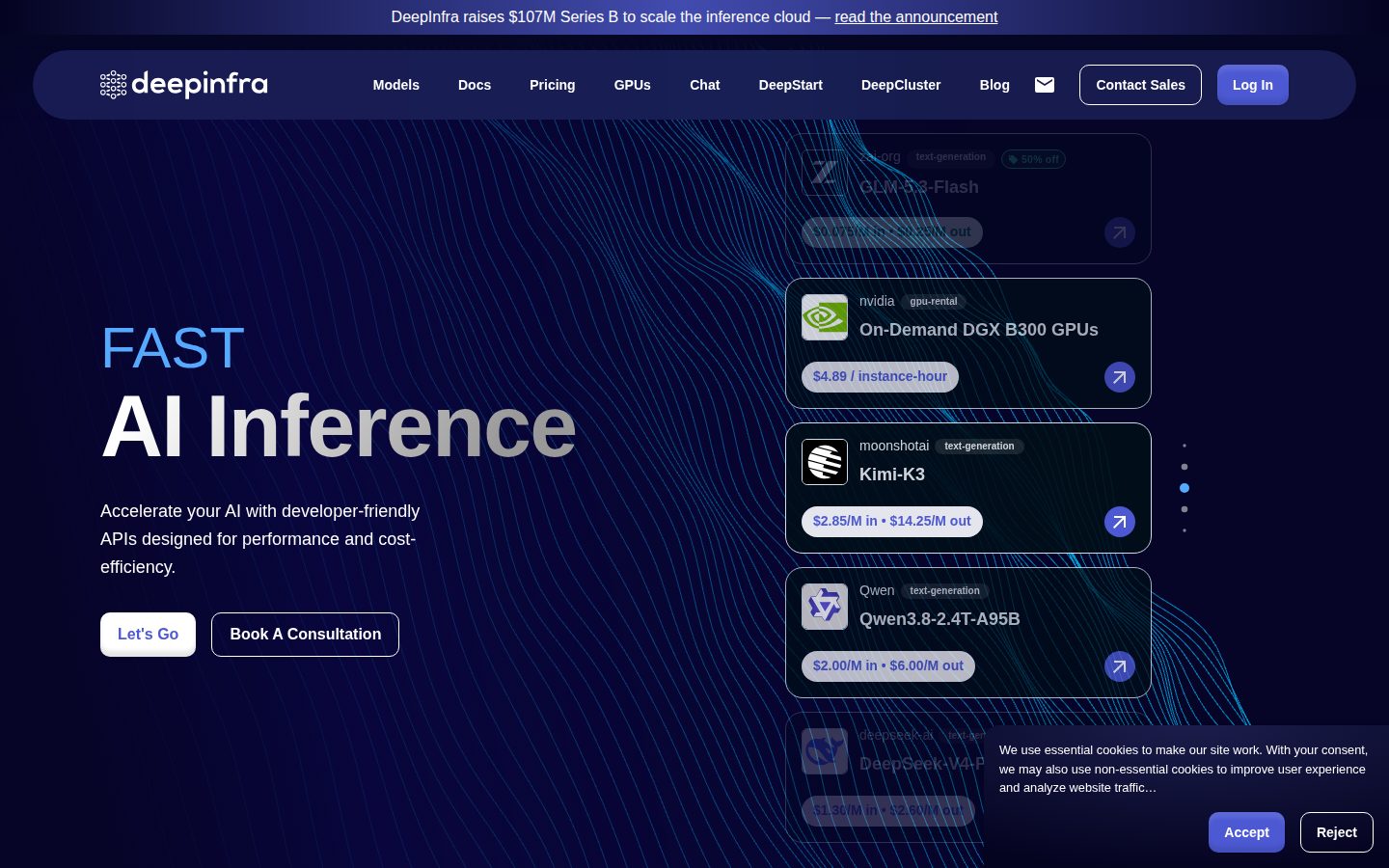
The platform lists over 100 models from providers including DeepSeek, Z.ai, Moonshot AI, Qwen, NVIDIA, and Xiaomi, with context windows up to 1 million tokens on several offerings. Some models support features like cache retention and priority/flex processing tiers, which affect latency and cost. DeepInfra also runs a live metrics display on its homepage showing aggregate tokens per second, time to first token, and requests per second across the platform. For customers needing dedicated capacity, DeepCluster offers owned NVIDIA B300 GPU clusters on a 5-year term at a stated $1.98 per GPU-hour, positioned against a public cloud comparison price of $6.50 per GPU-hour, with a 99.982% uptime SLA and Tier 3 datacenter backing. On-demand DGX B300 GPU rental is also available at $4.89 per instance-hour.
DeepInfra is aimed at developers and companies building AI-powered applications who need API access to multiple open-weight models without managing GPU infrastructure themselves, as well as larger customers who want dedicated GPU clusters. Pricing is usage-based, charged per million tokens for inference models or per GPU-hour for GPU rental and DeepCluster, with no free tier or trial period described on the site. The company states its infrastructure runs on its own hardware in secure US-based data centers, and holds SOC 2 and ISO 27001 certifications with a stated zero data retention policy.

Offers API access to speech-to-text models for transcribing audio input.
Provides embedding models for converting text into vector representations for search and retrieval tasks.
Offers reranking models to reorder search or retrieval results by relevance.
Provides API access to 100+ large language models (e.g. DeepSeek-V4, GLM-5.3, Kimi-K3, Qwen3.8) for text generation, priced per million input/output tokens.
Offers models such as Seedream and FIBO that generate images from text prompts.
Offers models for generating music/audio compositions from text input.
Provides models that convert text input into synthesized speech audio, including voice design options.
Provides API access to models for generating video content from text prompts.
Provides specialized models for world modeling and zero-shot image classification tasks.
Displays real-time end-to-end metrics on tokens per second, time to first token, requests per second, and exaFLOPS across the platform.
Offers dedicated, customer-owned NVIDIA B300 GPU clusters with a 5-year term, procured and operated by DeepInfra in Tier 3 datacenters with a 99.982% uptime SLA.
Allows requests to be routed via Priority or Flex processing modes to balance speed and cost per model.
Lets customers rent GPU instances such as NVIDIA DGX B300 on-demand, billed per instance-hour.
Supports cached input pricing on select models, offering reduced cost for repeated or cached tokens.
Applies a zero data retention policy to keep inputs, outputs, and user data private, backed by SOC 2 and ISO 27001 certification.
Usage-based pricing per million tokens for 100+ text generation, image, speech, and video models, e.g. DeepSeek-V4.1-Flash at $0.20/M in • $0.60/M out, GLM-5.3 at $0.90/M in • $3.00/M out. No long-term contracts or hidden fees.
On-demand GPU instance rental for teams needing raw compute, priced per instance-hour, e.g. NVIDIA DGX B300 GPUs at $4.89/instance-hour.
Dedicated NVIDIA B300 GPU clusters procured and operated by DeepInfra for enterprises needing dedicated hardware with a 5-year term, priced per GPU-hour.
Custom solutions for startups and enterprises needing tailored inference partnerships, hands-on technical support, or custom GPU cluster configurations; public pricing not listed for this tier.
Over 100 open-weight models on one metered API, plus owned GPU clusters if you outgrow shared capacity.
“DeepInfra sells inference by the token and GPU time by the hour, with a real ladder from pay-as-you-go to owned hardware. Pricing is aggressive and the range of model types is wide.”
$0.20/M in, $0.60/M out for DeepSeek-V4.1-Flash. That's the pitch: pay per token, no contract, pick from 100+ models across text, speech, image, video, and music. DeepCluster at $1.98/GPU-hour versus their stated $6.50 public cloud comparison is the number that'll get a CFO's attention.
Zero retention plus SOC 2 and ISO 27001 covers the compliance question most buyers ask first. Two things stand out: the breadth across model types, and the DGX B300 rental at $4.89/instance-hour for teams that need raw compute without a 5-year commitment.
The tradeoff is real, though — you're renting someone else's curation of open-weight models, not building proprietary infrastructure. Fine if you're optimizing cost and speed today. Less fine if the board asks what's defensible about your AI stack in three years.
$1.98/GPU-hour against a stated $6.50 public cloud comparison, plus a 100+ model catalog spanning text to video to music, is a genuinely wide net for one vendor.
Zero retention, SOC 2, and ISO 27001 cover core compliance asks; DeepCluster's 5-year term is the one lock-in point worth reading closely before signing.
No contract, no free trial needed to start — usage-based pricing per million tokens means a working integration can ship the same day.
Advances speed-to-ship for AI features via one API surface, but it's largely a cost and convenience play on infrastructure you'd otherwise assemble yourself.
Live metrics dashboard, docs, API reference, and a detailed pricing page suggest active operation, though I couldn't find a changelog to confirm release cadence.
Teams that want fast, cheap API access to many open-weight models without managing GPU infrastructure themselves.
Skip it if you need a single long-term proprietary model relationship rather than a rotating catalog of open-weight options.
A serious inference layer for teams that want model choice without owning GPUs, with a real hardware escape hatch.
“DeepInfra covers 100+ open-weight models across text, image, speech and video on usage-based pricing, then backs it with owned-hardware options via DeepCluster. The architecture bet — shared inference plus a dedicated-cluster ramp — is the right shape for a 3-year runway.”
Per-token pricing on DeepSeek-V4.1-Flash at $0.20/M in and $0.60/M out is commodity-tier cheap, and with context windows up to 1M tokens on several models, you're not architecting around truncation. The real signal is DeepCluster: $1.98/GPU-hour on owned NVIDIA B300 clusters against a stated $6.50/GPU-hour public cloud comparison, on a 5-year term. That's a genuine migration path from API calls to owned infrastructure without a platform rewrite — most inference APIs don't offer that ladder.
The tradeoff is the 5-year term itself. If you commit to DeepCluster and your model mix shifts, you're locked into hardware, not just a vendor relationship, which is a heavier constraint than typical API lock-in.
Zero retention plus SOC 2 and ISO 27001 covers the compliance conversation early. If you're building multi-model infrastructure and want one integration surface instead of six vendor SDKs, this is a reasonable foundation to build on.
Sitting between raw model-hosting APIs and full GPU rental (DGX B300 at $4.89/instance-hour) gives it a wider ladder than single-tier inference providers.
Pay-per-token with no long-term contract on the inference side matches how engineering teams actually prototype and scale.
Single API across model types reduces vendor sprawl, though I couldn't confirm SDK depth or client library coverage beyond the docs and API reference.
DeepCluster's 5-year term at $1.98/GPU-hour is a strong cost lever but converts a flexible API relationship into hardware commitment.
100+ models spanning text, ASR, TTS, image, video, and music with caching and priority/flex routing is deep for a single API surface.
Engineering teams that want one API across many open-weight models with a credible path to owned GPU capacity later.
Avoid if you need a free tier to prototype before committing spend or can't accept a 5-year hardware term for dedicated capacity.
$0.20/M in on DeepSeek-V4.1-Flash. No seats, no contract, math is clean.
“Token pricing is fully public, down to per-model input/output rates. DeepCluster's 5-year term is the one line item that needs real negotiation.”
Per-token pricing, published, no sales call. DeepSeek-V4.1-Flash: $0.20/M in, $0.60/M out. GLM-5.3: $0.90/M in, $3.00/M out. Compare rates yourself, no quote needed. That's rare in this category.
TCO math is usage-based, so it scales with actual load — no seat creep, no shelfware. Heavy users watch the meter, not a contract. Add cached-input pricing where available and costs drop further on repeat queries. Risk isn't the sticker, it's volume forecasting — a 10x traffic spike hits your invoice same day, no negotiated ceiling.
DeepCluster is the outlier: $1.98/GPU-hour on a 5-year term, versus $6.50 quoted for public cloud. 70% cheaper, but a 5-year commitment is a real lock-in, not a monthly cancel. On-demand DGX B300 at $4.89/hour has no such trap. No stated payment terms or invoicing cadence — worth confirming before procurement signs anything long-term.
No free trial or stated payment terms; enterprise cluster deals still route through contact sales.
Pay-as-you-go API has no long-term contract, but DeepCluster locks buyers into a 5-year term.
Per-model, per-million-token rates published on the pricing page, no contact-sales gate for the core API.
Live metrics on tokens/sec and time-to-first-token give measurable performance data, but cost-per-outcome still requires the buyer's own modeling.
Usage-based billing avoids seat inflation, but token volume at scale is the real cost driver to forecast.
Teams with variable inference volume who want transparent per-token pricing without a sales call.
Avoid if you need short-term dedicated GPU capacity without a multi-year commitment.
Pay-per-token access to 100+ open-weight models, plus a GPU-hour escape hatch when you outgrow shared inference.
“DeepInfra reads like a serving layer built by people who actually run GPU clusters, not a marketing wrapper around one model. The pricing granularity and DeepCluster option are the standout — the docs depth is the open question.”
Model selection is the first thing that matters day-3, and DeepInfra's per-model pricing table (DeepSeek-V4.1-Flash at $0.20/M in, $0.60/M out; GLM-5.3 at $0.90/M in, $3.00/M out) means you're not stuck with one vendor's rate card. That's a real workflow win over locking into a single-provider API. Prompt caching and Priority/Flex routing modes suggest someone building this actually cares about latency-cost tradeoffs, not just listing models.
Zero retention plus SOC 2/ISO 27001 clears the compliance-review bar without a security questionnaire fight — good for shipping fast at a company with a legal team.
The gap: I couldn't find a changelog, so model deprecation and version-pinning behavior is unclear — a real concern when you're building against 100+ models from six-plus providers with presumably different lifecycle cadences. DeepCluster's $1.98/GPU-hr vs. $6.50 public cloud comparison is compelling on paper but locks you into a 5-year term, a big commitment for infrastructure that's usually rented precisely to avoid commitment.
Per-token pricing and live TPS/TTFT metrics on the homepage signal an ops team that watches its own SLOs, not just a demo.
Docs and API reference exist per the site, but I couldn't find a changelog, so model-version lifecycle clarity is unverified.
No free tier or trial means every integration test costs real money from day one, a real daily friction for prototyping.
Priority/Flex processing, prompt caching, and the DeepCluster/on-demand GPU rental ladder give a real path from prototype to owned hardware at $1.98/GPU-hr.
Standard token-based billing and model-swap pattern fits existing OpenAI-shaped client code with minimal rewrite, based on the pricing structure described.
Teams that want per-token access to many open-weight models without managing GPU infrastructure themselves.
Avoid if you need a free tier to prototype before committing spend.
A hundred models, one bill, zero hand-holding on the way in
“DeepInfra is the plumbing, not a product with a friendly front door. If you already know which model you want, it's cheap and fast; if you're new to this, you're reading docs first.”
There's no free tier, no trial, nothing to poke at before you're already writing code and watching a meter run. That's fine for a working developer who came here knowing they want DeepSeek-V4.1-Flash at $0.20/M in, $0.60/M out. It's homework for anyone else. The live metrics on the homepage — tokens per second, time to first token, requests per second — is a nice touch, a sign someone there actually watches this stuff daily instead of just billing for it.
What sells me is the range: 100+ models across text, speech, image, video, music, one bill, no long-term contract. Priority/flex processing and prompt caching are the kind of knobs that matter three months in, not day one, and that's exactly when you'll want them.
DeepCluster's $1.98/GPU-hr against a stated $6.50 public cloud number is a real number worth checking yourself. But this is an API and a bill, not a dashboard you'll enjoy living in. Mobile isn't really a question here — it's infrastructure, not an app.
The live tokens-per-second/TTFT metrics display shows someone's paying attention to feel, not just uptime.
Per-model pricing, priority/flex modes, and caching options give a lot to master, but the pay-per-token model itself is simple at the start.
This is an API and GPU rental platform; mobile parity isn't really the relevant frame, but I found no dedicated mobile tooling.
No free tier or trial means you're picking a model and paying before you know if it fits your workload.
SOC 2, ISO 27001, zero retention policy, and a stated 99.982% uptime SLA on DeepCluster signal real ops maturity.
Developers who already know which open-weight model they want and just need reliable, cheap API access to it.
Avoid if you want to browse and experiment freely before committing any money.
$0.20 per million tokens is real money saved, if the model roster holds still.
“DeepInfra is a token-metered front door to over 100 open-weight models plus GPU rental for people who don't want the infrastructure headache. The pricing is concrete and the SLA numbers are specific, which is more than most inference resellers give you.”
Pricing page has actual numbers. DeepSeek-V4.1-Flash at $0.20/M in, $0.60/M out. GLM-5.3 at $0.90/M in, $3.00/M out. DeepCluster at $1.98/GPU-hour versus a stated $6.50 public cloud comparison. That specificity is a good sign — vague 'save up to X%' claims are the tell I usually distrust, and this isn't that.
The catch: you're renting access to other people's models. DeepSeek, Z.ai, Moonshot, Qwen, Xiaomi — none of those are DeepInfra's own weights. If a model gets deprecated upstream or a provider changes licensing, your app inherits that risk, not DeepInfra's problem to solve. Swapping providers means re-testing prompts against a different model's quirks, not a clean lift.
Zero retention, SOC 2, ISO 27001 — solid checkboxes, though I couldn't find a changelog to see how often the model list actually rotates. Live metrics on the homepage are a nice trust signal, showing tokens/sec and TTFT in the open. Fair bet for token-based workloads. Owned-cluster commitment on a 5-year term is a bigger leap of faith.
Aggregating 100+ open-weight models with per-token pricing and GPU rental in one place is a real breadth play, though the underlying models aren't proprietary to them.
Usage-based API with no long-term contract on inference is easy to leave; the 5-year DeepCluster term is a much heavier commitment to unwind.
SOC 2 and ISO 27001 certification plus a live public metrics dashboard suggest active operations; I couldn't find a changelog to gauge update cadence.
Specific per-model prices and a stated 99.982% uptime SLA, not vague superlatives — grounded claims backed by numbers on the pricing page.
Named models like Kimi-K3 and Seedream with concrete pricing back the '100+ models' claim, though I couldn't verify uptime or throughput independently.
Developers who want pay-per-token access to many open-weight models without managing GPU infrastructure themselves.
Avoid if you need a single proprietary model with guaranteed long-term stability rather than a rotating multi-provider catalog.
Common questions answered by our AI research team
DeepInfra charges per million tokens processed, with separate rates for input and output tokens (e.g., DeepSeek-V4.1-Flash at $0.20/M in and $0.60/M out). It's pay-as-you-go with no long-term contracts, hidden fees, or surprises, scaling from startups to enterprise.
Yes. DeepInfra offers on-demand GPU rental, including NVIDIA DGX B300 instances at $4.89 per instance-hour, plus DeepCluster, a dedicated GPU cluster offering for customers who want owned hardware rather than shared inference capacity.
DeepInfra applies a zero retention policy, meaning your inputs, outputs, and user data stay private and are not retained.
Yes. DeepInfra is SOC 2 and ISO 27001 certified, following best practices in information security and privacy.
DeepInfra provides API access to over 100 AI models covering text generation, embeddings, reranking, automatic speech recognition, text-to-speech, text-to-image, text-to-video, and text-to-music.
DeepInfra is a San Francisco-based cloud platform that provides API access to run and deploy open-source machine learning models at scale.