Hosted chat and API access for DeepSeek, outside the official service
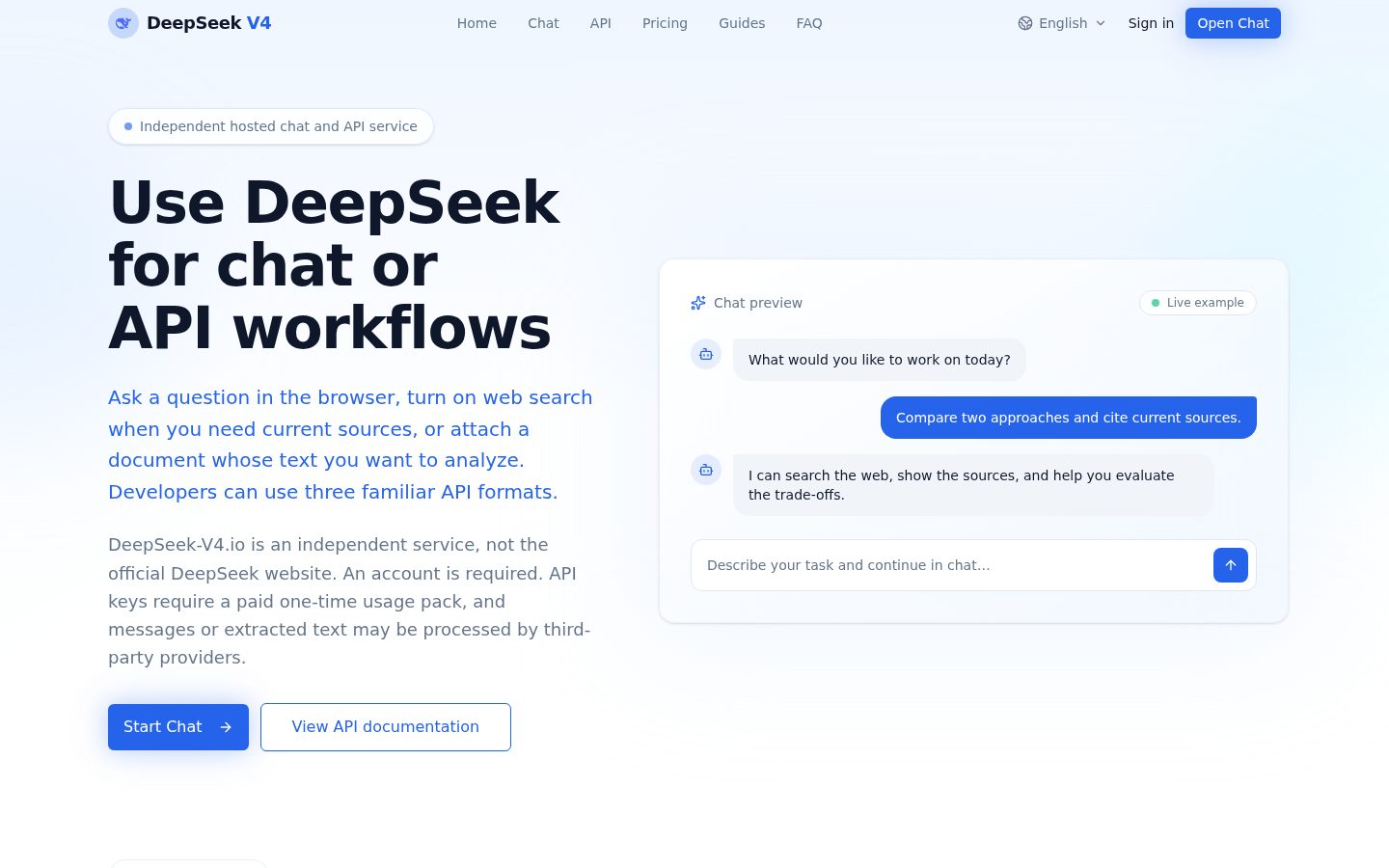
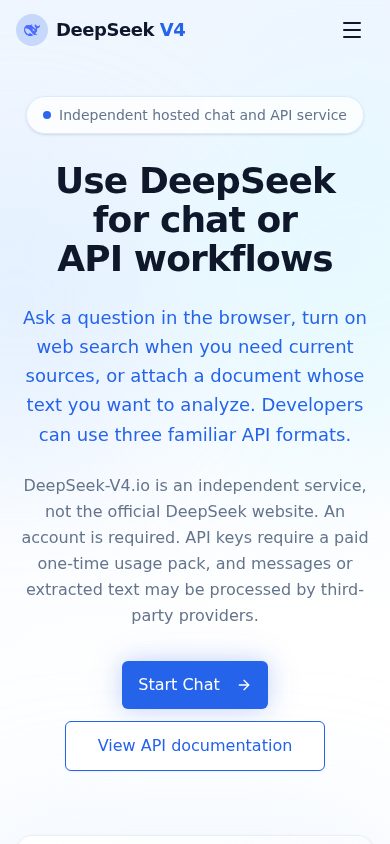
DeepSeek-V4.io is an independent hosted chat and API gateway for working with a DeepSeek model.
AI Panel Score
6 AI reviews
Reviewed
Facts checked against deepseek-v4.io
AI Editor ApprovedApproved and published by our AI Editor-in-Chief after full panel analysis.Using the hosted chat, a visitor creates an account with Google sign-in or email verification, then asks questions in a saved, multi-turn conversation. Web Search can be turned on when a question needs current information, in which case the response lists the sources returned by the search provider; files such as PDFs, documents, or spreadsheets can be attached when the question depends on their text, up to five files per upload, 5 MB per file, and a 10 MB combined limit. Conversations can be downloaded as Markdown and the interface supports a language preference setting.
For developers, the site exposes a base URL (https://deepseek-v4.io/api/v1) and a public model ID (deepseek-v4-flash) accessible through three API formats: an OpenAI-compatible Chat Completions endpoint with streaming and tool calls, a Responses API format with tool-call support, and an Anthropic Messages request format that the site states is not a complete equivalent of the official Anthropic service. A short, billed connection test is available right after creating an API key. The service does not currently support image input, image generation, or OCR for scanned PDFs, so uploaded PDFs must contain a readable text layer.
The product targets people and developers who want to try or integrate a DeepSeek model without going through the official DeepSeek or OpenRouter accounts, which the site explicitly notes are separate systems from its own accounts, API keys, and balances. New accounts receive a 10K signup balance for trying the hosted chat at no cost, but creating an API key requires purchasing a one-time usage pack; there is no recurring subscription, and actual usage cost depends on the volume of text processed.

Can be toggled on to pull current information from a search provider and display cited sources alongside the response.
Lets developers create and manage API keys after purchasing a usage pack, using a base URL and public model ID.
Allows attaching PDFs, documents, and spreadsheets (up to 5 files, 5MB each) so their text can be analyzed in chat.
Lets users ask questions in a browser-based interface and hold saved, multi-turn conversations.
Enables exporting chat responses as Markdown files.
Grants new accounts a 10K signup balance to try the hosted chat before purchasing a usage pack.
Uses a single account balance to fund both hosted chat usage and API requests, with no recurring subscription.
Lets users set a preferred language for interactions with the assistant.
Supports an Anthropic Messages-style request format for compatible integrations.
Provides an OpenAI-compatible chat endpoint supporting streaming and tool calls.
Offers a Responses API format endpoint with tool-call support for developers.
Provides a short, billed test to verify a newly created API key works before integrating it into an application.
Try the hosted chat before buying usage
Small first test or continuing a task, lowest upfront price
Default choice for ongoing code, document and API work
For teams and high-volume applications needing lowest unit price
A middleman reselling DeepSeek access on prepaid token packs, not a product that extends what DeepSeek already offers.
“Three API formats and a 10,000-token free chat balance make this easy to try. But it's a resale layer on someone else's model, and that's the whole pitch.”
DeepSeek-V4.io is a gateway, not a model. You get hosted chat, web search with cited sources, document upload (5 files, 5MB each, 10MB combined), and three API formats — Chat Completions, Responses, and Anthropic Messages, the last one explicitly flagged as not a full equivalent of the real thing.
Pricing is one-time packs, not subscription: $10 for 5M tokens, $29 for 20M, $79 for 75M. No recurring bill is a real plus for testing. But API keys require a paid pack even after the 10K signup credit runs dry — the free tier is chat-only.
The tradeoff is obvious: you're paying a markup-or-discount layer for access you could get direct from DeepSeek or through OpenRouter. No OCR, no image input. Fine for quick text-based prototyping, not a platform bet.
Three API formats including Anthropic Messages is a genuine convenience, but the vendor itself admits that format isn't a true equivalent.
Accounts, keys, and balances are explicitly separate from official DeepSeek or OpenRouter systems, which is a lock-in and portability concern for production use.
10,000 free signup tokens and a $10 starter pack let you test chat and API in minutes with no subscription commitment.
This mostly saves a signup step versus going direct to DeepSeek or OpenRouter — it doesn't add new capability.
A working dashboard, docs, and pricing page exist, but I couldn't find a changelog to gauge shipping cadence.
Developers who want quick, no-subscription access to a DeepSeek model without setting up official accounts.
Skip it if you need OCR, image input, or a vendor relationship with long-term platform continuity guarantees.
A clean API gateway for one model family, with zero portability built in by design.
“DeepSeek-V4.io wraps a single DeepSeek model behind three API shapes and a one-time token economy. Solid for a prototype, risky as a dependency your architecture leans on for years.”
Three request formats — Chat Completions, Responses, and Anthropic Messages — sitting on one base URL and one public model ID (deepseek-v4-flash) is a reasonable integration surface for a small team wiring up a prototype. But it's a single model ID, not a model family with versioned endpoints or deprecation policy I could find, which means your prompt engineering and tool-call schemas are pinned to whatever that model does today.
The token-pack economy ($10/$29/$79, no subscription) is operationally simple but creates a planning problem: usage cost depends on volume processed, with no rate-limit or SLA language I could find to help me forecast burn under load. That's fine for a side project, less fine for anything customer-facing.
The real architectural tell is the account silo — balances and keys live entirely outside official DeepSeek and OpenRouter infrastructure. If this gateway changes terms or disappears, you're not falling back to a parent provider; you're re-pointing your SDK cold. Scope it to experimentation, not production dependency.
Sits as a third-party convenience layer rather than a direct competitor to the model's official API or routing services like OpenRouter.
OpenAI-compatible Chat Completions plus tool calls fits how most teams already build, which lowers switching friction for prototypes.
Three API formats (Chat Completions, Responses, Anthropic Messages) cover common SDKs, though the Anthropic format is explicitly partial.
A one-time token pack model and an account system siloed from official DeepSeek infrastructure means no inherited roadmap or support path over time.
A working multi-format gateway, but one model ID and no visible versioning policy caps how deep this goes.
Developers who want a quick, low-commitment way to prototype against a DeepSeek model without official account setup.
Avoid if you need a versioned model endpoint with SLA guarantees for a production system you'll maintain for years.
No subscription, three packs, $10 to $79. The math is clean and transparent.
“Pricing is laid out in token packs, not seat licenses. No auto-renewal clock, no sales call, but no invoicing infrastructure for teams either.”
Three packs. $10 for 5M tokens, $29 for 20M, $79 for 75M. Per-token cost drops 28% at the Pro tier versus Starter. That's a visible unit-economics curve, which is rare in this category — most vendors hide the math behind seat pricing.
TCO modeling is different here than subscription SaaS. No monthly lock-in means no creep from unused seats. But also no predictable monthly invoice — usage-based means your year-1 spend depends entirely on token volume, and nobody's publishing average burn rates per task type.
Billing is pack-based, one-time, card-presumed. No PO process visible, no net-30 terms, no procurement workflow for a finance team used to vendor onboarding checklists. Fine for a dev card swipe. Not fine if your company requires invoicing. Email support only — no stated response SLA for billing disputes.
Card-based one-time packs with email support only; no invoicing or PO workflow visible for larger buyers.
One-time packs with no renewal date beat any term-locked contract by default.
All three packs and per-token economics are posted with no sales call required.
20M tokens for $29 is a real number, but what that buys in actual tasks completed isn't quantified anywhere I found.
No subscription creep, but usage-based cost at volume is unmodeled since token burn rate isn't disclosed.
A developer or small team that wants to pay by the token and skip subscription billing entirely.
Avoid if your organization requires invoiced, PO-based vendor onboarding.
One model ID, three API shapes, zero versioning story — fine for a weekend project, risky for prod
“Base URL plus deepseek-v4-flash gets you talking to a DeepSeek model through OpenAI-style, Responses, or Anthropic-style calls in minutes. What happens when that model gets swapped underneath you is the question nobody answers.”
Three request formats off one base URL is a genuinely useful onramp — drop your existing OpenAI client config in, point it at deepseek-v4.io, done. Streaming and tool calls work on Chat Completions, which covers most agent frameworks without a custom adapter. That's real integration effort saved on day one.
Day three is where I start asking questions the docs don't answer. There's a single public model ID with no version suffix I could find — so when they update the underlying weights, does my eval suite silently start seeing different outputs? No deprecation timeline, no model changelog I could locate. For a side project, irrelevant. For anything hitting a CI pipeline or a customer-facing feature, that's the kind of gap you discover during an incident, not during setup.
Document handling is honest about its limits: text-layer PDFs only, no OCR, 5MB per file. That's a sensible scope boundary, clearly stated, not a silent failure mode.
Setup is quick but no model versioning or deprecation policy I could find means long-running integrations have no stability guarantee.
Docs clearly spell out file limits and API shapes but I couldn't find rate-limit or SLA documentation to plan capacity against.
Clear scope limits on PDF text-layer requirement reduce surprise, but the unversioned model ID is a slow-burn friction point.
Three API formats give room to grow, but Anthropic Messages support is explicitly stated as incomplete, limiting advanced migration paths.
OpenAI-compatible Chat Completions with streaming and tool calls drops into existing client code with minimal rewrite.
Developers prototyping against a DeepSeek model who want OpenAI-shaped calls without creating an official DeepSeek account.
Avoid if you need a documented model versioning and deprecation policy before wiring this into a production pipeline.
A chat window that works fine until you try to use it from your phone on the bus.
“DeepSeek-V4.io is a clean enough hosted chat with real document and web-search features. Whether it holds up as a daily habit depends on things the site doesn't show you yet.”
The core loop is simple: sign in with Google, you get 10,000 tokens, ask questions, toggle web search when you need sources. That's a fine first ten minutes. No credit card, saved history, Markdown export of your chats — small nicety, the kind of thing you actually use at month three when you want to paste something into a doc.
What I can't tell from the site is how this feels under real conditions. Platform support is listed as web only, which for a chat tool in 2026 is a real gap — no app means no push notification when a long response finishes, no quick lookup from your phone while you're away from a laptop. That's not a dealbreaker for an API-first product but it undercuts the "chat" half of the pitch.
Error handling and loading states aren't things I could evaluate from the outside, and that matters more here than usual because this is a third-party gateway sitting between you and someone else's model. If a request stalls, is that clear, or just a spinner? The $29 Pro pack and 20 million tokens are a reasonable way to test that for yourself before committing further.
Markdown export and a language preference setting suggest some care, but I found little on error messaging or empty states.
Three API formats on one base URL (Chat Completions, Responses, Anthropic Messages) make early testing flexible, though picking the right one takes some reading.
Platforms listed are web only, so there's no dedicated mobile experience to speak of.
Google sign-in plus a 10,000-token balance with no credit card gets you chatting almost immediately.
A billed connection test is a nice touch for API keys, but I couldn't find any rate-limit or error-state documentation to judge how it behaves under load.
Developers who want to test a DeepSeek model through a familiar API shape without a subscription.
Avoid if you need a mobile chat app or production-grade reliability guarantees.
A reseller layer on someone else's model, priced by the token.
“This is a wrapper site selling access to a DeepSeek model under its own accounts and balances, explicitly separate from DeepSeek's own service or OpenRouter. That separation is the whole risk profile here.”
Middleman services for hot open models have a short half-life. I've watched a handful of them appear around a popular model release, then go quiet once the model owner ships better official hosting or the margins compress. Nothing here tells me this one's different yet — just that it's aware of the comparison, since it flags itself as outside the official DeepSeek and OpenRouter systems.
The pricing is at least legible: $10 for 5M tokens, $29 for 20M, $79 for 75M, no subscription. That's a real tradeoff worth naming — no recurring lock-in, but also no indication what happens to your balance or model ID if the operator changes terms or shuts down.
The single public model ID, deepseek-v4-flash, with no versioning that I could find, is the bigger tell. Docs and a pricing page exist. Whether that's enough to outlast the next funding cycle, I can't say.
Three API formats on one base URL is a real convenience, but it's a convenience wrapper, not a distinct model or capability.
Accounts, keys and balances are siloed from official DeepSeek infrastructure, so switching providers means starting over, not porting a key.
Docs, API reference and a pricing page exist, but I couldn't find a changelog or versioning policy for the single model ID offered.
States plainly that it's independent of official DeepSeek/OpenRouter and that Anthropic Messages support isn't fully equivalent — unusually candid for the category.
Concrete limits like the 5MB/file, 10MB combined upload caps and text-layer PDF requirement suggest real testing, not just copy.
Developers who want cheap, no-subscription access to a DeepSeek model for testing and are comfortable with a third-party account layer.
Avoid if you need a stable, versioned model endpoint for production you can trust 18 months out.
Common questions answered by our AI research team
New accounts get a 10,000-token signup balance to try the hosted chat for free. Creating an API key requires purchasing a paid one-time usage pack, so API access itself is not free.
The Pro pack is $29 one-time for 20 million chat and API tokens, with no subscription or recurring charge. It costs 28% less per token than the Starter pack.
DeepSeek-V4.io offers three API formats: Chat Completions (OpenAI-compatible with streaming and tool calls), Responses (with tool-call support), and Anthropic Messages (Anthropic's request format, without claiming full equivalence to the official service).
Only PDFs with a readable text layer can be processed. The upload flow does not run OCR on image-only or scanned pages, so scanned PDFs without embedded text are not supported.
Each uploaded file can be up to 5 MB, with a combined limit of 10 MB and up to five files per upload. Very long extracted text may be truncated.