Degreed logo

Degreed Review

Visit

AI-powered workforce learning platform for continuous skill development

Degreed is an AI-powered learning experience platform (LXP) for enterprise organizations managing workforce upskilling and skill gap analysis.

AI Panel Score

7.2/10

6 AI reviews

Reviewed

AI Editor Approved

What is Degreed?

Degreed is an AI-powered learning experience platform (LXP) for enterprise organizations managing workforce upskilling and skill gap analysis. The platform identifies skill gaps through workforce skill intelligence, then delivers personalized learning experiences, including AI coaching, role-plays, and curated pathways, to close them. Its core differentiator is linking skill data calibrated to custom rubrics with measurable before-and-after learning outcomes, positioning it as infrastructure for ongoing workforce transformation rather than one-time training. Pricing is quote-based. Key capabilities include Degreed Maestro, skill progression tracking, pre-built AI fluency and leadership development programs, and composable integrations for complex enterprise ecosystems. TopReviewed's six-seat AI review panel scored it 7.2/10, praising skill intelligence calibrated to custom rubrics rather than generic taxonomies while noting there is no free trial or sandbox, so evaluation relies on demos and references. It best fits enterprise L&D teams with a mandate to prove measurable upskilling outcomes to executives.

About Degreed

In practice, employees and L&D administrators use Degreed to map workforce skills against custom rubrics, surface gaps, and then follow dynamically generated learning paths tailored to each person's role and current proficiency level. The platform surfaces relevant content, supports AI-powered coaching interactions, and tracks skill progression over time rather than simply course completions.

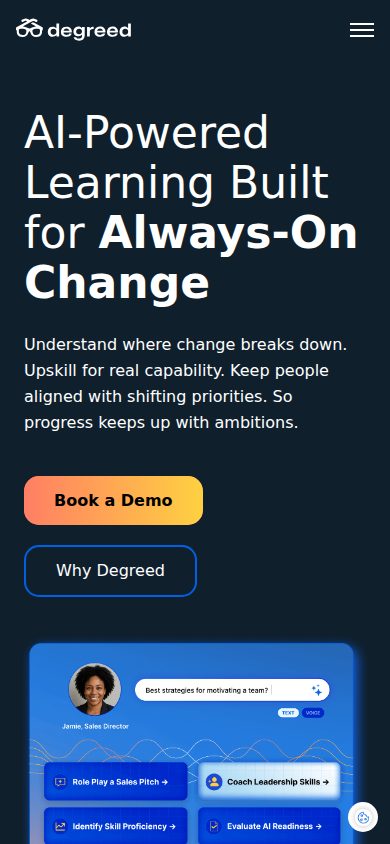
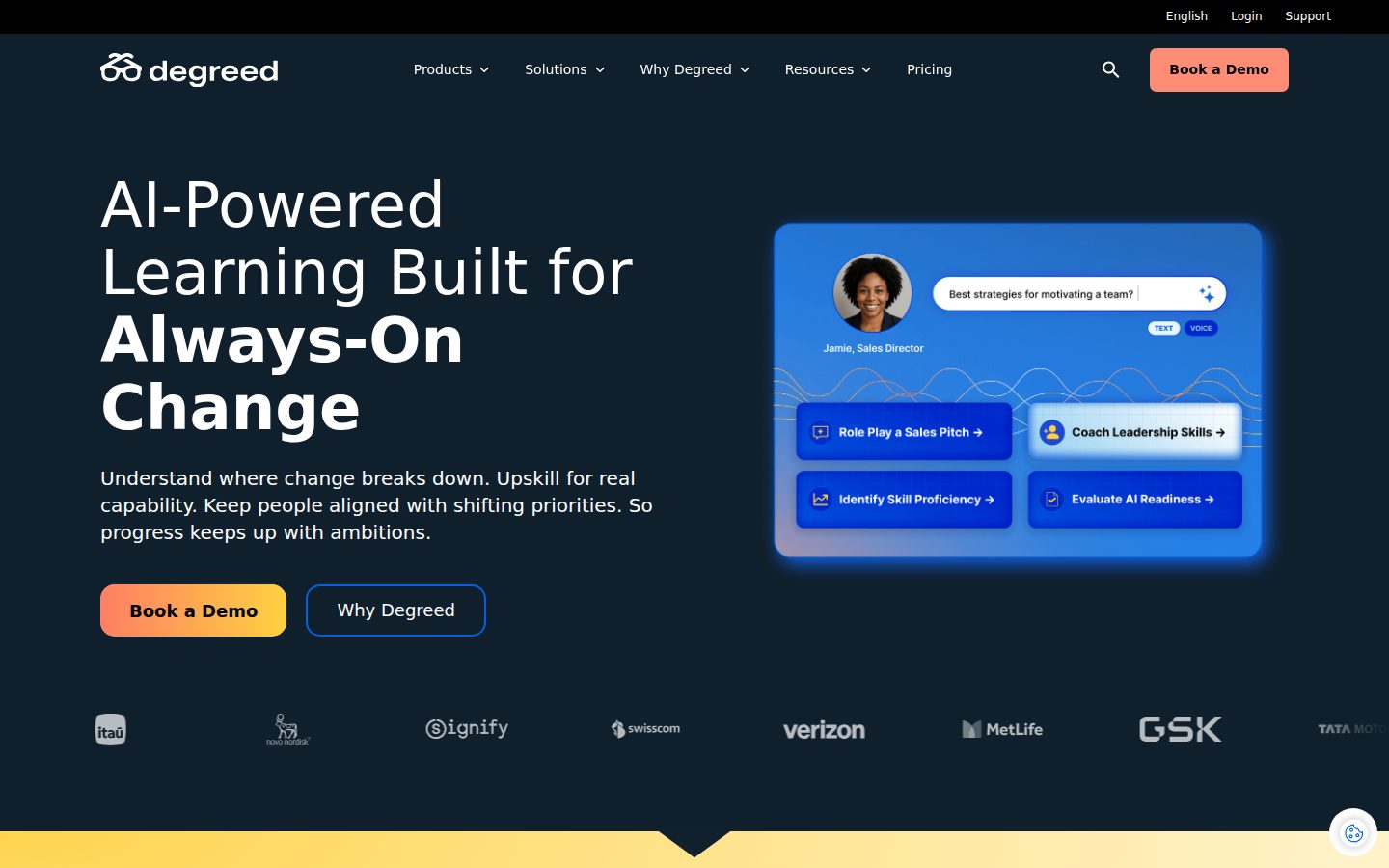
Degreed highlights several specific capabilities on its website: Maestro, an AI feature for dynamic learning path creation; skill plans tied to role and proficiency level; AI coaching and role-play simulations; and MCP-powered adaptive feedback loops intended to keep guidance current as organizational priorities shift. The platform also includes pre-built programs for AI fluency, leadership development, and sales enablement. It integrates with third-party tools and systems through what the company describes as a composable architecture, reducing total operating costs by consolidating redundant learning tools.

Degreed targets enterprise buyers across learning and development, HR, IT, and executive transformation roles. Competing products in the LXP and corporate learning space include Cornerstone OnDemand, 360Learning, Docebo, Sana, and Uplimit. Pricing is not publicly listed on the website; prospective customers are directed to contact sales for a demo, indicating an enterprise pricing model negotiated per contract.

The platform is web-based and integrates with existing HR systems and content libraries. It positions its interoperability and composability as suitable for organizations with complex, evolving technology ecosystems.

Features

AI

  • AI Coaching

    Delivers personalized AI-powered coaching experiences tailored to each employee's role and proficiency level to close skill gaps as they are identified.

  • Degreed Maestro

    An AI-powered capability (referenced by name in client testimonials and blog content) that enables rapid, scalable learning plan and pathway creation.

  • Pathway Curation

    Dynamically curates learning pathways personalized to each employee's role and skill level to accelerate targeted upskilling.

  • Role-Plays

    Provides AI-powered role-play exercises personalized to individual employees' roles and proficiency levels to build real capabilities.

Analytics

  • Skill Intelligence

    Generates high-fidelity skill data calibrated to custom rubrics to uncover an accurate picture of workforce strengths and weaknesses, identifying where development is needed most.

  • Skill Progression Tracking

    Highlights employees' real skill progression before and after learning to prove measurable outcomes from development investments.

Automation

  • Adaptive Feedback Loops (MCP)

    Uses adaptive feedback loops powered by MCP to keep learning guidance aligned with evolving organizational priorities over time.

Core

  • Leadership Development

    Provides a repeatable framework for building future-ready leaders at scale, designed to reflect organizational culture and elevate performance.

  • Revenue Effectiveness Enablement

    Delivers a continuous, scalable sales enablement engine to accelerate ramp-to-revenue and keep sales teams current on pitch readiness.

  • Skill Plans

    Creates personalized skill development plans aligned to each employee's role and proficiency, embedding learning reinforcement over time.

Customization

  • AI Fluency Program

    A role-aware program for building an AI-ready workforce that can be tailored to an organization's governance, standards, and brand voice.

Integration

  • Composable Integrations

    Offers interoperability with key tools and systems across a complex ecosystem, enabling people development to scale safely while lowering total operating costs.

Preview

Degreed desktop previewDegreed mobile preview

Pricing Plans

Contact Sales

Contact sales

Degreed is a sales-led enterprise learning platform. No public pricing tiers are listed. Prospective customers must book a demo or contact Degreed directly to get pricing information.

  • AI-powered personalized learning experiences
  • Skill intelligence and gap analysis
  • AI coaching, role-plays, and pathway curation
  • Integrations with HR and learning ecosystem tools
  • Leadership development and AI fluency programs
  • Outcome measurement and skill progression tracking

AI Panel Reviews

The Decision Maker

The Decision Maker

Strategic bet, vendor viability, timing, adoption approval
7.8/10

Degreed is the enterprise LXP default, but you'll pay to find out what it costs.

Established category player with real AI features — Maestro, skill intelligence, MCP feedback loops. No public pricing means every deal is a negotiation.

Degreed has been in this market long enough to have actual enterprise references, which already puts it ahead of newer entrants like Sana or Uplimit. The Maestro feature for dynamic pathway creation and before-and-after skill progression tracking are the kind of capabilities that make an L&D budget defensible in an executive review. That matters when the board asks what we got for the investment.

The tradeoff is real: no public pricing means I can't benchmark the deal without burning time on a sales cycle. Category norm is six-figure annual contracts for platforms like this. Cornerstone OnDemand sits in the same range and carries more baggage; Degreed's composable architecture argument is stronger for orgs with messy tool stacks.

Three questions before you sign. One: what's the contract length — are they locking you into 3 years? Two: does the AI fluency program actually adapt to your governance standards or is it a template? Three: can they show you a real before-and-after skill data set from a comparable customer? If yes to all three, pilot it.

Competitive Positioning7.8

Composable integrations and MCP adaptive feedback loops differentiate it from rigid LMS competitors, though 360Learning and Docebo offer faster SMB deployments.

Reputation Risk8.0

Recognized LXP category name — adopting Degreed won't raise eyebrows on any board, and competes credibly against Cornerstone OnDemand.

Speed to Value6.8

Before-and-after skill progression tracking is the right mechanism, but enterprise implementation cycles and no free trial means payback is measured in quarters, not weeks.

Strategic Fit8.2

Skill intelligence tied to custom rubrics plus role-aware AI fluency programs directly advance workforce transformation, not just training efficiency.

Vendor Viability7.5

No public funding data, but long enough in market with enterprise client base to suggest stability — not a Series A bet.

Pros

  • Maestro enables scalable, dynamic learning path creation without manual L&D overhead
  • Skill intelligence calibrated to custom rubrics — not just course completions
  • Pre-built programs for AI fluency and leadership development reduce build time
  • Composable architecture plays well in complex enterprise tool ecosystems

Cons

  • No public pricing — every deal is opaque until you're deep in a sales conversation
  • No free trial or sandbox means you're buying on demos and references alone
  • MCP-powered feedback loops sound compelling but no changelog to verify shipping cadence
  • Speed to ROI is slow by nature — skill change isn't a 30-day metric

Right for

Enterprise L&D teams with a mandate to prove measurable upskilling outcomes to an executive audience.

Avoid if

You need deployed and running inside 60 days or your L&D team is fewer than 5 people.

The Domain Strategist

The Domain Strategist

Craft and strategy in the product's domain — adapts identity per category, same lens
8.1/10

Degreed's skill intelligence architecture is the strongest foundation in enterprise LXP today.

Degreed isn't a course library with a chatbot on top — it's skill data infrastructure first, learning delivery second. For enterprise L&D teams trying to connect development investment to measurable workforce capability, that architecture is exactly right.

Maestro plus MCP-powered adaptive feedback loops signals someone on the product team understands that learning architecture has to flex with organizational priorities, not just content catalogs. The before-and-after skill progression tracking tied to custom rubrics is the feature I'd anchor a board-level L&D business case on — it's the difference between reporting completions and reporting capability delta. That's a genuine differentiator over Cornerstone OnDemand, which still leans heavily on compliance-first course tracking.

The composable integrations story is credible for complex enterprise stacks, and the pre-built programs — AI fluency, leadership, sales enablement — reduce time-to-deploy for teams without deep instructional design bandwidth. The tradeoff: no public pricing and no free trial means every evaluation goes through a sales cycle. For budget-constrained or mid-market L&D teams, that's a real barrier; Docebo and 360Learning both offer more transparent entry points.

If we adopt Degreed, in 3 years we have a skill graph that compounds — each data point makes the next pathway recommendation sharper. If we don't invest in the data hygiene and rubric calibration work upfront, that graph degrades into noise. This is high-ceiling infrastructure that rewards L&D orgs with the operational maturity to maintain it.

Category Positioning8.3

Positioned clearly above compliance-first LMS players like Cornerstone and ahead of lighter-weight LXPs by anchoring on skill intelligence depth.

Domain Fit8.2

Skill plans tied to role and proficiency level map directly to how senior L&D practitioners design development frameworks, not just training events.

Integration Surface7.5

Composable architecture with HR system integrations is the right posture; no public API docs in evidence limits independent technical evaluation.

Long-term Implications8.0

A compounding skill graph is a durable strategic asset, but it requires sustained data governance investment to stay accurate over time.

Strategic Depth8.5

Custom rubric calibration plus measurable before-and-after outcomes puts this above category-standard course-completion tracking.

Pros

  • Skill intelligence calibrated to custom rubrics — not generic taxonomy
  • Before-and-after outcome measurement built into the core workflow
  • Maestro enables scalable pathway creation without heavy instructional design lift
  • Pre-built programs for AI fluency and leadership cut deployment time

Cons

  • No public pricing — every evaluation requires a full enterprise sales cycle
  • No free trial or sandbox means limited hands-on diligence before commitment
  • Docs and changelog not publicly available, making technical vetting harder
  • High data governance overhead: rubric calibration requires sustained L&D operational investment

Right for

Enterprise L&D teams with the operational maturity to maintain a skill data layer and a mandate to prove capability ROI to the business.

Avoid if

Your organization needs transparent pricing, a self-serve trial, or lacks the internal bandwidth to manage ongoing rubric and skill data maintenance.

The Finance Lead

The Finance Lead

Money, total cost of ownership, contracts, procurement math
5.8/10

No public price, no free trial, no changelog — classic enterprise hostage setup.

Degreed hides all pricing behind a sales call. 3-year TCO is genuinely unknowable from public materials.

Zero published numbers. No tiers, no per-seat rate, no floor. The pricing page exists but directs to a demo — that's a pricing page in name only. Category norm for enterprise LXPs is $8–$20/seat/year negotiated, but Degreed won't confirm. At 50 seats, year-1 could be $25K or $150K. No way to model it.

The feature set is real. Maestro for dynamic pathway creation, MCP-powered adaptive feedback loops, before-and-after skill progression tracking — that's more than most LXPs show publicly. Cornerstone OnDemand charges similar opacity but has 20+ years of contract baggage. Degreed at least names its AI capabilities specifically.

The TCO risk isn't the license — it's implementation, content migration, and integration hours against a composable architecture with no published API docs. No changelog means no audit trail on feature drift. Auto-renewal terms and termination clauses are invisible until contract review. Procurement teams will spend 6–8 weeks just getting a number.

Billing & Procurement3.5

Sales-led only, no self-serve trial, no free plan — procurement cycle will be long and expensive.

Contract Flexibility4.5

No public auto-renewal terms, cancellation clauses, or term lengths — standard enterprise black box.

Pricing Transparency1.5

No tiers, no per-seat rate, no floor — demo required for any number.

ROI Clarity6.5

Skill Progression Tracking with before-and-after measurement is a named, specific feature — better ROI story than most LXP competitors.

Total Cost of Ownership4.0

Implementation, content migration, and integration costs are entirely opaque; no API docs or changelog to estimate scope.

Pros

  • Named AI features — Maestro, MCP adaptive loops — give procurement something concrete to evaluate
  • Before-and-after skill progression tracking is a specific, measurable ROI mechanism
  • Composable integrations claim reduces redundant tool consolidation costs, based on their site

Cons

  • No public pricing — 3-year TCO is unmodelable without a sales cycle
  • No free trial or free plan — zero low-friction evaluation path
  • No changelog or API docs publicly available — integration scope is a blind estimate
  • Contract terms invisible until late-stage negotiation

Right for

Enterprise L&D buyers with 200+ seats, dedicated procurement staff, and budget to run a 6-week vendor evaluation.

Avoid if

You need a price before booking a demo.

The Domain Practitioner

The Domain Practitioner

Daily hands-on reality in the product's domain — adapts identity per category, same lens
7.6/10

Enterprise-grade skill infrastructure that earns its complexity, if you can staff it.

Degreed is a serious LXP built for L&D teams managing workforce transformation at scale. Skill Intelligence tied to custom rubrics plus Maestro's dynamic path creation puts it ahead of Cornerstone OnDemand on personalization depth, but this is a platform you administer, not just launch.

Skill Plans tied to role and proficiency level is the right architecture. Most LXPs track course completions and call it done. Degreed's before-and-after skill progression tracking means you're building a case for L&D investment, not just a completion report. For any trainer who's spent two quarters arguing budget with a CFO, that matters. Maestro generating dynamic learning paths at scale is exactly the kind of feature that separates a platform from a content library.

Day three is where the enterprise weight shows. No public docs, no changelog, no API documentation surfaced publicly. That tells me configuration lives inside onboarding calls and customer success handoffs, not self-serve. Compared to 360Learning's admin-facing transparency, that's a slower ramp for any L&D team trying to build without constant vendor contact.

The tradeoff is straightforward: Degreed rewards organizations that can dedicate an L&D administrator to maintain rubrics, manage integrations, and interpret skill data. Solo trainers or lean teams will fight the overhead weekly. For a mid-to-large enterprise running leadership development, AI fluency programs, and sales enablement simultaneously, the composable integrations and MCP-powered adaptive feedback loops justify the contract conversation.

Day-3 Reality7.2

Skill Intelligence and Skill Plans are substantive features, but no changelog and no self-serve docs suggest daily admin work routes through vendor support, not independent troubleshooting.

Documentation Practitioner-Fit6.0

Blog exists but no public API docs, no changelog, and no practitioner-facing setup guides surface publicly — the docs signal is weak for a platform with this much configuration depth.

Friction Surface6.8

No free trial and no public pricing means every configuration question routes back to sales, which is a real weekly tax on L&D practitioners trying to iterate fast.

Power-User Depth8.2

Custom rubrics for skill calibration, MCP-powered adaptive feedback loops, and role-play simulations give experienced L&D administrators genuine depth to build against over time.

Workflow Integration7.8

Composable integrations with existing HR systems and content libraries reduce the 'new tab' problem; the architecture is designed to sit inside existing ecosystems, not replace them.

Pros

  • Before-and-after skill progression tracking gives L&D teams a real ROI narrative, not just completion counts
  • Maestro's dynamic path creation scales personalization without manual rebuilds for each role
  • Pre-built programs for AI fluency and leadership development cut time-to-launch for common training priorities
  • Composable integrations designed to consolidate redundant tools, lowering total operating costs

Cons

  • No public documentation or changelog — configuration opacity is a daily friction point for admin-heavy workflows
  • Contact-only pricing with no free trial means you're committing significant discovery time before seeing the product
  • Platform depth demands a dedicated L&D administrator to maintain rubrics and interpret skill data consistently
  • No API documentation surfaced publicly limits DIY integration work for technical L&D teams

Right for

Enterprise L&D teams managing multi-program workforce transformation who have the headcount to administer a sophisticated platform.

Avoid if

Your team is lean, your admin bandwidth is thin, or you need self-serve onboarding without a sales cycle.

The Power User

The Power User

Daily human experience, onboarding, polish, learning curve, reliability
7.6/10

Serious enterprise upskilling infrastructure, but you'll need a sales call to find out anything real

Degreed has the feature depth that big L&D teams actually need — skill gap mapping, AI coaching, measurable outcomes. The opacity around pricing and the complete absence of a free trial will frustrate anyone trying to build a business case without a salesperson in the room.

The feature list here is genuinely substantive. Maestro for dynamic pathway creation, AI role-plays calibrated to individual proficiency, before-and-after skill progression tracking — this isn't checkbox marketing. That's the infrastructure a 5,000-person company needs when 'we sent everyone a course' stops working. Compared to something like Cornerstone OnDemand, Degreed is leaning harder into skill intelligence rather than compliance tracking, which is the right bet for orgs actually trying to transform.

The daily-use picture is harder to read. No changelog, no public docs, no trial. Web-only with no mobile parity signals that field workers and frontline employees aren't really the audience. The polish of the day-to-day experience — empty states, loading behavior, onboarding micro-copy — is completely invisible from outside the demo wall.

That demo wall is the real tradeoff. Zero public pricing means every evaluation starts with a sales call. For enterprise buyers that's normal. For anyone trying to quietly explore options, it's a full stop.

Daily Polish6.5

No changelog and no public docs make it impossible to assess iteration quality — teams that care about polish usually publish both.

Learning Curve7.5

Role-aware Skill Plans and personalized pathway curation suggest the product adapts to user context over time rather than dumping everything on day one.

Mobile Parity5.5

Web-only platform — for a tool positioned as always-on workforce learning, no native mobile is a real gap for deskless or field employees.

Onboarding Experience6.0

No free trial and a mandatory sales demo means your first ten minutes are a pitch, not a product experience.

Reliability Feel7.0

Composable integrations and MCP-powered adaptive feedback suggest architectural maturity, but there's no public reliability data or uptime history to verify.

Pros

  • Maestro AI builds dynamic learning paths at scale — not just curated playlists
  • Before-and-after skill progression tracking gives L&D actual outcome data, not just completion rates
  • AI fluency and leadership development programs are pre-built and role-aware, which cuts implementation time
  • Composable integrations are designed for complex HR ecosystems, not greenfield installs

Cons

  • Zero public pricing — every conversation starts with a sales call
  • No free trial means no low-stakes way to feel the product before committing
  • Web-only with no mobile parity limits reach for non-desk workforces
  • No changelog or public docs makes it hard to track how fast the product is actually moving

Right for

Enterprise L&D teams who need skill gap infrastructure at scale and have budget and patience for a sales-led procurement process.

Avoid if

You need mobile access for frontline workers or want to evaluate the product hands-on before talking to sales.

The Skeptic

The Skeptic

Contrarian. Watch-outs, deal-breakers, broken promises, category patterns
6.2/10

Degreed: solid LXP skeleton, but the graveyard is full of these pitches

Named features like Maestro and MCP adaptive loops are specific enough to take seriously. But no changelog, no API docs, no public pricing, and a headline about 'always-on change' — I've seen this exact language from three platforms that quietly stagnated.

Three tells upfront. One: 'AI-Powered Learning Built for Always-On Change' — the kind of H1 that means everything and nothing. Two: no changelog listed. For an enterprise platform shipping AI features, that's a gap. Three: no public API docs, which matters when composability is the core differentiator pitch.

Fair where fair is due. Maestro and the MCP-powered feedback loop are named specifically — not vaporware language. Skill progression tracking with before-and-after outcomes is a real differentiator versus Cornerstone OnDemand, which still leans completion-based. The AI fluency and sales enablement programs show vertical thinking, not just platform generalism.

The exit story worries me most. Contact-only pricing plus no API docs plus enterprise lock-in is a triple that makes 18-month migration ugly. If Docebo or Sana wins your org's next procurement cycle, leaving Degreed costs real effort. That's the tradeoff nobody mentions in the demo.

Competitive Differentiation7.0

Before-and-after skill progression tied to custom rubrics is a real gap versus completion-tracking incumbents like Cornerstone OnDemand; Maestro adds credibility.

Exit Portability4.5

No public API docs and enterprise contract pricing means your skill data and learning paths are effectively locked — migration off this in 18 months is expensive.

Long-term Viability6.0

No public funding data, no changelog, company funding history is not visible — category has seen consolidation eat similar platforms; durable but not provably thriving.

Marketing Honesty5.5

'Always-On Change' and 'end-to-end learning' are superlatives the site doesn't ground with specifics — no case study numbers, no retention data visible.

Track Record Match6.5

Degreed has been in the LXP category long enough to survive multiple consolidation waves, but no changelog means shipping cadence is opaque — could go either way.

Pros

  • Maestro and MCP adaptive loops are named, specific AI features — not marketing wallpaper
  • Skill-based outcomes tracking is a genuine differentiator vs. completion-based LXPs
  • Composable integrations pitch is credible for orgs with complex HR stacks
  • Role-aware AI fluency program shows vertical depth, not just horizontal platform play

Cons

  • No changelog — can't verify shipping cadence for a platform selling on AI velocity
  • No API docs listed despite composability being the core enterprise pitch
  • Contact-only pricing makes multi-vendor comparison almost impossible before a sales call
  • Exit migration would be painful — skill data tied to custom rubrics doesn't export cleanly to Docebo or Sana

Right for

Enterprise L&D teams that have outgrown completion tracking and need skill-gap-to-outcome measurement at scale.

Avoid if

You need API-first flexibility or want to evaluate pricing without a sales process.

Buyer Questions

Common questions answered by our AI research team

Features

How does Degreed identify skill gaps in my workforce?

Degreed uses workforce skill intelligence to identify skill gaps, calibrating high-fidelity skill data against custom rubrics to pinpoint where capabilities fall short.

Features

Does Degreed offer AI coaching for employees?

Yes, Degreed offers AI coaching along with role-plays as part of its learning experience to help employees build real capability.

Features

Can Degreed measure learning outcomes before and after training?

Yes, Degreed links skill data to measurable before-and-after learning outcomes, functioning as infrastructure for ongoing workforce transformation rather than one-time training.

Features

Does Degreed support personalized learning pathways?

Yes, Degreed delivers curated personalized learning pathways designed to close identified skill gaps and align employees with organizational priorities.

Features

How does Degreed handle shifting business priorities?

Degreed is built for always-on change, keeping people aligned with shifting priorities so workforce progress keeps pace with evolving business ambitions.

Product Information

  • Company

    Degreed
  • Founded

    2012
  • Pricing

    Contact for pricing

Platforms

web

About Degreed

Degreed is an enterprise learning platform based in Pleasanton, California, providing skills intelligence, personalized pathways, and AI coaching for workforce development.

Resources

Blog

Also in AI Education & Training