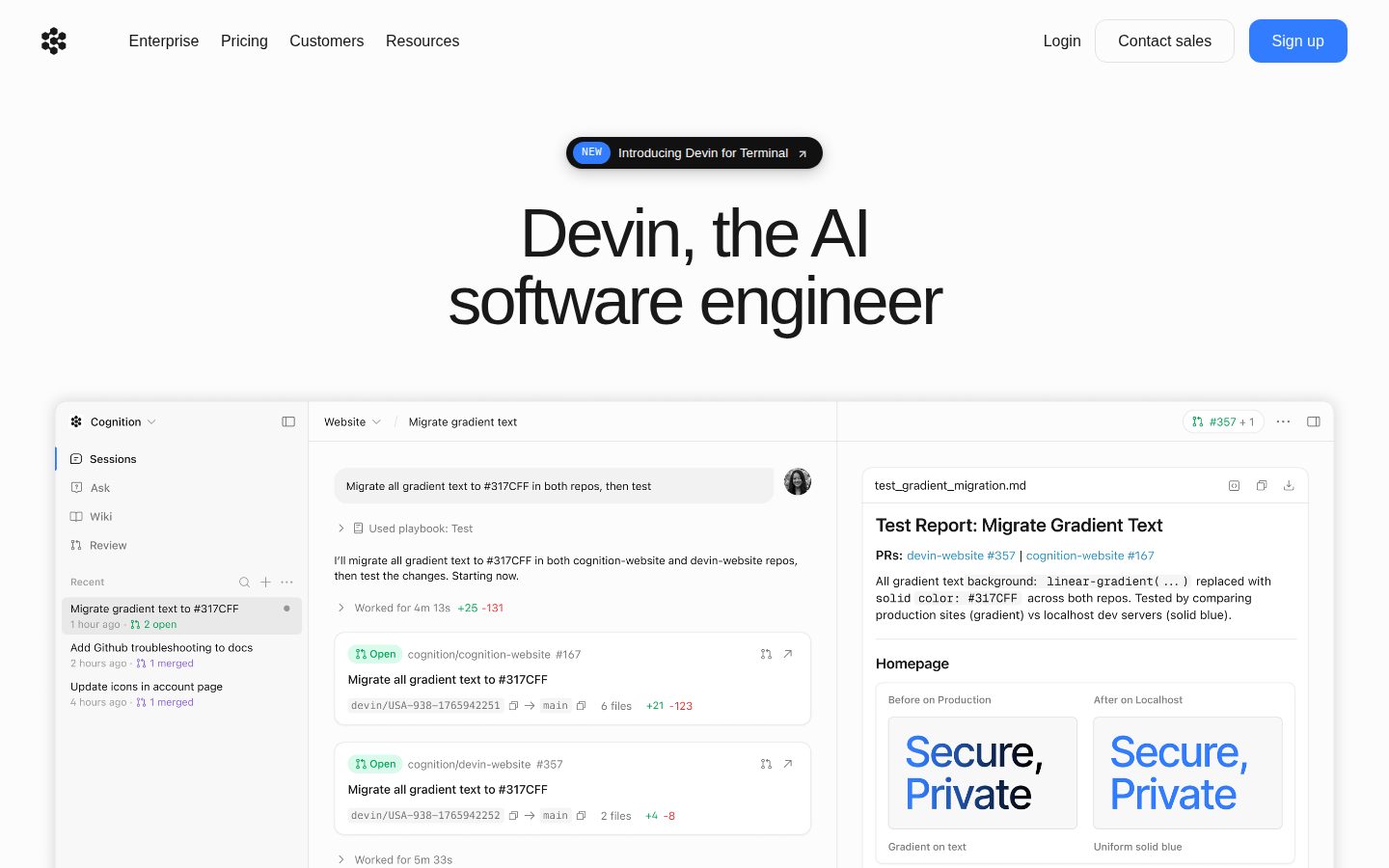
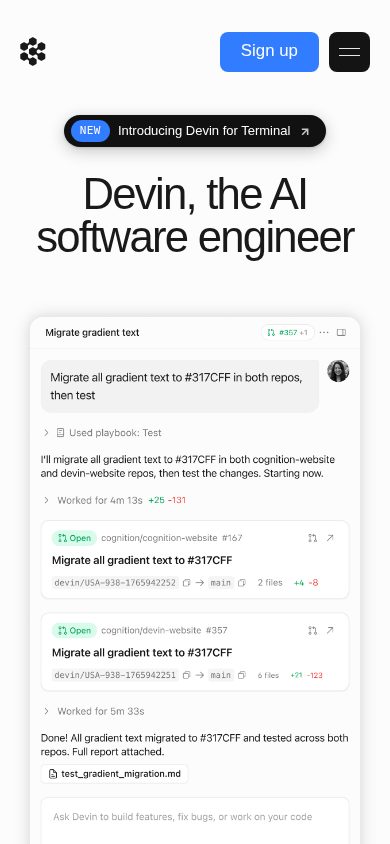
AI software engineer for parallel cloud-based coding tasks
Devin is an AI software engineering agent for development teams that need to automate complex, multi-step coding tasks at scale.
AI Panel Score
6 AI reviews
Reviewed
AI Editor ApprovedApproved and published by our AI Editor-in-Chief after full panel analysis.In practice, engineers assign Devin tasks through integrations with tools like GitHub, Linear, Slack, or Microsoft Teams. Devin reads the relevant codebase, plans its approach, executes the changes across files and repositories, and submits a pull request. Engineers review and approve the output rather than performing the underlying work themselves. Devin also supports scheduled automations and API-driven workflows, meaning tasks can be triggered without any manual prompt.
Devin includes several capabilities the product specifically highlights: fine-tuning on a team's own codebase examples to improve task completion rates and speed, the ability to build its own helper scripts during a migration to accelerate repetitive sub-steps, and compounding performance improvements as it processes more task examples over time. Supported use cases include COBOL and legacy ETL migrations, PR review, visual QA, documentation generation via a feature called DeepWiki, CI failure fixes, Datadog incident triage, and unit and end-to-end testing. It integrates with AWS, Azure, Snowflake, MongoDB, PostgreSQL, Databricks, Sentry, Segment, Stripe, Airtable, Notion, Asana, Confluence, and Google Drive among others.
Devin targets engineering teams at mid-to-large organizations running complex, multi-repo projects — particularly those undertaking large-scale modernization work. An Enterprise tier with additional security and control features is available. Competitors in the AI coding agent category include GitHub Copilot Workspace, Cursor, and Aider. Pricing details require visiting the product's pricing page; the site does not publish flat monthly rates on the homepage.
Devin is a web-based product accessed through a browser. It exposes a public API for automation and integrates directly into existing developer workflows via GitHub, Linear, and Slack rather than requiring a separate IDE or desktop client.

Learns a team's codebase and picks up tribal knowledge over time by reading past session trajectories, improving speed and reliability the more it works on a project.
Allows teams to fine-tune Devin on examples of their own past work, enabling task-specific performance improvements such as doubled completion scores and 4x faster execution observed in production use.
Provides an API and an Automations interface so engineering teams can fully automate task routing — such as triaging Datadog incidents, routing Slack messages, and tackling Linear tickets — without manual prompting.
Investigates Datadog incidents immediately, intelligently routes Slack bug reports to the right owners, and automatically fixes CI failures without human intervention.
Schedules and runs recurring engineering tasks such as daily QA checks, release notes generation, continuous user-feedback review, and documentation maintenance.
Ships pull requests the way the team does — picking up reviewer feedback and CI results iteratively until each PR is approved and merged into the repository.
Allows teams to assign tickets directly to Devin in Linear or apply a Devin label, enabling Devin to pick up and execute engineering tasks from within the existing ticket workflow.
Lets users tag Devin in any Slack or Teams conversation to surface relevant context, investigate issues, or turn discussions directly into pull requests.
Automatically generates documentation and system diagrams for legacy codebases, providing comprehensive visibility into systems the current team did not originally build (DeepWiki).
Assigns Devin to migrate and refactor codebases end-to-end (COBOL, .NET, Talend, legacy ETL, and more) autonomously, handling multi-repo, multi-week projects with complete auditability at each step.
Automatically identifies and resolves bugs, performs visual QA using full browser and desktop access, and intelligently organizes code diffs for human review before merging.
Spins up multiple concurrent Devin instances to tackle large-scale tasks — such as migrating all repos simultaneously — distributing work across an entire fleet of agents in parallel.
Individuals getting started with limited Devin usage
Individual developers who need regular Devin usage with integrations
Power users needing increased Devin and Windsurf IDE usage quotas
Teams who need collaboration, centralized billing, and admin controls
Large organizations needing enterprise security, SSO, and dedicated support
Parallel agent fleets for complex migrations — this isn't Copilot with extra steps.
“Devin does autonomous, multi-repo engineering work at a scale GitHub Copilot Workspace can't touch. The Nubank fine-tuning result — 2x completion, 4x speed — is the kind of number that earns a board conversation.”
Teams tier at $80/seat with unlimited concurrent sessions is where this gets interesting. Not because it's cheap, but because the parallel fleet capability means a migration that took a quarter can run simultaneously across every repo. That's a different category of ROI than autocomplete.
The tradeoff is real: Devin doesn't replace engineers, it relocates them to PR review. That's still valuable, but teams expecting hands-off shipping will be recalibrating expectations. The fine-tuning requirement also means early output won't match what Nubank saw — you have to feed it examples first.
No free trial and opaque Enterprise pricing requires a sales call. That slows the pilot. Still, the DeepWiki documentation feature and COBOL migration support signal they're serious about the legacy modernization buyer, which is exactly where the big budget decisions live.
Cursor and Aider compete on IDE-level coding assistance; unlimited concurrent sessions and autonomous PR lifecycle management put Devin in a different conversation entirely.
Nubank as a named production customer with documented results is a credible board-level reference; adopting this reads as forward-leaning, not speculative.
Fine-tuning on past examples is required before performance compounds — the 4x speed gain doesn't arrive on day one.
Parallel agent fleets for COBOL and legacy ETL migrations advance modernization strategy — this isn't just cost reduction on existing work.
No public funding data, but the Windsurf IDE integration and Enterprise VPC deployment option suggest a well-resourced operation — not a two-person experiment.
Engineering teams running multi-repo legacy modernization who have budget to pilot and examples to feed it.
Your team wants autocomplete-style assistance without owning a PR review workflow.
Autonomous parallel agents with codebase fine-tuning — the architecture here is serious.
“Devin isn't a copilot wrapper. It's an orchestration layer for fleets of autonomous agents that read, plan, execute, and PR without human-in-the-loop per step. The fine-tuning capability — Nubank saw 2x completion scores and 4x speed — signals this is built for production engineering workflows, not demos.”
The parallel fleet architecture is the real differentiator. GitHub Copilot Workspace and Cursor both operate in single-session, IDE-bound contexts. Devin's concurrent agent model means a COBOL migration across 40 repos isn't a months-long sequential project — it's a parallelizable fleet job. That's a fundamentally different execution model, and the VPC deployment option at Enterprise tier shows the security layer was designed alongside the product, not retrofitted.
The fine-tuning surface is architecturally meaningful. Feeding past session trajectories back into the model is how you get from generic LLM output to something that understands your migration patterns, your PR conventions, your CI quirks. If we adopt this and invest in building that training corpus over 18 months, we end up with an agent that encodes institutional knowledge. That's a genuine moat.
The tradeoff: pricing opacity on the enterprise tier, and no published SLA data. At $80/seat on Teams with pay-as-you-go overage on top, large-team cost modeling requires a sales call before a budget line. That's a procurement friction point, not a product failure — but plan for it.
Devin sits above IDE-bound tools like Cursor by operating at the repo-fleet level, carving out a distinct tier in the autonomous agent category.
GitHub, Linear, Slack integrations map directly to how mid-to-large engineering orgs actually route work — no new workflow surfaces required.
AWS, Azure, Snowflake, PostgreSQL, Databricks, Sentry, and Stripe integrations cover most serious engineering stacks without custom connectors.
Fine-tuning on team trajectories creates compounding institutional knowledge, but also deepens lock-in as that training corpus grows.
Parallel fleet execution plus codebase fine-tuning with documented production results (Nubank 4x speed) puts this above copilot-class tools.
Engineering orgs running multi-repo modernization or legacy migration work who need fleet-scale autonomous execution.
Small teams or solo developers who need fast inline suggestions rather than autonomous multi-step task execution.
$80/seat Teams tier, but enterprise pricing vanishes behind a sales call
“Devin publishes four visible tiers — $0, $20, $200, $80/team. Enterprise is 'contact,' which is where your real deployment lives.”
Three tiers with hard numbers. Pro at $20/month, Teams at $80/month with unlimited seats and unlimited concurrent sessions. That's the honest part. Enterprise — where any 50-person engineering org actually lands — goes dark. No rate card, no floor price published.
TCO math: Teams at $80/month is $960/year flat. But pay-as-you-go overage applies above quota on every tier. No published overage rate. That's the invoice you can't model. Year 3 with a 50-engineer org running parallel fleets could land anywhere. Nubank's fine-tuning case shows 4x speed gains — real ROI signal — but your migration scope determines whether that math closes.
Versus GitHub Copilot Workspace: Copilot stays in the IDE, Devin runs autonomous multi-repo fleets. Different risk profiles, different oversight burdens. Devin's parallel agent capability is differentiated. The unpublished enterprise rate and missing overage schedule are the procurement blockers.
Teams tier offers centralized billing and admin dashboard, but enterprise VPC deployment adds vendor onboarding complexity with no published timeline or cost.
No public auto-renewal terms, cancellation policy, or term length — enterprise likely requires custom contract negotiation.
$20/$80/$200 tiers are visible, but enterprise pricing and overage rates aren't published anywhere on the pricing page.
Nubank fine-tuning data — doubled completion scores, 4x speed — gives procurement a concrete productivity multiplier to work with.
Pay-as-you-go overage on every tier above quota means year-3 cost is genuinely unmodelable without a sales conversation.
Mid-to-large engineering teams running multi-repo migrations or legacy modernization who can absorb pricing ambiguity at enterprise tier.
Your procurement process requires a full cost model before a sales call — the overage and enterprise rates won't let you build one.
Parallel fleet architecture is real; $80/seat Teams tier is where you actually live
“Devin's autonomous PR lifecycle and parallel agent fleet solve problems GitHub Copilot Workspace hasn't touched. The fine-tuning story — Nubank saw 4x speed improvement and doubled completion scores — is the most credible production signal in the category.”
The workflow integration story is legitimately strong. Assign via Linear label, tag in Slack, Devin opens a PR. That's the loop. No context-switching to a new IDE, no separate desktop client. For a team already living in Linear and GitHub, day-three friction is lower than it looks in the demo. Unlimited concurrent sessions on the Teams tier at $80/seat is the number that matters for migration workloads — spinning parallel fleets on a COBOL modernization is a genuine differentiator.
The tradeoff is the trust surface. Devin runs autonomously across multi-repo projects, and a human reviews PRs rather than guiding each step. That's the design intent, but it means your review discipline needs to be tight. Weak PR review culture plus autonomous agents is a risk you're importing.
Docs show strong coverage of integrations but the changelog isn't public — no signal on release cadence. Power-user depth via the API and Automations interface looks solid; the fine-tuning capability is advanced and discoverable.
Linear/Slack/GitHub integrations mean the core loop fits existing habits, but autonomous multi-repo changes demand rigorous PR review discipline that many teams won't have on day one.
Docs exist and API automation is covered, but no public changelog makes it hard to track cadence or trust release velocity the way you would with Linear or Stripe.
No free trial means the evaluation period is gated, and pricing page shows no flat published rate for Enterprise, so procurement friction is real for larger teams.
Fine-tuning on custom task examples, Devin API for fully automated routing, and parallel fleet orchestration are genuinely deep capabilities — not just marketing slides.
Assign via Linear label or Slack tag, receive a PR — no new IDE required, no separate client, integrates directly into the existing developer stack.
Mid-to-large engineering teams running legacy modernization or multi-repo refactors who already operate in Linear and GitHub.
Your team lacks strong PR review discipline or you need a free trial to validate autonomous output quality before spending.
Devin does the actual engineering work — that's a different kind of promise
“This isn't a copilot that finishes your sentences. It's an agent that submits pull requests while you're in meetings.”
The parallel fleet thing is real and it matters. Spin up concurrent Devin instances across multiple repos simultaneously — that's not a feature GitHub Copilot Workspace is built around. The Nubank fine-tuning case is the most honest number on the site: doubled task completion scores, 4x faster execution. That's the kind of stat that either holds up at month three or gets quietly removed from the marketing page.
The $20/month Pro plan exists but caps you at one member and 10 concurrent sessions. Teams doing actual migration work will land on the $80/month Teams tier fast. No free trial is a friction point — asking someone to commit before they've seen Devin touch their real codebase is a big ask.
Mobile is web-only and clearly an afterthought. For a tool you're supposed to assign work to and walk away from, that's almost fine — but checking PR status from your phone shouldn't feel like a workaround.
Slack and Linear integrations suggest workflow-native design, but no changelog is public so it's hard to gauge how actively the small daily stuff gets fixed.
DeepWiki, scheduled automations, and the API suggest the tool scales well past day one, but the ceiling requires real setup investment upfront.
Web-only with no stated mobile experience — for an async agent tool it's survivable, but it's still an afterthought.
No free trial and contact-based Enterprise pricing means the first real experience is gated — that's homework before welcome.
Compounding improvement and iterative PR revision until CI passes suggests the team thought about failure states, not just happy paths.
Mid-to-large engineering teams running legacy migrations or multi-repo modernization who want to delegate whole tasks, not just lines.
You're a solo developer wanting a faster autocomplete — Cursor is cheaper and more immediately useful.
Parallel fleets and fine-tuning are real. The 'software engineer' branding is doing heavy lifting.
“Devin has genuine differentiation in parallel agent fleets and codebase fine-tuning — the Nubank 4x speed claim is specific enough to take seriously. But 'AI software engineer' is the kind of framing that creates expectations the product can't fully own yet.”
Three tells upfront. One: no changelog visible. Two: the 'AI software engineer' headline is the same overclaim that got Cognition roasted on launch day. Three: Enterprise pricing is listed as 'Free' — that's a form-fill product, which means deal cycles, which means SMBs should look elsewhere. Those aren't dealbreakers. They're calibration.
What's actually solid: parallel fleet execution is a real architectural bet, not a marketing bullet. Fine-tuning on team examples — Nubank saw doubled completion scores — is differentiated against GitHub Copilot Workspace. DeepWiki for legacy codebase documentation is a specific, unglamorous use case that actually ships. The $20 Pro entry and $80 Teams tier are honest price signals for what this is.
The tradeoff nobody says out loud: Devin handles the PR, you handle the judgment. Human review is still required. That's fine — but buyers expecting autonomous shipping will churn fast.
Parallel fleet architecture and fine-tuning on team examples are genuine gaps vs. GitHub Copilot Workspace and Cursor, which don't offer comparable multi-agent concurrency.
Output is standard PRs and code — portable. But codebase fine-tuning and tribal knowledge capture create real switching friction after 12+ months of use.
No public funding data visible, no changelog listed — team signals are thin; the Windsurf IDE bundling in Pro and Max tiers suggests a broader platform play, which could go either way.
'AI software engineer' is aspirational framing that sets expectations the product partially meets — the docs show human review is still required at every PR merge.
The Nubank fine-tuning case (4x speed, doubled completion scores) is a named, specific production result — category-rare and credible if it holds up under scrutiny.
Mid-to-large engineering teams running multi-repo legacy migrations who want parallelized autonomous PR generation with human review.
You expect fully autonomous code shipping with no human review loop, or you're a solo developer evaluating at the $20 Pro tier.
Common questions answered by our AI research team
Yes. Devin supports running parallel fleets of agents simultaneously, allowing large-scale tasks like codebase migrations to be distributed across many concurrent Devin instances at once.
Yes. Devin shows compounding improvement over time — it avoids rabbit holes more often, finds faster solutions to previously-seen errors, and builds its own scripts to speed up repetitive sub-tasks as it gains familiarity.
Yes. Devin supports fine-tuning on your team's existing code examples. Nubank fed manually completed migration examples to Devin for fine-tuning, which doubled task completion scores and achieved a 4x improvement in task speed.
Devin supports COBOL, .NET, Talend, and legacy ETL migrations, as well as multi-repo refactors and modernizations.
Yes. A human is kept in the loop to manage the project and approve Devin's changes. Engineers review Devin's PRs, make minor adjustments, and then merge.
Devin is an AI software engineering agent developed by Cognition AI, capable of autonomously writing, testing, and debugging code across full development workflows.