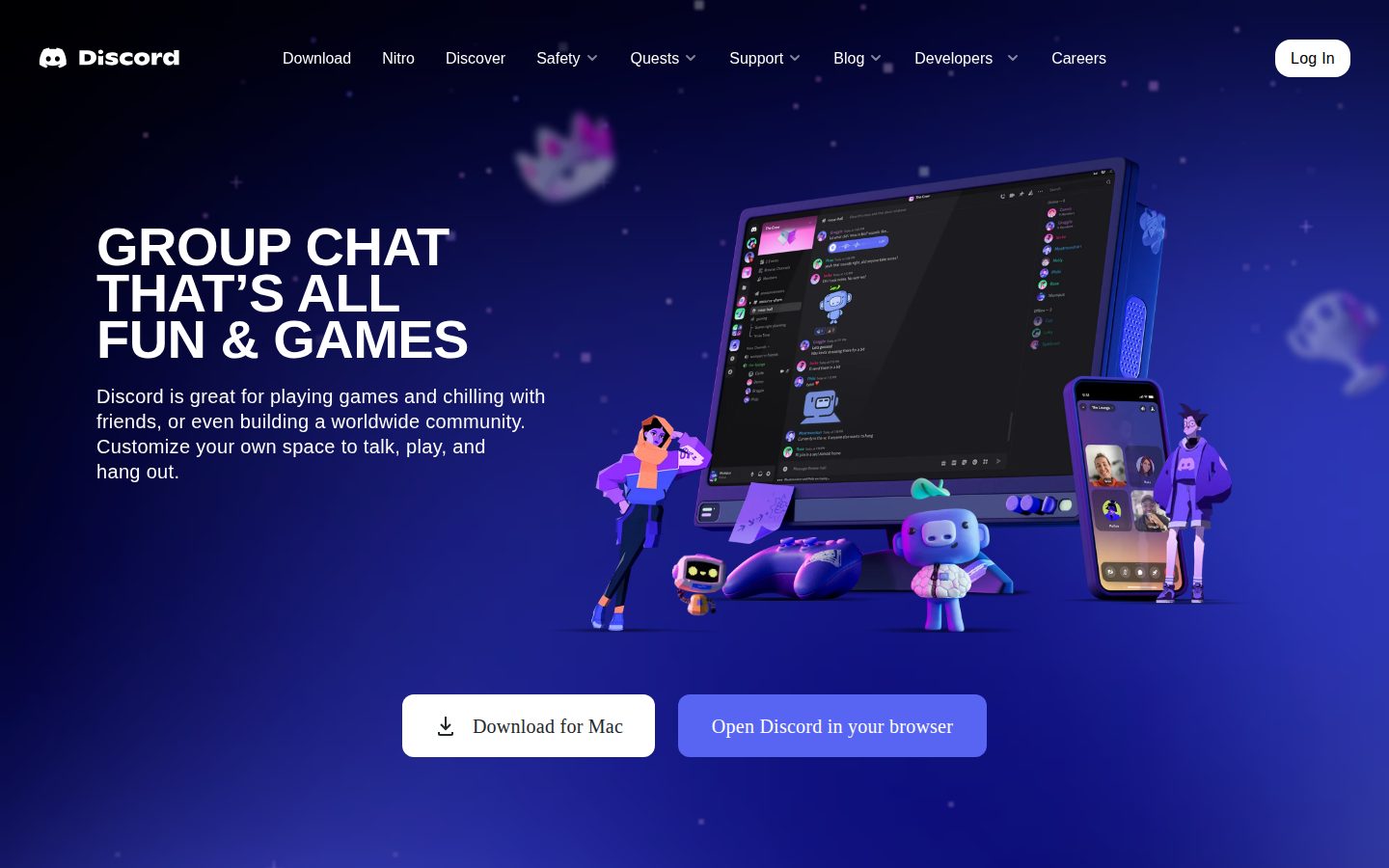
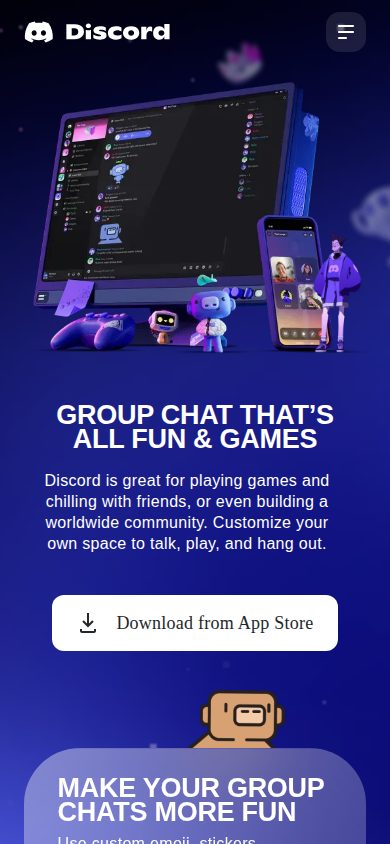
Chat, voice, and video for communities and friends
Discord is a messaging platform combining text, voice, and video communication organized into servers and channels.
AI Panel Score
6 AI reviews
Reviewed
AI Editor ApprovedApproved and published by our AI Editor-in-Chief after full panel analysis.Discord is a multi-format communication platform that organizes conversations into servers, which function as self-contained communities. Each server can contain multiple text channels, voice channels, video channels, and stage channels, allowing server administrators to structure communication by topic, purpose, or audience. Members can participate in real-time voice and video calls, share screens, and send messages with support for file attachments, embeds, and reactions.
The platform was launched in 2015 with a focus on gaming, providing low-latency voice chat for players who needed to communicate during games. Since then, its user base has broadened significantly to include communities centered on education, art, technology, finance, and general interest topics. As of recent years, Discord reports hundreds of millions of registered users across a wide range of demographics.
Discord offers a free tier that includes access to most core features, including unlimited servers, voice and video calls, and direct messaging. The paid tier, called Discord Nitro, adds perks such as enhanced upload limits, animated avatars, custom profile banners, higher video streaming quality, and the ability to use custom emojis across all servers. Server boosting, a component of Nitro, unlocks additional capabilities for individual servers such as improved audio quality and more emoji slots.
Server administrators have access to role-based permission systems, moderation tools, and integrations with third-party bots and applications. Bots built on the Discord API can automate moderation, play music, run polls, connect to external services, and perform a wide variety of custom functions. This extensibility has made Discord a common choice for developer communities and technically oriented groups.
In the broader market, Discord competes with platforms such as Slack and Microsoft Teams for team communication, and with platforms like Reddit and Facebook Groups for community hosting. Its combination of real-time voice, text, and community management tools in a single free product distinguishes it from many alternatives that charge for comparable functionality.

Enables users to watch videos, play built-in games, listen to music, and scroll together within a group chat.
Provides tools to manage multiple group chats with friends across different devices and platforms.
Shows which friends are online, playing games, and for supported games displays the specific modes or characters they are playing with a direct join option.
Provides high quality, low latency screen streaming so users can share gameplay, shows, or photos in real time.
Supports video calling as part of an integrated communication suite alongside text and voice chat.
Users can hop in and out of voice or text chats without needing to call or invite anyone, keeping group chat persistent.
Allows users to use custom emoji, stickers, and soundboard effects in voice, video, or text chats to express personality.
Users can set a custom avatar, status, and written profile that appears in chat.
Lets users add soundboard audio effects to voice chats to personalize their communication experience.
Discord is available on PC, phone, and console, allowing users to seamlessly switch between devices while maintaining their group chats.
Default Discord experience with no subscription required
Entry-level Nitro with key perks for casual users
Full-featured Nitro subscription for power users who want the best Discord experience
Turned down Microsoft's $12B in 2021, filed a confidential S-1 in January 2026 — that bet aged well.
“Discord launched in 2015 as a gaming voice tool and now serves 200M+ monthly actives across communities, education, and creator audiences. The January 6, 2026 confidential IPO filing with Goldman and JPMorgan settles the vendor-viability question more cleanly than any pitch deck could.”
Microsoft offered $12 billion in 2021. Discord said no. Five years later they filed confidentially with the SEC on January 6, 2026 — Goldman and JPMorgan leading, reports targeting a $25 billion debut. That's not a vendor at risk of disappearing.
Don't waste energy debating adoption — your developers, marketing team, and Gen Z customer base already live here. The real call is positioning: lean into Discord for community and creator strategy, keep Slack for internal ops, keep Reddit for public forums. Server Boosts and the open bot API are the platform moat — integrations Slack still gatekeeps behind enterprise plans.
But Nitro at $9.99/month is consumer billing, not enterprise SSO with seat governance. No admin console a CFO would recognize. Use it for community outreach and creator partnerships. For regulated internal comms, stay with Microsoft Teams.
Dominant in gaming and community hosting versus Reddit and Facebook Groups; not chasing Slack on enterprise.
Household-name platform on a public-company trajectory; defensible to a board for community use.
Free tier, browser access, no install required — your audience is already on the platform.
Strong for community and creator strategy; mismatched for internal enterprise comms where Slack or Teams already sit.
Confidential SEC S-1 filing January 2026 with Goldman and JPMorgan, $25B reported target, 200M+ MAU — 3-year question is closed.
Companies who want to build community presence with developers, gamers, or creator audiences.
Teams who need enterprise SSO and seat-based governance for regulated internal communications.
Discord is the default community substrate for 200M monthly actives, but server sprawl becomes the three-year governance tax.
“656 million registered accounts and 200 million monthly actives sit on the Servers-Channels-Roles graph Jason Citron's team shipped in May 2015. Free covers the substrate while Nitro at $9.99 and Server Boosting monetize perks, but server-by-server permissions never compose into org-wide governance.”
Eleven years in, Discord runs 656 million registered accounts and roughly 200 million monthly actives — scale most "community platforms" pitch deck their way toward. Jason Citron and Stanislav Vishnevskiy shipped the public app in May 2015 with Servers, Channels, and Roles as the membership graph. Stage Channels and Forum Channels still stack on that model.
The craft ceiling shows in the bot layer and Activities. The API turned third parties into the moderation, music, and ticketing stack Slack and Microsoft Teams keep building in-house. Soundboard, custom emoji per server, and HD screen share all run on the free tier.
However, the three-year tax is governance. Server-by-server permissions don't compose into org-wide policy, audit logs stay shallow, and Server Boosting plus Nitro at $9.99 monetize perks, not admin depth. For a community lead picking durable substrate, Discord is the right call — for an enterprise picking team chat, it isn't.
200M monthly actives across 656M registered accounts defines the community-chat category against Slack and Microsoft Teams.
Servers, Roles, and bot-driven moderation match how community leads actually structure member-driven spaces.
Public Bot API, OAuth, and Activities turned the third-party ecosystem into the de facto integration layer.
Server-level permissions and shallow audit logs cap the governance ceiling for any three-year org-wide bet.
Eleven-year voice-first stack with Stage Channels and Forum Channels layered on the original membership graph.
Community leads who run member-driven servers at scale.
Enterprise IT teams who need org-wide governance and audit depth.
Discord Nitro at $9.99/month with no enterprise SKU — community spend, not procurement spend.
“Discord publishes three tiers — Free, Nitro Basic at $2.99/month, Nitro at $9.99 — with no seat-based business plan. Hit $725M ARR by end of 2024, so the runway question is closed, but the procurement path is not.”
What's missing from the pricing page is the line procurement actually needs. No per-seat business tier. No SSO add-on. No published volume terms. Discord launched in 2015 and never built an enterprise SKU.
The math is consumer math. Nitro runs $9.99/month or $99.99 annually — a 17% prepay discount. Nitro Basic at $2.99 caps file uploads at 50MB. A 50-person creator team self-expensing Nitro is $6K/year on cards, untracked. Server Boosts add $4.99 each on top.
Slack charges $7.25/user on Pro with audited SSO and DLP. Microsoft Teams bundles inside E3. Discord doesn't compete on that surface — voice rooms and community persistence are the moat. The tradeoff is real: zero procurement friction because there's nothing to procure, but also no MSA, no DPA in your name, no consolidated invoice.
Card-based monthly billing with no consolidated invoice, no PO support, no VAT-compliant business entity flow.
No MSA, no enterprise contract surface, no termination-for-convenience clause to negotiate.
Three tiers visible on the public pricing page, no sales call required for any of them.
Engagement metrics live inside the platform but no formal ROI instrumentation versus Slack analytics.
Consumer-style $9.99/month per user with no volume discount surface — self-expense sprawl at scale.
Community managers and creator teams who run voice-first hangouts.
Enterprises who need SSO, DPAs, and a consolidated invoice.
AutoMod's six-rule keyword ceiling forces big-server mods onto Wick or Carl-bot by month two.
“AutoMod and Onboarding carry Discord for community admins running servers up to a few thousand members. But the six-rule keyword cap and Discord's threadbare search drive any growing server to add Wick or Carl-bot on top.”
Mod queue work happens in AutoMod's Custom Keyword rules, and the ceiling shows up fast — six rules per server, 1,000 keywords each, ten regex patterns at 260 characters. A 5,000-member fandom server hits that wall by month two and starts layering Wick or Carl-bot on top.
Onboarding (the rules-and-roles gate launched in 2022) finally gave admins something Slack doesn't ship: a self-serve role picker that runs before a new member sees any channel. Forum Channels handle long-running threads better than Reddit for active topics, though search across a year of posts returns garbage.
Free voice, video, and 100 servers stays category-defining for a 2015 product. But moderator search is the daily fight — no regex, no date range, no filter by role.
Works for the median server, but moderator search and AutoMod ceilings surface fast under load.
Developer API docs are solid; moderator-facing AutoMod docs are functional but lag the changelog.
Search, AutoMod rule caps, and mobile mod UX accumulate small daily fights over a working week.
Role permissions, slash-command bots, and the Discord API give admins deep customization past native limits.
Most target communities already live here, so onboarding new members rarely requires platform migration.
Community admins who run mid-sized servers on Discord's free tier.
Teams who need searchable long-form discussion archives.
Discord still wins mobile parity, and the free tier is the quiet flex
“Discord runs full-feature on iOS, Android, and desktop with the same servers and voice rooms, free for ~200M monthly users. Nitro at $9.99/month adds 500MB uploads and HD streams, but the moderation surface still gets messy at scale.”
Most chat apps treat mobile like a courtesy. Discord doesn't — iOS and Android have the same servers, same voice rooms as desktop, which after a decade still feels rare. Launched 2015 for gamers complaining about Teamspeak, now ~200M monthly users running book clubs and study groups.
Server Boosts and Stage Channels are the structural moves nobody copies well. You don't pay to host a community, you pay to upgrade one — pricing that maps to who cares. Nitro at $9.99/month buys 500MB uploads, HD streams, and custom emoji everywhere. Nitro Basic at $2.99 is the honest entry.
But the moderation surface is still a fight on day 30. AutoMod helps; bot sprawl doesn't. Versus Slack for teams or Reddit for asynchronous community, Discord wins on real-time hangout feel and loses on threading and search. The free tier doing this much is the quiet flex.
A decade of iteration shows in micro-interactions, but inconsistencies still surface across server settings panels.
First hour is friendly, but role-based permissions and bot configuration get tangled around month three.
iOS and Android run the same servers, same voice, same video as desktop — best in category.
An invite link drops you straight into a working channel — one of the smoothest joins in chat.
Low-latency voice rooms and autosave behavior in DMs feel solid; the brand is built on this.
Communities who need real-time voice and text in one free app.
Teams who need deep message threading and search.
Rejected Microsoft's $12B in 2021, filed for IPO in January 2026 — the standalone bet is on the clock.
“Discord turned down Microsoft's $12 billion offer in April 2021 and finally filed confidentially for a 2026 IPO, with Goldman Sachs and JPMorgan underwriting. The fundamentals are real — 200M monthly users, $725M 2024 revenue, free-tier plus $9.99/month Nitro — but Slack owns work chat and Reddit owns broader community, leaving gaming-adjacent voice as the durable moat.”
Discord turned down Microsoft's $12B offer in April 2021. Confidentially filed S-1 in January 2026 with Goldman and JPMorgan underwriting. The standalone bet finally meets the public-market clock.
The receipts hold up. Launched 2015. 200M monthly users. $725M revenue in 2024, up from $575M the year before. Nitro at $9.99/month carries the monetization story, with Server Boosts stacked on top. Free tier still ships unlimited servers and voice. Real product, real cash flow.
But the moat is thinner than the numbers suggest. Slack and Microsoft Teams own work chat. Reddit owns broader community. Discord's edge is real-time voice plus low-friction servers — durable for gamers, softer for everyone else. Exit travels for bot integrations and invite links, but server history lives on their side.
Real-time voice channels plus server-first community model is genuinely distinct from Slack, Teams, and Reddit, even if work chat is lost ground.
Bot integrations and invite links port, but server message history and role structures live on Discord's side with no clean export.
200M MAU, confidential SEC filing in January 2026, and Goldman Sachs plus JPMorgan as underwriters signal a credible three-year bet.
"Group chat that's all fun & games" matches what the free tier and Nitro pages actually deliver — no enterprise overclaim.
Ten-year survivor that rejected $12B from Microsoft in 2021 and grew revenue from $575M to $725M into the 2026 S-1 window.
Communities who need persistent voice channels and free unlimited servers.
Teams who need a work chat with SLAs and admin compliance.
Common questions answered by our AI research team
Yes, you can use Discord directly in your browser without downloading anything. The homepage explicitly offers an 'Open Discord in your browser' option alongside the download option.
Yes, Discord supports high-quality, low-latency streaming that makes it feel like you're hanging out on the couch with friends. You can stream while playing games, watching shows, looking at photos, or doing other activities together.
Yes, for supported games, you can see what modes or characters your friends are playing and directly join up. However, this feature does not work for all games — the content specifies it only works 'for supported games.'
Yes, Discord is available on PC, phone, and console. The content states you can easily switch between devices and use tools to manage multiple group chats with friends.
Custom emoji, stickers, and soundboard effects can be used in voice, video, or text chats — not just text channels. The content specifically states these features add your personality 'to your voice, video, or text chat.'
Company
DiscordFounded
2015Pricing
From $10/moFree Plan
Available


Discord is a San Francisco-based communication platform for voice, video, and text chat, originally built for gamers and now used by more than 200 million monthly active users.