Conversational marketing and sales platform for revenue teams
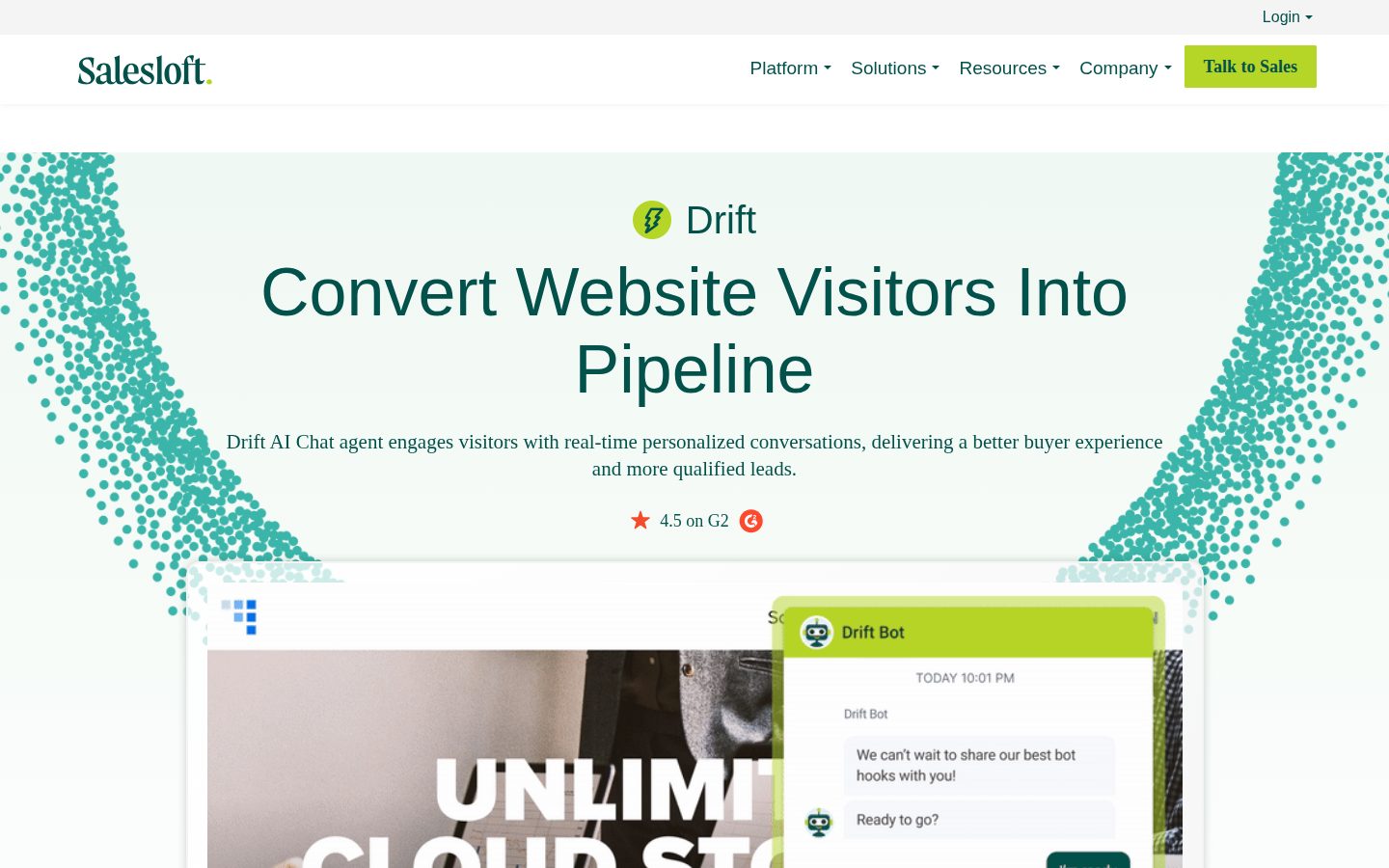
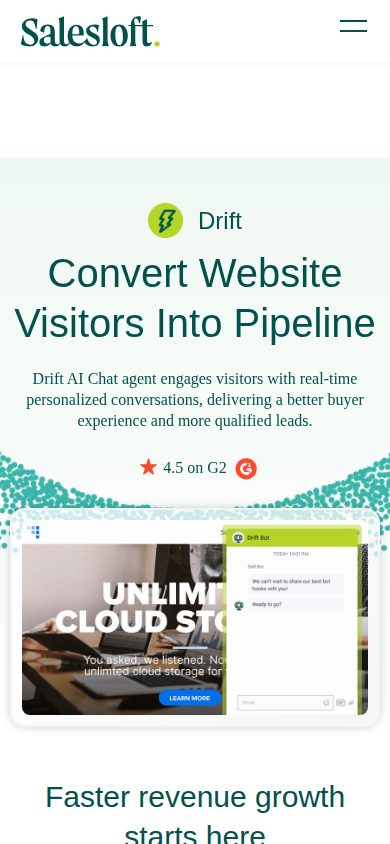
Drift is a conversational marketing and sales platform that uses live chat, chatbots, and AI to engage website visitors.
AI Panel Score
6 AI reviews
Reviewed
Drift is a conversational marketing and sales platform built to help B2B companies engage website visitors and convert them into pipeline. Rather than relying on traditional lead capture forms, Drift enables real-time conversations through live chat and AI-driven chatbots that can qualify visitors, answer questions, and schedule meetings automatically—at any hour of the day.
The platform is primarily aimed at marketing and sales teams at mid-market and enterprise B2B companies. It serves a range of roles, including demand generation marketers, account executives, and sales development representatives who want to reduce response times and increase engagement with high-intent visitors.
Key capabilities include customizable chatbot playbooks, account-based marketing (ABM) integrations that personalize conversations based on the visitor's company, meeting scheduling automation, video messaging, and an AI assistant called Drift AI. The platform also provides analytics and reporting tools to track conversation performance and pipeline influence.
Drift integrates with a broad ecosystem of tools commonly used in B2B go-to-market stacks, including Salesforce, HubSpot, Marketo, Outreach, and Salesloft, among others. These integrations allow revenue teams to sync conversation data with existing CRM records and workflows.
In the conversational marketing category, Drift competes with platforms such as Intercom and Qualified. Drift has historically positioned itself as a revenue-focused platform rather than a general-purpose customer support tool, with its feature set and pricing structure oriented toward enterprise sales use cases.
Engages website visitors with real-time personalized AI-powered conversations to qualify leads and accelerate sales cycles 24/7.
Identifies anonymous website visitors and surfaces relevant account data such as company name, location, and account history to reveal high-intent buyers.
Tracks engagement metrics, identifies high-converting conversations, and attributes chat activity to pipeline and revenue outcomes.
Scores visitor engagement in real time to surface high-intent accounts and deliver the most relevant chat experience to each visitor.
Uses tech stack data to identify and qualify high-value buyers in real time, allowing them to skip form queues and connect immediately with a rep.
Automatically routes qualified buyers from high-intent accounts into the seller's Rhythm workflow as a prioritized action with context for personalized follow-up.
Enables real-time live conversations between website visitors and sales reps, allowing buyers to skip forms and engage directly.
Allows prospects to book meetings directly through chat conversations without leaving the website or filling out separate forms.
Integrates with CRM systems and sales tools like Salesloft to automatically sync chat interaction data and buyer signals into existing sales workflows.
Feeds qualified buyer interactions directly into the Salesloft Rhythm workflow, surfacing prioritized seller actions tied to live chat engagement signals.
Drift is part of Salesloft since 2024. Pricing is sales-led with no public list; analyst quotes range from ~$2,500/mo (Premium) to $8,000-$15,000+/mo (Enterprise) on annual contracts. Inbox seats add roughly $80/user/month.
A defensible chat bet for revenue teams, but only if you already run Salesloft.
“Drift is now Salesloft's Chat module, and Salesloft is backed by Vista Equity at a 2022 valuation of $2.3 billion. The catch is that the standalone roadmap is gone.”
Drift stopped being its own company in February 2024, when Salesloft bought it for a reported $500 million. Salesloft itself is Vista Equity-backed at a $2.3 billion valuation. Vendor survival is not the board's question here.
The real call is whether Drift advances you or just rebuilds chat you already run. Fastlane pulls tech-stack data to push high-intent buyers past form queues, and Intelligent Lead Routing feeds those buyers straight into Rhythm as prioritized seller actions. Intercom competes on breadth, but Drift is now wired for one motion: revenue orchestration inside Salesloft.
However, that wiring is the constraint. The standalone product is being absorbed, pricing is sales-led with no public list, and Inbox seats run roughly $80 per user monthly. If you already run Salesloft, pilot it with one revenue team for 90 days. If you do not, skip it.
Intercom and Qualified remain viable independents while Drift now only advances a Salesloft-centric stack.
Buying a consolidated Salesloft module reads as a safe board decision, not a risky bet.
Fastlane and Rhythm routing pay back fast once Salesloft is already in place.
Strong fit for Salesloft shops, but a poor fit as an independent chat tool since the standalone roadmap is ending.
Drift is owned by Vista-backed Salesloft, valued at $2.3 billion, so survival is not in doubt.
Revenue teams who already run Salesloft as their engagement platform.
Companies who want a standalone conversational marketing tool.
Drift is now the Chat module of Salesloft, so the strategic bet is the platform, not the widget.
“Drift built the conversational marketing category and now feeds the Salesloft revenue platform. The craft is strong, but adopting it commits you to a six-module suite.”

A demand-gen leader scoping a conversational marketing layer through 2029 should weigh the acquisition before any feature count. David Cancel and Elias Torres founded Drift in Boston in 2015 and built the Conversational Marketing category outright. Salesloft acquired it in February 2024, and Drift is now the Chat module of a six-component revenue platform.
The craft ceiling holds. Fastlane reads tech-stack data to fast-track high-intent buyers past form queues, and Site Visitor Deanonymization surfaces account context before a rep replies. Against Qualified, the genuine edge is Rhythm Workflow Integration, which lands qualified conversations as prioritized seller actions inside Salesloft itself.
The catch is the platform bet. Standalone Drift no longer exists as its own roadmap, however that reframes the three-year decision as Salesloft, not the chat box. Pricing is contact-sales only on annual contracts, with analyst estimates near $2,500 a month at the Premium tier.
Drift founded the conversational marketing category in 2015 and still leads against Qualified and Intercom.
Real-time qualification and in-chat meeting booking match how B2B sales and demand-gen teams actually work.
Rhythm Workflow Integration plus native Salesforce, HubSpot, and Marketo ties land conversations directly in seller workflows.
Standalone Drift is gone, so adopting it is a multi-year commitment to the broader Salesloft platform.
Fastlane and Site Visitor Deanonymization show category-defining craft from the team that created conversational marketing.
B2B revenue teams who want chat tied to a unified pipeline workflow.
Lean teams who want a standalone chat tool without a platform commitment.
Drift is now a Salesloft module with zero public pricing and a $30K annual floor.
“Salesloft bought Drift in 2024 and folded it into the platform. Nothing on the pricing page survives without a sales call.”
Salesloft acquired Drift in 2024 and rebuilt it as the Chat module of a six-part platform. There is no list price. Analyst quotes put Premium near $2,500 a month on annual terms, so the entry floor is roughly $30K a year. Advanced and Enterprise run higher, with enterprise contracts cited at $80K to $150K-plus.
The catch is the bundle. Drift no longer prices as a standalone chat tool, and Fastlane and Rhythm Workflow Integration are most valuable when you already pay for Salesloft. Buy Drift alone and you carry platform overhead for one module. Inbox seats also add roughly $80 per user monthly on top of the tier.
ROI Reporting ties conversations to pipeline, so the value is measurable once live. But annual contracts, no free trial, and custom-only quotes mean procurement starts blind. Intercom and Qualified both publish more of their pricing.
Custom quotes and a sales-led process add procurement friction versus self-serve competitors.
Annual contracts are required with no monthly option and no free trial to de-risk the term.
Pricing model is contact-sales only; no tier is published and no free plan exists.
ROI Reporting attributes chat activity to pipeline and revenue, so value is auditable post-launch.
Roughly $30K floor plus ~$80/user inbox seats and platform overhead if Drift is bought alone.
Revenue teams who already run the Salesloft platform.
Buyers who want standalone chat with transparent pricing.
Fastlane routes hot buyers straight to a rep, but every plan hides behind a sales call.
“Site Visitor Deanonymization gives reps account context before a prospect bounces. But there is no public pricing and no free tier to scope a pilot against.”
An SDR judges a chat tool by the Tuesday a named account lands and they need context before the visitor clicks away. Site Visitor Deanonymization surfaces company name, location, and account history the moment someone hits the site, so a rep opens with the account instead of asking who they are talking to.
The daily-workflow win is Fastlane. It reads tech-stack signals to spot high-value buyers and pulls them past the form queue onto a live rep right away. Qualified conversations drop into Salesloft Rhythm as a prioritized seller action with context attached, so nothing gets retyped into the CRM. Intercom's chat still routes most threads into a support inbox, not a pipeline.
The catch is buying it. There is no public pricing and no free tier. Analyst quotes start near $2,500/month on annual contracts, with Inbox seats adding roughly $80/user/month. Scoping a pilot means a sales call first.
Deanonymization and real-time scoring give reps account context the moment a visitor lands.
Docs site exists and feature pages are workflow-oriented, though no public changelog.
Live routing cuts daily friction, but no free tier means every pilot starts with a sales call.
Customizable chatbot playbooks and ABM personalization scale from simple chat to enterprise orchestration.
Fastlane and Rhythm integration feed qualified buyers straight into the Salesloft seller workflow.
B2B revenue teams who route website visitors into a Salesloft pipeline.
Small teams who need transparent pricing before committing to a contract.
Drift still does the chat job well, but it stopped being its own product
“The live chat and chatbot playbooks are solid and the meeting booking still feels quick. The catch is Drift is now the Chat module inside Salesloft, not a standalone tool you can size up alone.”
Drift was acquired by Salesloft in February 2024, and three months in that is the part you feel most. It is now one of six platform modules, and Fastlane is the feature that still earns its keep — it reads a visitor's tech stack and lets a high-intent buyer skip the form queue straight to a rep.
The day-three workflow is genuinely smooth. A qualified buyer drops into a Rhythm action with context attached, so a seller is not guessing who they are talking to. Intercom feels broader but more support-shaped; Drift stays pointed at pipeline.
But the website now just redirects to a Salesloft page, and there is no public pricing — analyst quotes put Premium near $2,500 a month on annual contracts. You cannot judge your real day-thirty cost until sales is on the call.
Fastlane and meeting booking remove real friction, though the post-acquisition redirect to a Salesloft page feels unfinished.
Real-Time Engagement Scoring and Rhythm routing reward depth, but full value needs the wider Salesloft platform learned too.
Listed for iOS and Android, but conversational sales chat is a desktop-first workflow so this stays neutral.
Chatbot playbooks are customizable but sales-led setup and annual contracts mean no self-serve first hour.
Mature platform with deep Salesforce and HubSpot integrations and analytics that attribute chats to pipeline.
B2B revenue teams who want website chat tied to pipeline
Small teams who want a standalone chat tool with public pricing
Acquired by Salesloft in 2024 and absorbed into its platform, no longer a standalone bet.
“Drift was bought by Salesloft in February 2024 and is now the Chat module of a larger platform. The product still works, but the catch is contact-only pricing and an exit story that does not port.”
Drift doesn't really exist as Drift anymore. Salesloft acquired it in February 2024, and it now ships as the Chat module of someone else's revenue platform.

The acquired-tool pattern has its own graveyard. Some keep shipping. Some get quietly folded into a parent roadmap and starved. Drift leans toward the second read — qualified buyers now route into Rhythm, Salesloft's workflow, and the marketing voice is Salesloft's, not Drift's. Fastlane still does real work, pulling tech-stack data to fast-track high-intent visitors past form queues. But the catch is that most of this only pays off if you already live inside Salesloft.
Pricing is the yellow flag. Contact-only, no public list, analyst quotes start near $2,500/month on annual contracts. Intercom and Qualified at least publish a starting number. Exit portability is thin too — playbooks and conversation history don't port out cleanly.
Fastlane and Rhythm routing are genuine, but the differentiation now depends on the wider Salesloft stack rather than Drift itself.
Playbooks, routing logic, and conversation history are tied to the Salesloft platform with no clean migration path.
Salesloft is a Vista Equity-backed platform with roughly 6,000 customers, so the parent is durable even if the Drift name is not.
The site is candid that Drift is now part of Salesloft, though the page redirects and the Drift brand is fading from the copy.
Founded around 2014 by David Cancel and Elias Torres, it has a real history, but the acquired-then-absorbed pattern is a mixed signal.
B2B revenue teams already standardized on Salesloft.
Buyers who want a standalone conversational tool with transparent pricing.
Common questions answered by our AI research team
Yes. Drift identifies high-intent buyers and surfaces relevant account data such as company name, location, and account history, effectively deanonymizing site visitors as they land on the website.
Yes. Drift integrates with CRM and marketing automation tools to tie conversations to revenue outcomes, and the Salesloft platform connects with the broader revenue tech ecosystem including CRM.
Drift uses Fastlane, which pulls data from your existing tech stack to identify and qualify high-value buyers in real time, allowing them to skip form queues and connect with a rep immediately.
Yes. AI-powered chat agents instantly qualify leads and let buyers book meetings or chat live with a rep directly through the conversation flow.
Drift is Salesloft's Chat module — one of six core platform components. It feeds qualified leads into Rhythm workflows as prioritized seller actions, connecting website conversations to the broader revenue orchestration platform.