EvenUp logo

EvenUp Review

Visit

Proactive AI platform for personal injury law firms

EvenUp is an AI software platform for personal injury law firms that manages case work from intake through trial.

AI Panel Score

7.3/10

6 AI reviews

Reviewed

About EvenUp

EvenUp connects to a personal injury firm's existing case management system and applies AI across each stage of a case. During intake, it reviews new files to flag high-value cases and can verify insurance coverage through automated calls to carriers. During treatment, it tracks a plaintiff's care timeline, flags missing documentation, and extracts case data automatically. For demands, it can draft instant AI-generated demands or route cases for legal review, pulling from a settlement and verdict dataset to support valuation of injuries and pain and suffering.

Beyond drafting, the platform includes features for negotiation, discovery, and trial support: an AI negotiation assistant that surfaces defense arguments and builds case financials, tools to generate and respond to discovery requests, exhibit management with redaction and reordering, and the ability to turn medical records into interactive chronologies for trial. EvenUp also offers "Communication Agents" for client and carrier communication, and an executive analytics module for tracking firm-level performance. The company describes its offering as Pre-Litigation as a Service (PLAAS), packaging intake, treatment, demand, and negotiation workflows into a single product line, alongside separate litigation solutions for discovery and trial.

EvenUp is built for personal injury law firms and their attorneys, paralegals, and case managers, ranging from solo practices to larger firms handling high case volumes. Pricing is not published on the website and is handled through a sales process (schedule a demo/call), placing it in a contact-based pricing model. Named competitors in the legal AI and personal injury case management space include products like Filevine, Litify, and CASEpeer, though EvenUp's site does not directly name competitors.

The platform is web-based and integrates with a firm's existing case management system (CMS) rather than replacing it outright. EvenUp states it is SOC2-audited and HIPAA-attested, relevant given the platform processes medical records and treatment data as part of its case workflows.

Features

AI

  • Demands™ (AI-Drafted Demand Letters)

    An AI-and-human hybrid product that drafts comprehensive settlement demand letters by extracting injuries, procedures, and damages from case records.

  • Piai™ AI Engine

    EvenUp's proprietary AI model, trained on the industry's largest structured personal injury dataset, that powers document drafting and case analysis.

Analytics

  • AI Playbooks™

    A feature within the Claims Intelligence Platform that analyzes uploaded case files and extracts key insights every time new documents are added, supporting faster case decisions.

  • Executive Analytics

    Delivers performance and operations insights across a firm's caseload to support management decision-making.

  • Settlement Repository / Verdict Database

    A database of past settlements and verdicts used for case valuation benchmarking, referenced within demand packages to support higher settlement arguments.

Automation

  • Dynamic Exhibit Management

    Automatically organizes exhibits within drafted documents and keeps citations synced as exhibits are added or changed.

  • Express Demands™

    A faster-turnaround demand letter product drafted by AI in combination with EvenUp's team of legal professionals to eliminate drafting bottlenecks.

  • Voice Agent™ / Communication Agents

    AI-driven communication agents that handle client and case conversations, proactively catching issues early in client interactions.

Core

  • Claims Intelligence Platform™

    EvenUp's core platform that streamlines caseload management, accelerates case preparation, and helps drive higher settlements using PI-specific AI.

  • Line-Level Citations

    A verification capability that lets attorneys check every AI-generated statement against a specific line-level source citation in the underlying records.

Integration

  • CMS Integrations (SmartAdvocate, Litify, CASEpeer)

    Integrates with case management systems such as SmartAdvocate, Litify, and CASEpeer with automated data exchange.

Support

  • Pre-Litigation-as-a-Service (PLAAS)

    A combined software-and-staffing offering that handles the full pre-litigation lifecycle—claim setup, treatment tracking, records/bills retrieval, and demand preparation—using U.S.-based case management staff alongside the AI platform.

Preview

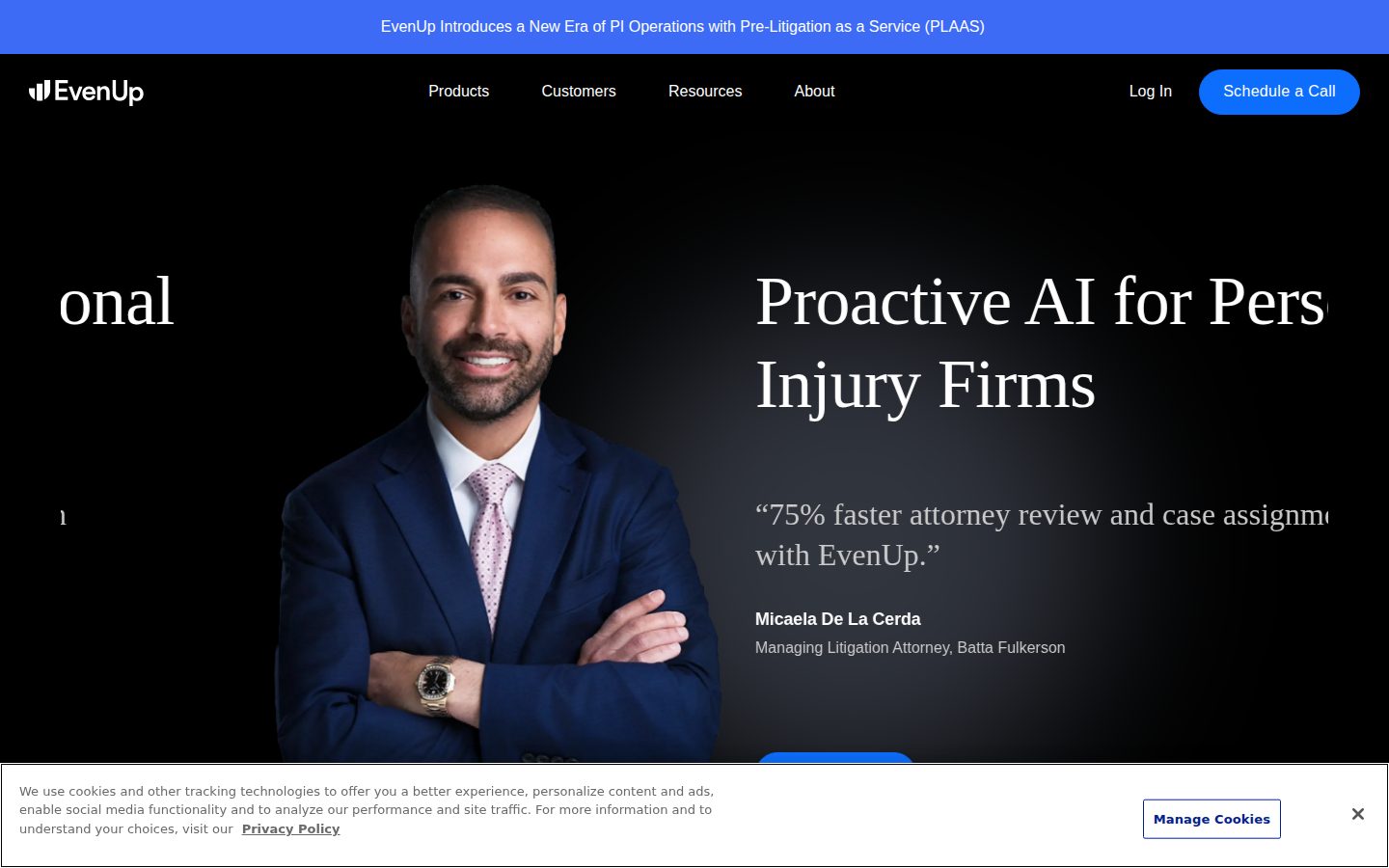
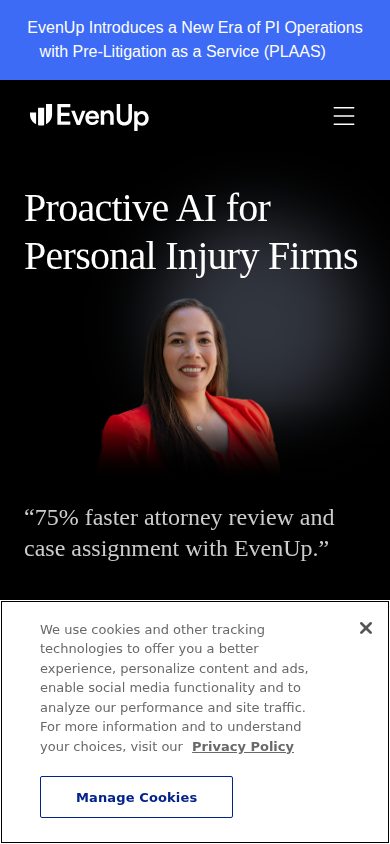
EvenUp desktop previewEvenUp mobile preview

Pricing Plans

Contact Sales

Contact sales

EvenUp is a sales-led legal technology platform for personal injury law firms (AI-powered demand letters, case valuation, and medical record summarization). Pricing is not publicly listed and requires contacting EvenUp's sales team for a custom quote based on firm size and case volume.

  • AI-generated demand letters
  • Medical record summarization and chronology
  • Case valuation and damages analysis
  • Integration with case management systems

AI Panel Reviews

The Decision Maker

The Decision Maker

Strategic bet, vendor viability, timing, adoption approval
7.6/10

A narrow, deep bet on personal injury demand work — not a general legal AI play.

EvenUp doesn't touch pricing pages, doesn't name competitors, and doesn't need to. It's built for one workflow and it's built deep.

This isn't a horizontal legal AI tool. It's a vertical play on personal injury demands, and the line-level citation verification plus the settlement/verdict database are real moats against Filevine or CASEpeer, which are case management first, not valuation-driven.

Contact-based pricing with no free trial means procurement friction up front. That's fine for a $2M+ revenue firm, less fine if you're testing appetite for AI in legal ops broadly.

SOC2 and HIPAA attestation matter here since medical records are core to the product, not an afterthought. The tradeoff: you're betting on a single-category vendor in a legal AI market that's still consolidating. If PI law isn't your firm's bread and butter, skip it entirely.

Competitive Positioning8.0

No named competitor on their own site, but Filevine and Litify remain case-management incumbents EvenUp integrates with rather than replaces.

Reputation Risk7.0

AI-drafted demand letters in litigation still raise eyebrows with opposing counsel and some judges, even with citation verification.

Speed to Value7.5

Express Demands and instant AI demands target immediate drafting bottlenecks, a concrete near-term payback.

Strategic Fit8.0

PLAAS packaging moves firms from cost-saving on drafting to actual case-volume capacity, per the '15x more cases' claim.

Vendor Viability7.5

No public funding data in evidence, but SOC2 audit and enterprise CMS integrations (SmartAdvocate, Litify, CASEpeer) suggest real operating maturity.

Pros

  • Line-level citation verification against source records
  • Deep CMS integrations with SmartAdvocate, Litify, CASEpeer
  • SOC2-audited and HIPAA-attested for medical data handling

Cons

  • No published pricing, sales-led process adds friction
  • No free trial to de-risk the buy
  • Single-vertical bet on personal injury only

Right for

High-volume personal injury firms that want AI to accelerate demands and case valuation, not replace their CMS.

Avoid if

Skip it if your firm's caseload isn't personal injury or if you need transparent self-serve pricing.

The Domain Strategist

The Domain Strategist

Craft and strategy in the product's domain — adapts identity per category, same lens
7.8/10

Line-level citations and SOC2/HIPAA attestation make this defensible for signature authority, not just efficiency.

EvenUp automates demand drafting and case valuation with fact-level verification, which matters when a partner is signing off on AI-drafted work product. The open question is what three years of dependency on their Piai model and settlement dataset does to firm leverage.

As GC-adjacent counsel for a PI practice, my first question is always attribution: who's liable when an AI-drafted demand misstates an injury or damages figure. EvenUp's line-level citation feature — checking every AI statement against source records — is the right architecture for that risk, not a nice-to-have. SOC2 audit and HIPAA attestation are table stakes given the volume of medical records flowing through, but at least they're stated plainly rather than buried.

The PLAAS model (Pre-Litigation-as-a-Service) bundles software with U.S.-based staff, which changes the vendor relationship from tool to quasi-outsourced function. That's a bigger commitment than deploying Filevine or CASEpeer as case management, and it's worth board-level scrutiny before signing.

Integration with SmartAdvocate, Litify, and CASEpeer means it layers onto existing CMS rather than replacing it — good for switching cost, but it means your firm's data now lives partly in EvenUp's proprietary settlement database, a lock-in vector no pricing page discloses.

Category Positioning7.7

Positions above general practice-management tools like Filevine and Litify by specializing entirely in PI valuation and demand work.

Domain Fit8.2

Intake-through-trial coverage mirrors how PI firms actually run case lifecycles, unlike generic legal AI tools.

Integration Surface7.8

Named CMS integrations with SmartAdvocate, Litify, and CASEpeer reduce rip-and-replace risk, though pricing opacity complicates procurement review.

Long-term Implications7.0

PLAAS staffing bundle and proprietary dataset create real switching cost after multi-year adoption, per their own product description.

Strategic Depth8.0

Line-level citation verification and a proprietary settlement/verdict dataset go beyond template drafting into defensible valuation support.

Pros

  • Line-level citation verification against source records supports defensibility of AI-drafted demands
  • SOC2 audit and HIPAA attestation address medical-data compliance concerns directly
  • CMS integrations (SmartAdvocate, Litify, CASEpeer) avoid a rip-and-replace decision

Cons

  • No published pricing forces a sales-cycle negotiation with no benchmark
  • PLAAS staffing bundle deepens dependency beyond a typical software contract
  • Settlement dataset and AI model create a proprietary data lock-in not addressed on their site

Right for

Mid-to-large PI firms that want fact-verifiable AI drafting layered onto an existing CMS.

Avoid if

Avoid if your firm needs transparent, non-negotiated pricing before committing legal and IT resources to review.

The Finance Lead

The Finance Lead

Money, total cost of ownership, contracts, procurement math
6.2/10

Zero pricing published. Contact-sales for everything. Budget accordingly.

No published tier, no starting price, no free trial. Procurement gets a demo call instead of a number.

No pricing page. No published tier. Just "contact sales." That's the whole model here — compare to Filevine or Litify, both also sales-led in this category, so EvenUp isn't unusual, just opaque.

TCO math is a black box without a quote. Firm size and case volume drive cost, per their own site. PLAAS bundles software with U.S.-based staffing — that's not a per-seat SaaS fee, that's a services contract. Year 3 cost depends entirely on case volume growth, and nothing here lets you model that in advance.

SOC2 and HIPAA attestation reduce one risk category: security review friction. But contract terms — auto-renewal window, termination clause, exhibit/data export format on offboarding — aren't disclosed anywhere in the evidence. For a platform holding medical records and case financials, that's the number procurement will actually ask for first.

Billing & Procurement5.5

SOC2/HIPAA attestation eases security review, but no invoicing or payment terms disclosed.

Contract Flexibility5.0

No published term length, renewal, or cancellation terms in the evidence provided.

Pricing Transparency2.5

No tiers, no starting price, sales-call-only model per the evidence.

ROI Clarity7.0

Claim of reviewing 15x more cases and settlement-database-backed valuation gives a measurable, if vendor-sourced, benchmark.

Total Cost of Ownership5.0

PLAAS bundles software with staffing, so cost scales with case volume in ways you can't model pre-quote.

Pros

  • SOC2-audited, HIPAA-attested — relevant given medical record handling
  • CMS integrations named explicitly: SmartAdvocate, Litify, CASEpeer
  • Line-level citation verification gives an audit trail for AI-drafted demands

Cons

  • No pricing page, no tier breakdown, no starting number anywhere
  • PLAAS staffing component makes cost scale unpredictably with case volume
  • No disclosed contract term, renewal, or cancellation process

Right for

PI firms with enough case volume to justify a custom sales negotiation.

Avoid if

Avoid if your procurement process requires published pricing before a first call.

The Domain Practitioner

The Domain Practitioner

Daily hands-on reality in the product's domain — adapts identity per category, same lens
7.6/10

Demand drafting that actually cites the medical records — but no pricing page means I can't scope it myself

EvenUp automates the part of my job that eats the most billable hours: chasing records and drafting demands. The line-level citation feature is the thing that'll actually get adopted by attorneys who don't trust black-box AI.

Demand drafting is where paralegals live, and EvenUp's pitch — pull from the CMS, draft in the firm's tone, cite every line back to source records — hits the actual pain point. Not 'AI writes your letters,' but 'AI writes a first draft you can verify fast,' which is the difference between adoption and shelf-ware. Line-Level Citations matters more than the flashy trial-chronology stuff, because that's what keeps an attorney from having to redo my work.

Integration with SmartAdvocate, Litify, and CASEpeer means it sits on top of the CMS rather than replacing it, which is the right call — nobody's migrating case data twice.

Day-3 concern: Communication Agents making calls to insurance carriers and clients on my case files means I'm now reviewing AI conversation logs, not eliminating a task. And with no published pricing, no free trial, and a sales-call gate, I can't tell if this fits a five-attorney PI shop or only firms running Litify-scale volume.

Day-3 Reality7.5

Citation-checking against source records is the kind of feature that survives past the demo, per the stated line-level verification capability.

Documentation Practitioner-Fit6.5

No public docs or pricing page (docs=N, pricing-page=N) — everything routes through a sales demo, not a manual.

Friction Surface6.8

Adds a review layer for AI-drafted demands and carrier calls, trading typing time for oversight time.

Power-User Depth7.8

Scales from Express Demands for routine cases to full discovery/trial support and executive analytics for firm-wide caseload tracking.

Workflow Integration8.0

Sits on top of existing CMS (SmartAdvocate, Litify, CASEpeer) rather than forcing a rip-and-replace.

Pros

  • Line-level citations let paralegals verify AI drafts against source records fast
  • CMS integrations with SmartAdvocate, Litify, CASEpeer avoid duplicate data entry
  • Settlement/verdict database gives real benchmarking for demand valuation, not guesswork

Cons

  • No published pricing or free trial — full sales-call gate before you can even scope cost
  • Communication Agents calling clients/carriers directly adds a new review task, not a pure time save
  • No public docs page, so onboarding depth is unclear before you're already a customer

Right for

Mid-to-high-volume PI firms drowning in demand drafting and treatment-tracking who already run Litify, CASEpeer, or SmartAdvocate.

Avoid if

Skip if you're a small solo-practice shop needing transparent, low-commitment pricing before committing budget.

The Power User

The Power User

Daily human experience, onboarding, polish, learning curve, reliability
7.6/10

Deep tool for a narrow job, but you'll never touch it without a sales call first

EvenUp bets everything on personal injury firms and it shows in the feature depth. Whether it's a joy to use daily is basically a guess, since there's no pricing page or trial to test that against.

No pricing page, no free trial, no docs. Everything routes through 'schedule a demo,' which tells me this is built for firm partners signing contracts, not the paralegal who'll live in it every day. That's fine for legal software, it's just the norm, but it means I can't tell you what day three feels like. Nobody outside a sales call has.

What's genuinely good on paper: line-level citations checking every AI statement against source records is the kind of feature that matters at 4pm when you're double-checking a demand letter before it goes out. The settlement/verdict database for valuation and CMS integrations with SmartAdvocate, Litify, and CASEpeer show they built for firms' actual workflows instead of asking firms to change.

But PLAAS bundles software with actual staffing, which blurs whether you're buying a tool or outsourcing casework. That's a bigger decision than most SaaS purchases, and the site gives you zero signal on cost or onboarding time to help you make it.

Daily Polish6.5

Feature list is dense and specific but no public product screenshots or demo footage to judge the actual UI feel.

Learning Curve7.2

Staged workflow from intake through trial mirrors how firms already work, easing the ramp versus competitors like Filevine.

Mobile Parity5.0

No mobile platform info published at all, and category norm for legal case tools is desktop-first anyway.

Onboarding Experience5.5

No trial, no pricing page, everything gated behind sales calls, so first ten minutes is a phone call, not the product.

Reliability Feel7.8

SOC2 audit and HIPAA attestation plus line-level citation verification suggest a team that takes accuracy seriously.

Pros

  • Line-level citation verification against source records builds real trust for legal review
  • CMS integrations with SmartAdvocate, Litify, and CASEpeer mean it slots into existing workflows
  • PLAAS bundles staffing with software for firms that want hands-off pre-litigation work

Cons

  • No published pricing means every buyer starts from zero information
  • No free trial to sanity-check the AI drafting before committing
  • Mobile experience is undocumented entirely

Right for

Mid-to-large personal injury firms with high case volume who want AI drafting plus staffing support.

Avoid if

You're a solo practitioner who wants to try before a sales call.

The Skeptic

The Skeptic

Contrarian. Watch-outs, deal-breakers, broken promises, category patterns
7.1/10

Trademarked everything. No pricing page. That combo means one thing: enterprise sales motion.

EvenUp layers AI drafting and analytics on top of Filevine/Litify/CASEpeer rather than replacing them. Deep feature set for personal injury specifically, but the moat depends entirely on data and headcount you can't audit from outside.

Three tells before the docs. One: 'leading' and 'proactive' in the H1 — the kind of superlative every legal AI vendor uses right now. Two: no pricing page, contact-sales only, category norm for this segment but still a friction point. Three: trademark symbols on nearly every feature name — Demands™, Piai™, Playbooks™ — which reads more like brand defense than product maturity.

What's actually solid: line-level citations against source records, CMS integrations with SmartAdvocate, Litify, and CASEpeer named explicitly, and a settlement/verdict dataset for valuation. That's a real wedge against Filevine and Litify, who are case management first, not AI-drafting first. EvenUp isn't replacing your CMS — it's sitting on top, which helps exit portability if this doesn't work out.

SOC2 and HIPAA-attested is table stakes for medical record handling, not a differentiator. PLAAS bundling software with staffing is the interesting bet — also the part that's hardest to unwind in 18 months if you've built workflow around their people.

Competitive Differentiation7.5

Clear PI-specific wedge against Filevine, Litify, and CASEpeer via demand drafting and verdict-database valuation.

Exit Portability6.5

Sits atop existing CMS rather than replacing it, but PLAAS staffing layer would be harder to unwind than pure software.

Long-term Viability7.5

SOC2/HIPAA attestation and broad feature depth (intake through trial) suggest real investment, though no funding figures are public here.

Marketing Honesty6.5

'15x more cases' claim is specific but unverifiable; 'leading' and 'proactive' are aspirational category language.

Track Record Match7.0

Vertical AI-plus-staffing model mirrors successful legal-ops plays, though PLAAS staffing dependency is untested at scale.

Pros

  • Line-level citation verification against source records
  • Named CMS integrations with SmartAdvocate, Litify, CASEpeer
  • Full lifecycle coverage from intake through trial prep

Cons

  • No public pricing, sales-gated from step one
  • Trademark-heavy naming across nearly every feature
  • PLAAS staffing dependency is harder to exit than pure software

Right for

Mid-to-large personal injury firms already on Litify or CASEpeer wanting AI drafting layered on top.

Avoid if

You're a solo practice that can't absorb a sales-cycle-gated, custom-quote procurement process.

Buyer Questions

Common questions answered by our AI research team

Security

Is EvenUp SOC2 and HIPAA compliant?

Yes. EvenUp is SOC2-audited and HIPAA-attested, meeting security and healthcare data protection standards required by personal injury firms.

Integration

Does EvenUp pull data from my case management system?

Yes. EvenUp uses proactive AI that extracts key case information directly from your CMS, letting firms review 15x more cases in the same amount of time.

Features

Can EvenUp draft demand letters automatically?

Yes. EvenUp drafts demands in minutes in your firm's exact tone using one-click templates, offering both instant AI demands and legal-reviewed demands depending on case type.

Features

Does EvenUp verify facts and citations in documents?

Yes. EvenUp verifies every fact, citation, and exhibit in one click with line-level citations, checking documents against source records for accuracy.

Features

Can EvenUp help with discovery and trial prep?

Yes. EvenUp supports discovery by creating and responding to discovery requests in minutes grounded in case facts, and aids trial prep with interactive medical chronologies, motion drafting, and real-time deadline tracking.

Also in AI Legal